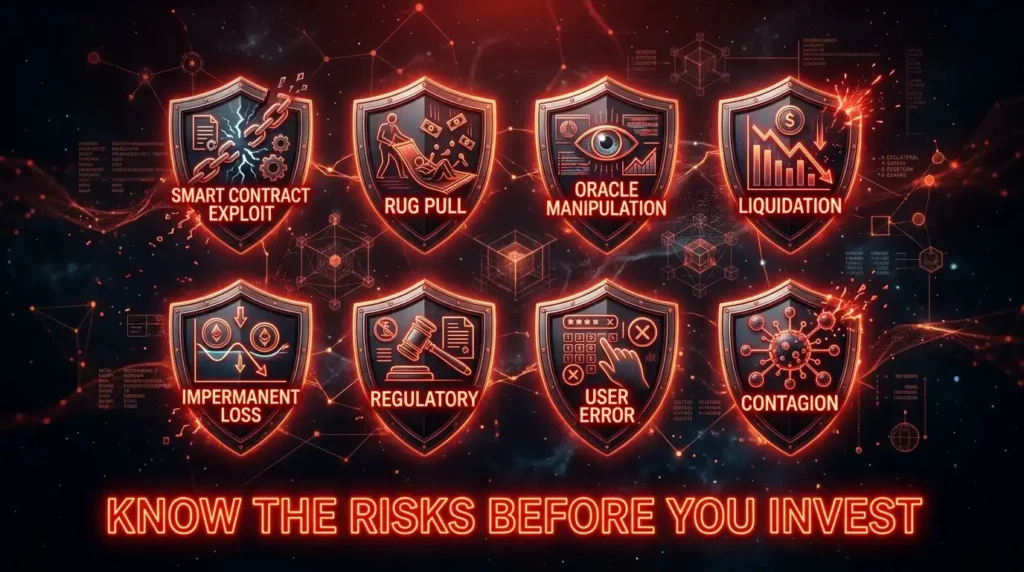
DeFi offers genuine financial innovation — yield, composability, permissionless access, and transparency that traditional finance can’t match. But it also operates in an environment where a single bug in a smart contract can drain hundreds of millions of dollars in seconds, and where the absence of intermediaries means the absence of protection when things go wrong.
Understanding DeFi risks isn’t optional. It’s the prerequisite for participating safely.
This guide covers every major DeFi risk category — what each is, how it happens, real examples, and concrete steps to reduce your exposure.
The DeFi Risk Landscape in 2026
DeFi has lost significant capital to exploits and fraud since its inception:
- 2021: ~$1.3 billion in DeFi losses
- 2022: ~$3.8 billion (Terra/LUNA collapse alone: $40B in market cap destruction)
- 2023: ~$1.8 billion
- 2024: ~$1.5 billion
- Q1 2026: ~$482 million in 90 days
These are not rounding errors. They represent real losses from real protocols used by real people. The technology is powerful — and the attack surface is real.
At the same time: well-audited protocols with years of track records (Aave, Uniswap, Curve, Maker) have operated for 4–8 years without major exploits. Risk is not evenly distributed. The protocols you choose matter enormously.
Risk 1: Smart Contract Risk
What It Is
Smart contracts are the foundation of every DeFi protocol. They’re self-executing code that automatically enforces the rules of financial agreements. But code can have bugs — and in DeFi, bugs can be immediately and irreversibly exploited.
Unlike traditional software bugs that might cause a crash or data corruption, DeFi smart contract bugs can result in instant, total loss of all funds in the contract.
How Exploits Happen
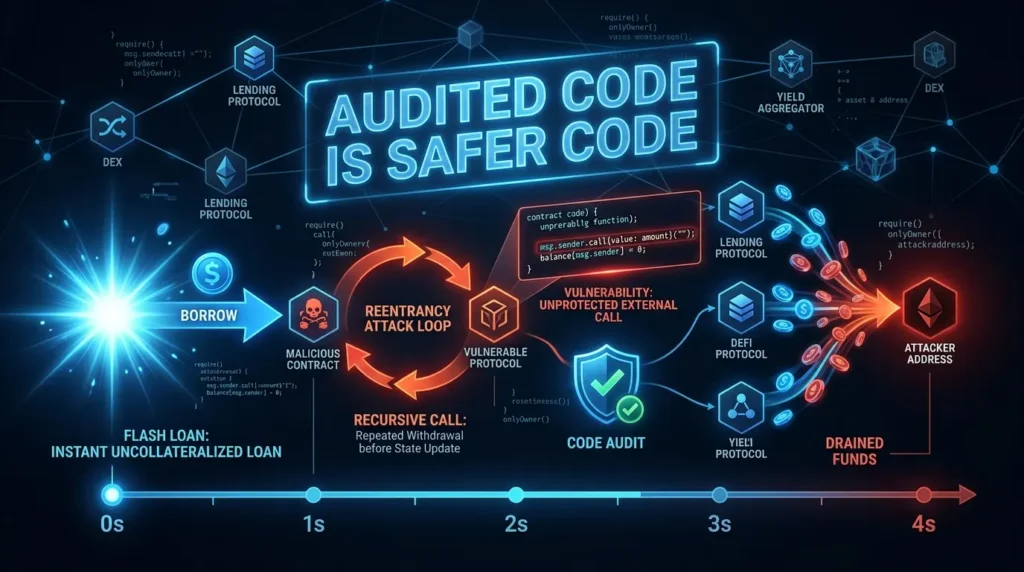
Reentrancy attacks:
A function sends funds before updating the contract’s internal state. An attacker contracts repeatedly calls the function before state is updated — draining funds in a loop.
Historic example: The DAO hack (2016) — $60 million in ETH drained via reentrancy. This led to Ethereum’s hard fork.
Flash loan attacks:
Flash loans provide uncollateralized loans that must be repaid in the same transaction. Attackers use them to manipulate prices, drain liquidity, or exploit logic errors in protocols — all within one atomic transaction.
Example: Euler Finance (March 2023) — $197 million drained via complex flash loan attack. (Notably, the attacker later returned ~$177 million.)
Logic errors:
The contract code is technically correct but the business logic is wrong. Conditions that should be impossible to meet become exploitable in edge cases.
Access control vulnerabilities:
Admin functions that should only be callable by trusted addresses are accidentally accessible to anyone.
Example: Ronin Bridge (March 2022) — $625 million stolen due to compromised validator keys with excessive permissions.
Price manipulation:
Attacker manipulates the price of an asset within a protocol (often using flash loans) to trigger incorrect liquidations or drain funds.
The Statistics
According to blockchain security firm Certik’s 2024 annual report, smart contract vulnerabilities and private key compromises accounted for over 70% of all DeFi losses. The average exploit takes less than 10 minutes from attack initiation to funds drained.
How to Reduce Smart Contract Risk
Use protocols with multiple audits:
Look for protocols audited by multiple reputable security firms — Trail of Bits, OpenZeppelin, Certik, Chainalysis, Spearbit. One audit is good; three from different firms is better.
Prioritize battle-tested protocols:
Aave has been running since 2017. Uniswap since 2018. Curve since 2020. Code that has processed billions in transactions without exploit is more reliable than code deployed last month. Time is a proxy for security — not perfect, but meaningful.
Check DeFi Safety ratings:
DeFi Safety (defisafety.com) rates protocols on security practices, documentation, and audit quality. Use it as a filter.
Don’t overconcentrate in single protocols:
If you have $50,000 in DeFi, spreading across 5 established protocols means a single exploit takes 20% of your exposure, not 100%.
Use DeFi insurance:
Nexus Mutual, InsurAce, and similar protocols offer cover against smart contract exploits. Premiums are typically 1–5% annually — worth considering for large positions.
Risk 2: Rug Pulls
What It Is
A rug pull is a deliberate exit scam where the developers of a DeFi protocol abandon it after collecting investor funds — “pulling the rug” from underneath them.
Unlike smart contract exploits (which can happen to legitimate projects), rug pulls are intentional fraud.
Types of Rug Pulls
Hard rug:
Developers drain the liquidity pool in a single transaction, abandoning the project immediately. Price drops to near zero instantly. Funds are gone.
Soft rug:
Developers gradually sell their token allocation, slowly exiting their position over days or weeks. Price declines steadily as they dump. More plausibly deniable than a hard rug.
Exit scam (launch phase):
Project raises funds through a presale or IDO, then disappears before delivering anything. No product, no team, no funds.
Red Flags Before They Rug
Anonymous team with no track record:
Not all anonymous teams rug — many legitimate DeFi projects are pseudonymous. But zero verifiable identity combined with other red flags is concerning.
No third-party audit:
Reputable protocols always get audited. “We’re getting audited soon” is a red flag.
Unlocked or team-controlled liquidity:
LP tokens that the team can redeem at any time are a hard rug waiting to happen. Look for liquidity locked through third-party services (Team Finance, Uncx Network) with verified lock data.
Token supply concentrated in team wallets:
Check the token contract on Etherscan — if 20%+ of supply is in 1–3 wallets controlled by the team, they can dump and devastate the price.
No real product or use case:
Projects with compelling hype but no actual technology being built are suspicious. What does the protocol actually do?
Unrealistic APYs:
500%+ APY on a new token with no clear revenue model. What’s generating this yield? If the answer is “token emissions,” ask who’s buying those tokens.
Sudden social media silence or account deletion:
Team goes quiet on Twitter/Telegram before a rug. Not always — but often.
How to Reduce Rug Pull Risk
Check liquidity lock status:
Use DefiLlama, Dexscreener, or Team Finance to verify liquidity is locked and for how long.
Verify contract ownership:
Has the deployer renounced contract ownership? Can they still mint tokens or modify the contract? Check on Etherscan.
Check audit status:
Look for audits from reputable firms on the project’s official documentation.
Use Rugcheck.xyz (Solana) or Token Sniffer (Ethereum):
Automated tools that check common rug pull indicators on new tokens.
Start small:
For any new, unproven protocol — treat the first investment as potentially going to zero. Don’t bet the farm on a protocol launched two weeks ago.
Risk 3: Oracle Manipulation
What It Is
DeFi protocols need real-world price data — what is ETH worth right now, what is BTC worth? They get this from price oracles — data feeds that bring external prices on-chain.
Oracle manipulation attacks exploit the gap between on-chain oracle prices and actual market prices.
How Oracle Attacks Work
Flash loan price manipulation:
Attacker takes a flash loan → buys a large amount of token X on a DEX → the DEX price of token X is now artificially high → attacker uses token X as collateral in a lending protocol that uses that DEX as its price oracle → borrows far more than the actual value of token X → repays the flash loan → exits with the borrowed funds.
The entire attack happens in one transaction. The oracle saw the manipulated price for a fraction of a second — long enough for the exploit to work.
Example: Mango Markets (October 2022) — $117 million drained via MNGO token price manipulation.
Why This Risk Exists
The weakest point is on-chain DEXs used as price oracles. A DEX price reflects trades in that specific pool — which can be temporarily manipulated with enough capital (especially via flash loans).
How to Reduce Oracle Risk
Use protocols with Chainlink or Pyth oracles:
Chainlink aggregates prices from dozens of data sources, making manipulation extremely expensive. Pyth (used on Solana and increasingly on Ethereum) uses institutional-grade price feeds.
Avoid protocols using single-source DEX price feeds:
Protocols relying on a single Uniswap pool for pricing are vulnerable. Multiple-source oracles or TWAP (Time-Weighted Average Price) oracles are significantly more robust.
Risk 4: Liquidation Risk
What It Is
DeFi lending protocols are overcollateralized — you deposit more value than you borrow. If your collateral’s value falls enough, an automated liquidation mechanism sells your collateral to repay your debt.
Liquidation risk is the risk of losing a portion of your collateral due to unfavorable price movements.
How Liquidations Happen
- You supply $10,000 ETH as collateral on Aave
- You borrow $6,000 USDC (60% LTV — conservative)
- ETH price drops 40% — your collateral is now worth $6,000
- Your Health Factor drops below 1.0
- Liquidators (bots) repay part of your debt and receive your collateral at a 5–10% discount
- You receive back the remaining collateral (after their fee) — less than you started with
Cascade Liquidations
During rapid market crashes, many positions hit their liquidation threshold simultaneously. Liquidator selling of collateral creates more selling pressure, driving prices lower, triggering more liquidations. This cascade can cause prices to overshoot dramatically.
Example: March 2020 (“Black Thursday”) — ETH dropped 50% in hours. DeFi liquidation cascades caused ETH price on-chain to briefly deviate dramatically from off-chain prices.
How to Reduce Liquidation Risk
Maintain a high Health Factor (above 2.0)
The further from 1.0, the more price movement your position can absorb.
Borrow less than the maximum
If max LTV is 80%, borrow 40–50% maximum.
Monitor actively during volatile markets
Set up alerts via DeFiSaver, Tenderly, or protocol notifications.
Use automated protection tools
DeFiSaver allows setting automated actions: if Health Factor drops below X, automatically add collateral or repay debt.
Avoid highly correlated leverage
Borrowing ETH against stETH (highly correlated) is lower liquidation risk than borrowing USDC against ETH (different volatility profiles).
Risk 5: Impermanent Loss
What It Is
Impermanent loss (IL) is the reduction in value experienced by liquidity providers compared to simply holding the same tokens — caused by price divergence between pooled assets.
(Full explanation in our dedicated guide: What Is Impermanent Loss?)
Quick summary:
- Provide ETH/USDC liquidity when ETH = $2,000
- ETH doubles to $4,000
- Your LP position = $5,657 vs. $6,000 from simply holding → $343 impermanent loss (5.7%)
How to Minimize IL
- Use stablecoin pools (USDC/USDT) — near-zero IL
- Use correlated asset pools (ETH/stETH) — low IL
- Avoid volatile/uncorrelated pairs unless fee income clearly compensates
Risk 6: Regulatory Risk
What It Is
DeFi operates in an evolving, uncertain regulatory environment. Regulatory actions can affect:
- Protocol accessibility (frontend blocking of certain jurisdictions)
- Protocol operation (forced shutdown or modification)
- Asset legality (certain tokens deemed securities)
- Tax treatment of DeFi activities
The Current Landscape (2026)
EU (MiCA): Comprehensive crypto regulation implemented in 2024. Most DeFi protocols currently fall outside MiCA’s direct scope — but regulators are developing DeFi-specific frameworks.
US: SEC has taken enforcement action against centralized actors but DeFi protocols remain largely unaddressed. The CFTC has broader jurisdiction over DeFi derivatives. The regulatory situation remains contested.
Global CARF: 48+ countries implementing crypto reporting requirements affecting DeFi users.
How to Reduce Regulatory Risk
Use established, decentralized protocols:
Truly decentralized protocols with no central admin (Uniswap’s deployed contracts, for example) are significantly harder to shut down than centralized front-ends.
Understand your local tax obligations:
DeFi activity generates taxable events in most jurisdictions. Use crypto tax software (Koinly, CoinTracker) to track.
Stay informed:
Regulatory developments can move quickly. Follow reliable crypto regulatory news sources.
Risk 7: User Error (Self-Custody Risk)

What It Is
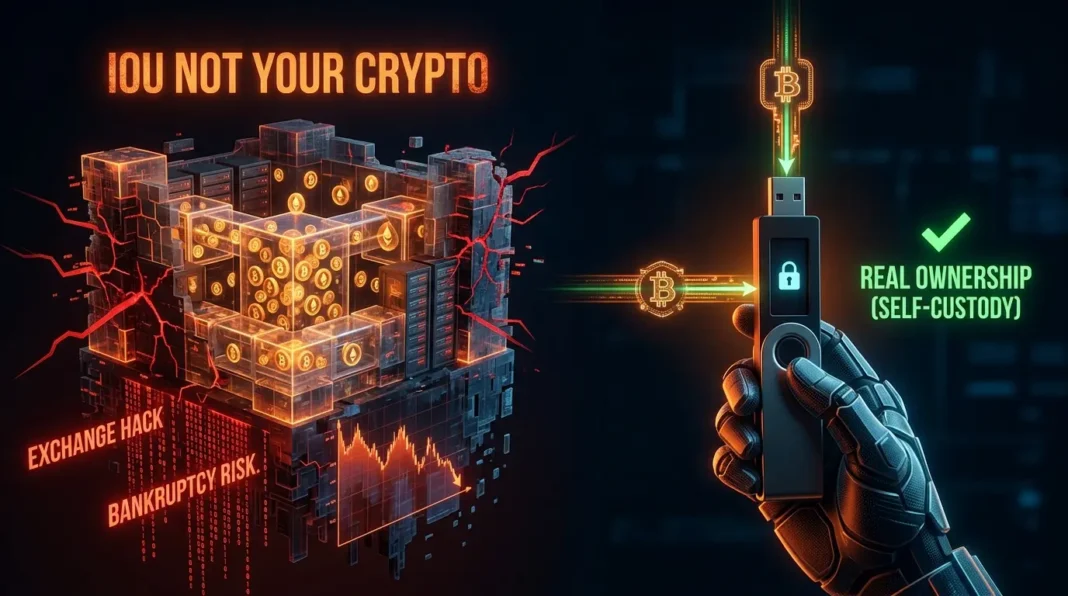
Unlike CeFi, DeFi has no customer service, no password reset, and no reversal mechanism. User errors are permanent.
Common user errors:
- Sending funds to the wrong address
- Losing seed phrase → permanent loss of wallet access
- Approving a malicious contract (phishing)
- Connecting wallet to a fake DeFi website
- Signing a transaction without reading what it does
Phishing: The Most Common Attack
Phishing is the most common way DeFi users lose funds — more common than smart contract exploits for individual users.
How it works:
- Fake websites that look identical to real DeFi protocols (app.aave.com vs. app.aave.co)
- Fake Discord/Telegram messages with “urgent security alerts”
- Fake airdrops requiring you to connect your wallet and approve a draining transaction
- Search ads for “Uniswap,” “Aave,” etc. that lead to phishing sites
Critical warning: Crypto drainer malware can request approval to transfer all tokens in your wallet. A single click “Approve” on the wrong site can drain everything.
How to Reduce User Error Risk
Bookmark all DeFi sites you use regularly:
Never use search engines to find DeFi protocols. Bookmark the official URL. Type it manually if needed.
Read every transaction before signing:
MetaMask shows what a transaction does. Never click “Confirm” without reading.
Use a hardware wallet for significant amounts:
Ledger or Trezor require physical confirmation of every transaction — phishing sites can’t drain hardware wallets without physical button presses.
Revoke unnecessary token approvals regularly:
Use Revoke.cash or Etherscan’s Token Approval Checker. Old approvals are attack vectors.
Never click links in Discord or Telegram from DMs:
DeFi team members never DM first. Unsolicited messages with “urgent” claims are always scams.
Use a dedicated browser or profile for DeFi:
Reduces cross-contamination from other browsing.
Risk 8: Systemic/Contagion Risk
What It Is
DeFi’s composability — protocols built on top of each other — is a strength and a weakness simultaneously.
When one protocol fails, it can cascade through everything built on top of it. This is contagion risk.
Example: Terra/LUNA collapse (May 2022):
- LUNA/UST collapsed
- Celsius (which had lent to Terra-adjacent protocols) froze withdrawals → bankruptcy
- Three Arrows Capital (leveraged across DeFi) → bankruptcy
- Multiple other lenders who had extended credit to 3AC → distress
- stETH briefly depegged as Celsius and others sold stETH to raise liquidity
- ETH price fell, triggering liquidations across DeFi lending markets
A single algorithmic stablecoin failure cascaded into an industry-wide crisis.
How to Reduce Contagion Risk
Diversify across protocols and chains:
Don’t concentrate all DeFi exposure in one protocol or one ecosystem.
Understand protocol dependencies:
If Protocol A is built on Protocol B’s liquidity, a B failure affects A. Map your dependency chain.
Maintain stablecoin reserves:
Having stablecoins outside the DeFi ecosystem gives you resilience — and buying power during crises.
DeFi Risk Framework: A Practical Checklist
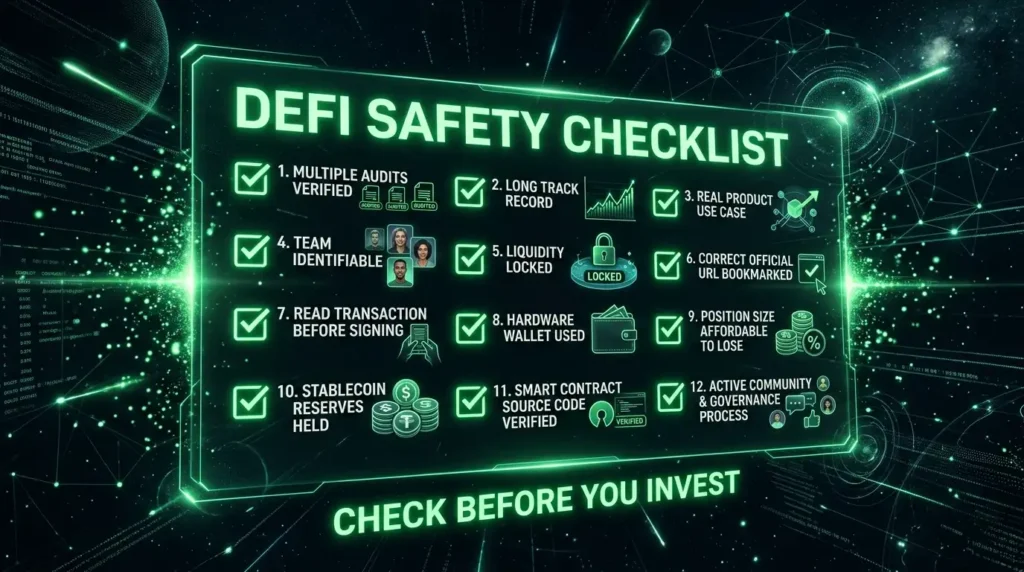
Before using any DeFi protocol, ask:
Security:
- ☐ Has the protocol been audited by multiple reputable firms?
- ☐ How long has it been running without major exploit?
- ☐ Is there a bug bounty program?
Legitimacy:
- ☐ Is the team identifiable or at least pseudonymous with track record?
- ☐ Is liquidity locked or otherwise verifiable?
- ☐ Is there a real product/use case?
Risk profile:
- ☐ Do I understand exactly how this protocol works?
- ☐ What is the worst-case scenario for my deposit?
- ☐ Am I comfortable with this amount going to zero?
Operational:
- ☐ Am I connecting to the correct official URL?
- ☐ Have I read what the transaction does before signing?
- ☐ Is my hardware wallet being used for significant amounts?
Key Terminology
Smart contract exploit: Attack that takes advantage of a vulnerability in DeFi protocol code to drain funds.
Rug pull: Deliberate exit scam by developers who abandon a project after collecting funds.
Oracle manipulation: Attack that temporarily distorts price feeds to exploit DeFi protocols using those prices.
Liquidation: Automatic sale of collateral when a borrower’s Health Factor falls below the minimum — often with a penalty.
Flash loan: Uncollateralized loan that must be repaid in the same blockchain transaction — used in many attack vectors.
Impermanent loss: Reduction in LP value vs. holding, caused by price divergence between pooled assets.
Phishing: Fraudulent websites or messages designed to steal wallet credentials or drain funds via malicious approvals.
Contagion risk: Risk that failure of one protocol cascades to others through DeFi’s composability.
DeFi Safety: Protocol security rating platform (defisafety.com).
Revoke.cash: Tool for revoking unnecessary token approvals that could be exploited.
The Bottom Line
DeFi risk is real, present, and unevenly distributed. Billions have been lost — and will continue to be lost — primarily by users who:
- Used unaudited or poorly audited protocols
- Didn’t understand what they were depositing into
- Clicked on phishing links
- Took on more leverage than their risk tolerance warranted
The good news: established, well-audited DeFi protocols have operated safely for years at massive scale. Aave, Uniswap, Curve, and MakerDAO collectively process trillions in annual volume with strong security records.
The risk-managed approach to DeFi:
- Start with established, multi-audited protocols only
- Begin with small amounts — learn before scaling
- Bookmark all URLs, use hardware wallets for significant positions
- Never deposit more than you can genuinely afford to lose entirely
- Maintain stablecoin reserves outside DeFi protocols
- Stay informed — the space moves fast
DeFi rewards the informed and punishes the careless. Take the time to understand what you’re doing before doing it. 🛡️
Disclaimer: This article is for informational and educational purposes only and does not constitute financial advice. DeFi involves significant risks including total loss of capital. Always conduct your own research before participating in any DeFi protocol.