
Founded: 2018
Headquarters: Dubai, UAE
CEO: Ben Zhou
Users: 80+ million registered
Supported assets: 400+ cryptocurrencies (spot and derivatives)
Regulated: VARA (Dubai), MiCA (EU via Bybit EU GmbH), multiple jurisdiction-specific licenses
Not available in: USA, UK, Canada, France, Singapore, and certain other jurisdictions
Bybit launched in 2018 with a focus on derivatives trading and has grown to become one of the world’s largest cryptocurrency exchanges by volume. With over 80 million registered users and daily trading volumes exceeding $20 billion, the platform has expanded well beyond its derivatives roots to offer spot trading, copy trading, automated bots, yield products, P2P trading, and Web3 tools.
This review covers Bybit’s current feature set, fee structure, security posture, and who the platform serves in 2026 — including a factual account of the February 2025 security incident and the company’s response.
Who Is Bybit For?
Bybit is best for:
- Experienced derivatives traders seeking high-liquidity perpetuals and futures
- Active traders who want copy trading, automated bots, and advanced order types
- Users in eligible jurisdictions outside the US looking for a competitive fee structure
- Traders who want P2P options and flexible deposit methods
- Those who want access to early token listings and launchpad projects
Bybit may not be ideal for:
- US, UK, Canadian, French, or Singaporean residents (service not available)
- Complete beginners seeking the simplest onboarding experience
- Users prioritizing the most conservative regulatory standing
- Long-term holders who prefer minimal interaction with the platform
Platform Overview

Bybit has evolved from a derivatives-first exchange into what it describes as a “full-stack” trading ecosystem. Core products as of 2026:
Spot Trading: Bybit’s spot market covers 400+ cryptocurrency pairs with competitive maker-taker fees. The spot interface has become more prominent as the exchange has grown beyond derivatives.
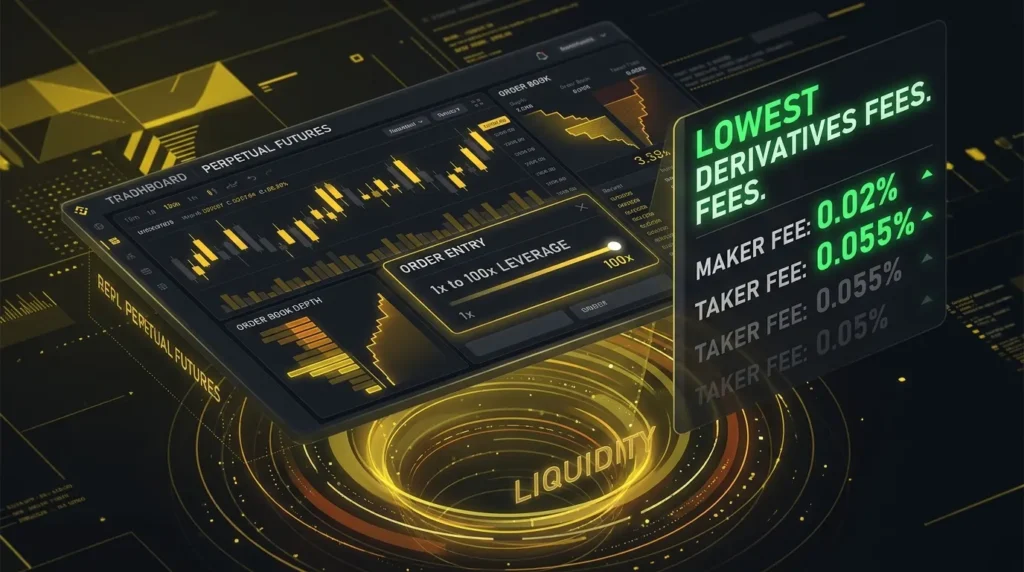
Derivatives (Perpetuals and Futures): The platform’s original strength. Bybit supports USDT-margined perpetuals, USDC-settled contracts, and inverse perpetuals across 300+ assets with leverage up to 100x on select pairs. The derivatives engine processes up to 100,000 transactions per second and maintains deep liquidity on major pairs.
Options Trading: Bybit offers crypto options for eligible users, expanding the range of instruments available to sophisticated traders.
Copy Trading: Users can follow and automatically replicate strategies from verified top traders on the platform. A risk management framework allows followers to set loss limits and position sizing.
Trading Bots: Built-in automated trading tools including Grid Bots (automated range trading), DCA Bots, and Martingale strategies. These enable systematic approaches without continuous manual monitoring.
Bybit Earn: Yield products including flexible savings, fixed-term deposits, and staking for supported assets. APYs vary by asset and market conditions.
P2P Trading: Peer-to-peer marketplace allowing direct fiat-to-crypto trades between users, with Bybit acting as escrow. Supports multiple fiat currencies and payment methods.
Launchpad: Early access to new token listings. Bybit has developed a track record of listing tokens that see significant first-day activity.
Fees
Spot Trading Fees
Bybit uses a maker-taker model for spot trading:
| Tier | Maker Fee | Taker Fee |
|---|---|---|
| VIP 0 (standard) | 0.10% | 0.10% |
| VIP 1 | 0.08% | 0.10% |
| VIP 2 | 0.06% | 0.08% |
| VIP 3 | 0.04% | 0.06% |
| Pro tiers | Lower | Lower |
The 0.10%/0.10% base rate is competitive and straightforward — no separate “simple” and “advanced” interface distinction. Users interact with one unified trading account.
Derivatives Fees
Perpetual futures fees are significantly lower:
- Standard (VIP 0): Maker 0.02% / Taker 0.055%
- Higher VIP tiers receive further reductions
These derivatives rates are among the most competitive available on major exchanges.
Deposit and Withdrawal Fees
- Crypto deposits: Free
- Crypto withdrawals: Network fee applies (varies by asset and congestion)
- Fiat via card: EU cards ~1.10%, non-EU ~2.70–3.05% (displayed before confirmation)
Supported Assets and Markets
Bybit lists 400+ cryptocurrencies across spot and derivatives. This is a mid-range selection — more than Coinbase or Kraken, less than Binance. New tokens are listed regularly, often before many other major exchanges.
Global fiat support: Bybit supports fiat deposits and withdrawals in multiple currencies through P2P and payment partners, covering many regions globally.
Stocks and indices: Bybit has expanded into traditional financial products including tokenized stocks, indices, commodities, and forex for eligible users — continuing the trend of major crypto exchanges adding TradFi instruments.
Security
Security Architecture
Bybit employs a layered security model:
- Cold wallet storage for the majority of user funds
- Multi-signature wallet authorization for transactions
- Trusted Execution Environment (TEE) and Threshold Signature Schemes (TSS) for key protection
- 2FA required for login and withdrawals (TOTP authenticator apps and passkeys)
- Withdrawal address whitelisting with new-address lockout period
- Anti-phishing code system for email communications
- Regular security audits and penetration testing
The February 2025 Incident
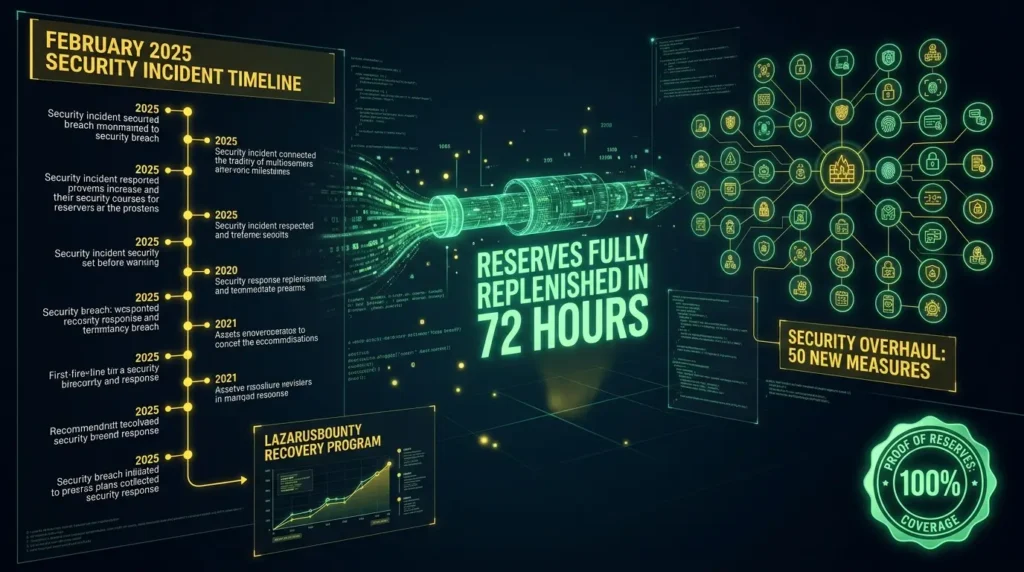
In February 2025, Bybit experienced a significant security incident in which approximately $1.5 billion in ETH was stolen during a transfer between internal wallets. The incident was subsequently attributed by investigators and US officials to the Lazarus Group, a North Korean state-sponsored hacking operation.
Independent investigation reports from Sygnia Labs and Verichains indicated the attack originated from malicious JavaScript code in the Safe{Wallet} interface rather than a vulnerability in Bybit’s core infrastructure — meaning the attacker compromised the signing interface rather than Bybit’s wallet systems directly.
Bybit’s response:
- Continued processing user withdrawals throughout the incident (hundreds of thousands processed immediately after the breach)
- Secured emergency liquidity to maintain 1:1 reserve backing
- Full reserves were replenished within approximately 72 hours
- Subsequent Proof of Reserves audits confirmed 100%+ coverage
- Security overhaul described by the company as including “50+” new measures and tighter key-management controls
- Launched “LazarusBounty” program offering up to 10% of recovered funds to security teams and investigators assisting recovery efforts
- No user funds were taken from individual accounts; no customer balance reductions were implemented
The incident has been widely documented in industry media, and Bybit’s handling — particularly the rapid reserve replenishment and continued withdrawal processing — was noted as contrasting with some previous exchange incidents in the industry.
Proof of Reserves
Bybit publishes monthly Proof of Reserves attestations verified by Hacken, a third-party blockchain security firm. The attestations use a Merkle tree approach allowing individual users to self-verify their funds are included. The dashboard shows the latest attestation date and covered assets.
Current Security Standing (2026)
Bybit’s post-incident security posture includes multiple third-party audit certifications and an expanded internal security framework. Users should note that as of this review’s publication, Bybit’s security measures have received independent verification through its PoR program.
Regulation and Geographic Availability
Bybit operates with a jurisdiction-specific regulatory approach:
- Dubai/UAE: VARA regulatory engagement (primary base)
- EU/EEA: Bybit EU GmbH, MiCA-licensed via CySEC CASP register, operating bybit.eu for spot services
- Multiple other jurisdictions: Various local licenses and registrations
Not available in: USA, UK, Canada, France, Singapore, and certain additional jurisdictions. Users in restricted regions are required to verify and comply with local regulations. Bybit verifies user location during KYC.
Prospective users should confirm availability and the specific regulatory entity serving their jurisdiction before registering.
Mobile Apps
Bybit’s mobile apps are consistently highly rated: 4.7/5 on iOS App Store (46,000+ ratings) and 4.5/5 on Google Play (1.39 million+ reviews, 10 million+ downloads). App store ratings reflect strong user satisfaction with the trading experience and platform performance.
Pros and Cons
Pros:
- Deep derivatives liquidity — one of the largest perpetuals markets globally
- Competitive fees — 0.10%/0.10% spot, 0.02%/0.055% futures at base tier
- Comprehensive feature set — copy trading, bots, P2P, Earn, Launchpad
- Monthly Proof of Reserves with user self-verification
- Strong mobile app performance (4.5–4.7/5 ratings)
- Early token listings with consistent access to new projects
Cons:
- Not available to US, UK, Canadian, French, and Singaporean users
- February 2025 security incident (addressed with full reserve replenishment and security overhaul)
- Less conservative regulatory standing than Coinbase or Kraken for compliance-focused users
- Mixed Trustpilot ratings (3.2/5) primarily driven by customer support and account verification complaints
- No crypto deposit insurance
How to Get Started on Bybit
- Verify availability in your jurisdiction at bybit.com
- Create an account with your email
- Complete KYC verification (government ID required)
- Enable 2FA — authenticator app strongly recommended
- Enable withdrawal address whitelist for additional security
- Set up anti-phishing code in security settings
- Deposit crypto or use P2P for fiat-to-crypto
- Select your trading product — Spot, Derivatives, or Earn
The Verdict
Bybit is a comprehensive trading platform with particular strengths in derivatives liquidity, competitive fees, and an extensive suite of active trading tools. It has grown significantly from its 2018 derivatives-focused origins to serve 80+ million users across spot, yield, and Web3 products.
The February 2025 security incident is a material fact that informed users should be aware of and factor into their platform assessment. Bybit’s response — maintaining withdrawals, rapidly replenishing reserves, and implementing an expanded security framework — represents the documented record of how the company handled the event.
For eligible users who are comfortable with Bybit’s regulatory profile and security history, the platform offers a competitive and feature-rich trading environment. Users should follow standard exchange security practices and consider keeping only active trading capital on the platform, with longer-term holdings in personal cold storage.
Best for: Active derivatives traders, users in eligible jurisdictions wanting comprehensive trading tools, copy traders, and those seeking early access to new token listings.
Disclaimer: This review is for informational purposes only and does not constitute financial advice. Cryptocurrency investments carry significant risk, including the potential loss of all invested capital. TheHashmark.com may receive a commission if you sign up through affiliate links, at no additional cost to you. Always conduct your own research before making any investment decisions.