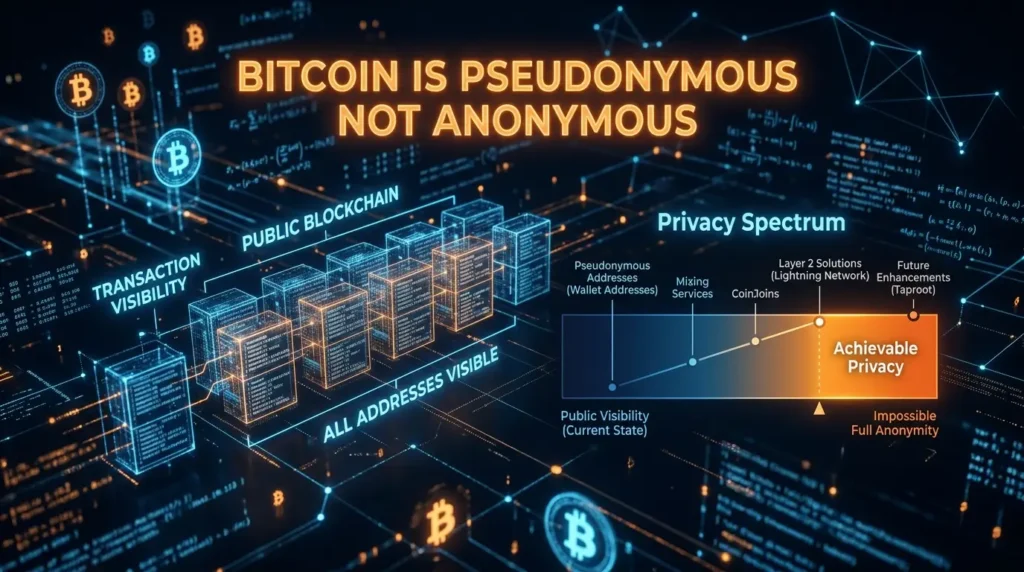
Bitcoin has a reputation for being anonymous. That reputation is largely incorrect.
Every Bitcoin transaction is permanently recorded on a public blockchain visible to anyone. Wallet addresses don’t display names — but with the right tools and data points, they can be linked to real identities. Blockchain analytics firms do this professionally for exchanges, regulators, and law enforcement.
That said, privacy and anonymity are different things. Achieving complete anonymity with Bitcoin is extremely difficult for most users. Achieving meaningful privacy — reducing the connections between your identity and your on-chain activity — is more realistic and achievable with the right approach.
This guide covers what actually works, what doesn’t, and what the honest limits of Bitcoin privacy are in 2026.
The Key Distinction: Anonymity vs. Privacy
Anonymity = no one can connect your real identity to your Bitcoin activity. Extremely difficult to achieve completely.
Privacy = significantly reducing the ease with which your identity can be linked to your transactions. Achievable with the right tools and practices.
Most people who ask “how do I buy Bitcoin anonymously” actually want privacy — they don’t want their financial activity easily accessible or linked to their personal data. That’s a more realistic goal.
Why Bitcoin Is Not Anonymous

Before covering methods, understanding why Bitcoin isn’t anonymous is essential:
Public blockchain: Every transaction — sender address, receiver address, amount, timestamp — is publicly visible on-chain forever. Anyone can look up any wallet’s complete history on a blockchain explorer.
Address reuse: If you use the same Bitcoin address repeatedly, all activity becomes connected. Anyone who knows one transaction can see all others from the same address.
Exchange KYC links: The moment you withdraw Bitcoin from a KYC exchange to a wallet, that wallet address is linked to your verified identity in the exchange’s records. Every subsequent transaction from that address can be traced.
IP address logging: Nodes on the Bitcoin network can log the IP address from which a transaction was first broadcast. Without privacy tools, your internet address can be associated with transactions.
Blockchain analytics: Companies like Chainalysis and Elliptic specialize in tracing Bitcoin flows, clustering addresses, and linking on-chain activity to real identities — particularly when funds touch regulated exchanges.
Step 1: Buy Without Identity Verification
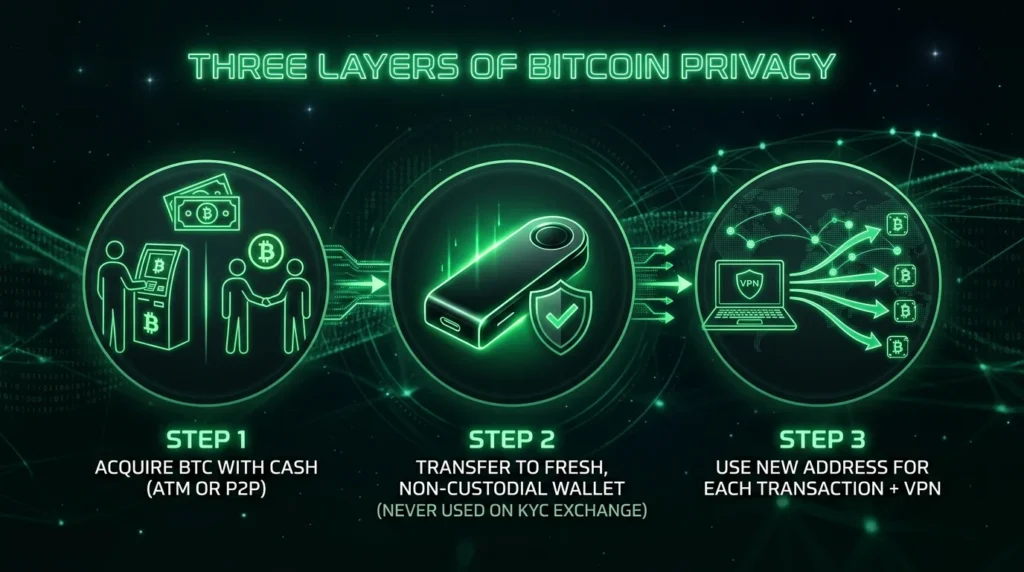
The first privacy layer is the purchase itself — acquiring Bitcoin without linking your identity to the wallet address.
Option A: Bitcoin ATM with cash
Many machines allow purchases below their verification threshold (typically $200–$900 depending on operator and jurisdiction) with only a phone number. You insert cash, scan your wallet QR code, receive Bitcoin. No government ID, no exchange account.
Limitations: Phone number is still collected. Security cameras record the transaction. Not fully anonymous but significantly less traceable than a KYC exchange withdrawal.
Option B: P2P cash trade
Platforms like Bisq or Hodl Hodl allow direct trades with other individuals. Pay with cash in person or through privacy-friendly payment methods. The platform itself doesn’t require identity verification.
Limitations: Counterparty risk. Personal safety considerations for in-person trades. Seller may independently request verification.
Option C: Mining
Acquiring Bitcoin by mining is one of the more private methods — you receive BTC as mining rewards directly to your wallet with no purchase transaction linking your identity. Not practical for most individuals in 2026 given the hardware and electricity costs.
What doesn’t work for anonymity:
- Credit or debit cards — always linked to your identity through your bank
- Bank transfers — always traceable
- PayPal — always linked to verified PayPal account
- Any KYC exchange withdrawal — permanently links your identity to the receiving address
Step 2: Use a Fresh, Non-Custodial Wallet
The wallet you receive Bitcoin into matters significantly for privacy.
Non-custodial wallet: You control the private keys. The wallet provider collects no personal information about you. Examples: Sparrow Wallet (Bitcoin-focused, privacy features), Wasabi Wallet (built-in CoinJoin), Electrum.
Generate a fresh wallet: Don’t receive anonymous Bitcoin into a wallet you’ve previously used with a KYC exchange. The moment those funds touch, the privacy benefit of your purchase method is eliminated.
Hardware wallets for storage: Ledger and Trezor don’t require identity verification to use. They store private keys offline. For long-term storage of privacy-acquired Bitcoin, a hardware wallet is appropriate.
Address generation: Modern Bitcoin wallets generate a new address for each transaction by default. Use this feature — avoid reusing addresses.
Step 3: Post-Purchase Privacy Practices
What you do with Bitcoin after buying it is as important as how you bought it.
Don’t send to KYC exchanges
If you send privacy-acquired Bitcoin to a KYC exchange (Coinbase, Kraken, etc.) — you’ve linked the wallet to your identity. The exchange’s KYC records now connect to your transaction history.
Use new addresses for each transaction
Every time you receive Bitcoin, use a fresh address. Most modern wallets do this automatically with HD (Hierarchical Deterministic) wallet structure.
Be careful with on-chain analysis triggers
Common patterns that chain analysis tools use to link addresses:
- Sending from multiple addresses to one address (address clustering)
- Round number transactions
- Change address tracking
- Timing correlation with known exchange activity
VPN or Tor when using wallets
When broadcasting Bitcoin transactions or connecting to block explorers, your IP address can be logged. A reputable VPN or the Tor Browser masks your IP address, adding another layer of separation.
Note: VPN legality and privacy policies vary. Use a reputable no-logs VPN provider. Tor is free and open-source.
Privacy Coins: An Alternative Approach
For users who want stronger on-chain privacy than Bitcoin provides, privacy coins are sometimes discussed:
Monero (XMR): Transactions on Monero are private by default — amounts, sender, and recipient are obscured using ring signatures, stealth addresses, and RingCT. Considered the strongest privacy coin from a technical standpoint.
Zcash (ZEC): Offers optional shielded transactions that hide transaction details. Privacy is not automatic — users must specifically use shielded addresses.
Important regulatory note: Privacy coins face increasing regulatory scrutiny globally. The EU has indicated restrictions on privacy coins and no-KYC wallets with changes expected from 2027. Several regulated exchanges have delisted Monero citing compliance concerns. Before using privacy coins, verify their legal status in your jurisdiction — this is an evolving area.
This is not a recommendation to use privacy coins — it’s disclosure of their existence for informational purposes.
What Significantly Reduces Privacy
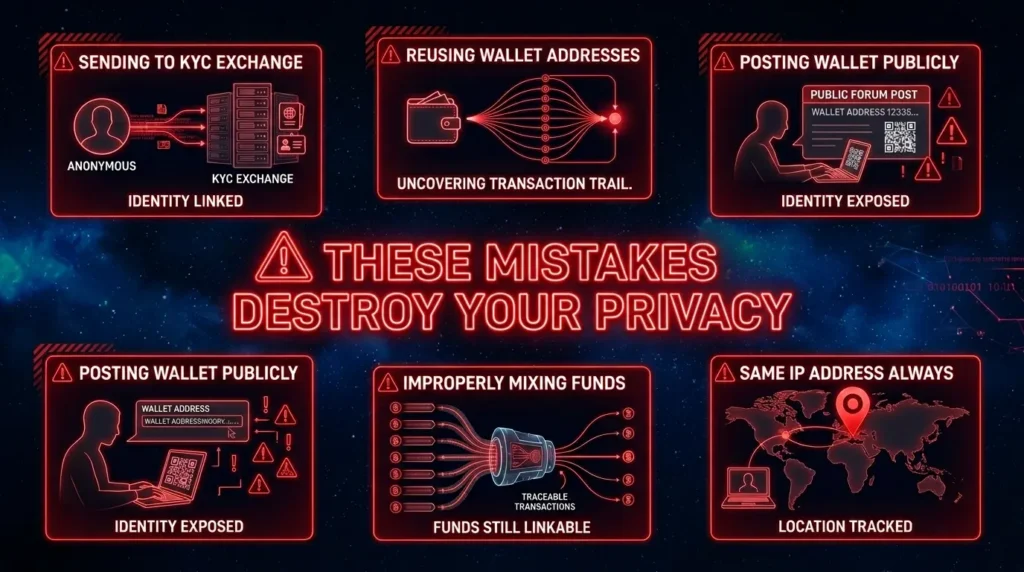
These common mistakes undermine privacy regardless of how you purchased Bitcoin:
Reusing wallet addresses — Creates a visible transaction graph connecting all your activity.
Sending anonymous Bitcoin to a KYC exchange — Immediately links your identity to all prior transactions from that wallet.
Posting wallet addresses publicly — On social media, forums, or donation pages. Once a wallet is publicly associated with your identity, its entire history is visible.
Using the same IP address — Consistently connecting to Bitcoin network infrastructure from the same IP address creates a linkage point.
Mixing anonymous and KYC-linked funds — In the same wallet. Keep separate wallets for different privacy levels.
The Honest Reality of Bitcoin Privacy in 2026
Complete Bitcoin anonymity is extremely difficult to achieve and maintain. The public blockchain, professional analytics firms, and tightening global KYC/AML regulations create significant challenges.
Realistic privacy goals:
- Purchasing without a government ID database entry (Bitcoin ATM, P2P cash)
- Receiving Bitcoin to a wallet not previously linked to your identity
- Reducing on-chain transaction linkability through address hygiene
- Masking your IP address when using wallets
What remains difficult:
- Cashing out anonymously (converting back to fiat almost always requires identity)
- Using Bitcoin for purchases without revealing the address
- Preventing all chain analysis linking
For most users with privacy concerns, the practical approach is: use a Bitcoin ATM or P2P cash trade for purchase, receive to a fresh non-custodial wallet, practice good address hygiene, and accept that “privacy” is the realistic goal rather than “complete anonymity.”
Legal Reminder
Privacy from exchanges and blockchains does not exempt anyone from tax obligations. In the US, UK, EU, and most jurisdictions, Bitcoin gains are taxable regardless of how the Bitcoin was acquired.
Using anonymous methods to purchase Bitcoin for legal personal use is generally permissible in many jurisdictions. Using such methods to evade taxes or launder funds is illegal. Always verify the legal framework in your specific location.
Key Terminology
Pseudonymous: Transactions tied to wallet addresses rather than real names — visible on the public blockchain but not directly identifying.
Chain analysis: The practice of tracing Bitcoin transactions across the blockchain to identify patterns and link addresses to real identities.
CoinJoin: A Bitcoin privacy technique that combines multiple transactions from different users into a single transaction, making it harder to trace individual inputs to outputs.
Non-custodial wallet: A wallet where you control the private keys — no third party holds or can access your funds.
HD Wallet (Hierarchical Deterministic): A wallet that generates a new address for each transaction from a single seed phrase — the standard for modern Bitcoin wallets.
Tor: Free open-source software that routes internet traffic through multiple servers to mask IP addresses.
The Bottom Line
Bitcoin privacy is achievable; Bitcoin anonymity is not — at least not completely, and not without significant technical effort and trade-offs.
The most practical path:
- Buy with cash via Bitcoin ATM (below KYC threshold) or P2P cash trade
- Receive to a fresh non-custodial wallet not previously linked to your identity
- Practice address hygiene — new address for each transaction
- Use a VPN when connecting to Bitcoin infrastructure
- Never mix with KYC exchange funds in the same wallet
- Keep records — tax obligations remain regardless of method
Privacy is a spectrum, not a switch. Every step in the right direction meaningfully reduces your exposure. 🔒
Disclaimer: This article is for informational and educational purposes only and does not constitute financial or legal advice. Always verify local laws and tax obligations in your jurisdiction before using any privacy methods. Cryptocurrency investments carry significant risk. Always conduct your own research.