Founded: 2017
CEO: Richard Teng (since November 2023)
Global reach: 180+ countries
Supported assets: 600+ cryptocurrencies, 1,500+ trading pairs
Daily trading volume: One of the largest globally
US availability: Global Binance not available to US users; Binance.US is the separate US-regulated platform
Binance is the world’s largest cryptocurrency exchange by trading volume, launched in 2017 by Changpeng Zhao (CZ) after a $15 million ICO. In less than a year, it grew to become the dominant global trading venue. Today, under CEO Richard Teng who assumed leadership in November 2023, Binance operates across 180+ countries with 600+ supported cryptocurrencies and arguably the deepest liquidity in the market.
This review covers Binance’s products, fee structure, security practices, regulatory history, and the important distinction between global Binance and Binance.US.
Important: Global Binance vs. Binance.US
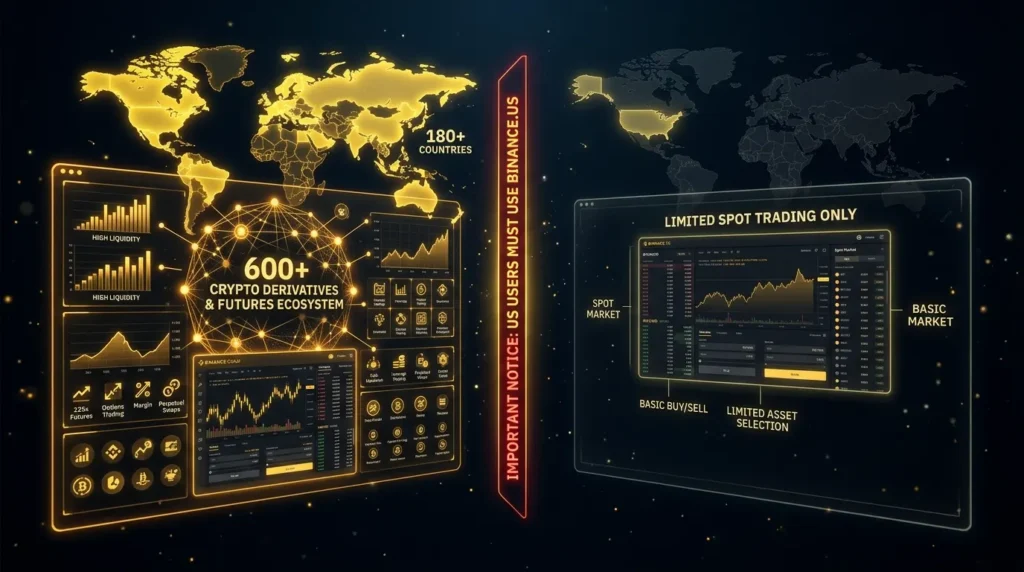
Before anything else: US residents cannot use the global Binance platform.
Since 2019, Binance has restricted US-based users from the main exchange. Binance.US is a separate, independently operated entity specifically for US users. It offers fewer trading pairs, no derivatives trading, and operates under US regulatory compliance. The two platforms share branding but are distinct businesses.
This review covers global Binance (binance.com) — the platform available to international users. A brief Binance.US section is included at the end for US-based readers.
Who Is Binance For?
Binance is best for:
- International traders outside the US seeking maximum asset selection and liquidity
- Active traders who want the widest range of trading instruments — spot, margin, futures, options
- Users who hold BNB and want to reduce trading fees
- Those who want copy trading, automated bots, P2P, and a comprehensive all-in-one ecosystem
- Developers and institutions who need deep liquidity and API access
Binance may not be ideal for:
- US residents (must use Binance.US instead)
- Users who prioritize the most conservative regulatory standing
- Complete beginners who may find the feature depth overwhelming
- Users seeking the simplest possible interface
Platform and Products
Binance has evolved from a crypto-to-crypto trading venue into what it calls a comprehensive “everything app” for crypto:
Spot Trading: The core product. 600+ cryptocurrencies and 1,500+ trading pairs. Three interface modes: Convert (simplest), Classic (standard), and Advanced (full order book and charting). The breadth of listed assets is unmatched among major exchanges.
Derivatives: Futures with up to 125x leverage on 300+ pairs. USDT-margined and coin-margined perpetuals. Options trading available. Among the highest derivatives volume globally.
Margin Trading: Borrow against collateral to increase position size. Available on a range of trading pairs.
Copy Trading: Follow and automatically replicate strategies from verified traders on the platform, with risk management controls.
Trading Bots: Built-in automated strategies including Grid Trading, DCA, and others accessible directly from the interface.
Binance Earn: A suite of yield products including flexible savings, fixed-term products, staking, and liquidity provision. One of the most comprehensive passive income product sets in the industry.
P2P Trading: Direct peer-to-peer fiat-to-crypto marketplace supporting many payment methods and fiat currencies across global markets.
Launchpad: Token launch platform. Over 70 projects have launched through the program. Early participants have historically seen significant first-day token performance.
Web3 Wallet: Integrated Web3 wallet with cross-chain functionality and access to DeFi protocols and dApps directly from the Binance app.
Binance Academy: Comprehensive free educational platform covering crypto fundamentals, trading strategy, security, DeFi, and more — one of the most extensive educational resources in the industry.
Binance Pay: No-fee crypto payments between Binance users globally.
Fees
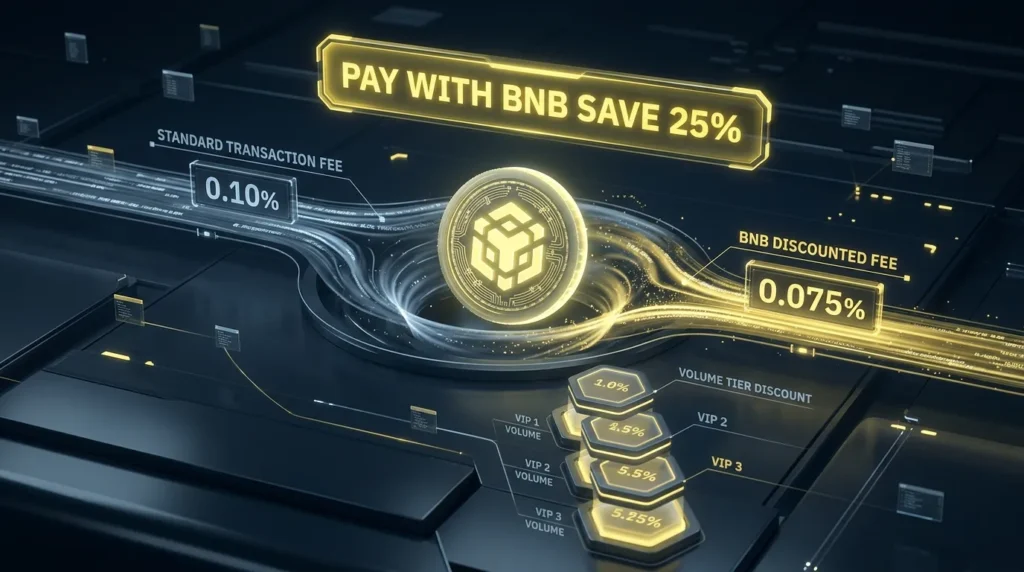
Spot Trading Fees
Binance uses a maker-taker model. Standard base rates:
- Maker: 0.10%
- Taker: 0.10%
BNB discount: Users who pay fees using Binance’s native token BNB receive a 25% fee discount, reducing effective rates to 0.075% maker/taker at the base level.
Volume discounts: Higher 30-day trading volumes unlock progressively lower rates across VIP tiers, reaching near-zero at the highest levels.
The 0.10% base rate is among the lowest starting fees of any major exchange — significantly below Coinbase’s standard interface and slightly below Kraken’s Advanced Trade base rates.
Derivatives Fees
Standard perpetuals futures:
- Maker: 0.02%
- Taker: 0.05%
Among the lowest derivatives fees of any major exchange at scale.
Deposit and Withdrawal Fees
- Crypto deposits: Free
- Crypto withdrawals: Network fee applies (displayed before confirmation)
- Fiat via card: Approximately 3.3% for credit/debit card deposits — standard for the industry at card rates
Security
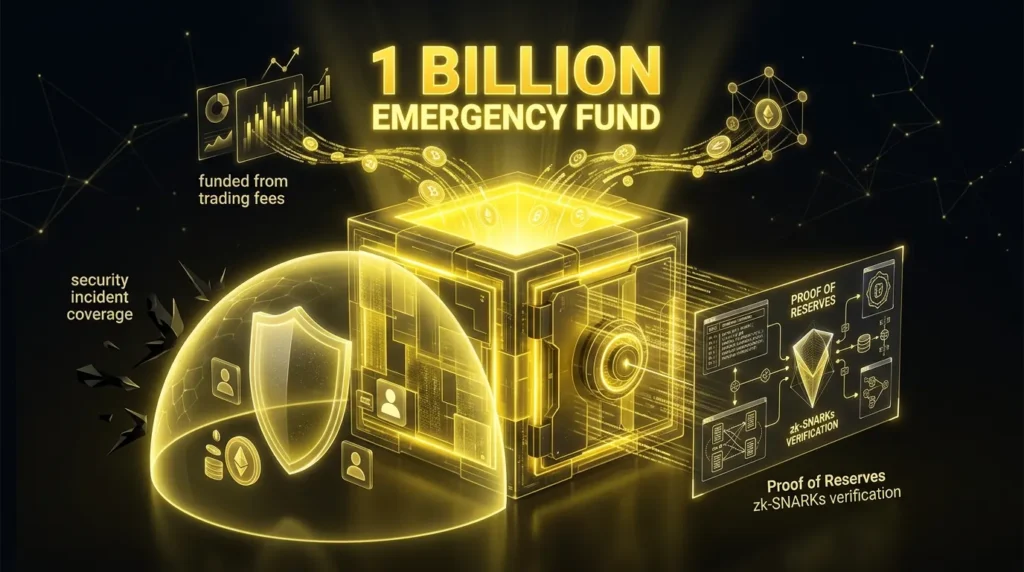
Binance operates an extensive security infrastructure:
Cold Storage: The majority of user assets are stored in offline cold wallets, with a smaller portion in hot wallets for operational liquidity.
SAFU (Secure Asset Fund for Users): Binance established SAFU in July 2018, funded from a percentage of trading fees. As of February 2026, the fund held approximately $1 billion in crypto assets. SAFU is designed as an emergency fund to compensate users in the event of security incidents. It is not a regulated deposit insurance scheme, and its application depends on incident specifics and platform policy.
Proof of Reserves: Binance publishes Proof of Reserves using zk-SNARKs (zero-knowledge cryptographic proofs), allowing users to verify their funds are included in the exchange’s holdings.
Standard Account Security: 2FA (authenticator app, hardware key), withdrawal address whitelisting, anti-phishing codes, device management, and real-time security monitoring.
Security Track Record: In May 2019, hackers withdrew approximately 7,000 BTC ($40 million at the time) from Binance’s hot wallets. Binance covered all losses from its SAFU fund — no user funds were lost. Subsequent security enhancements were implemented following this incident. No successful breach resulting in uncompensated user fund loss has been publicly reported since.
Regulatory History
Binance has operated within a complex and evolving regulatory environment globally. Key facts for informed users:
2023 US Settlement: In November 2023, Binance reached a $4.3 billion settlement with the US Department of Justice related to anti-money laundering violations and Bank Secrecy Act charges. As part of the settlement, founder Changpeng Zhao stepped down as CEO. Richard Teng assumed the CEO role. The settlement included ongoing monitoring requirements.
2025 SEC lawsuit resolution: The SEC lawsuit against Binance.US was dropped in May 2025 amid shifting regulatory attitudes toward crypto in the United States.
Current compliance posture: Under CEO Richard Teng, Binance has increased its focus on regulatory compliance, KYC/AML procedures, and obtaining local licenses in additional jurisdictions. The platform holds licenses in multiple regions including parts of Europe, the Middle East, Asia-Pacific, Latin America, and Africa. Coverage varies by jurisdiction.
Important note for users: Binance’s regulatory status is jurisdiction-specific. Service availability, product access (particularly derivatives and margin), and KYC requirements vary by country. Users should verify current availability and terms for their specific location.
BNB: Binance’s Native Token
BNB (Binance Coin) is the native utility token of the Binance ecosystem. Practical uses:
- Fee discounts: 25% reduction on trading fees when used to pay
- Launchpad access: BNB staking often required for Launchpool participation
- BNB Chain: Native token of the BNB Smart Chain blockchain, used for gas fees across hundreds of dApps
As of 2026, BNB trades as the fourth-largest cryptocurrency by market capitalization. Holding BNB is a meaningful cost reduction tool for active Binance traders.
Mobile App
Binance’s mobile app is available for iOS and Android and is consistently one of the most downloaded finance applications globally. The app covers the full product suite with smart widget customization for trading workflow optimization. A “Lite” mode is available for simpler navigation. App store ratings are generally positive, though the depth of features can be overwhelming for first-time users.
Binance.US: The US Option
For US residents, Binance.US (binance.us) is the separate regulated option:
- Spot trading only — no derivatives, no margin
- Fewer trading pairs and lower liquidity than global Binance
- Lower fees: Selected BTC/ETH USD pairs: 0% maker/taker. Most pairs: starting at 0.38%/0.57%
- Regulatory standing: Subject to US federal compliance requirements; SEC lawsuit dropped in May 2025
- No Proof of Reserves published
Binance.US is a viable low-cost spot trading option for US users on major pairs, though its lower liquidity and limited product set make it a different offering than the global platform.
Pros and Cons
Pros:
- Largest global exchange — deepest liquidity and tightest spreads on major pairs
- Lowest fees among major exchanges — 0.10% base with BNB discount to 0.075%
- Most comprehensive product ecosystem — spot, derivatives, earn, P2P, bots, copy trading, Web3
- 600+ cryptocurrencies — largest selection of major exchanges
- SAFU emergency fund (~$1 billion)
- Binance Academy — among the best free crypto education resources available
- Globally accessible in 180+ countries
Cons:
- Not available to US users on the global platform (Binance.US is the limited US alternative)
- Complex interface can be overwhelming for beginners
- Regulatory history (2023 DOJ settlement, monitoring requirements) is a relevant consideration
- Customer support receives mixed reviews at scale
- Interface complexity requires a learning curve
How to Get Started on Binance
- Verify availability in your jurisdiction at binance.com
- Create an account with email or phone number
- Complete KYC verification (government ID required for full access)
- Enable 2FA — authenticator app recommended
- Set up withdrawal address whitelist and anti-phishing code
- Deposit crypto or fiat via preferred method
- Start with Classic or Advanced trading interface; explore other products as you become familiar
The Verdict
Binance is the largest cryptocurrency exchange in the world for a reason: its liquidity depth, fee competitiveness, and product breadth are difficult to match at scale. For international traders looking for a single comprehensive platform, Binance offers more trading instruments, lower fees, and more supported assets than most alternatives.
The regulatory history — particularly the 2023 DOJ settlement — is a factual element of Binance’s profile that informed users should weigh. Under current leadership, the company has increased its compliance focus and continues to operate across 180+ countries.
US users should use Binance.US or consider Coinbase or Kraken as alternative regulated platforms with a more established domestic compliance record.
Best for: International active traders seeking maximum liquidity and asset selection, derivatives traders, cost-conscious users who hold BNB, and anyone wanting a comprehensive all-in-one crypto ecosystem.
Disclaimer: This review is for informational purposes only and does not constitute financial advice. Cryptocurrency investments carry significant risk, including the potential loss of all invested capital. TheHashmark.com may receive a commission if you sign up through affiliate links, at no additional cost to you. Always conduct your own research before making any investment decisions.