When evaluating any DeFi protocol, one number appears everywhere: TVL. It’s the headline metric on DeFiLlama, referenced in every DeFi article, and used as the primary proxy for protocol size and adoption.
But TVL is both more useful and more misleading than most people realize. Understanding what it actually measures — and what it doesn’t — is essential for anyone making decisions based on DeFi data.
What Is TVL?
Total Value Locked (TVL) is the total dollar value of all crypto assets deposited in a DeFi protocol or across all DeFi protocols combined.
The simple formula:
TVL = Σ (Quantity of each asset × Current price of that asset)
If Aave holds 500,000 ETH at $2,500 and 1 billion USDC:
TVL = (500,000 × $2,500) + $1,000,000,000 = $1.25B + $1B = $2.25 billion
TVL updates continuously as deposits and withdrawals occur and as asset prices change.
Why TVL Matters: What It Measures
1. Protocol Trust and Adoption
TVL is the market’s collective vote of confidence in a protocol. When billions of dollars are locked in a smart contract, it implies:
- Users trust the protocol’s security
- The protocol has been tested at scale
- Institutional and retail capital has validated it
A new protocol with $500K TVL vs. Aave with $15B TVL represents fundamentally different levels of market validation.
2. Liquidity Available to Users
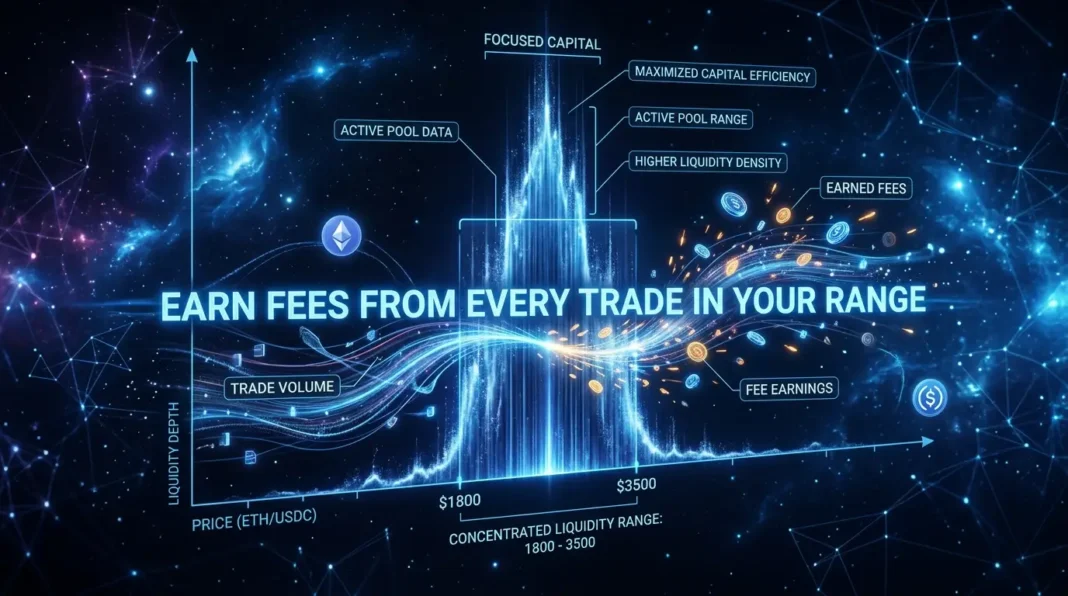
For DEXs (Uniswap, Curve), TVL directly determines liquidity depth — how large a trade can execute without significant slippage. Higher TVL = better prices for traders.
For lending protocols (Aave, Compound), TVL determines how much can be borrowed — more TVL means more borrowing capacity and lower interest rates through improved liquidity.
3. Protocol Revenue Potential
More TVL generally means:
- More trading volume (for DEXs) → more fee revenue
- More borrowing (for lending protocols) → more interest revenue
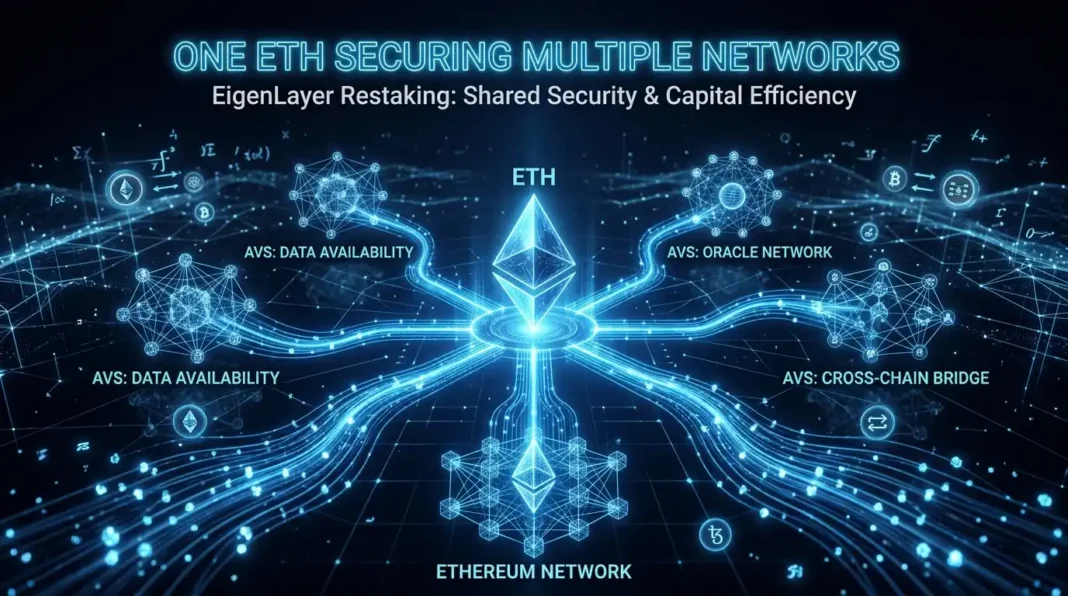
- More restaking (for EigenLayer-type protocols) → more security services provided
4. Ecosystem Health Indicator
Total DeFi TVL across all protocols serves as a macro indicator for the health of the DeFi ecosystem:
- Rising TVL → capital flowing into DeFi (bullish signal)
- Falling TVL → capital leaving DeFi (could be bearish or price-driven)
- TVL concentration → which chains and protocols are winning
Current DeFi TVL: The Landscape in April 2026
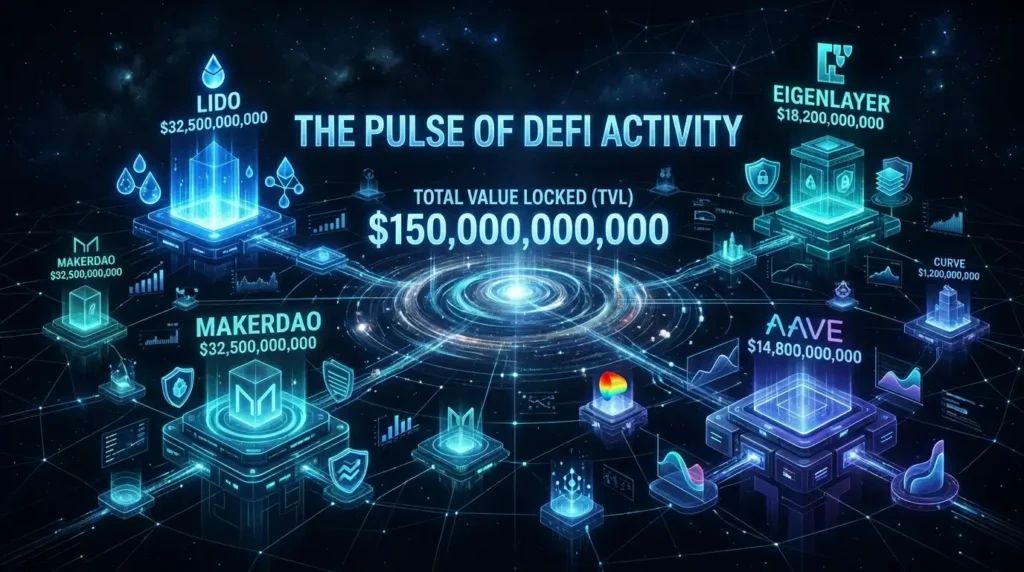
Total DeFi TVL (April 2026): approximately $150–160 billion across all chains
Top protocols by TVL:
| Protocol | Category | TVL (approx.) |
|---|---|---|
| Lido Finance | Liquid Staking | ~$35B |
| EigenLayer | Restaking | ~$12B |
| Aave V3 | Lending | ~$15B |
| Maker/Sky | Stablecoin/Lending | ~$10B |
| Uniswap | DEX | ~$8B |
| Curve Finance | DEX (Stablecoins) | ~$4B |
| Pendle | Yield | ~$4B |
| Morpho | Lending | ~$3.5B |
| Rocket Pool | Liquid Staking | ~$3.5B |
| Ether.fi | Restaking/Liquid Staking | ~$6B |
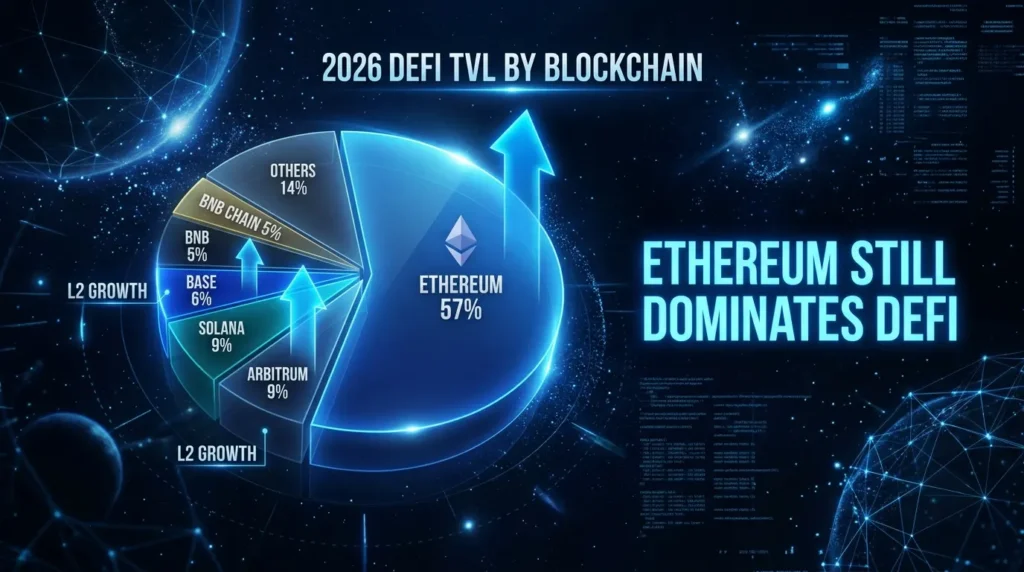
TVL by blockchain (approximate):
| Chain | TVL Share |
|---|---|
| Ethereum | ~55–60% |
| Arbitrum | ~8–10% |
| Base | ~5–7% |
| Solana | ~8–10% |
| BNB Chain | ~4–5% |
| Others | ~10–15% |
Ethereum dominates DeFi TVL — its security, liquidity depth, and developer ecosystem make it the preferred chain for large-value DeFi activity. Layer 2s (Arbitrum, Base) are growing rapidly, particularly for retail-sized activity.
TVL vs. Market Cap: An Important Distinction
These two metrics are frequently confused.
Market Cap = Total value of a token’s circulating supply at current price
Market Cap = Price × Circulating Supply
TVL = Total assets deposited in a protocol’s smart contracts
Example — Uniswap:
- UNI token market cap: ~$5 billion (price × UNI supply)
- Uniswap protocol TVL: ~$8 billion (assets in liquidity pools)
These are measuring completely different things. Market cap reflects what the market thinks the UNI governance token is worth. TVL reflects how much liquidity users have deposited to trade against.
The P/TVL ratio (Price-to-TVL, analogous to P/E ratio in stocks) is sometimes used to evaluate whether a DeFi protocol’s token is cheap or expensive relative to the protocol’s actual usage. Lower P/TVL = potentially undervalued relative to protocol activity.
TVL by Category: What Each Means
Liquid Staking TVL
The largest DeFi category. Represents ETH (or SOL, etc.) deposited into liquid staking protocols (Lido, Rocket Pool, Jito).
What it tells you: How much staked ETH has been “liquid-ified” — made available for DeFi composability while still securing the network.
Lending Protocol TVL
Represents assets supplied to lending markets (Aave, Compound, Morpho). Includes both the supplied collateral and the borrowed assets outstanding.
What it tells you: Total credit extended through DeFi lending. High lending TVL with high utilization rates = active borrowing demand = good protocol health.
DEX TVL
Represents liquidity in trading pools (Uniswap, Curve). The actual liquidity available for trading.
What it tells you: How deep the liquidity is for trading. Low DEX TVL relative to volume = thin markets = high slippage for traders.
Restaking TVL
Represents assets deposited in restaking protocols (EigenLayer, Symbiotic). ETH security being extended to additional networks.
What it tells you: How much economic security is available to secure new networks and infrastructure.
The Limitations of TVL: What It Doesn’t Tell You
TVL is a useful but imperfect metric. Understanding its limitations prevents misuse:
1. TVL Is Price-Sensitive
If ETH price drops 50%, DeFi TVL drops roughly 50% — even with the same number of ETH deposited. A protocol didn’t “lose” assets; the dollar value changed.
Implication: Comparing TVL across different market conditions (bull vs. bear market) is misleading without accounting for underlying asset price changes. A protocol with $5B TVL in a bear market may represent more actual usage than $15B TVL at peak bull market prices.
Solution: Look at TVL denominated in ETH or in the native asset where possible, not just USD.
2. Double Counting (The Biggest Limitation)
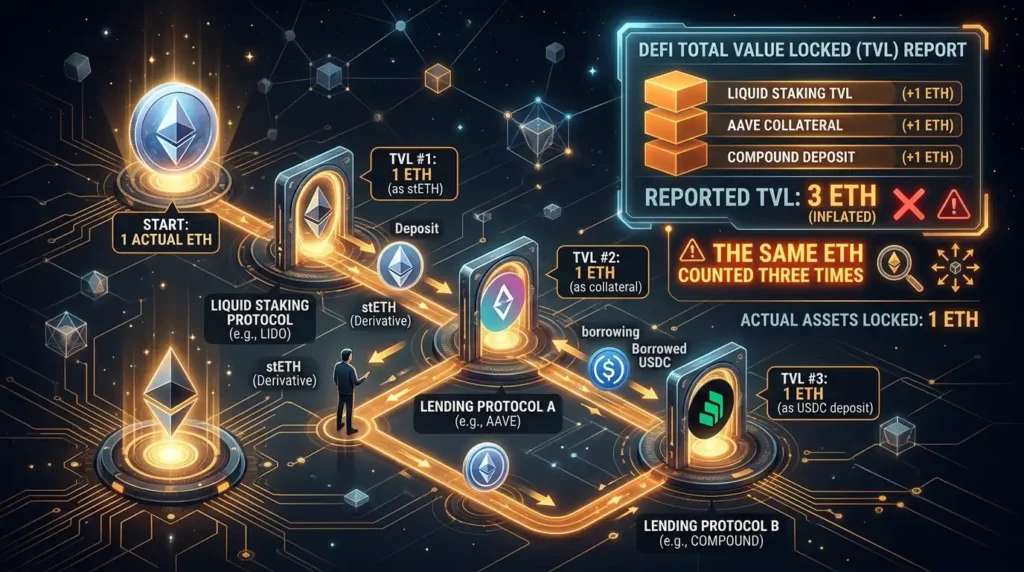
This is the most significant — and most overlooked — limitation of TVL.
The problem: When you stake ETH → receive stETH → deposit stETH into Aave → borrow USDC → deposit USDC into Compound, each protocol counts the full value:
- Lido: counts your stETH value (~1 ETH)
- Aave: counts your stETH collateral (~1 ETH)
- Compound: counts your USDC deposit (value of USDC borrowed against ETH)
The same ETH is counted 3+ times across different protocols. The “total” DeFi TVL significantly overstates the actual unique capital deployed.
Why it matters: When someone says “DeFi has $150B TVL,” the actual unique capital (not double-counted) is meaningfully lower — perhaps $80–100B. TVL should be understood as a relative measure (comparing protocols to each other) rather than an absolute measure of unique capital.
DeFiLlama partially addresses this with “double counted” metrics and “canonical TVL” measures — worth checking for a cleaner picture.
3. TVL Doesn’t Measure Activity
A protocol can have $10B TVL with almost no actual usage. Conversely, a DEX aggregator might have minimal TVL but route billions in volume.
Better paired metrics:
- Volume/TVL ratio: For DEXs — measures how actively the locked capital is being used
- Utilization rate: For lending protocols — percentage of supplied assets currently borrowed
- Revenue: Actual protocol revenue from fees (visible on DeFiLlama’s “Fees” dashboard)
A protocol with $1B TVL generating $10M in monthly fees may be healthier than a protocol with $5B TVL generating $100K in monthly fees.
4. TVL Can Be Inflated by Incentives
Protocols sometimes offer high token rewards to attract temporary liquidity — “mercenary capital” that leaves the moment incentives dry up.
During the DeFi Summer 2020, protocols offered 1,000%+ APY in governance tokens. TVL exploded — then crashed when incentives ended. The TVL was real in dollar terms, but it wasn’t genuine organic adoption.
Signal of incentive-driven vs. organic TVL: Sudden TVL spikes that coincide with high-APY farming programs, followed by TVL drops when rewards decrease.
5. TVL Doesn’t Measure Safety
A protocol with $5B TVL is not necessarily safer than one with $500M TVL. TVL reflects user trust — but users can be wrong. Many protocols with high TVL have been exploited.
How to Use TVL Effectively: Practical Framework
For Evaluating a Specific Protocol
Step 1: Find the protocol on DeFiLlama (defillama.com)
Step 2: Check TVL trend
- Is TVL growing, stable, or declining?
- Sudden drops may indicate exploits, rug pulls, or loss of confidence
Step 3: Compare TVL to revenue (fees)
- Protocol generates $X/month in fees on $Y TVL
- Fee/TVL ratio tells you how efficiently the protocol monetizes its liquidity
Step 4: Check utilization (for lending protocols)
- Utilization rate = Borrowed / Supplied
- High utilization (70%+) = good demand, rates may be high
- Very high utilization (90%+) = risk of withdrawal liquidity shortfalls
Step 5: Compare to competitors
- Aave vs. Compound: compare TVL, revenue, utilization
- Uniswap vs. Curve: compare TVL, volume, fee income
For Macro DeFi Assessment
Total DeFi TVL as a ratio to total crypto market cap provides context:
- DeFi TVL / Total Crypto Market Cap = DeFi penetration ratio
- In 2026: ~$150B TVL / ~$2.5T market cap = ~6% penetration
- Rising ratio → DeFi growing relative to overall crypto market
TVL concentration by chain tells you which ecosystems are winning developer and user attention.
Where to Find TVL Data: DeFiLlama
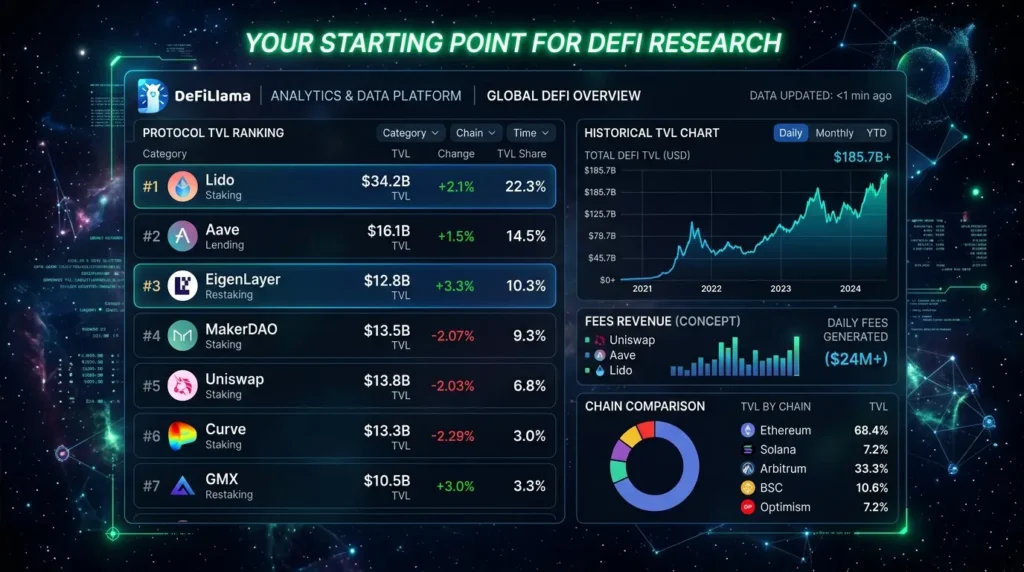
DeFiLlama (defillama.com) is the authoritative source for DeFi TVL data. It’s free, comprehensive, and covers thousands of protocols across hundreds of chains.
Key features:
- Protocol TVL with historical charts
- TVL by chain breakdown
- Revenue/fees dashboard (separate from TVL)
- Comparison tools for multiple protocols
- “Raises” tracking (protocol funding rounds)
- Stablecoins TVL
How to use it:
- Go to defillama.com
- Main page shows top protocols by TVL with 24h/7d/1m changes
- Click any protocol for detailed metrics including TVL history, revenue, and token data
- Use the “Chains” tab to compare blockchain ecosystem TVL
- Use “Fees” section to see protocol revenue separate from TVL
DeFiLlama alternatives:
- Token Terminal: Cleaner revenue and P/S ratio data
- Dune Analytics: Custom on-chain analytics dashboards
- Messari: Research-grade protocol data with more context
Key Terminology
TVL (Total Value Locked): The total dollar value of crypto assets deposited in a DeFi protocol.
Double Counting: When the same underlying asset is counted in multiple protocols’ TVL simultaneously — inflating total DeFi TVL.
Utilization Rate: For lending protocols — the percentage of supplied assets currently borrowed. Key health metric.
P/TVL Ratio: A token’s market cap divided by the protocol’s TVL — analogous to P/E ratio, indicates relative valuation.
Mercenary Capital: Liquidity attracted purely by high token incentives that quickly exits when rewards end.
DeFiLlama: The primary aggregator for DeFi TVL data across thousands of protocols and hundreds of chains.
Canonical TVL: DeFiLlama’s measure that attempts to reduce double counting by tracking only the base-layer assets.
Volume/TVL Ratio: For DEXs — daily trading volume divided by TVL. Measures capital efficiency.
The Bottom Line
TVL is the most important standardized metric in DeFi — and the most frequently misused. Understanding what it actually measures turns it from a vanity number into a useful analytical tool.
TVL is useful for:
- Comparing protocols within the same category (Aave vs. Compound)
- Tracking a protocol’s growth or decline over time
- Assessing ecosystem distribution (which chains are winning)
- A first-pass filter for protocol legitimacy (tiny TVL = less tested)
TVL is misleading for:
- Comparing absolute DeFi size across time (price-sensitive)
- Claiming DeFi has $X in “unique” capital (double counting)
- Assessing protocol safety (TVL ≠ security)
- Ignoring alongside revenue and utilization data
The right approach: Use TVL as one data point among several. Pair it with revenue, utilization rate, volume/TVL ratio, and protocol track record for a complete picture.
DeFiLlama is your starting point — bookmark it. 📊
Disclaimer: This article is for informational and educational purposes only and does not constitute financial advice. DeFi investments carry significant risks. Always conduct your own research before using any protocol.