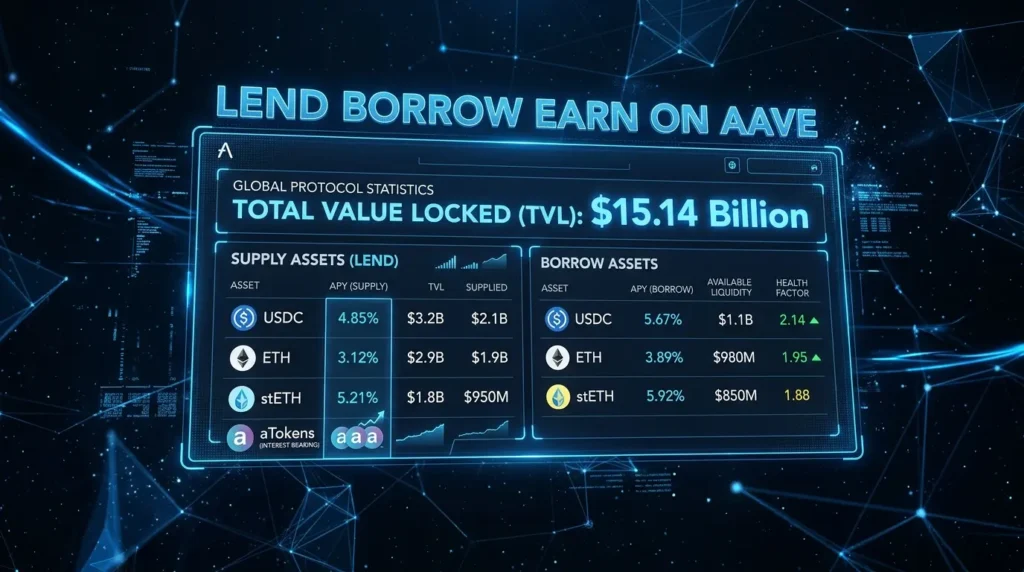
Aave is the largest DeFi lending protocol in the world — managing over $15 billion in Total Value Locked across more than a dozen blockchain networks. It allows anyone to lend crypto and earn interest, or borrow against their holdings without selling.
If you’ve never used a DeFi protocol before, Aave is one of the best starting points. The interface is clean, the mechanics are straightforward once explained, and the risk profile — particularly for simple supplying — is among the most manageable in DeFi.
This guide walks through everything step by step: setting up, supplying assets to earn yield, and (for those ready) borrowing safely.
What Is Aave?
Aave is a decentralized lending protocol — a DeFi marketplace connecting lenders and borrowers through smart contracts.
For lenders (suppliers):
Deposit crypto → earn variable interest from borrowers → withdraw anytime
For borrowers:
Deposit collateral → borrow up to a certain percentage of collateral value → pay variable interest → repay whenever you want
No credit check. No application. No minimum. No maximum. The protocol handles everything automatically through smart contracts.
Aave V3 (current version):
- Available on: Ethereum, Arbitrum, Optimism, Base, Polygon, Avalanche, and others
- Supports 30+ assets including ETH, WBTC, USDC, USDT, DAI, stETH, and more
- Features: Efficiency Mode (eMode), cross-chain functionality, isolation mode for newer assets
Why Arbitrum/Base over Ethereum mainnet for beginners:
Gas fees on Ethereum mainnet can make small transactions expensive ($5–30+ per transaction). Arbitrum and Base offer the same Aave V3 protocol with gas fees of $0.01–$0.10. For beginners with smaller positions, always start on a Layer 2.
Before You Start: What You Need
1. A non-custodial wallet
- MetaMask (most widely used, browser extension + mobile)
- Rabby (good alternative with better transaction previews)
- Any WalletConnect-compatible wallet
2. Crypto to deposit
To supply on Aave, you need the asset you want to supply. Common starting assets:
- USDC or USDT: Stablecoin supply earns 4–12% APY with no price risk on the supplied asset
- ETH: Supply earns 2–5% APY — good for long-term ETH holders
- stETH: Supply earns staking rewards + Aave supply APY
3. ETH for gas fees
Even on L2s, you need a small amount of ETH (or the network’s native token) to pay transaction fees. On Arbitrum or Base, ~$5–10 in ETH covers many transactions.
4. Access to Aave
Official URL: app.aave.com — always verify you’re on the official domain. Bookmark it, don’t search for it.
Setting Up: Connecting Your Wallet
Step 1: Go to app.aave.com
Step 2: Click “Connect wallet” in the top right
Step 3: Select your wallet (MetaMask, WalletConnect, etc.)
Step 4: Approve the connection in your wallet popup
Step 5: Select your network
Click the network selector (top right) and choose your preferred network. For beginners: Arbitrum or Base (low gas, full V3 features).
Step 6: Your wallet is connected — you’ll see your address displayed and any assets you hold that are relevant to Aave.
Part 1: Supplying Assets (Earning Interest)

Supplying is the simplest Aave action — deposit an asset, earn variable interest automatically.
Understanding the Supply Dashboard
After connecting, the main Aave dashboard shows:
“Assets to supply” — tokens in your wallet eligible to supply
Supply APY — current annual percentage yield for supplying (variable, changes with market demand)
Can be collateral — whether the supplied asset can be used to borrow against
Step-by-Step: Supplying USDC on Aave (Arbitrum)
Step 1: Ensure you have USDC in your MetaMask wallet on Arbitrum
Step 2: On app.aave.com, select Arbitrum network
Step 3: Find USDC in the “Assets to supply” section
Step 4: Click “Supply” next to USDC
Step 5: Enter the amount you want to supply (start small — $50–$100 to learn)
Step 6: First-time only — Approve USDC
Before supplying for the first time, you must approve Aave’s contract to use your USDC. This is a one-time permission transaction per token per network. Confirm in MetaMask.
Step 7: Click “Supply USDC” and confirm the transaction in MetaMask
Step 8: You receive aUSDC — Aave’s interest-bearing token representing your USDC supply position. Your aUSDC balance increases in real time as interest accrues.
Step 9: Done! Your USDC is now earning interest automatically.
What You Receive: aTokens
When you supply to Aave, you receive aTokens — interest-bearing derivatives:
- Supply USDC → receive aUSDC
- Supply ETH → receive aWETH
- Supply stETH → receive astETH
aTokens automatically accumulate interest — your aUSDC balance grows in real time, reflecting the current supply APY.
Important: Keep your aTokens — they’re your receipt. You need them to withdraw your USDC plus accumulated interest.
Current Supply APYs on Aave V3 (Approximate, April 2026)
Rates are variable and change constantly — verify current rates on app.aave.com
| Asset | Supply APY (approx.) | Collateral? |
|---|---|---|
| USDC | 4–10% | Yes |
| USDT | 4–10% | Yes |
| ETH/WETH | 2–5% | Yes |
| WBTC | 1–3% | Yes |
| stETH | 2–4% (+ Lido staking rewards) | Yes |
| DAI | 4–8% | Yes |
| GHO | Varies | No |
Withdrawing Your Supply
Step 1: Go to your Aave dashboard → “Your supplies” section
Step 2: Click “Withdraw” next to the asset
Step 3: Enter the amount to withdraw (or click “Max”)
Step 4: Confirm in MetaMask
Your asset (plus all accumulated interest) returns to your wallet immediately.
Note: Withdrawals are instant unless utilization rate is very high (rare). If the pool is 100% utilized (all assets borrowed), withdrawal may have to wait for borrowers to repay. This is uncommon for major assets.
Part 2: Borrowing on Aave

Borrowing on Aave lets you access liquidity without selling your crypto. It’s more complex than supplying and carries liquidation risk — read this section carefully before borrowing.
Why Borrow on Aave?
Common use cases:
- Access stablecoins without selling ETH (avoiding a taxable event)
- Leverage a position (borrow stablecoins, buy more ETH)
- Short an asset (borrow, sell, repay when price drops)
- Yield arbitrage (borrow at X%, deploy at Y% > X%)
Key Concepts Before Borrowing
Collateral: The asset you deposit that secures your loan. Must be worth more than what you borrow.
LTV (Loan-to-Value): The maximum percentage of your collateral value you can borrow.
- Example: ETH has 80% LTV on Aave → deposit $10,000 ETH → can borrow up to $8,000
Liquidation Threshold: The LTV at which your position gets liquidated.
- Example: ETH liquidation threshold is 82.5% → if your borrowed amount reaches 82.5% of collateral value, liquidation triggers
Health Factor: A number above 1.0 means your position is safe. Below 1.0 triggers liquidation.
- Health Factor = (Collateral Value × Liquidation Threshold) ÷ Borrowed Value
- Health Factor > 2.0 → comfortable
- Health Factor 1.5–2.0 → monitor closely
- Health Factor 1.0–1.5 → add collateral or repay urgently
- Health Factor < 1.0 → liquidation triggered
Always maintain a Health Factor above 1.5 — ideally above 2.0 for safety margin.
Step-by-Step: Borrowing USDC Against ETH Collateral
Step 1: Supply ETH as collateral
Follow the supply steps above — supply your ETH. Make sure “Use as Collateral” is enabled (toggle in the supply interface).
Step 2: Navigate to the “Borrow” section
In the Aave dashboard, find the “Assets to borrow” section.
Step 3: Select USDC and click “Borrow”
Step 4: Enter the amount to borrow
The interface shows your current Health Factor and how it changes with different borrow amounts.
Safe borrow amount: Aim for a Health Factor of 2.0 or higher after borrowing.
Example:
- You supplied $10,000 ETH (LTV 80%, liquidation threshold 82.5%)
- Maximum borrow: $8,000 USDC
- Safe borrow (to maintain HF ~2.0): ~$4,000–5,000 USDC
Step 5: Choose interest rate type
- Variable rate: Changes with market conditions. Usually lower but can spike.
- Stable rate: Fixed for a period (not always available). Higher but predictable.
For beginners: variable rate for shorter borrowing periods.
Step 6: Confirm the transaction in MetaMask
Step 7: USDC appears in your wallet. You now have a borrow position.
Managing Your Borrow Position
Monitoring:
Check your Health Factor regularly — daily if you have a leveraged position, weekly for conservative borrowing.
Set up alerts via DeFiSaver, Aave’s own notification system, or on-chain monitoring tools like Tenderly.
Adding collateral:
If your Health Factor drops (e.g., ETH price falls), you can add more ETH as collateral to restore it.
Repaying:
Go to your Aave dashboard → “Your borrows” → click “Repay” → enter amount → confirm.
You can repay partially or fully at any time. There’s no penalty for early repayment.
Interest accrual:
Your borrow amount increases over time as interest accrues. A $5,000 USDC borrow at 6% APY means you owe $300 more after one year — your Health Factor will slowly decline as debt grows, even if ETH price stays flat.
Liquidation: What Happens and How to Avoid It
What triggers liquidation:
Your Health Factor falls below 1.0. This happens when:
- Your collateral’s price drops (ETH price falls)
- Your borrowed asset’s price rises (borrowing non-stablecoins)
- Interest on your borrow accumulates, increasing debt
What happens during liquidation:
Liquidators (bots scanning the blockchain) repay a portion of your debt and receive your collateral at a discount (the liquidation penalty, typically 5–10%). You lose a portion of your collateral — often more than the liquidation penalty alone due to timing.
How to avoid liquidation:
- Maintain a Health Factor above 2.0 (more conservative than Aave’s minimum)
- Borrow only a fraction of your maximum (40–50% of max LTV rather than 80%)
- Monitor daily during volatile markets
- Repay or add collateral when Health Factor drops below 1.5
- Use automated tools (DeFiSaver) to set up automatic collateral addition or debt repayment at threshold Health Factors
Efficiency Mode (eMode): Maximizing Correlated Asset Borrowing
Aave V3 introduced eMode — a feature that allows much higher LTV ratios for correlated asset pairs.
How eMode works:
When your collateral and borrowed asset are in the same eMode category (e.g., both are ETH-correlated), you can borrow up to 95% LTV instead of the standard 80%.
Example:
- Normal mode: Supply stETH → borrow up to 72% in USDC
- eMode (ETH category): Supply stETH → borrow up to 90% ETH/WETH
Use case: The LST loop strategy (supply stETH, borrow ETH, stake more ETH, repeat) uses eMode to maximize capital efficiency.
Warning: Higher LTV means your liquidation threshold is also higher — leave even more safety margin when using eMode.
Aave V3 on Different Networks: Which to Use
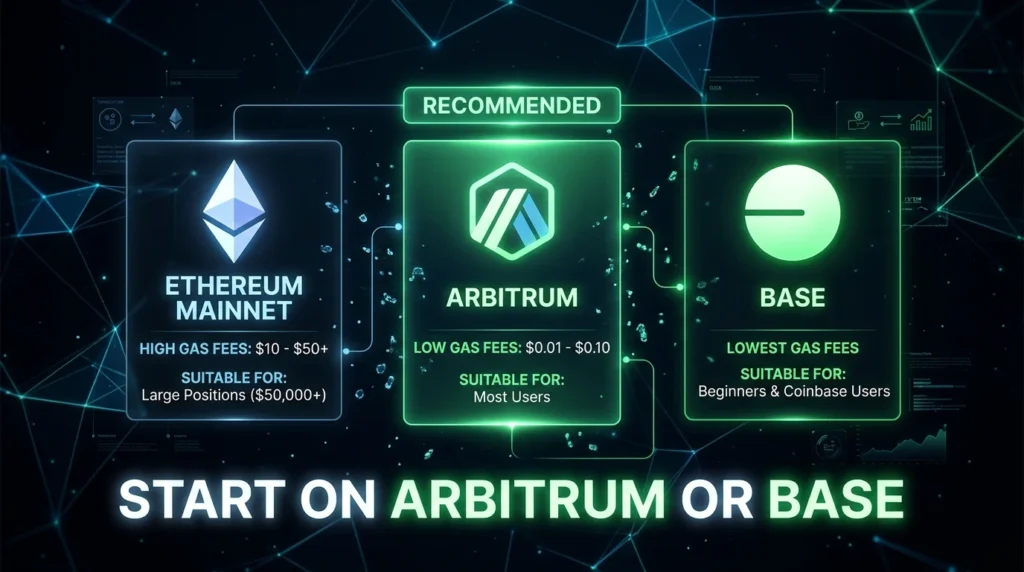
Ethereum Mainnet:
- Highest TVL and liquidity ($10B+)
- Most assets supported
- High gas fees ($10–50+ per transaction)
- Best for: Large positions ($50,000+) where gas is proportionally small
Arbitrum:
- Full V3 feature set
- Gas: $0.01–$0.10
- Good asset selection (ETH, WBTC, USDC, USDT, DAI, stETH)
- Best for: Most users, including beginners
Base:
- Coinbase’s L2 — growing rapidly
- Full V3 features
- Gas: $0.01–$0.05
- Best for: Beginners, small-to-medium positions, users coming from Coinbase ecosystem
Optimism:
- Similar to Arbitrum — full V3, low gas
- Slightly less TVL than Arbitrum
Polygon:
- Low gas
- Lower TVL and liquidity than Arbitrum/Base
- Useful for certain assets
Recommendation for beginners: Start on Arbitrum or Base — full functionality, minimal gas costs, significant liquidity.
Common Beginner Mistakes on Aave
Borrowing too close to the maximum LTV:
The #1 cause of liquidations. Always leave significant buffer. If max borrow is $8,000, borrow $3,000–4,000 maximum as a beginner.
Ignoring interest rate changes:
Variable borrow rates can spike during high demand periods. A 5% rate can jump to 20%+ during market stress. Monitor your position.
Not understanding aToken mechanics:
Your aUSDC balance grows, not your USDC balance. When you withdraw, you burn aUSDC and receive USDC. Don’t transfer your aTokens away accidentally — you’d lose access to your deposit.
Using the mainnet for small positions:
$200 in supply on Ethereum mainnet might cost $30 in gas to enter and exit. Use Arbitrum or Base.
Supplying volatile assets as collateral and borrowing near maximum:
If you supply a volatile asset (like a small-cap token) and borrow near the maximum, a 20% price drop could liquidate you. Match volatility to your borrow ratio — the more volatile the collateral, the more conservative the borrow.
Forgetting about borrow interest accumulation:
Your debt grows over time even if you don’t interact with the position. Check your Health Factor weekly.
Key Terminology
Supply: Depositing an asset into Aave to earn interest from borrowers.
Borrow: Taking a loan against deposited collateral.
aToken: Interest-bearing token received when supplying — balance grows in real time (aUSDC, aWETH).
Health Factor: Safety metric above 1.0 indicates position is safe; below 1.0 triggers liquidation.
LTV (Loan-to-Value): Maximum percentage of collateral value that can be borrowed.
Liquidation Threshold: The LTV at which a position is liquidated — slightly higher than max LTV.
Liquidation Penalty: The discount liquidators receive on collateral when liquidating a position (typically 5–10%).
eMode (Efficiency Mode): Aave V3 feature enabling higher LTV for correlated asset pairs.
Variable Rate: Interest rate that changes with supply and demand — used for most borrows.
Utilization Rate: Percentage of supplied assets currently borrowed — drives interest rate calculations.
The Bottom Line
Aave is one of DeFi’s most mature and battle-tested protocols — operating since 2017 with multiple successful audits and billions in TVL.
Start here (lowest risk path):
- Get MetaMask installed and funded with USDC on Arbitrum
- Go to app.aave.com → select Arbitrum
- Supply $50–100 USDC → earn 4–10% APY
- Watch your aUSDC balance grow in real time
- Withdraw whenever you want — no lock-up
When you’re comfortable with supplying:
- Supply ETH as collateral
- Borrow a small amount of USDC (target Health Factor > 2.0)
- Monitor Health Factor weekly
The honest assessment:
Aave supply (lending) is one of the most accessible and risk-managed DeFi activities available. Smart contract risk exists — as with all DeFi — but Aave’s track record since 2017 and multiple audits make it one of the most trusted protocols in the ecosystem.
Borrowing introduces liquidation risk that requires active monitoring. Start with small test positions before committing significant capital to borrowed strategies. 🏦
Disclaimer: This article is for informational and educational purposes only and does not constitute financial advice. DeFi protocols including Aave carry risks including smart contract vulnerabilities, liquidation, and variable interest rates. Always conduct your own research before depositing or borrowing.