This is one of the first questions every new crypto investor asks — and the answer is more nuanced than most guides admit.
The short version: for short-term trading, a reputable exchange is acceptable. For significant long-term holdings, it carries risks that most investors don’t fully appreciate.
Here’s the full picture.
What “Leaving Crypto on an Exchange” Actually Means
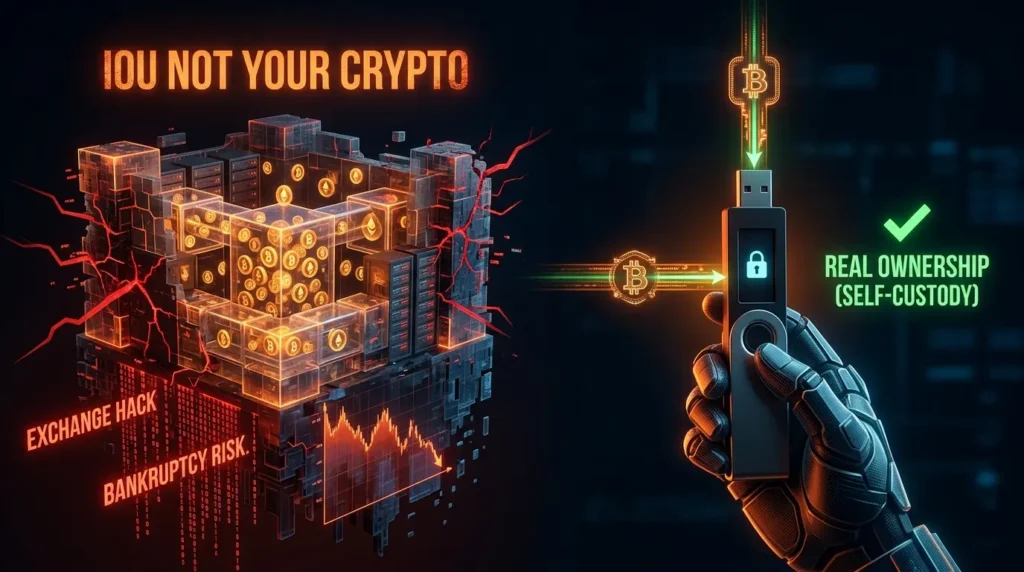
When you buy Bitcoin on Coinbase or ETH on Kraken and leave it there, you don’t actually hold crypto. You hold an IOU — an entry in the exchange’s internal database saying they owe you that amount.
The exchange holds the actual private keys. They control the actual wallets. Your account balance is a claim against them, not ownership of crypto on the blockchain.
This is called custodial storage — the exchange is the custodian of your assets.
This distinction matters enormously, because it means:
- Your access to your crypto depends entirely on the exchange’s continued operation
- If the exchange is hacked, frozen by regulators, or goes bankrupt — your access goes with it
- You have no cryptographic proof of ownership — only a legal claim
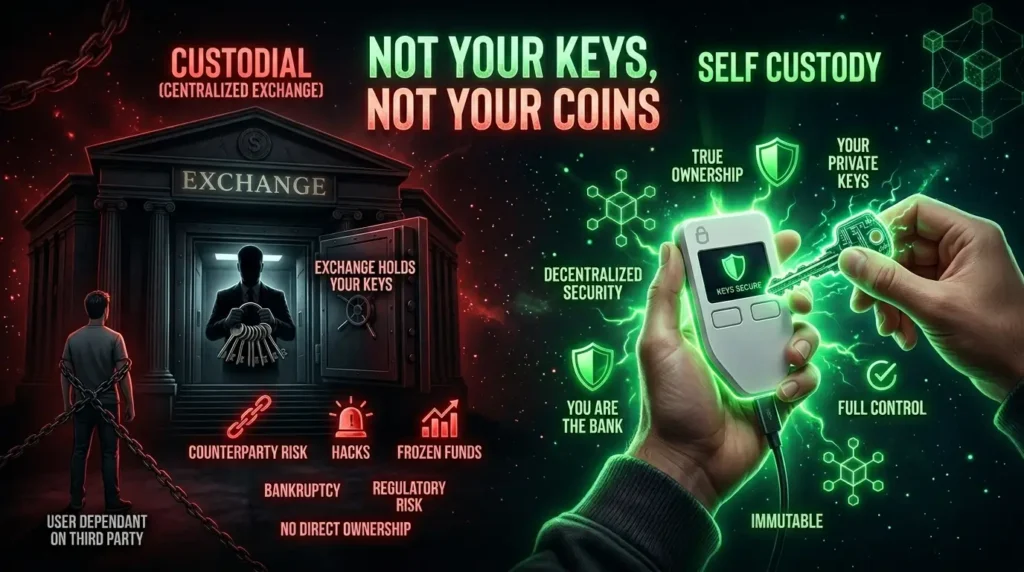
The crypto community’s blunt summary: “Not your keys, not your coins.”
The Real Risks of Exchange Storage

Risk #1: Hacks
Centralized exchanges are honeypots — they hold enormous concentrations of user funds in internet-connected wallets, making them high-value targets for sophisticated attackers.
The track record:
- 2014 — Mt. Gox: 850,000 BTC lost. Users waited over 10 years for partial repayment. Many received less than the dollar value of what they deposited.
- 2016 — Bitfinex: $72 million in Bitcoin stolen.
- 2022 — FTX: Not a hack, but collapse — $8 billion in user funds misappropriated.
- February 2025 — Bybit: $1.5 billion stolen in a single attack — the largest crypto theft in history, attributed to North Korea’s Lazarus Group.
- 2025 total: Over $2.7 billion stolen from crypto platforms according to multiple security firms.
The Bybit hack is particularly instructive. Bybit was a well-funded, professional, security-conscious exchange. They were not negligent. Lazarus Group — a state-sponsored operation with essentially unlimited resources — found a way through. If Bybit can lose $1.5 billion to a single attack, no exchange is immune.
Risk #2: Exchange Collapse / Bankruptcy
Hacks get attention. Exchange insolvency — where funds are simply gone due to mismanagement, fraud, or market conditions — has historically cost users far more.
FTX (November 2022) is the defining example. In one week, the second-largest crypto exchange globally went from apparently thriving to completely insolvent. Sam Bankman-Fried and associates had been secretly using customer deposits to fund trading bets at Alameda Research — a textbook misappropriation of funds.
The aftermath: billions in customer funds were frozen, inaccessible for years. Many users lost everything. FTX customers became creditors in a bankruptcy case — receiving pennies on the dollar, years later.
The legal reality: When you deposit crypto on an exchange, you generally become an unsecured creditor if they go bankrupt. You don’t own crypto — you have a claim. Unsecured creditors are last in line.
This is not hypothetical. Mt. Gox users waited over a decade for partial recovery. FTX users are still working through bankruptcy proceedings.
Risk #3: Regulatory Action and Account Freezes
Exchanges operate within regulatory environments that can change rapidly. Governments can:
- Freeze exchange accounts pending investigation
- Require KYC/AML compliance that suddenly excludes certain users
- Prohibit withdrawals while audits or legal proceedings occur
- Force exchange shutdowns in specific jurisdictions
In 2023, Binance.US significantly restricted operations under regulatory pressure. In multiple countries, exchanges have been shut down without warning, leaving users unable to access funds for extended periods.
If you’re in a jurisdiction that takes aggressive action against crypto — or if the exchange is targeted — your access to your own funds is not guaranteed.
Risk #4: You Don’t Own the Crypto
Beyond the practical risks, there’s a fundamental philosophical point that matters to serious crypto users:
Cryptocurrency was designed specifically to enable ownership without trusted intermediaries. The entire point of Bitcoin — according to its whitepaper — is that you don’t need to trust a third party.
When you leave crypto on an exchange, you’ve recreated exactly the trusted-intermediary relationship that crypto was designed to eliminate. You trust them to be honest, solvent, and accessible. That trust has been broken, repeatedly, throughout crypto’s history.
When Is It Acceptable to Leave Crypto on an Exchange?
Despite these risks, there are legitimate reasons to keep some crypto on exchanges:
Active trading: If you’re regularly trading — using limit orders, responding to market movements — moving funds on and off exchange constantly is impractical. Keeping trading capital on exchange makes operational sense.
Small amounts relative to your holdings: Many experienced crypto holders keep a small percentage (10–20%) on reputable exchanges for active use, while the majority sits in cold storage.
Short-term purchases: If you just bought crypto and plan to dollar-cost average or hold short-term, staying on a major exchange while you set up self-custody is a reasonable temporary arrangement.
Simplicity for beginners: For someone just getting started with crypto, a reputable regulated exchange is often more beginner-friendly than immediate self-custody. The learning curve for hardware wallets is real.
How to Evaluate Exchange Safety
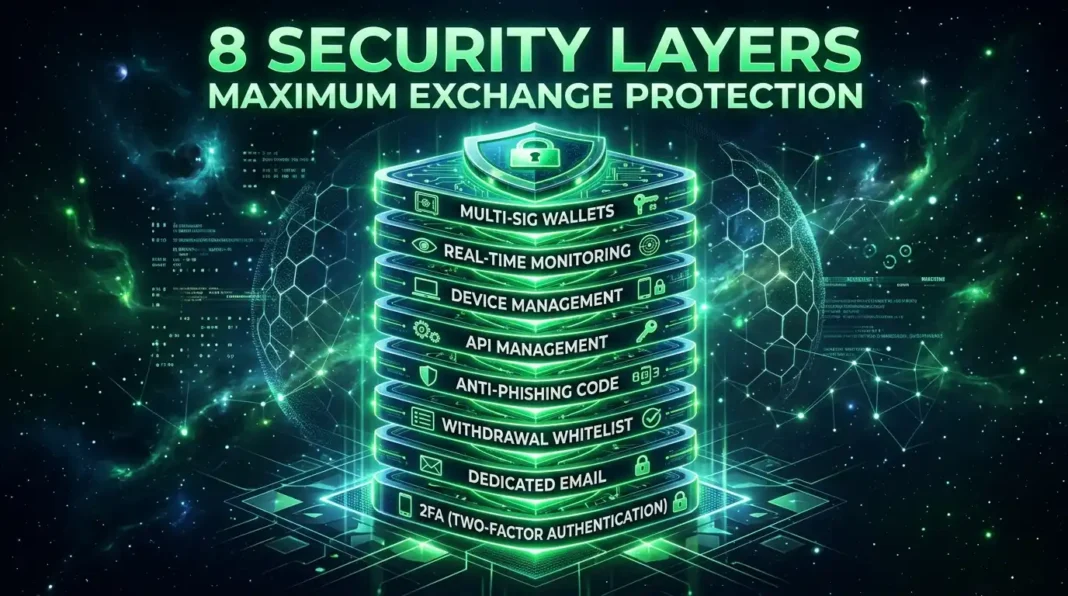
Not all exchanges carry equal risk. If you must keep crypto on an exchange, these factors matter:
Regulatory compliance: Exchanges regulated by the SEC, CFTC, or equivalent authorities in major jurisdictions (FinCEN registration, EU licensing) face stricter oversight and have more accountability.
Proof of Reserves: After FTX, reputable exchanges publish cryptographic proof that their on-chain holdings match customer balances. Coinbase, Kraken, and Binance all publish this. Skepticism is warranted even with proof — it only shows assets, not liabilities.
Track record: How long has the exchange operated? Have they been hacked? How did they respond?
Insurance and security: Does the exchange maintain FDIC insurance on USD deposits? Do they carry crime insurance on crypto holdings? Coinbase insures USD deposits up to $250,000. Crypto holdings are generally not federally insured regardless of which exchange you use.
Withdrawal history: Has the exchange ever restricted or frozen withdrawals? During the 2022 bear market, multiple exchanges including Celsius, Voyager, and others froze withdrawals and never resumed them.
The Practical Framework: How Much to Keep Where
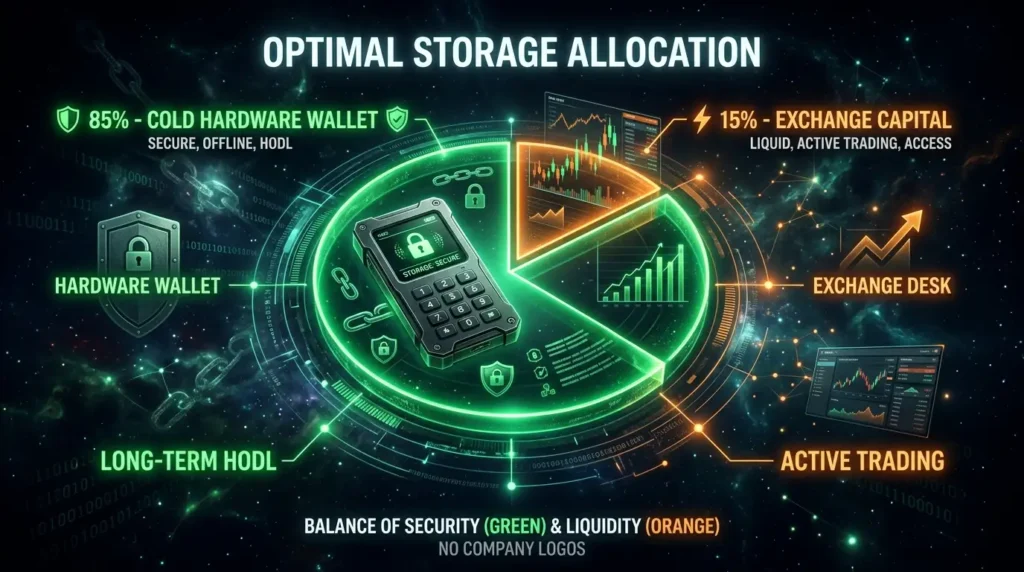
This is how most experienced crypto holders structure their storage in 2026:
On exchange (10–20% max):
- Active trading capital
- Funds you’ll need to access quickly
- Small amounts for DeFi interactions via exchange on-ramps
Hardware wallet (80–90%):
- Long-term holdings
- Anything you’re not actively trading
- The amount you can’t afford to lose access to
The calculation is simple: the cost of a hardware wallet ($59–$179) versus the risk of losing access to your entire holdings due to exchange failure, hack, or regulatory action. For anyone holding more than a few hundred dollars long-term, the hardware wallet is obvious insurance.
The Steps to Move from Exchange to Self-Custody
If you’ve been keeping significant crypto on an exchange and want to move to self-custody:
- Get a hardware wallet — Ledger or Trezor, purchased directly from the manufacturer’s official website.
- Set it up carefully — Follow the setup guide completely. Generate your seed phrase, write it down by hand, store it physically offline. Test that you’ve recorded it correctly.
- Start with a test transaction — Before moving everything, send a small amount to your hardware wallet address. Verify it arrives. Then send it back. This confirms you’ve set everything up correctly.
- Move your holdings — Transfer from the exchange to your hardware wallet address. Verify the transaction on a blockchain explorer.
- Only keep trading amounts on the exchange — Going forward, withdraw after each trade or purchase rather than letting balances accumulate.
Key Terminology
Custodial Storage: Keeping crypto on an exchange where they hold the private keys — you have an account balance, not crypto ownership.
Self-Custody: Holding your own private keys through a hardware wallet or software wallet — you own the actual crypto on the blockchain.
Not Your Keys, Not Your Coins: The crypto community’s statement that custodial exchange balances are not true crypto ownership.
Proof of Reserves: Cryptographic attestation by an exchange showing their on-chain holdings match or exceed customer balances.
Unsecured Creditor: The legal status of exchange users in a bankruptcy — last in line to recover funds, after secured creditors.
Cold Storage: Keeping private keys offline on a hardware device — the highest security tier for personal crypto storage.
The Bottom Line
Is it safe to leave crypto on an exchange?
For small amounts and short-term use — yes, on reputable exchanges.
For significant long-term holdings — no, the risks are real and documented.
The evidence is overwhelming: exchange hacks happen, exchanges collapse, regulatory freezes occur. The crypto industry has lost billions of dollars in customer funds through exchange failures since 2011.
The alternative — a hardware wallet where you hold the keys — eliminates exchange risk entirely. Your crypto is on the blockchain, proven by cryptography, accessible only by you.
“The only reason to leave tokens on an exchange is laziness, or lack of understanding.” — Castle Funds, on exchange risk.
Not your keys, not your coins. 🔑
Disclaimer: This article is for informational purposes only and does not constitute financial advice. Cryptocurrency investments carry significant risk, including the potential loss of all invested capital. Always conduct your own research before making any investment decisions.