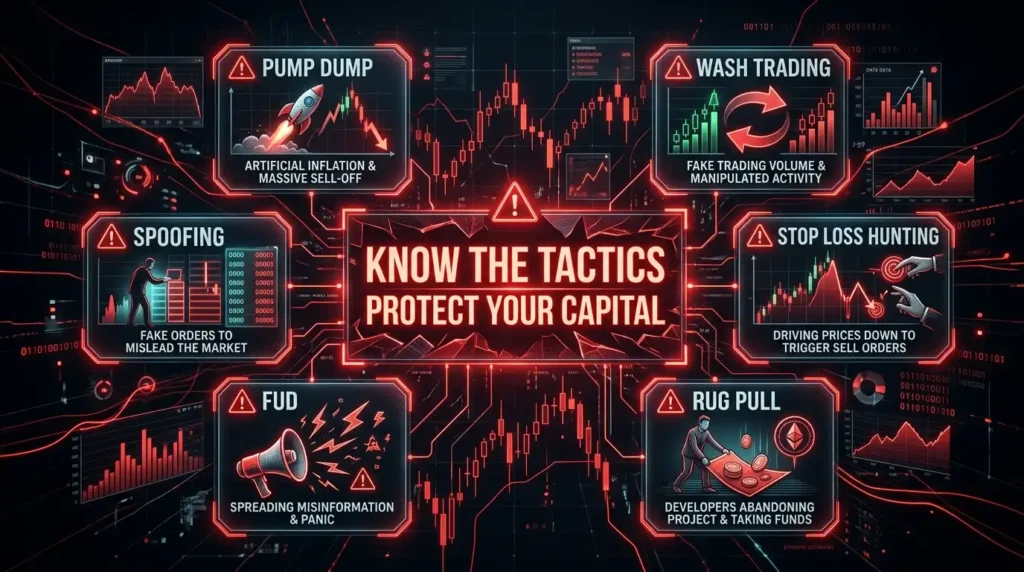
Crypto markets are less regulated than traditional financial markets. This creates opportunities — but it also creates an environment where certain manipulative practices occur more openly and frequently than in stocks or commodities.
Understanding these tactics won’t make you immune to them. But recognizing the patterns can help you avoid being the person on the losing side of an engineered price move.
This guide covers the most common forms of crypto market manipulation — how each works, who benefits, who loses, and what to watch for.
Why Crypto Is Particularly Vulnerable to Manipulation
Several characteristics make crypto markets more susceptible than traditional markets:
Low liquidity on smaller assets: A relatively small amount of capital can move the price of a low-cap token dramatically. Manipulating Bitcoin’s price would require billions. Manipulating a small altcoin might require only thousands.
Concentrated ownership: Many tokens have a significant percentage of their supply held by a small number of wallets. These large holders — “whales” — can move markets with single transactions.
Pseudonymous markets: Manipulators can operate through multiple wallets without easy attribution.
Retail FOMO: Crypto markets have a large population of inexperienced investors susceptible to coordinated hype and fear campaigns.
24/7 markets with no circuit breakers: Unlike stock markets which halt trading during extreme moves, crypto exchanges generally have no automatic pause mechanisms.
Limited regulatory enforcement: While regulation is increasing globally, enforcement of anti-manipulation rules in crypto remains less consistent than in traditional markets.
Manipulation Tactic 1: Pump and Dump
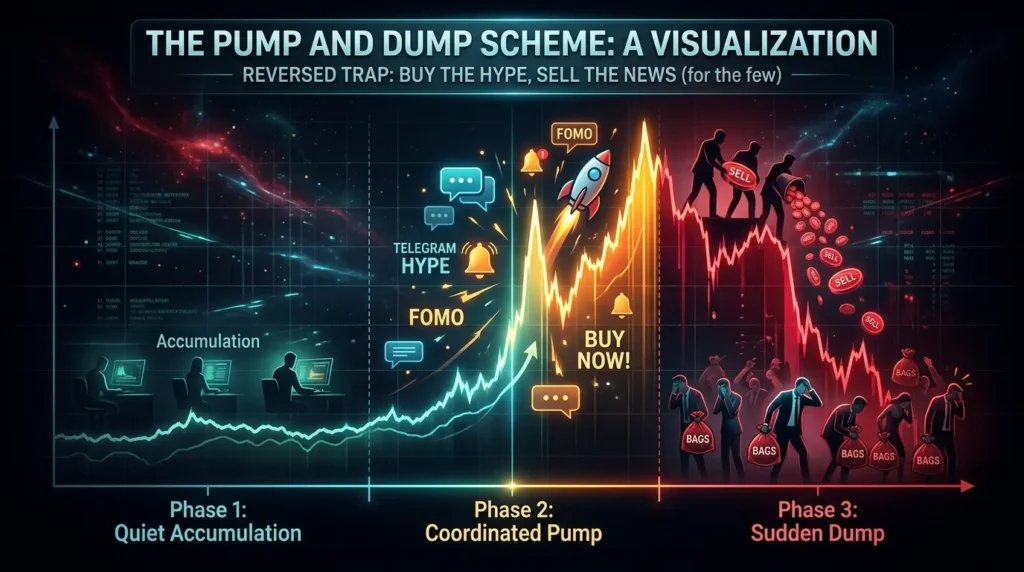
The oldest market manipulation scheme — and the most common in crypto.
How It Works
Phase 1 — Accumulation (quiet):
The orchestrators identify a low-liquidity, low-market-cap token. They quietly accumulate a large position at low prices, without creating significant price movement. This requires patience and multiple wallets to avoid detection.
Phase 2 — The Pump (coordinated hype):
The scheme is activated. Coordinated promotional campaigns launch simultaneously across:
- Telegram and Discord groups (often with thousands of paid members)
- Twitter/X accounts (including paid influencers and bot networks)
- YouTube and other video platforms
- Crypto forums and Reddit
The messaging focuses on:
- “Insider information” about an upcoming partnership, listing, or technological breakthrough
- Claims of massive price targets (“100x potential”)
- Urgency: “Buy NOW before it’s too late”
- FOMO-inducing price charts showing recent gains
As retail investors pile in, price rises dramatically — sometimes 200–500% in hours. This further attracts attention, drawing in more buyers.
Phase 3 — The Dump:
At or near the peak, the orchestrators sell their accumulated position into the buying pressure they created. Price collapses rapidly — often back to or below pre-pump levels within hours. Those who bought during the pump are left holding tokens that have lost most of their value.
Who Gets Hurt
Retail investors who:
- Saw the price movement and bought in during the pump
- Received “tips” through Telegram groups or social media
- Experienced FOMO and bought without research
Red Flags of a Pump and Dump
- Sudden massive price increase (200%+) in hours with no legitimate news catalyst
- Token is unknown with very low market cap and thin trading history
- Social media suddenly flooded with the token’s name from accounts with little history
- Telegram or Discord groups with thousands of members promoting it aggressively
- Claims of “insider information” or guaranteed returns
- Concentrated token ownership — a few wallets hold most of the supply
Manipulation Tactic 2: Wash Trading
How It Works
Wash trading occurs when a trader (or coordinated group) repeatedly buys and sells the same asset between accounts they control, generating artificial trading volume.
The trader isn’t making a profit on these trades — the goal is to create the illusion of market activity and liquidity.
Why manipulators do this:
- Higher volume rankings on CoinMarketCap, CoinGecko and other aggregators
- Appears to attract genuine traders who interpret volume as real interest
- Gives the appearance of legitimacy to an otherwise dead project
- Some smaller exchanges have been accused of tolerating or participating in wash trading to improve their own volume rankings
How to spot wash trading:
- Volume is extremely high relative to market cap (e.g., 24-hour volume exceeding 50–100% of market cap regularly)
- Volume spikes occur without corresponding price movement
- A small number of wallets account for most of the trading activity
- On-chain analysis shows the same tokens moving between closely related wallets
Manipulation Tactic 3: Spoofing (Fake Order Walls)
How It Works
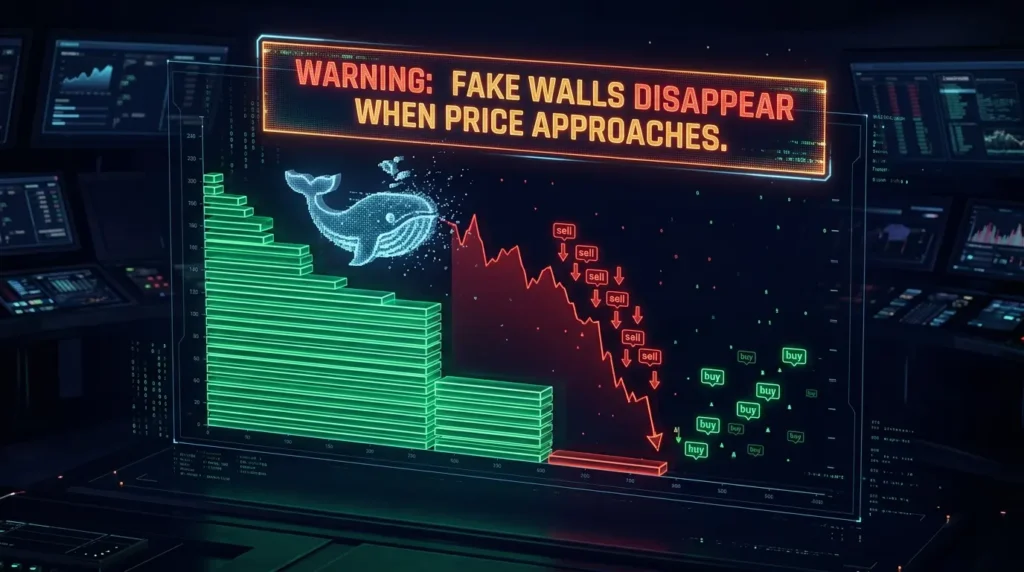
Spoofing involves placing large buy or sell orders in the order book with no intention of executing them. The goal is to create a false impression of supply or demand.
Buy wall spoof:
A whale places a massive buy order just below the current price. This creates the appearance of strong support — “look at all these buyers.” Other traders see this and feel confident buying, expecting the price to hold. The moment enough retail buyers have purchased, the spoofer cancels the fake order and sells into the buying pressure.
Sell wall spoof:
A large sell order placed just above current price creates the illusion of heavy resistance — discouraging buyers and making sellers nervous. Traders sell, price drops, the spoofer cancels the sell order and buys the dip they engineered.
Layering: An advanced version of spoofing where multiple fake orders are placed at different price levels simultaneously, creating an even more convincing false picture of market depth.
What to watch for:
- Large orders that appear and disappear within seconds or milliseconds
- Massive walls that vanish just as price approaches them
- Repeated patterns of the same behavior at specific price levels
Manipulation Tactic 4: Stop-Loss Hunting
How It Works
Experienced traders and whales know that retail traders commonly place stop-losses at predictable levels — just below round numbers, just below recent support, just below moving averages.
A whale with sufficient capital can temporarily push the price down to these levels, triggering cascades of automated stop-loss sells from retail traders. The wave of stop-loss sell orders drops the price further, which the whale then buys at the temporarily depressed price — before the market recovers.
Why it works:
Stop-losses are designed to protect traders but create predictable selling pressure at known levels. In thin markets (low liquidity periods, typically weekends or late nights), even moderate capital can push price to trigger clusters of stops.
How to defend against it:
- Avoid placing stops at obvious round numbers or widely-watched technical levels
- Use slightly non-obvious stop-loss placement — slightly below the obvious level (where the engineered dip may not reach)
- Consider time-based stops (exit if thesis doesn’t play out within X time) rather than price-only stops
- Trade more liquid assets during peak hours
Manipulation Tactic 5: FUD and FOMO Campaigns
Price manipulation doesn’t require touching the order book — it can be done entirely through information.
FUD (Fear, Uncertainty, Doubt)
Coordinated campaigns spreading negative information — true, false, or exaggerated — to drive price down.
Why manipulators use FUD:
- A whale with a large short position benefits from price declining
- Competitors spread negative narratives about rival projects
- Accumulating entities spread fear to suppress price while they buy cheaply
FUD examples:
- False news about exchange hacks or project team exits
- Exaggerated or fabricated regulatory threats
- “Insider leaks” about damaging news that never materializes
- Anonymous social media accounts with no track record posting alarming “revelations”
FOMO Campaigns
The inverse — coordinated positive hype to drive price up artificially (often the “pump” phase of a pump and dump).
FOMO signals:
- Multiple influencers posting about the same token simultaneously
- Viral “discovery” of an obscure token by supposedly independent accounts
- Coordinated narrative about a major partnership or catalyst that turns out to be misrepresented or false
Manipulation Tactic 6: Rug Pulls (DeFi Specific)
Particularly common in DeFi, a rug pull occurs when the developers of a project abandon it after collecting investors’ funds.
Soft rug: Developers gradually sell their token allocations, slowly dumping on investors over weeks or months.
Hard rug: Developers drain the liquidity pool suddenly — taking all investor funds in a single transaction — and disappear.
How to identify rug pull risks:
- Anonymous or unverified team with no track record
- No third-party audit of the smart contract
- Locked vs. unlocked liquidity — liquidity that can be removed by the team at any time is a major red flag
- Concentrated token supply in team wallets
- No real use case or product — pure hype
- Very short trading history (days or weeks)
How to Protect Yourself from Manipulation
General Principles
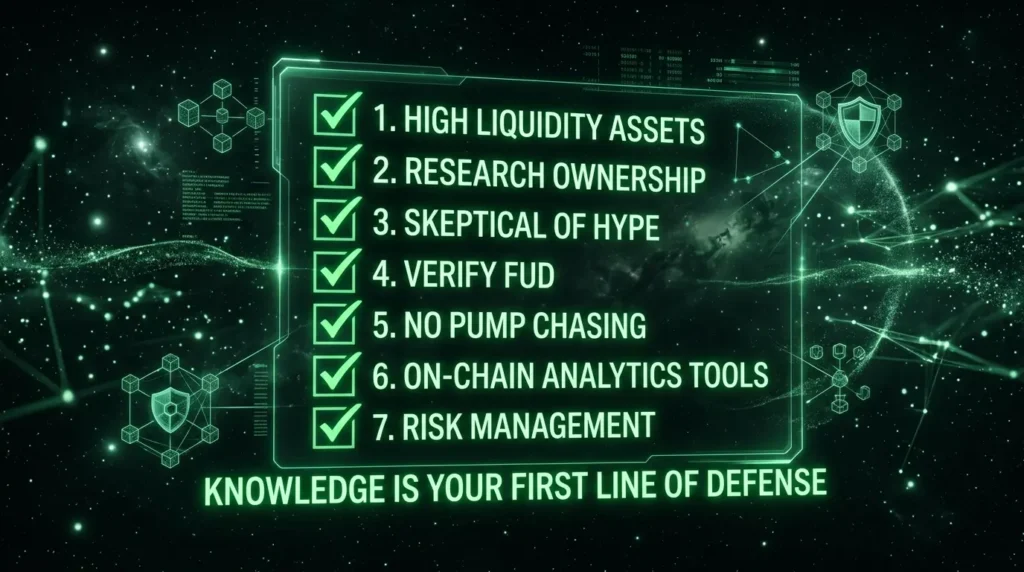
Stick to high-market-cap assets for serious capital:
Bitcoin, Ethereum, and other large-cap assets are significantly harder to manipulate due to the capital required to move them meaningfully. The deeper the liquidity, the harder the manipulation.
Research before buying:
Before purchasing any token:
- How long has it been trading? (Days/weeks = higher manipulation risk)
- Who controls the supply? (Check Etherscan, Solscan, BscScan for wallet distribution)
- Is there a real product or use case?
- Has the smart contract been audited by a reputable firm?
Be skeptical of coordinated hype:
If a token is suddenly everywhere in Telegram, Twitter, and YouTube simultaneously — ask why. Organic interest develops gradually. Coordinated campaigns activate all at once.
Verify before reacting to FUD:
Before panic-selling on negative news, check multiple independent sources. Anonymous social media accounts with dramatic “insider revelations” have an obvious motivation to manipulate.
Don’t chase pumps:
If a token has already moved 200% in an hour — the pump has likely already happened. Buying into an existing pump is buying at or near the point where orchestrators are selling.
Use on-chain analytics:
Tools like Nansen, Arkham Intelligence, and Whale Alert track large wallet movements and can provide early warning of unusual activity. Etherscan, Solscan, and BscScan let you check token distribution and wallet activity.
For Traders Specifically
Use limit orders, not market orders:
Market orders during a manipulated pump execute at whatever price exists — often near the top. Limit orders force execution at your specified price or better.
Understand the order book:
Learn to recognize suspicious patterns — large walls that disappear, rapid order placement and cancellation.
Respect your risk management:
Even if you believe manipulation is happening, trade with defined risk. You can be right about the scheme but wrong about the timing.
The Regulatory Landscape
Crypto market manipulation is illegal in most jurisdictions — but enforcement varies.
What’s prohibited: Wash trading, spoofing, and coordinated manipulation schemes are illegal under financial law in the US, EU, UK, and many other jurisdictions.
What’s improving: With MiCA implementation in the EU, expanded SEC and CFTC enforcement in the US, and global coordination through IOSCO, the regulatory framework around crypto manipulation is tightening.
What remains challenging: Cross-border enforcement is complex. Anonymous wallets make attribution difficult. DeFi manipulation in particular operates in grey areas.
The practical effect for retail investors: manipulation occurs and consequences for orchestrators are inconsistent. Your best protection is your own awareness, not regulation.
Key Terminology
Pump and Dump: Coordinated scheme to artificially inflate an asset’s price through hype, then sell into the buying pressure.
Wash Trading: Buying and selling an asset between self-controlled accounts to create false volume.
Spoofing: Placing large orders with no intention of executing them to manipulate other traders’ perceptions.
Stop-Loss Hunting: Deliberately moving price to trigger retail traders’ stop-loss orders, creating buying opportunities for the manipulator.
FUD: Fear, Uncertainty, Doubt — spreading negative information to drive price down.
Whale: A holder of cryptocurrency in sufficient quantity to influence market prices with individual transactions.
Rug Pull: DeFi scheme where project developers remove liquidity or sell holdings, leaving investors with worthless tokens.
Liquidity: The ease with which an asset can be bought or sold without significantly affecting its price. Low liquidity = easier to manipulate.
The Bottom Line
Market manipulation is a reality in crypto — particularly in low-liquidity, small-cap tokens. The tactics outlined in this guide are not theoretical; they occur regularly and cause real financial harm.
The practical protections:
- Stick to high-liquidity, established assets for significant capital
- Research token ownership distribution before buying
- Be deeply skeptical of coordinated hype — especially in Telegram groups
- Never buy something solely because of sudden price action
- Verify FUD through multiple independent sources before reacting
- Use risk management — no single trade should be able to seriously damage your portfolio
The crypto market is not uniquely evil — traditional markets have manipulation too. But the combination of lower liquidity, lighter regulation, and retail FOMO makes it a more fertile environment for the schemes described here.
Knowledge is your first line of defense. 🛡️
Disclaimer: This article is for informational and educational purposes only and does not constitute financial or legal advice. Cryptocurrency investments carry significant risk. Always conduct your own research before making investment decisions.