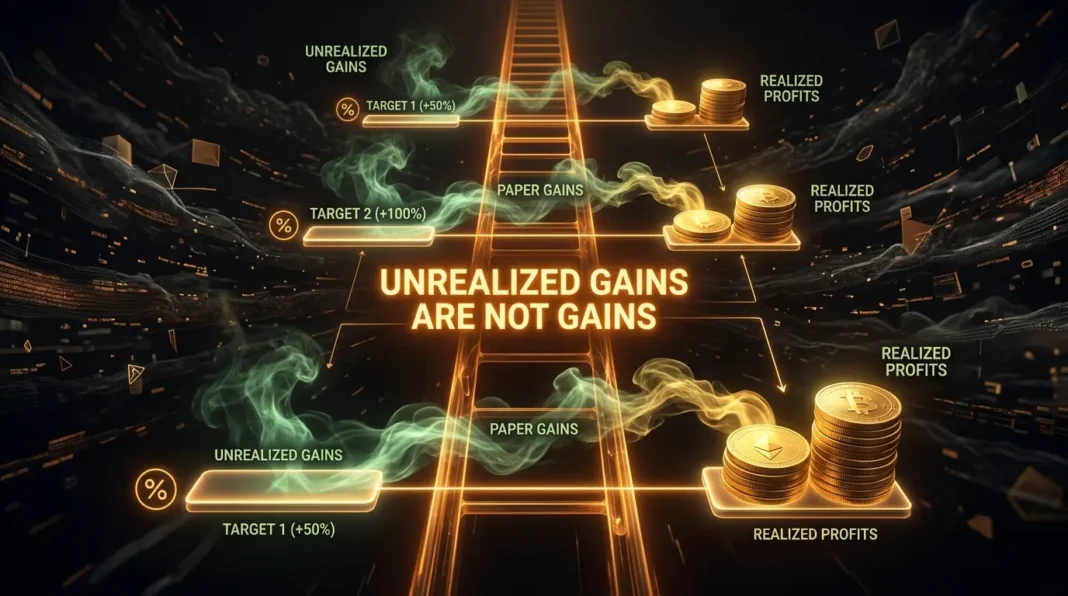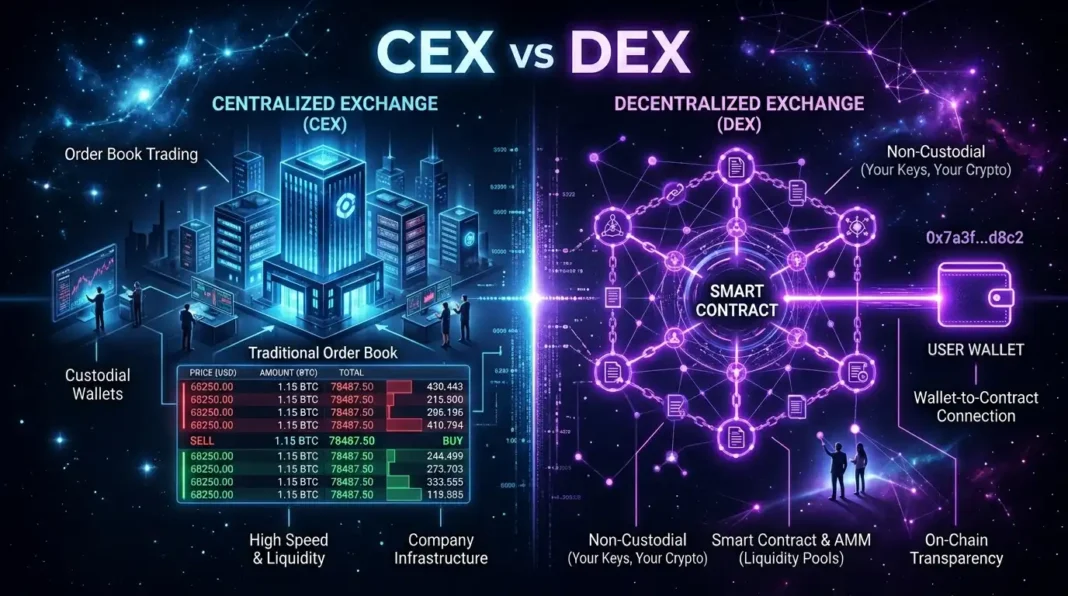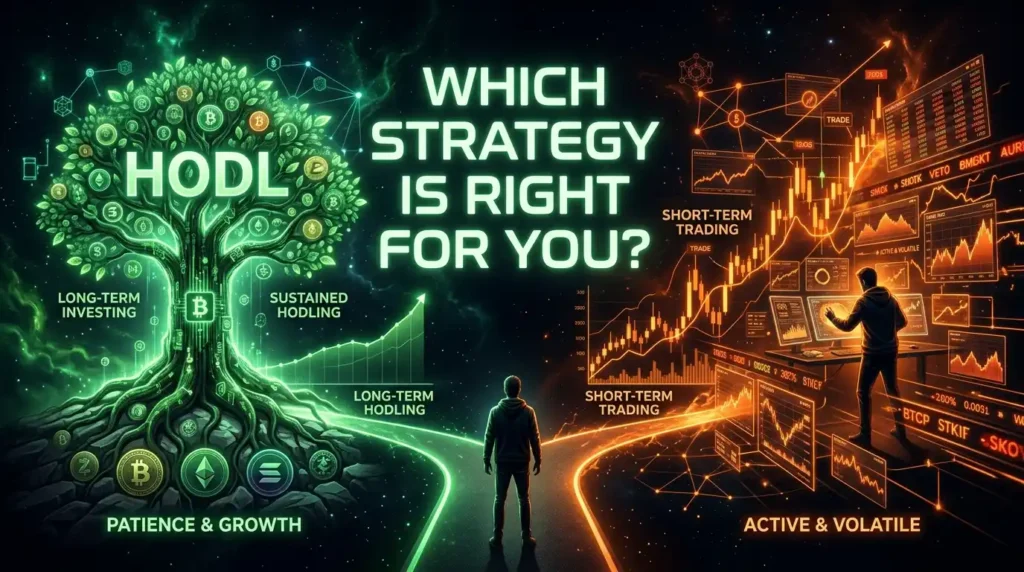
Every crypto investor faces the same fundamental question: do you buy and hold for years, or actively trade to capture shorter-term price movements?
The answer isn’t universal. It depends on your goals, available time, risk tolerance, emotional discipline, and — critically — your honest assessment of your own skills. Neither strategy is objectively better. They’re designed for different people with different objectives.
This guide breaks down both approaches clearly, including the tax implications most investors don’t think about until it’s too late.
The Two Fundamental Approaches
Long-Term Investing (HODL)
HODL originated from a famously misspelled “hold” in a 2013 Bitcoin forum post, later adopted as an acronym for “Hold On for Dear Life.” The strategy is simple: buy cryptocurrencies you believe in and hold them for years, regardless of short-term price movements.
The core belief behind HODLing: blockchain technology and digital assets have long-term adoption potential, and short-term volatility is noise compared to multi-year trends.
Time horizon: 1 year minimum, typically 3–10+ years
Activity level: Very low — review occasionally, don’t react to daily price swings
Primary assets: Bitcoin, Ethereum, established large-cap cryptocurrencies
Short-Term Trading
Short-term trading involves actively buying and selling crypto to capture price movements over days, weeks, or even minutes. It comes in several forms:
Swing Trading: Holding positions from a few days to several weeks, trying to capture “swings” in price within a larger trend. Uses technical analysis — chart patterns, indicators, support/resistance levels.
Day Trading: Opening and closing positions within a single day. Requires significant time commitment and technical skill. Crypto markets run 24/7 — there’s no closing bell.
Scalping: Very short-term trades lasting minutes to hours, capturing small price movements repeatedly. Extremely demanding and typically suited only to experienced traders with fast execution.
Long-Term Investing: The Case For It
Historical Performance
Bitcoin’s long-term track record is well documented. Despite severe bear markets (80%+ drawdowns in 2018 and 2022), long-term holders who maintained positions through full market cycles accumulated substantial gains. A $100/month Bitcoin DCA from 2014 through 2026 returned over +6,700% on invested capital — numbers that would be extraordinarily difficult to match through active trading over the same period.
Simplicity
Long-term investing requires no technical analysis skills, no chart reading, no understanding of order books or indicators. Buy quality assets, store them securely, check in periodically.
Lower Costs
Every trade has a cost — exchange fees, spreads, potential slippage. Long-term investors execute far fewer transactions, dramatically reducing cumulative costs.
Tax Advantage
In the US, assets held longer than one year qualify for long-term capital gains tax rates (0%, 15%, or 20% depending on income) — significantly lower than short-term rates which are taxed as ordinary income (up to 37%). This difference alone can materially impact net returns.
Emotional Simplicity
You don’t need to monitor markets daily. You’re not reacting to headlines or price alerts. This suits investors who have other priorities — jobs, families, businesses.
The Main Risk
Wrong asset selection. If you HODL a cryptocurrency that fails, declines into irrelevance, or gets overtaken by competitors — you’ve held through losses without the opportunity to exit. Research before committing is critical. Bitcoin and Ethereum have 10+ year track records. Most altcoins don’t.
Short-Term Trading: The Case For It
Potential to Profit in Any Market Direction
Long-term investors can only profit when prices go up. Traders can potentially profit in bear markets through short positions (on exchanges that support derivatives) or by rotating between assets during downturns.
Compounding Smaller Gains
Rather than waiting years for a large move, active traders aim to compound many smaller gains. A 5% gain made 20 times could theoretically produce more than one 100% gain — though in practice this is extremely difficult to execute consistently.
Capitalizing on Volatility
Crypto is one of the most volatile asset classes in existence. Bitcoin can move 10–15% in a single week. Altcoins can move 30–50% in days. Active traders see this volatility as opportunity rather than risk to endure.
The Hard Truth About Short-Term Trading
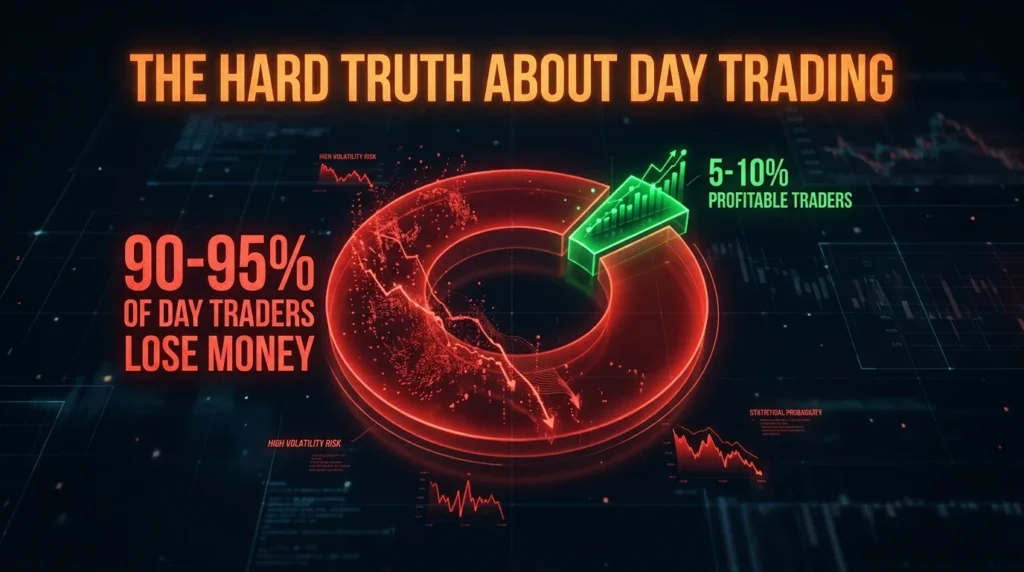
Studies consistently show that approximately 90–95% of active day traders lose money over time. This isn’t a warning to discourage anyone — it’s a data point to take seriously.
Short-term trading requires:
- Deep technical analysis knowledge
- Strict risk management discipline (position sizing, stop losses)
- Emotional control under pressure — the ability to take a loss without revenge trading
- Significant time commitment
- Realistic capital — small accounts face significant headwinds from fees
Most people who “try trading” do so without these foundations, lose money, and conclude the market is rigged. The market isn’t rigged — but consistent profitability requires more skill development than most beginners expect.
Side-by-Side Comparison
| Factor | Long-Term (HODL) | Short-Term (Trading) |
|---|---|---|
| Time commitment | Low | High |
| Skills required | Research, patience | Technical analysis, discipline |
| Typical time horizon | 1–10+ years | Minutes to weeks |
| Tax rate (US) | Long-term CGT (0–20%) | Short-term CGT (ordinary income, up to 37%) |
| Transaction costs | Very low | Cumulative and significant |
| Stress level | Low | High |
| Profit in bear markets | Difficult | Possible |
| Historical success rate | High for Bitcoin/ETH long-term | ~5–10% of traders profitable long-term |
| Best assets | BTC, ETH, established large-caps | Any with sufficient liquidity and volatility |
The Tax Dimension: More Important Than Most Realize
This is where many investors make costly mistakes.
In the US (and most jurisdictions):
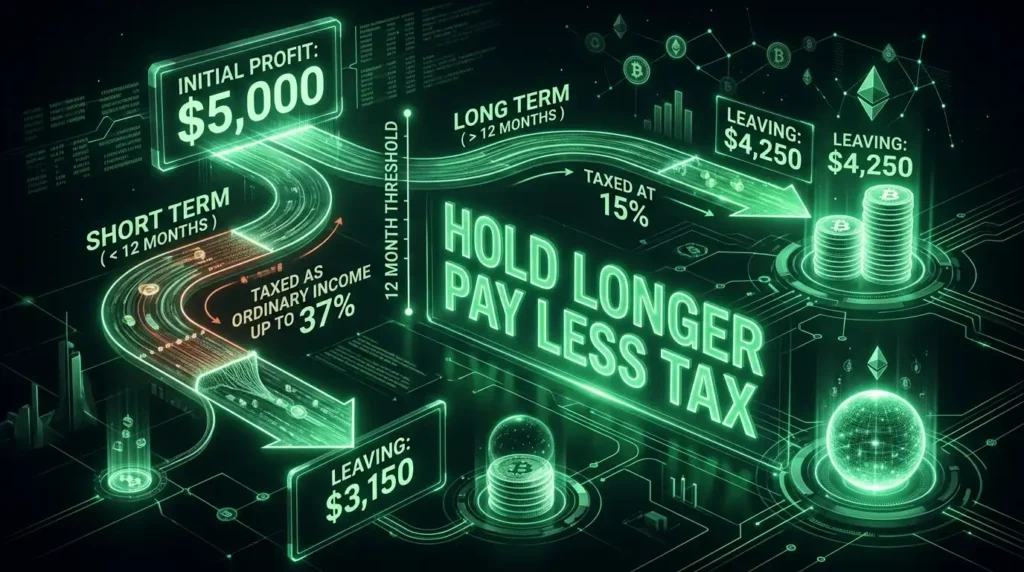
Short-term: Any crypto sold within 12 months of purchase is taxed as ordinary income — the same rate as your salary. If you’re in the 32% or 37% tax bracket, this applies to every profitable trade.
Long-term: Crypto held for more than 12 months before selling is taxed at preferential long-term capital gains rates — 0% (up to ~$47,000 income), 15% (up to ~$518,000), or 20% above that (2026 approximate thresholds).
Every trade is a taxable event. Selling Bitcoin to buy Ethereum is two taxable events — a sale of BTC and a purchase of ETH. Day traders can generate hundreds of taxable events in a year, creating complex reporting obligations.
Practical example:
You turn $10,000 into $15,000 trading crypto in one year. Your $5,000 profit, taxed as ordinary income at 32%, leaves you $3,400. If the same $5,000 gain came from holding for 13 months, taxed at 15% long-term rate, you’d keep $4,250. Same gain, $850 difference — just from holding longer.
Multiply this across multiple trades and years, and the tax difference becomes substantial.
The Hybrid Approach: What Many Experienced Investors Do

Most experienced crypto investors don’t choose one approach exclusively. A common framework:
Core portfolio (70–80%): Long-term holdings in Bitcoin and Ethereum. Not touched regardless of short-term price action. Stored in cold storage.
Satellite portfolio (20–30%): More active allocation for opportunities — swing trading selected altcoins, participating in new project launches, taking profits on rallies and redeploying during corrections.
This approach provides long-term compounding as a foundation while allowing participation in shorter-term opportunities without risking core holdings.
How to Choose: 5 Questions to Ask Yourself
1. How much time can you honestly dedicate?
Active trading requires daily attention. If you have a full-time job, family commitments, or other priorities, long-term investing is more realistic.
2. What is your risk tolerance?
Can you watch your portfolio drop 40% without panic-selling? Long-term investing requires this emotional fortitude. Short-term trading requires different emotional control — taking losses quickly, not over-trading.
3. Do you have trading skills?
Technical analysis, chart reading, risk management — these are learnable skills, but they take time. Starting to actively trade without them is how most people lose money.
4. What are your financial goals?
Building long-term wealth → Long-term investing
Generating active income from markets → Short-term trading (requires significant skill)
5. What are your tax implications?
If you’re in a high tax bracket, the difference between long-term and short-term capital gains rates may significantly influence your strategy.
Key Terminology
HODL: Buy and hold strategy — holding crypto for years regardless of short-term volatility. Originally a 2013 forum typo.
Swing Trading: Holding positions for days to weeks, capturing price swings within trends.
Day Trading: Opening and closing all positions within a single trading day.
Scalping: Very short-term trades lasting minutes to hours, targeting small price movements.
Long-Term Capital Gains: Tax rate applied to assets held more than 12 months — lower than ordinary income rates.
Short-Term Capital Gains: Tax rate applied to assets held less than 12 months — taxed as ordinary income.
Time Horizon: The intended length of time an investment is held before being sold or evaluated.
DYOR (Do Your Own Research): Research an asset thoroughly before investing — understanding the technology, use case, team, and market position.
The Bottom Line
Neither long-term investing nor short-term trading is “better” — they’re optimized for different goals and different people.
Choose long-term investing if:
- You believe in crypto’s multi-year potential
- You have limited time for active market monitoring
- You want lower tax rates and less complexity
- You don’t yet have deep technical trading skills
Choose short-term trading if:
- You’re committed to developing real trading skills
- You have time to monitor markets regularly
- You understand and accept the statistics (most traders lose money)
- You have a clear risk management framework
Start with long-term investing. Build your positions in Bitcoin and Ethereum. Learn how markets move. Develop your technical analysis skills gradually. If you find yourself drawn to more active participation after genuinely understanding the market — then explore trading with a small dedicated allocation you can afford to lose entirely.
The market will be there. Your capital is more easily replaced when lost slowly over time through poor trades than when you’ve committed everything at once. 📈
Disclaimer: This article is for informational purposes only and does not constitute financial or tax advice. Cryptocurrency investments carry significant risk, including the potential loss of all invested capital. Tax rules vary by jurisdiction. Always consult a qualified financial or tax professional for your specific situation. Always conduct your own research before making any investment decisions.