Every financial service you use today — saving, borrowing, trading, investing — runs through institutions: banks, brokers, exchanges, and payment processors. These institutions hold your money, approve your transactions, set the interest rates, and collect fees for doing so. You don’t really control your money. You trust someone else to control it on your behalf.
Decentralized Finance (DeFi) is a parallel financial system built on blockchain technology that removes these intermediaries entirely. Instead of trusting a bank to hold your savings, you interact directly with smart contracts — self-executing code that enforces the rules of a financial agreement automatically.
In 2026, DeFi manages over $150 billion in Total Value Locked (TVL) across hundreds of protocols. It has evolved from an experimental niche into a functioning financial ecosystem offering lending, borrowing, trading, yield generation, insurance, and derivatives — all without a bank account, credit check, or government ID.
This guide explains what DeFi is, how it works, the major categories and protocols, and how to start participating safely.
DeFi vs Traditional Finance: The Core Difference
To understand DeFi, it helps to understand what it replaces.
Traditional Finance (TradFi):
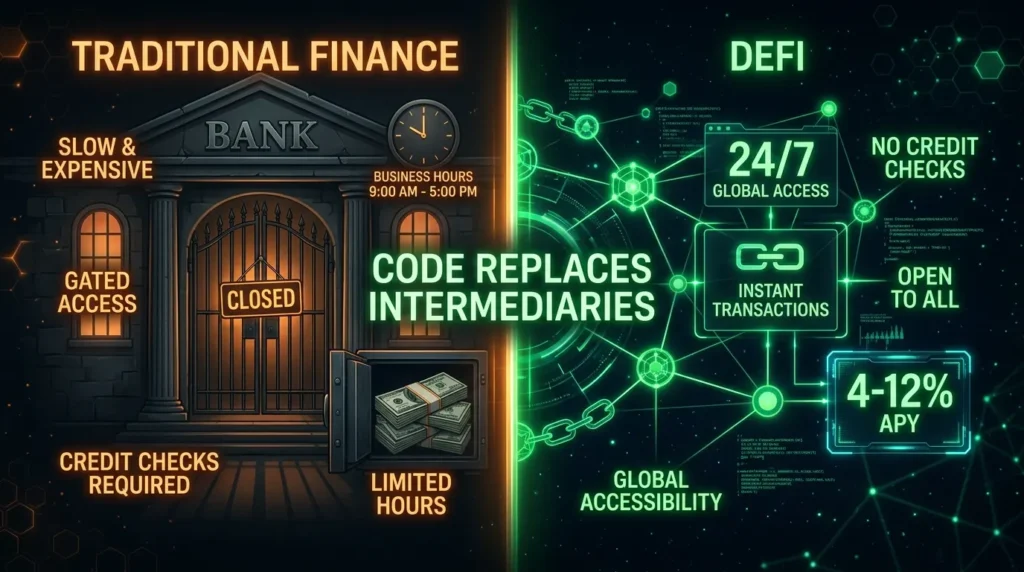
- You deposit money at a bank → bank lends it to others → you earn 0.5% APY
- You want to borrow → bank checks your credit score, income, identity
- You trade stocks → broker executes on your behalf, charges commissions
- You send money internationally → correspondent banks, 3–5 day settlement, $25+ fees
- Operating hours: weekdays, 9–5 in your timezone
Decentralized Finance (DeFi):
- You deposit crypto in a smart contract → contract lends it to borrowers → you earn 4–12% APY automatically
- You want to borrow → deposit collateral worth more than the loan, receive funds instantly — no credit check, no ID
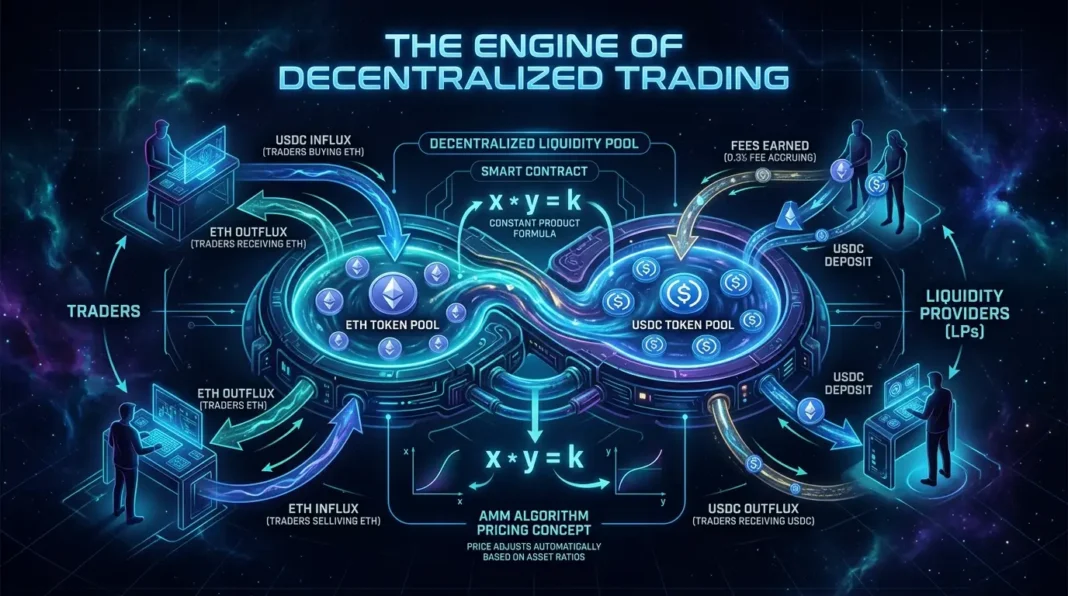
- You trade tokens → automated market maker (AMM) executes instantly from a liquidity pool
- You send value globally → blockchain confirmation in seconds to minutes, $0.01–$2 in fees
- Operating hours: 24/7/365, never closed
The key shift: rules enforced by code, not by people. Smart contracts execute automatically when conditions are met. No human can override them, delay them, or selectively apply them.
How DeFi Works: The Technology Stack
DeFi is built on several layers of technology working together:
Smart Contracts: The Foundation
A smart contract is self-executing code stored on a blockchain. It contains the rules of an agreement and automatically enforces them when triggered.
Simple example:
A lending smart contract might say: “If User A deposits 1 ETH as collateral, release 1,500 USDC to their address. If the collateral value falls below $1,875 (125% collateral ratio), liquidate 1 ETH to repay the loan automatically.”
No human intervention needed. The contract checks conditions constantly and executes accordingly.
Ethereum is the primary smart contract platform — most major DeFi protocols run on Ethereum or Ethereum-compatible networks (Arbitrum, Base, Optimism, Polygon). Solana hosts a growing DeFi ecosystem. The protocols are open-source — anyone can read the code, which means anyone can verify the rules.
Wallets: Your DeFi Interface
To use DeFi, you need a non-custodial wallet — a wallet where you control the private keys, not a company.
- MetaMask: The most widely used Ethereum/EVM-compatible wallet. Browser extension + mobile app.
- Rabby: Growing alternative with better transaction preview and security features.
- Phantom: The primary Solana wallet, also supports Ethereum.
- WalletConnect: Protocol allowing any compatible wallet to connect to DeFi dApps via QR code.
When you connect your wallet to a DeFi protocol, you’re authorizing the protocol’s smart contracts to interact with your tokens. You never give up your private keys — you sign transactions from your wallet.
Tokens: The Currency of DeFi
DeFi runs on tokens:
Native tokens: ETH (Ethereum), SOL (Solana), AVAX (Avalanche) — used to pay transaction fees (gas) on their respective networks.
Stablecoins: USDC, USDT, DAI — dollar-pegged tokens that act as the primary stable medium of exchange in DeFi protocols.
Governance tokens: UNI (Uniswap), AAVE (Aave), CRV (Curve) — grant voting rights over protocol decisions.
LP tokens (Liquidity Provider tokens): Received when providing liquidity to a DEX pool — represent your share of the pool.
Liquid Staking Tokens (LSTs): stETH (Lido), rETH (Rocket Pool) — represent staked ETH while keeping it liquid.
The Major DeFi Categories
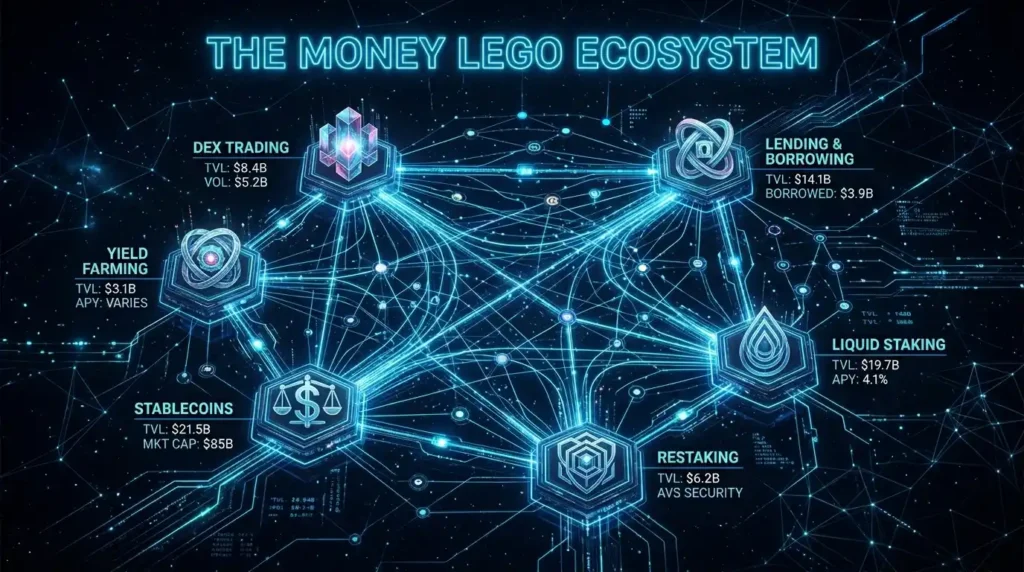
1. Decentralized Exchanges (DEXs)
DEXs allow you to swap tokens directly from your wallet without a centralized exchange.
How they work: Most DEXs use the Automated Market Maker (AMM) model. Instead of matching buyers with sellers through an order book, AMMs use mathematical formulas to price assets in liquidity pools. Traders swap against the pool; liquidity providers earn a percentage of trading fees.
The major DEXs:
Uniswap (Ethereum/multichain): The largest DEX by volume. Introduced the AMM model that most others copied. Handles billions in daily volume. Version 4 (2025) introduced customizable pool logic.
Curve Finance: Specialized in stablecoin and similar-asset swaps (USDC/USDT, ETH/stETH). Extremely low slippage on correlated pairs. CRV governance token controls which pools receive liquidity incentives — the “Curve Wars” phenomenon.
Jupiter (Solana): The dominant DEX aggregator on Solana. Routes trades across multiple Solana DEXs to find the best price. Handles the majority of Solana’s DeFi trading volume.
PancakeSwap (BNB Chain): The primary DEX on BNB Smart Chain. Lower fees than Ethereum mainnet.
Raydium (Solana): Major Solana AMM with deep liquidity on SOL-based pairs.
2. Lending and Borrowing Protocols
DeFi lending works without credit scores — it’s overcollateralized. You deposit more value than you borrow, which protects the protocol if your collateral loses value.
Why borrow in DeFi?
- Access liquidity without selling your crypto (and triggering a taxable event)
- Leverage positions
- Yield arbitrage — borrow at X% APY, deploy at Y% > X%
The major lending protocols:
Aave (V3): The largest DeFi lending protocol. Operates across Ethereum, Polygon, Arbitrum, Optimism, Base, Avalanche, and more. Key features include efficiency mode (higher borrowing power for correlated assets) and cross-chain functionality. Supplies earn variable interest from borrowers; rates adjust algorithmically with supply and demand.
2026 context: Aave V3 manages $15+ billion in TVL. Stablecoin supply APYs range from 4–12% depending on demand. WBTC supply earns 1–3%; ETH earns 2–5%.
Compound: The pioneer of algorithmic interest rate markets. Simpler than Aave, focused on major assets. COMP governance token.
Morpho: A protocol layered on top of Aave and Compound that matches lenders and borrowers directly when possible, improving rates for both sides.
Maker/Sky: The protocol behind DAI (now rebranding to USDS). Users lock collateral to mint the DAI stablecoin. One of DeFi’s oldest and most tested protocols.
3. Liquid Staking
Ethereum’s Proof of Stake requires 32 ETH (~$50,000+) to run a validator node. Liquid staking protocols pool ETH from many users, stake it collectively, and issue a liquid staking token (LST) representing the staker’s position.
How it works:
- Deposit ETH to Lido
- Receive stETH (1:1 with ETH, plus accumulated rewards)
- stETH earns staking rewards (~3.5% APY in 2026) automatically — the token value increases relative to ETH
- stETH can be used in other DeFi protocols simultaneously — as collateral on Aave, in Curve liquidity pools, etc.
The major liquid staking protocols:
Lido Finance: Controls approximately 30% of all staked ETH — the dominant liquid staking protocol. Issues stETH on Ethereum and various liquid staking tokens on other chains.
Rocket Pool: Decentralized alternative to Lido. Anyone can run a node with 8 ETH (vs. 32 ETH solo staking). Issues rETH. More decentralized but smaller scale than Lido.
Ether.fi: Growing quickly in 2025-2026 via restaking integration with EigenLayer. Issues eETH.
Jito (Solana): The dominant liquid staking protocol on Solana. Issues JitoSOL. Additionally captures MEV (Maximal Extractable Value) revenue to boost staker returns.
4. Yield Farming and Liquidity Mining
Yield farming is the practice of deploying crypto assets across DeFi protocols to maximize returns. It combines multiple income sources: trading fees, staking rewards, and governance token incentives.
The progression (2020 → 2026):
DeFi Summer 2020 saw astronomical yields of 1,000%+ APY as protocols competed for liquidity by distributing governance tokens. These yields were unsustainable. By 2026, the landscape has matured significantly:
- Sustainable stablecoin yields from established protocols: 5–15% APY
- ETH/major asset yields: 3–10% APY
- Volatile pair yields: 10–50%+ APY (higher risk)
- “Too good to be true” yields (100%+): Generally involve new, untested protocols with unsustainable emissions
Common yield farming strategies in 2026:
Stablecoin lending: Deposit USDC or USDT to Aave → earn 4–8% APY with minimal price risk. The simplest, lowest-risk DeFi yield strategy.
Stablecoin LP: Provide USDC/USDT or USDC/DAI liquidity to Curve → earn trading fees + CRV incentives. Minimal impermanent loss on stable pairs.
LST looping: Stake ETH → receive stETH → deposit stETH as collateral on Aave → borrow ETH → stake again. Amplifies staking yield with leverage (also amplifies liquidation risk).
Real Yield farming: Focus on protocols generating revenue from actual usage (trading fees, borrowing interest) rather than inflationary token emissions. More sustainable but typically lower APY.
5. Restaking
Restaking is one of the defining DeFi innovations of 2025-2026.
The concept: Once ETH is staked to secure the Ethereum network, restaking allows that same staked ETH to simultaneously secure additional protocols (called Actively Validated Services or AVSs) — earning additional rewards from each.
EigenLayer is the primary restaking protocol on Ethereum. Users restake their LSTs (stETH, rETH) or native ETH to EigenLayer, which then deploys this security to AVSs — oracle networks, bridges, data availability layers, and more.
The tradeoff: Restaking amplifies yield but also amplifies slashing risk — if you or an AVS misbehaves, your staked ETH can be slashed (penalized). The additional complexity and interconnected risk profiles require careful consideration.
2026 context: EigenLayer has attracted $10+ billion in restaked ETH. Competitors like Symbiotic and Karak operate similar models.
6. Decentralized Stablecoins
Beyond centralized stablecoins (USDC, USDT), DeFi has produced decentralized alternatives:
DAI / USDS (Maker/Sky): Backed by a diversified basket of collateral including ETH, WBTC, and real-world assets (RWAs). One of the most tested decentralized stablecoins. The Maker protocol rebranded to Sky in 2024, with DAI gradually transitioning to USDS.
GHO (Aave): Aave’s native stablecoin, mintable by depositing collateral in Aave V3. Integrated directly into the lending market.
FRAX: Partially algorithmic, partially collateral-backed stablecoin. One of the more innovative and complex stablecoin designs.
Total Value Locked (TVL): Measuring DeFi’s Size
TVL (Total Value Locked) is the primary metric for measuring DeFi’s scale — the total dollar value of all crypto assets deposited in DeFi protocols.
As of April 2026: Total DeFi TVL is approximately $150–160 billion across all chains.
Top protocols by TVL (approximate, April 2026):
- Lido Finance: ~$35 billion (liquid staking dominance)
- Aave: ~$15 billion
- EigenLayer: ~$12 billion
- Maker/Sky: ~$10 billion
- Uniswap: ~$8 billion
TVL by chain:
- Ethereum mainnet: ~60% of all DeFi TVL
- Arbitrum, Base, Optimism (Ethereum L2s): ~20% collectively
- Solana: ~10%
- BNB Chain: ~5%
- Others: ~5%
Why TVL matters:
- Higher TVL = more trust in the protocol, more liquidity available
- Rapidly rising TVL can signal genuine adoption or incentivized yield farming (temporary)
- Rapidly falling TVL (“TVL exodus”) signals loss of confidence or better opportunities elsewhere
Limitations of TVL: TVL can be inflated by the same assets being counted multiple times across layered protocols (deposit ETH → receive stETH → deposit stETH → receive receipt token, etc.). It’s a useful size indicator but not a perfect measure.
DeFi Risks: What You Must Understand Before Participating
DeFi offers genuine opportunities but carries risks that traditional finance doesn’t. Understanding these is not optional.
Smart Contract Risk
DeFi protocols are code. Code can have bugs. Even audited protocols have been exploited — resulting in total loss of deposited funds.
Scale of the problem: DeFi hacks and exploits resulted in approximately $1.5 billion in losses in 2024. No protocol is 100% safe from smart contract risk.
Risk mitigation:
- Use protocols with long track records and multiple security audits (Aave, Curve, Uniswap have been running for years)
- Check audits on platforms like DeFiLlama
- Start with small amounts in any new protocol
Impermanent Loss
When providing liquidity to a DEX pool, price divergence between the two assets in your pool can result in your position being worth less than if you simply held the tokens.
The loss is “impermanent” because it reverses if prices return to their original ratio — but if you withdraw while prices are diverged, it becomes permanent.
Affected: Liquidity providers in volatile asset pairs.
Less affected: Stablecoin pairs (USDC/USDT, USDC/DAI) have near-zero impermanent loss.
(Full explanation in our dedicated guide: What Is Impermanent Loss?)
Liquidation Risk
If you borrow against collateral in DeFi, a significant price drop in your collateral can trigger automatic liquidation — your collateral is sold to repay the loan, potentially at a loss.
Example: You deposit ETH as collateral and borrow USDC. If ETH drops 40% rapidly, the system may liquidate your ETH before you can add more collateral.
Risk mitigation: Maintain a healthy collateralization ratio (well above the minimum), monitor positions actively, and don’t over-leverage.
Oracle Risk
DeFi protocols use price oracles (like Chainlink) to know the real-world price of assets. If an oracle is manipulated or reports incorrect prices, it can trigger wrong liquidations or allow attackers to exploit the protocol.
Regulatory Risk
DeFi is evolving in an increasingly complex regulatory environment. The EU’s MiCA framework, US regulatory scrutiny, and global AML/KYC requirements are creating compliance challenges for DeFi protocols. Future regulation could restrict access to or use of certain DeFi protocols.
How to Get Started with DeFi: Step by Step
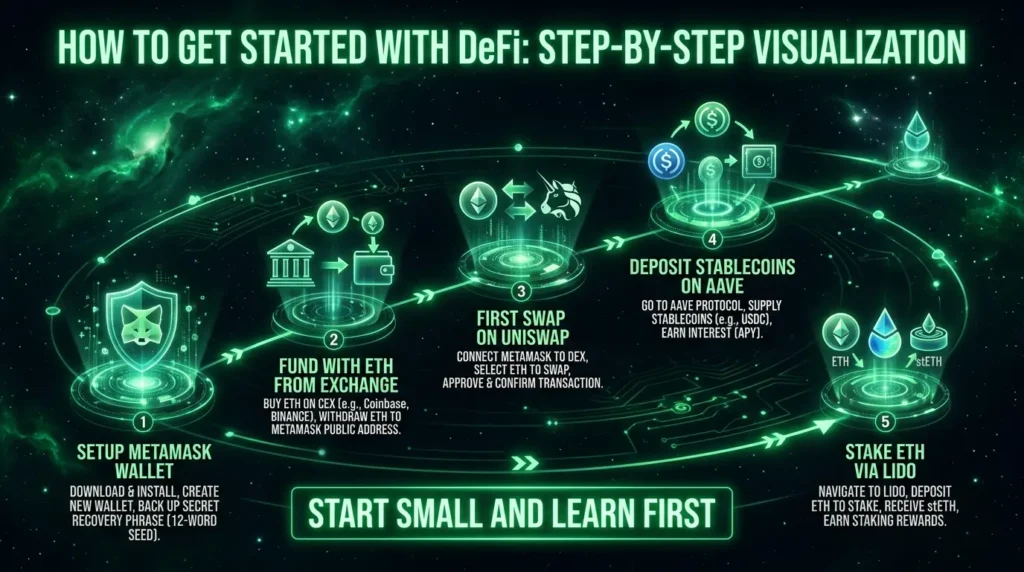
Step 1: Set up a non-custodial wallet
Download MetaMask (Ethereum/EVM) or Phantom (Solana) from official sources only. Create a new wallet, write down your seed phrase on paper — store it offline.
Step 2: Fund your wallet
Buy ETH (or SOL for Solana) on a regulated exchange (Coinbase, Kraken). Withdraw to your wallet address. This is your “gas money” for paying transaction fees.
Step 3: Start with something simple
Your first DeFi interaction should be low-risk:
- Swap a small amount of tokens on Uniswap (Ethereum) or Jupiter (Solana) to experience a DEX
- Deposit USDC to Aave to start earning yield with minimal price risk
- Stake ETH via Lido to receive stETH and earn ~3.5% APY
Step 4: Graduate gradually
Once comfortable with simple operations:
- Try providing stablecoin liquidity on Curve
- Explore Aave’s borrowing features with small positions
- Learn about impermanent loss before providing liquidity in volatile pairs
Step 5: Track everything
Use DefiLlama (defillama.com) to monitor protocol TVL and health. Use Zapper or Zerion to track your DeFi portfolio across protocols.
Key DeFi Resources
DeFiLlama (defillama.com): TVL data, protocol analytics, yield tracking. Essential.
Etherscan (etherscan.io): Ethereum blockchain explorer. Verify transactions and contracts.
Solscan (solscan.io): Solana’s equivalent of Etherscan.
DeFi Safety (defisafety.com): Protocol security ratings and audit reviews.
Key Terminology
DeFi (Decentralized Finance): Financial services built on blockchain smart contracts without traditional intermediaries.
Smart Contract: Self-executing code stored on a blockchain that automatically enforces agreement terms.
TVL (Total Value Locked): Total dollar value of assets deposited in DeFi protocols — the primary metric of DeFi’s scale.
AMM (Automated Market Maker): Algorithm that prices tokens in a liquidity pool based on mathematical formulas rather than order books.
Liquidity Pool: Smart contract holding two or more tokens that DEXs use to facilitate trading.
LP Token: Receipt token received when providing liquidity to a pool — represents your share.
Overcollateralized Lending: Borrowing that requires depositing more value than you receive — protects the protocol from default.
LST (Liquid Staking Token): Token representing staked crypto (stETH, JitoSOL) that can be used elsewhere in DeFi while staking rewards accrue.
Impermanent Loss: Temporary reduction in liquidity provider value caused by price divergence between pooled assets.
Oracle: Service providing real-world price data to smart contracts (Chainlink, Pyth).
Restaking: Using already-staked assets to simultaneously secure additional networks for additional yield.
Gas: Transaction fee paid to network validators for processing transactions on-chain.
The Bottom Line
DeFi is a genuine innovation — a functioning alternative financial system accessible to anyone with an internet connection and a non-custodial wallet. In 2026, it manages $150+ billion in assets and offers financial services that are faster, cheaper, and more transparent than many traditional alternatives.
It is also genuinely risky. Smart contract exploits, liquidations, impermanent loss, and regulatory uncertainty are real. The learning curve is steep.
The right approach:
- Start with established, audited protocols
- Begin with low-risk operations (stablecoin lending, liquid staking)
- Use amounts you can afford to lose entirely while you’re learning
- Understand every protocol before depositing significant capital
- Never invest more than you understand
DeFi is not a get-rich-quick scheme. It’s a new financial infrastructure — and like all infrastructure, it rewards those who take the time to understand how it actually works. 🔗
Disclaimer: This article is for informational and educational purposes only and does not constitute financial advice. DeFi involves significant risks including smart contract vulnerabilities, liquidation, and impermanent loss. Cryptocurrency investments can result in total loss of invested capital. Always conduct your own research before participating in any DeFi protocol.