Impermanent loss is the most important concept every DeFi liquidity provider must understand — and one of the most frequently misunderstood.
The name itself is confusing. “Impermanent” suggests the loss goes away. Sometimes it does. Sometimes it doesn’t. And while the mathematics behind it looks intimidating at first glance, the concept is actually straightforward once you see it through a simple example.
This guide explains exactly what impermanent loss is, walks through the math with real numbers, shows you when it’s worth the risk, and tells you how to minimize it.
What Is Impermanent Loss?
Impermanent loss (IL) is the difference in value between:
- Holding tokens in your wallet (doing nothing)
- Providing those same tokens as liquidity to a DEX pool
When you provide liquidity to an Automated Market Maker (AMM) like Uniswap, the protocol automatically rebalances your position as prices change. If one token in your pool increases significantly in value relative to the other, the AMM sells the appreciating token and buys the depreciating one — always maintaining the pool’s mathematical balance.
The result: you end up with fewer of the token that went up in price, and more of the token that went down. Your position is worth less than if you’d simply held the original tokens.
Why “impermanent”?
The loss only becomes real (realized) when you withdraw your liquidity. If prices return to the original ratio at which you deposited, the impermanent loss disappears completely. But if you withdraw while prices are diverged from your entry, the loss is permanent.
More accurate name: Many in the DeFi community prefer “divergence loss” — it more accurately describes the mechanism. The loss occurs because of price divergence between the two pooled assets.
How Impermanent Loss Happens: The Mechanism
The key is understanding why AMMs rebalance your position.
AMMs use formulas (like Uniswap’s x × y = k) to price trades. When external market prices change, arbitrageurs exploit the price difference between the AMM and other markets, bringing the pool’s price back in line with the market. This arbitrage is what rebalances your position — and creates impermanent loss.
Simple analogy:
Imagine you own a fruit stand with equal baskets of apples and oranges. Your pricing rule: the total basket value must always equal a constant. If apples become worth twice as much externally, people will buy your cheap apples until the basket rebalances — you’ll have fewer apples and more oranges than when you started. You’ve sold your appreciating asset below market value.
Impermanent Loss: Step-by-Step Example
Let’s use real numbers to make this concrete.
Initial Setup
You provide liquidity to an ETH/USDC pool on Uniswap when ETH is $2,000.
You deposit:
- 1 ETH = $2,000
- 2,000 USDC = $2,000
- Total: $4,000
The pool now contains (along with everyone else’s liquidity):
- You own a small share of the total pool
For simplicity, let’s say your 1 ETH + 2,000 USDC represents the entire pool.
Pool state: x = 1 ETH, y = 2,000 USDC
Constant: k = 1 × 2,000 = 2,000
Scenario 1: ETH Doubles to $4,000
What happens: External markets show ETH at $4,000. Arbitrageurs buy ETH from the pool (which is still pricing ETH at $2,000) until the pool price matches the market.
New pool state (after arbitrage):
The pool must still satisfy x × y = 2,000 AND the ratio must reflect the new price of $4,000/ETH.
If ETH price = y/x = $4,000:
- Then y = 4,000x
- And x × (4,000x) = 2,000 → 4,000x² = 2,000 → x² = 0.5 → x = 0.707 ETH
- y = 4,000 × 0.707 = $2,828 USDC
Your position is now worth:
0.707 ETH × $4,000 + $2,828 USDC = $2,828 + $2,828 = $5,657
What if you had just HELD?
1 ETH × $4,000 + 2,000 USDC = $4,000 + $2,000 = $6,000
Impermanent Loss:
$6,000 – $5,657 = $343
As a percentage: $343 / $6,000 = 5.72%
You’re $343 poorer (5.72%) than if you’d simply held the tokens.
Scenario 2: ETH Drops to $1,000
New pool state:
If ETH price = y/x = $1,000:
- x × (1,000x) = 2,000 → 1,000x² = 2,000 → x = 1.414 ETH
- y = 1,000 × 1.414 = $1,414 USDC
Your LP position:
1.414 × $1,000 + $1,414 = $1,414 + $1,414 = $2,828
If you had held:
1 ETH × $1,000 + 2,000 USDC = $1,000 + $2,000 = $3,000
Impermanent Loss:
$3,000 – $2,828 = $172
As a percentage: $172 / $3,000 = 5.72%
Important observation: Both a 100% price increase AND a 50% price decrease produce the same ~5.7% impermanent loss. Impermanent loss is symmetric — it doesn’t matter which direction prices diverge.
Scenario 3: ETH Returns to $2,000
If ETH returns to its original price, arbitrageurs restore the pool to its original state:
- 1 ETH + 2,000 USDC = $4,000
Impermanent Loss: $0 — completely eliminated.
This is why the loss is called “impermanent.” If prices return to where you started, the loss disappears.
The Impermanent Loss Table: Quick Reference
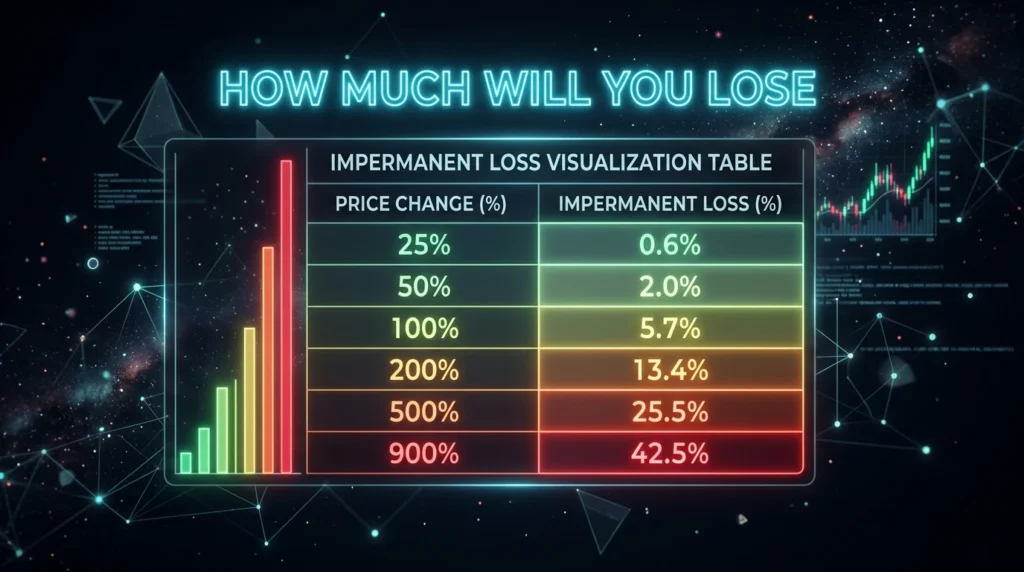
| Price change of one asset | Impermanent Loss |
|---|---|
| No change (0%) | 0% |
| ±25% | ~0.6% |
| ±50% | ~2.0% |
| ±75% | ~3.8% |
| ±100% (2x or 0.5x) | ~5.7% |
| ±200% (3x) | ~13.4% |
| ±300% (4x) | ~20.0% |
| ±400% (5x) | ~25.5% |
| ±900% (10x) | ~42.5% |
Key insights from this table:
- Small price moves produce tiny IL (25% move = 0.6% IL)
- Moderate moves produce manageable IL (2x move = 5.7%)
- Large moves produce significant IL (10x move = 42.5%)
- IL grows much faster at extreme price ranges than moderate ones
When Does Impermanent Loss Become Permanent?
Impermanent loss becomes permanently realized when you withdraw your liquidity while prices are diverged from your entry ratio.
Examples of permanent IL:
Example 1: You provide ETH/USDC liquidity at $2,000 ETH. ETH pumps to $10,000. You need the money and withdraw. Your position contains less ETH than you deposited (sold by the AMM as ETH rose). IL is now permanent.
Example 2: You provide liquidity to a token pair. One token is a new DeFi project token that loses 95% of its value. You withdraw. The AMM bought more of the declining token as it fell. IL is now permanent and significant.
Example 3: The protocol gets hacked and funds are stolen. No impermanence — the loss is total and immediate.
The mental model: Think of impermanent loss like an unrealized loss in traditional investing. As long as you’re still in the position, there’s a chance it recovers. The moment you exit, whatever the current state is becomes your final realized result.
The Fee vs. IL Equation: Is LP Profitable?
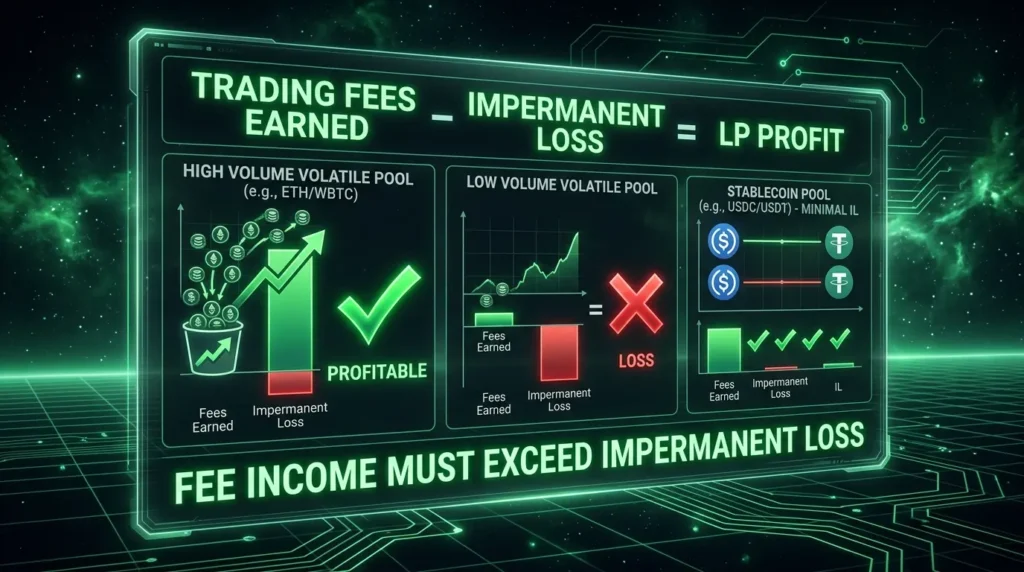
Impermanent loss doesn’t mean liquidity provision is always unprofitable. The key question: do the trading fees you earn exceed the impermanent loss you incur?
The LP profitability formula:
LP Profit = Trading Fees Earned – Impermanent Loss
If fees > IL → LP is profitable vs. holding
If fees < IL → Holding was better than LP
When fees tend to exceed IL:
High-volume pools: More trades = more fees. The ETH/USDC pool on Uniswap on Ethereum mainnet handles billions in daily volume. Fee income for LPs can be substantial.
Low-volatility pairs: Assets that don’t diverge much in price produce minimal IL. Stablecoin pools (USDC/USDT) have near-zero IL regardless of time. Correlated pairs (ETH/stETH, WBTC/ETH) have low IL.
High fee tiers: Uniswap offers 0.01%, 0.05%, 0.30%, and 1.00% fee tiers. Higher fees generate more income (but pools with higher fees have less volume — the market tends to use the optimal tier).
When IL tends to exceed fees:
Low-volume pools: If a pool has minimal trading activity, fee income is negligible even if IL is small.
High-volatility pairs: A memecoin paired with ETH can experience 10–50x price moves, generating enormous IL that no fee income can offset.
During strong trending markets: In a strong bull run where ETH goes from $2,000 to $8,000, an ETH/USDC LP constantly sold ETH as it rose. Fee income rarely compensates for selling a 4x asset at incrementally worse prices.
Impermanent Loss by Pool Type
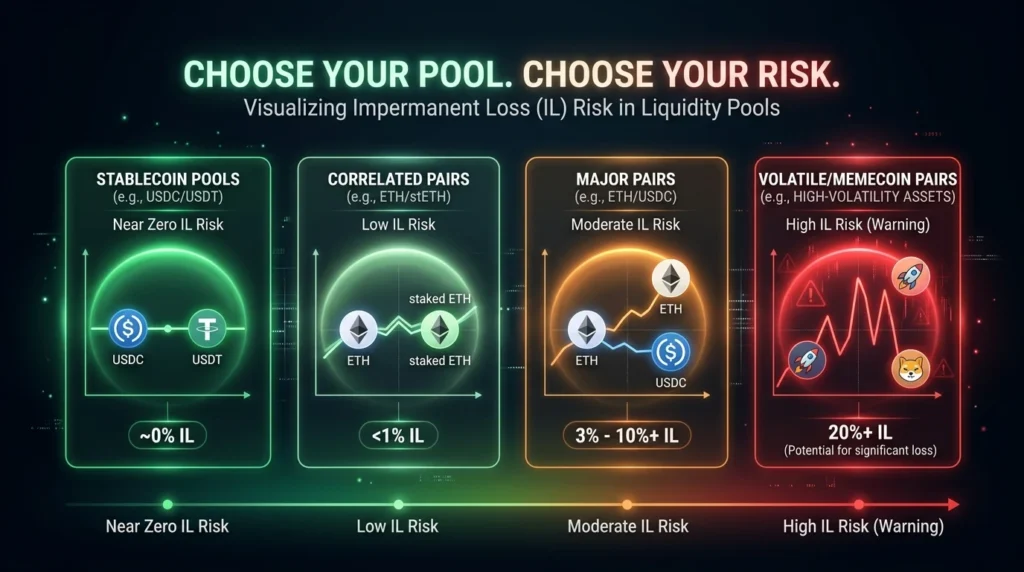
Stablecoin Pools (USDC/USDT, USDC/DAI): Near-Zero IL
Both assets are dollar-pegged and designed to maintain ~$1 value. Price divergence between them is minimal (typically 0.01–0.05% at most). IL in these pools is effectively zero.
Examples: Curve Finance 3pool (USDC/USDT/DAI), Uniswap USDC/USDT pool
Practical reality: You provide liquidity and earn trading fees with essentially no IL risk. This is why stablecoin pools are the recommended starting point for new liquidity providers.
Correlated Asset Pools (ETH/stETH, WBTC/ETH): Low IL
Assets that track each other closely — like ETH and its liquid staking token stETH — have very low IL because prices rarely diverge significantly.
stETH/ETH: stETH is designed to be redeemable for ETH, so the price stays close to 1:1. IL in this pool is minimal.
WBTC/ETH: Both are major crypto assets that tend to move in the same direction (both rise in bull markets, both fall in bear markets). IL exists but is lower than entirely uncorrelated pairs.
Correlated-But-Independent Pairs (ETH/LINK, ETH/SOL): Moderate IL
These assets may both be crypto, but their individual price movements can diverge significantly. If ETH doubles but LINK stays flat (or vice versa), IL accumulates.
Volatile/Uncorrelated Pairs (ETH/MEMECOIN, ETH/NEW-TOKEN): High IL
The most dangerous for IL. New tokens or memecoins can experience 10–100x movements relative to ETH. IL of 42%+ (the 10x scenario) is realistic in these pools.
The warning: High-volume memecoin pools sometimes advertise 100%+ APY in fees — but if the memecoin 10x’s against ETH (or collapses 90%), the IL can exceed several years of fee income.
How to Minimize Impermanent Loss
1. Choose Low-Volatility Pairs
The single most impactful decision. Stablecoin pools have near-zero IL. Correlated asset pools have low IL. Volatile-uncorrelated pairs have high IL. Match your risk tolerance to the pair type.
2. Use Stablecoin Pools as Your Entry Point
Earn trading fees from real DeFi activity with essentially no price risk or IL. Curve Finance’s stablecoin pools are the benchmark for this approach.
3. Prefer Concentrated Liquidity Within a Tight Range
On Uniswap v3, providing liquidity within a narrow price range earns significantly more fees on trades within that range. If your range is tight and prices stay within it, your fee income is much higher relative to IL.
The tradeoff: If price exits your range, you stop earning fees and hold 100% of the depreciating asset.
4. Choose Pools With High Volume-to-TVL Ratios
A pool earning 5% of its TVL in daily trading fees will compensate for IL much faster than a pool earning 0.1% of its TVL. Check Uniswap Analytics, DeFiLlama, or Revert Finance for volume/fee data on specific pools.
5. Monitor Your Position
Impermanent loss grows non-linearly — the first 50% price move causes modest IL, but the next 50% causes proportionally more. Setting alerts for significant price movements lets you decide whether to rebalance or exit before IL becomes prohibitive.
6. Consider Hedging
Some experienced LPs hedge their IL exposure using derivatives — options or perpetual futures positions that profit when their LP position incurs IL. Complex and typically only used for large positions where hedging costs are justified.
7. Accept IL as a Cost of Doing Business
For stablecoin pools, IL is so minimal it barely matters. For volatile pairs, IL is the price of admission — the question is whether the fee revenue and any additional incentives (liquidity mining rewards) justify that cost. Don’t avoid all IL — just price it correctly.
Tools for Tracking and Calculating Impermanent Loss
Impermanent Loss Calculators:
- DailyDeFi.org — Simple IL calculator: enter initial prices and current prices
- Uniswap V3 Calculator (revert.finance) — Advanced analytics for Uniswap v3 concentrated positions
- APY.vision — Portfolio tracker with IL calculation across multiple protocols
Portfolio Trackers with IL Display:
- Zerion — Shows LP positions with IL metrics
- Zapper — DeFi portfolio tracker with yield and IL data
- DeBank — Multi-chain DeFi position tracker
Pool Analytics:
- DeFiLlama — Protocol TVL and fee data
- Uniswap Analytics (info.uniswap.org) — Pool-specific volume and fee data
- Curve Finance Analytics — Curve-specific pool metrics
Common Impermanent Loss Misconceptions
“If I don’t withdraw, the IL doesn’t exist.”
Technically true in accounting terms, but your opportunity cost is real. While your IL is “impermanent,” the alternative returns you could have earned by simply holding are also accumulating. Check your IL regularly to make informed decisions about whether to continue providing liquidity.
“Stablecoin pools have zero IL.”
Near-zero, not exactly zero. Stablecoins occasionally depeg slightly (USDC briefly went to $0.87 during the Silicon Valley Bank crisis in March 2023). These events are brief but can cause tiny IL in stablecoin pools. In practice, this IL is so minimal as to be negligible for most purposes.
“High APY always compensates for IL.”
High advertised APY numbers often include token incentive rewards that depreciate. A pool showing 80% APY in a new governance token may have earned you significant IL while the governance token lost 90% of its value. Always calculate fee-only APY (excluding token incentives) and compare to your realized IL.
“IL only hurts you in down markets.”
IL occurs whenever price diverges — up OR down. A token that 10x’s against ETH creates as much IL as one that collapses 90%. Bull markets are not automatically safe for LPs.
Key Terminology
Impermanent Loss (IL): The difference in value between holding tokens and providing those tokens as liquidity to a DEX pool — caused by price divergence between pooled assets.
Divergence Loss: Alternative (more accurate) name for impermanent loss.
AMM (Automated Market Maker): The algorithm that automatically reprices tokens in a liquidity pool — the mechanism that creates IL through constant rebalancing.
Arbitrage: The practice of exploiting price differences between markets — arbitrageurs drive the rebalancing that creates IL.
x × y = k: The constant product formula used by Uniswap v2 and most basic AMMs — determines how pool rebalancing affects LP positions.
Realized Loss: The point when you withdraw liquidity — whatever IL exists at that moment becomes permanent and real.
Correlated assets: Assets that tend to move in price together — produce less IL in LP positions (e.g., ETH/stETH).
Concentrated Liquidity: Providing LP in a specific price range (Uniswap v3) — higher capital efficiency but position becomes all-one-asset if price exits range.
The Bottom Line
Impermanent loss is real, it’s important, and it’s manageable — with the right pair selection and strategy.
The simplified framework:
Lowest IL risk:
→ Stablecoin/stablecoin pools (USDC/USDT, USDC/DAI)
→ Near-zero IL, earn real trading fees, best starting point for new LPs
Low IL risk:
→ Correlated asset pools (ETH/stETH, WBTC/ETH)
→ Small IL potential, decent fee income from correlated DeFi activity
Moderate IL risk:
→ Major asset pairs (ETH/USDC, ETH/BTC)
→ IL depends on how much the ratio diverges, substantial fee income possible
High IL risk:
→ Volatile/uncorrelated pairs (ETH/NEW-TOKEN, ETH/MEMECOIN)
→ Significant IL possible, only justified by very high fee/incentive income
Before providing liquidity anywhere: estimate the fee APY, estimate likely IL given the pair’s historical volatility, and only proceed if the math favors LP over holding.
The best DeFi participants don’t fear impermanent loss — they understand it, price it correctly, and choose the pools where the math works in their favor. 📊
Disclaimer: This article is for informational and educational purposes only and does not constitute financial advice. Providing liquidity in DeFi involves significant risks including impermanent loss, smart contract vulnerabilities, and total loss of capital. Always conduct your own research.