Think about the last time you bought something online. You paid, the seller shipped the item, and some platform (Amazon, eBay, PayPal) sat in the middle — holding your money, verifying the transaction, resolving disputes. The entire process depended on trusting that middleman.
Now imagine removing that middleman entirely. The rules of the transaction are written in code. When you pay, the code automatically transfers what you bought. If the conditions aren’t met, the money automatically returns to you. No company in the middle. No human judgment. No possibility of one party changing the terms after the fact.
That’s a smart contract.
It’s one of the most important ideas in all of crypto — and understanding it unlocks everything from DeFi to NFTs to decentralized governance. Let’s break it down.
The Quick Answer: What Is a Smart Contract?
A smart contract is a self-executing program stored on a blockchain that automatically performs actions when specific, predetermined conditions are met — with no intermediary required.
The name is a bit misleading. It’s not “smart” in the AI sense, and it’s not a legal contract in the traditional sense. It’s simply code on a blockchain that runs exactly as programmed, every single time, without exception.
Think of it like this: a smart contract is to agreements what a calculator is to math. You don’t trust the calculator because it’s honest — you trust it because it follows rules that can’t be broken. 2 + 2 will always equal 4. Smart contracts work the same way.
The Vending Machine Analogy (It’s Perfect)
The concept of smart contracts was first described by computer scientist Nick Szabo in 1994 — long before blockchain existed. And he used an analogy that remains the best explanation to this day:
The vending machine.

When you put money in a vending machine and press a button:
- The machine checks if you put in enough money ✓
- It checks if the item is in stock ✓
- It dispenses the item
- It returns your change
No cashier is involved. No negotiation. No possibility of the machine deciding to keep your money and give nothing back. The machine follows its programmed rules every single time — regardless of who you are, what time it is, or what mood the machine is in.
A smart contract works exactly the same way, except instead of snacks, it handles digital assets, permissions, and agreements — at any scale, for anyone in the world.
Szabo recognized that digital protocols could enforce contracts through code, making it impossible for either party to cheat after the agreement was made. The technology of the 1990s wasn’t ready. But when Ethereum launched in 2015, his vision finally had a home.
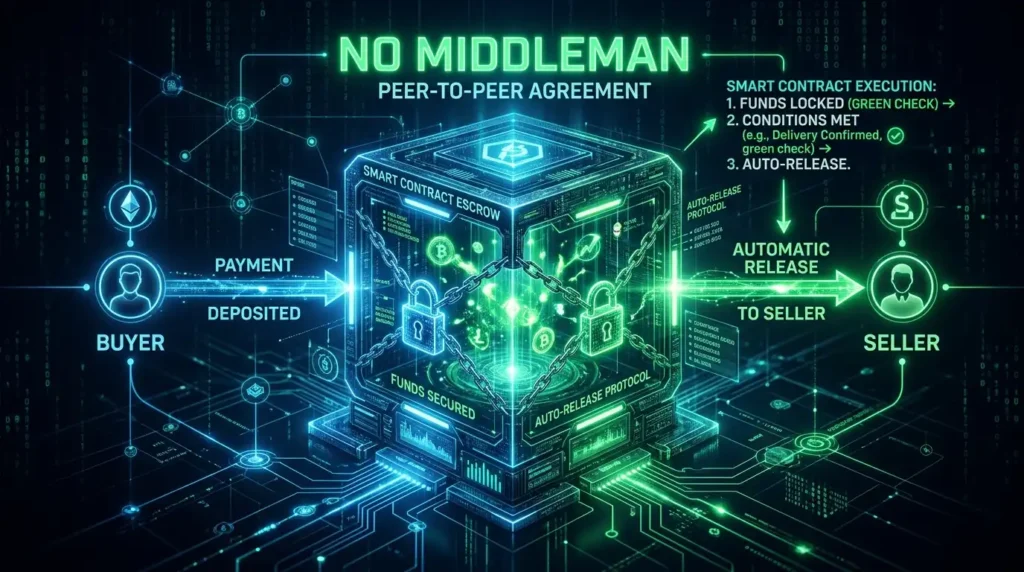
A Concrete Example: Escrow Without a Lawyer
Here’s a real-world scenario that shows exactly how a smart contract replaces a traditional intermediary:
The old way — Traditional Escrow:
- Alice wants to buy a digital asset from Bob for $1,000
- They hire an escrow company to hold the money
- Alice pays the escrow company
- Bob delivers the asset
- The escrow company verifies delivery and releases payment to Bob
- The escrow company charges a fee for this service
The smart contract way:
- A developer writes a smart contract with these rules:
- “If Bob delivers the asset, automatically send $1,000 to Bob”
- “If no delivery within 7 days, automatically return $1,000 to Alice”
- Alice deposits $1,000 into the smart contract
- Bob delivers the asset — the condition is automatically verified
- The $1,000 instantly, automatically transfers to Bob
- No escrow company, no fee, no delay, no possibility of either party cheating
The rules are enforced by math and code — not by a human being who could make mistakes, take a bribe, or go bankrupt.
How Do Smart Contracts Actually Work?
You don’t need to understand the code, but here’s what happens under the hood:
Step 1 — A developer writes the contract.
Smart contracts are written in programming languages designed for blockchains. On Ethereum (the dominant platform for smart contracts), the primary language is called Solidity. The developer writes the logic: the conditions, the rules, and the actions that execute when those conditions are met.
Step 2 — The contract is deployed to the blockchain.
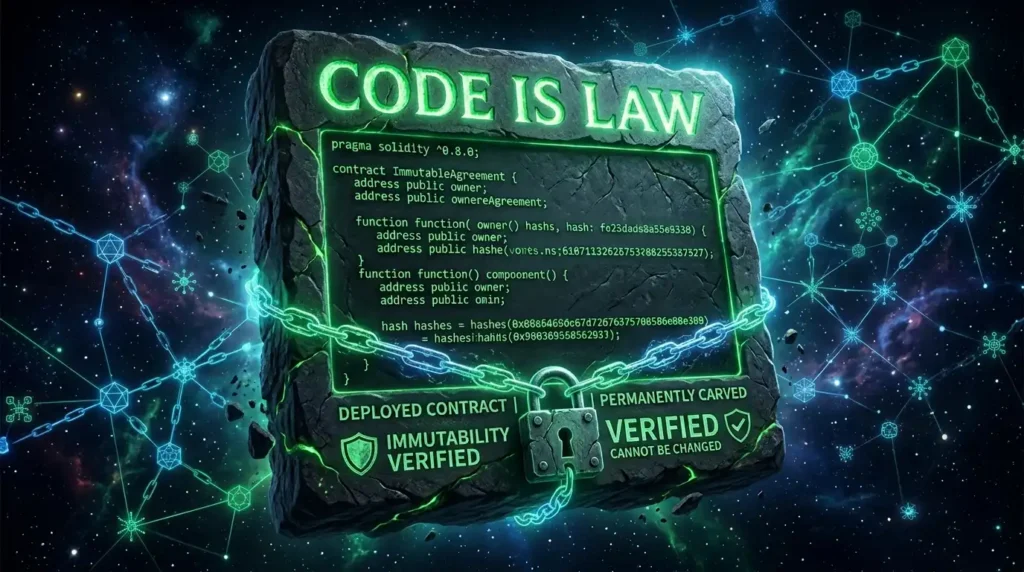
The code is broadcast to the network just like a regular transaction. Once confirmed, it lives at a permanent address on the blockchain. Crucially: it cannot be modified after deployment. Like a law carved in stone, the rules are fixed.
Step 3 — Anyone can interact with the contract.
Users send transactions to the contract’s address to trigger its functions — depositing tokens, requesting a swap, minting an NFT. The contract executes automatically when conditions are met.
Step 4 — The blockchain enforces execution.
Every node in the network runs the contract’s code and verifies the output. The result is recorded immutably on the blockchain. No single entity controls it.
The key properties:
- Deterministic: The same input always produces the same output
- Transparent: The code is publicly visible on the blockchain for anyone to read
- Immutable: Once deployed, the code cannot be changed
- Trustless: No one needs to trust the other party — they only need to trust the code
Where Are Smart Contracts Running?
Smart contracts are supported by most major modern blockchains:
Ethereum — The original home of smart contracts (launched 2015). The most mature developer ecosystem, with the most DeFi protocols, NFT marketplaces, and enterprise applications. Slower and more expensive than some alternatives, but the most battle-tested.
Solana — High-speed, low-fee smart contracts. Popular for DeFi, NFTs, and consumer apps where speed matters. Different architecture from Ethereum.
BNB Chain — Binance’s blockchain, EVM-compatible (can run Ethereum code). High traffic, lower fees, more centralized.
Layer 2s (Arbitrum, Optimism, Base, zkSync) — Smart contracts on top of Ethereum, inheriting its security but with much lower fees (often under $0.01) and faster speeds. In 2026, Layer 2 networks process more transactions than Ethereum itself.
Avalanche, Polygon, and others — Each offering different tradeoffs in speed, cost, and decentralization.
Bitcoin — Historically very limited scripting. However, recent upgrades have expanded Bitcoin’s smart contract capabilities, though still far less flexible than Ethereum.
What Are Smart Contracts Used For?
Smart contracts are the engine behind most of what makes crypto interesting beyond just sending money:
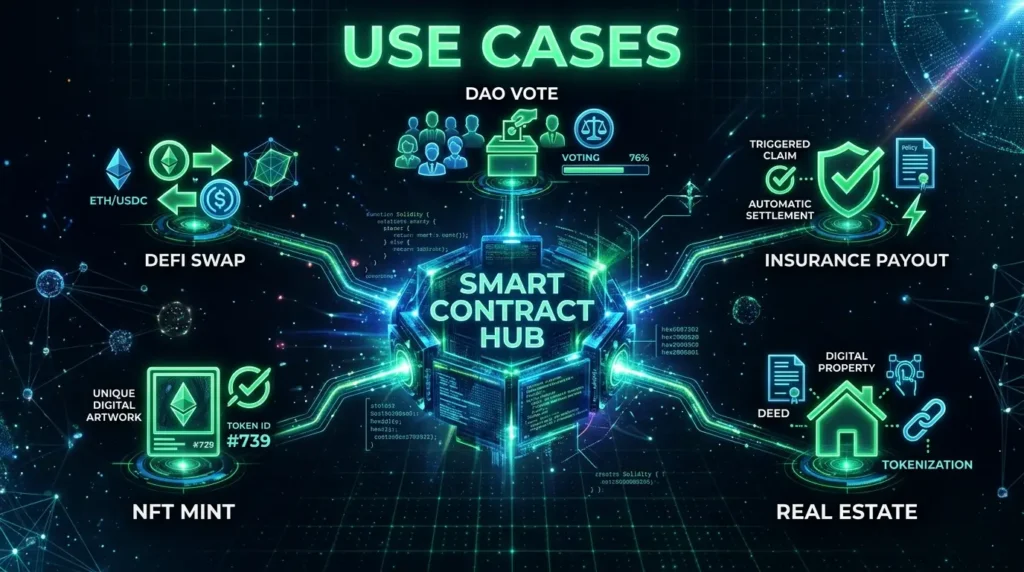
DeFi (Decentralized Finance)
Every DeFi protocol runs on smart contracts:
- Uniswap: swaps tokens automatically through a liquidity pool smart contract
- Aave: lends and borrows crypto through contracts that manage collateral and liquidations
- MakerDAO: creates the DAI stablecoin through a complex system of smart contracts managing collateral ratios
Billions of dollars flow through these contracts daily, with no company controlling them.
NFTs (Non-Fungible Tokens)
When you buy an NFT on OpenSea or any marketplace, a smart contract:
- Verifies your payment
- Transfers ownership to your wallet
- Records the transfer permanently on the blockchain
The NFT’s ownership history is encoded in smart contract interactions, visible to anyone.
Token Launches and ICOs
When a project launches a new token, smart contracts handle the distribution: “Send 0.01 ETH, receive 1,000 tokens automatically.” No team member needs to manually send tokens to thousands of participants.
DAOs (Decentralized Autonomous Organizations)
DAO governance runs through smart contracts. Token holders vote on proposals, and if a proposal passes, the smart contract automatically executes the decision — whether that’s releasing funds from a treasury or changing a protocol parameter.
Real-World Asset Tokenization
Franklin Templeton’s $1+ billion government money market fund (BENJI) on Stellar runs on smart contracts. Every share issuance, redemption, and yield distribution is executed automatically.
Insurance
Parametric insurance contracts automatically pay out when verifiable conditions are met. A crop insurance contract might check weather data and automatically send payment when rainfall falls below a threshold — no claims adjuster required.
Supply Chain
Companies use smart contracts to automatically trigger payments when verified delivery milestones are met. When GPS data confirms a shipment arrived at the warehouse, the contract releases payment to the supplier.
Smart Contracts vs. Traditional Contracts
| Feature | Traditional Contract | Smart Contract |
|---|---|---|
| Who enforces it? | Courts, lawyers, humans | Code, mathematics |
| Can be modified after signing? | Potentially, through legal process | No — immutable |
| Execution speed | Days to months | Seconds |
| Cost | Legal fees, notary fees | Gas fees (often cents) |
| Transparency | Private between parties | Public on blockchain |
| Geographic limits | Jurisdiction-dependent | Borderless |
| Risk of non-compliance | Real | Impossible by design |
| Handles disputes? | Yes, through legal system | No — code is the judge |
Smart Contract Risks: The Honest Part
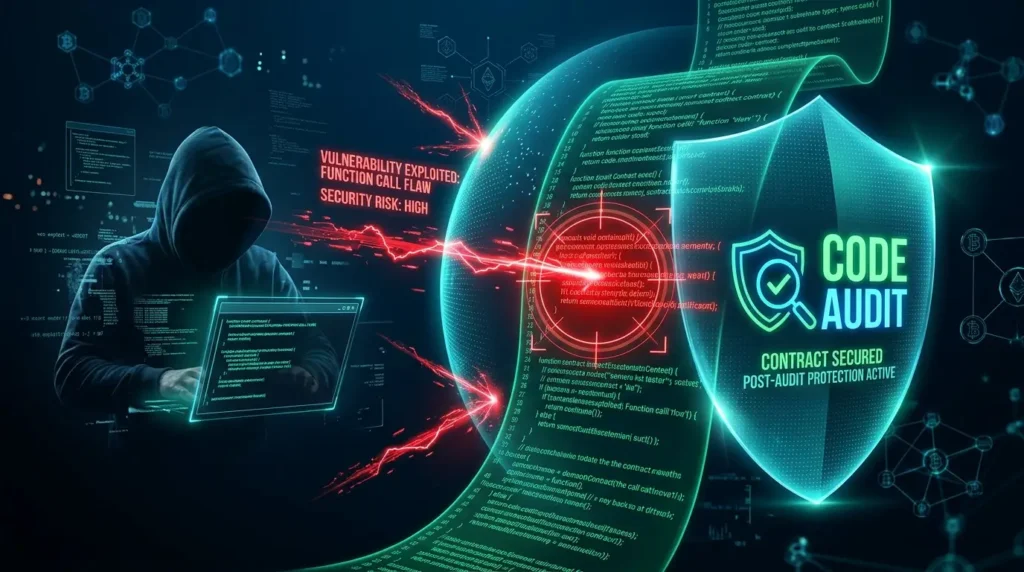
Smart contracts are powerful, but they are not infallible. Here’s what can go wrong:
Code Bugs: A smart contract runs exactly as written — including any mistakes in the code. In July 2023, hackers stole $24 million by exploiting a vulnerability in the Curve Finance smart contracts. In 2016, the “DAO hack” drained $60 million from an early Ethereum smart contract by exploiting a reentrancy bug. Hundreds of millions have been lost to smart contract exploits over the years.
Immutability is a Double-Edged Sword: Once deployed, a contract cannot be fixed. If a bug is discovered after deployment, the only options are to deploy a new version (and migrate users) or use upgrade mechanisms planned in advance. Many protocols build in upgrade paths, but this adds complexity and centralization risk.
Oracle Risk: Smart contracts can’t access external data on their own — they can only see data on the blockchain. To act on real-world data (prices, weather, sports scores), they use “oracles” — services that feed external data to the blockchain. If the oracle is compromised or manipulated, the contract may execute incorrectly.
Token Approvals: When you interact with a DeFi protocol, you often grant the smart contract permission to spend your tokens (“token approval”). Malicious contracts can exploit overly broad approvals to drain wallets. Always review what you’re approving before signing.
Complexity Risk: The more complex a smart contract, the more attack surface. Many of the biggest DeFi hacks exploited interactions between multiple smart contracts in ways the developers didn’t anticipate.
How to protect yourself:
- Only use protocols that have been audited by reputable security firms
- Be cautious with new, unaudited protocols (especially ones offering suspiciously high yields)
- Review and limit token approvals — use tools like Revoke.cash to manage existing approvals
- If something looks too good to be true in DeFi, it usually is
Smart Contract Audits: What They Are and Why They Matter
A smart contract audit is a security review performed by specialized firms who analyze the code line by line, looking for vulnerabilities, logic errors, and edge cases.
Major audit firms include OpenZeppelin, Trail of Bits, Certik, and Consensys Diligence.
A clean audit doesn’t guarantee safety — auditors can miss things — but an unaudited protocol carries dramatically higher risk. Before using any significant amount of money in a DeFi protocol, check whether it’s been audited and by whom. This information is usually publicly available in the protocol’s documentation.
Key Smart Contract Terminology
Smart Contract: A self-executing program stored on a blockchain that automatically performs actions when specific conditions are met.
Solidity: The most popular programming language for writing smart contracts on Ethereum and EVM-compatible blockchains.
EVM (Ethereum Virtual Machine): The computing environment that executes smart contracts on Ethereum and all EVM-compatible chains.
Deployment: The act of publishing a smart contract to the blockchain. Once deployed, the code is permanent.
Gas: The computational fee paid to execute operations on a blockchain. Running a smart contract requires gas, paid in the network’s native token (ETH on Ethereum).
Token Approval: Permission granted to a smart contract to move tokens from your wallet. Must be explicitly signed by the wallet owner.
Oracle: A service that provides external, real-world data to smart contracts.
Audit: A security review of smart contract code by a specialized firm.
Reentrancy Attack: A type of smart contract exploit where an attacker repeatedly calls a function before the first execution completes — famously used in the 2016 DAO hack.
Immutability: The property of smart contracts that makes their code permanently fixed after deployment.
The Bottom Line
Smart contracts are the missing piece that transforms blockchain from just a payment system into a programmable financial infrastructure.
They allow complete strangers to make binding agreements enforced by mathematics — not by lawyers, banks, escrow agents, or governments. They enable DeFi protocols managing billions of dollars with no CEO. They allow artists to sell directly to collectors with royalties automatically paid forever. They make possible entire economies governed by code that no one can secretly modify.
The vending machine doesn’t care who you are. It doesn’t take bribes. It doesn’t make exceptions. And for the first time in history, that same logic can be applied to financial agreements of any complexity, between any parties, anywhere in the world.
Code is law. And sometimes, that’s a beautiful thing. ⚙️
Disclaimer: This article is for informational purposes only and does not constitute financial advice. Cryptocurrency investments carry significant risk, including the potential loss of all invested capital. Always conduct your own research before making any investment decisions.