Staking is one of the most widely used — and most widely misunderstood — concepts in cryptocurrency.
At its simplest: staking means locking up your cryptocurrency to help secure a blockchain network, in exchange for earning rewards. Think of it as earning interest for letting a protocol use your holdings to maintain network integrity.
But the word “staking” has been stretched to cover many different activities — some that actually secure a network, some that don’t. Understanding the difference determines whether your staking rewards are genuinely earned or come with hidden risks you didn’t anticipate.
This guide covers everything: what staking really is, how Proof of Stake works technically, which assets you can stake, what to realistically expect in returns, and the risks involved.
What Is Staking? The Technical Foundation
To understand staking, you need to understand the problem it solves.
The Consensus Problem
Every blockchain needs a way to agree on which transactions are valid and which order they occurred in — this is called consensus. In Bitcoin’s original design, this was solved through Proof of Work (PoW): miners compete to solve a computationally expensive puzzle. The winner adds the next block and earns a reward. The computational expense makes cheating prohibitively costly.
Proof of Work works. Bitcoin has never been successfully attacked. But it requires enormous, continuously growing amounts of electricity — Bitcoin mining consumes more electricity annually than many countries.
The Proof of Stake Solution
Proof of Stake (PoS) replaces computational work with economic stake. Instead of miners spending electricity to earn the right to validate transactions, validators lock up (stake) cryptocurrency as collateral.
The mechanism:
- Validators lock crypto into a smart contract (the “stake”)
- The protocol randomly selects validators to propose and attest to new blocks — weighted by stake size
- Honest validators earn rewards (new tokens + transaction fees)
- Dishonest validators — those who try to approve fraudulent transactions — face slashing: a portion of their stake is confiscated and burned
The economic logic: validators have real financial skin in the game. Cheating means losing your own money. The honest path is profitable; the dishonest path is costly.
Ethereum’s Merge: The Defining Moment
In September 2022, Ethereum completed its transition from Proof of Work to Proof of Stake — called “The Merge.” This was one of the most significant events in blockchain history:
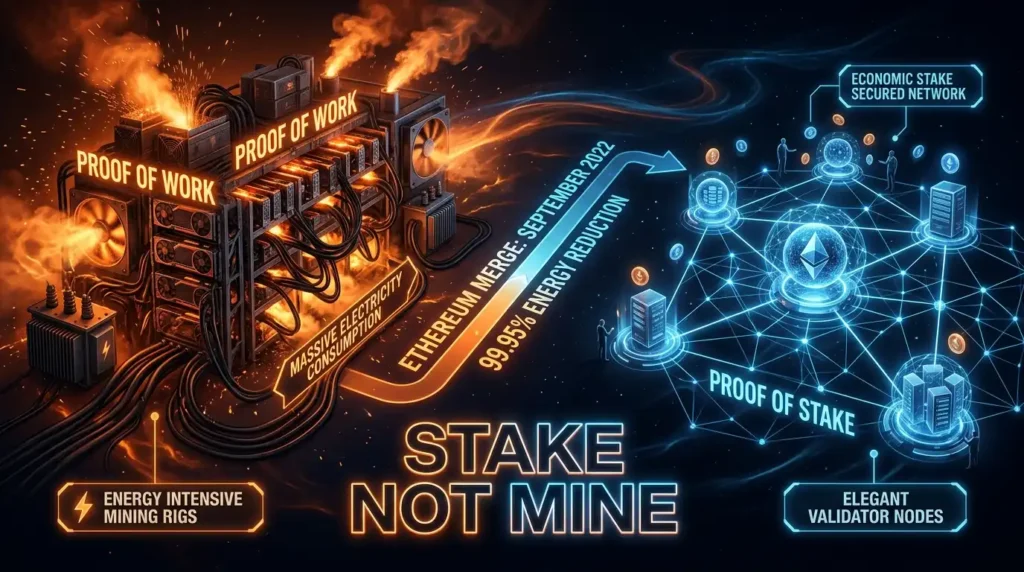
- Ethereum’s energy consumption dropped ~99.95% overnight
- ETH stakers became the network’s validators
- Staking rewards replaced miner block rewards
- Approximately 33+ million ETH is now staked (as of April 2026)
Ethereum’s transition validated PoS at scale. Most major blockchains launched since 2019 use Proof of Stake or variants of it.
How Staking Works: Validators, Delegators, and Pools
Solo Staking (Running Your Own Validator)
The most direct form of staking — you run a validator node yourself.
Ethereum solo staking requirements:
- 32 ETH minimum (~$50,000–80,000 at current prices)
- Dedicated hardware running 24/7 (or cloud equivalent)
- Technical knowledge to set up and maintain the node
- Responsibility for uptime — extended downtime means missed rewards (and potentially minor slashing penalties)
Solo staking gives maximum control and the highest rewards, but the 32 ETH minimum and technical requirements put it out of reach for most investors.
Other networks with solo staking options:
- Solana: ~1 SOL minimum, but effective staking requires delegation to validators
- Cardano: No minimum for delegation (ADA staking is non-custodial by design)
- Cosmos: Delegation-based, no minimum
Delegation (Staking Without Running a Node)
Most PoS blockchains allow delegation — you lock your tokens and assign them to an existing validator. The validator does the technical work; you share in the rewards proportionally (minus the validator’s commission, typically 5–15%).
Key characteristics of delegation:
- No minimum on most networks (or very low)
- No technical setup required
- Non-custodial on most chains — your tokens don’t leave your wallet, you simply delegate the staking right
- Rewards accumulate and can be re-staked (compounded)
- Unstaking periods apply — you must wait to unlock funds (lockup varies by chain)
Delegation on major networks:
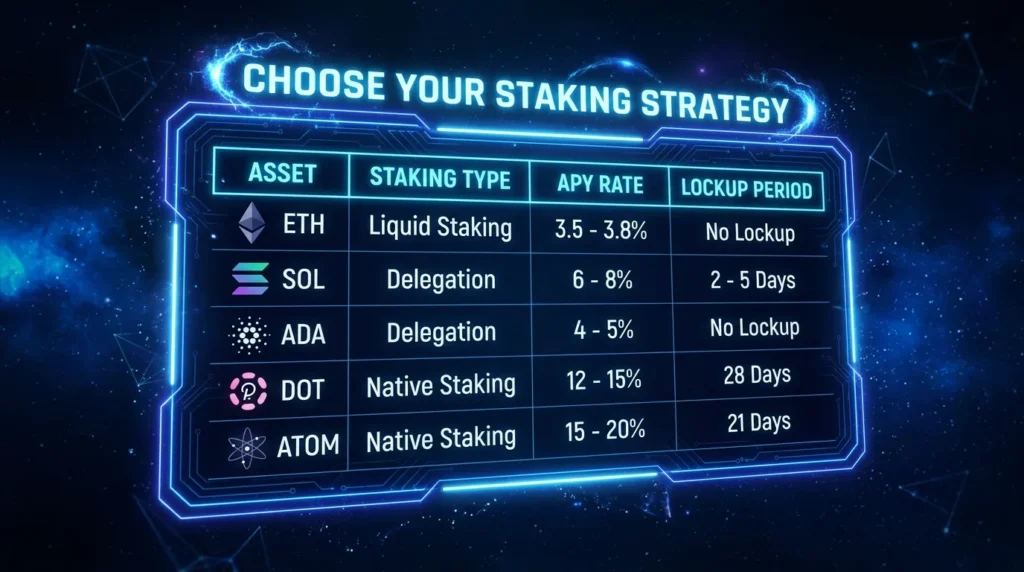
- Solana: Delegate SOL to a validator in Phantom or Solflare wallet. ~2–5 day unstaking period. ~6–8% APY currently.
- Cardano: Delegate ADA from Daedalus or Yoroi wallet. No lockup — can undelegate at any time. ~4–5% APY.
- Cosmos (ATOM): Delegate from Keplr wallet. 21-day unstaking period. ~15–20% APY (includes high inflation).
- Polkadot (DOT): Nomination pools allow small holders to participate. 28-day unbonding period. ~12–15% APY.
Staking Pools (Exchange Staking)
Centralized exchanges aggregate customer deposits and stake collectively on their behalf:
- Coinbase: ETH staking (~2.5–3.2% effective APY after their 25% commission). Available in most US states.
- Kraken: Multi-asset staking. Competitive rates, returned to US clients in January 2025.
- Binance: BNB staking and various other assets.
Advantages of exchange staking:
- No minimum amount
- No technical knowledge required
- No unstaking period on some platforms (they manage liquidity)
Disadvantages:
- Custodial — the exchange holds your keys
- Commission reduces effective APY
- Regulatory risk — exchanges can restrict or suspend staking (as seen in 2023)
- Counterparty risk — exchange solvency concerns
Liquid Staking: The Best of Both Worlds
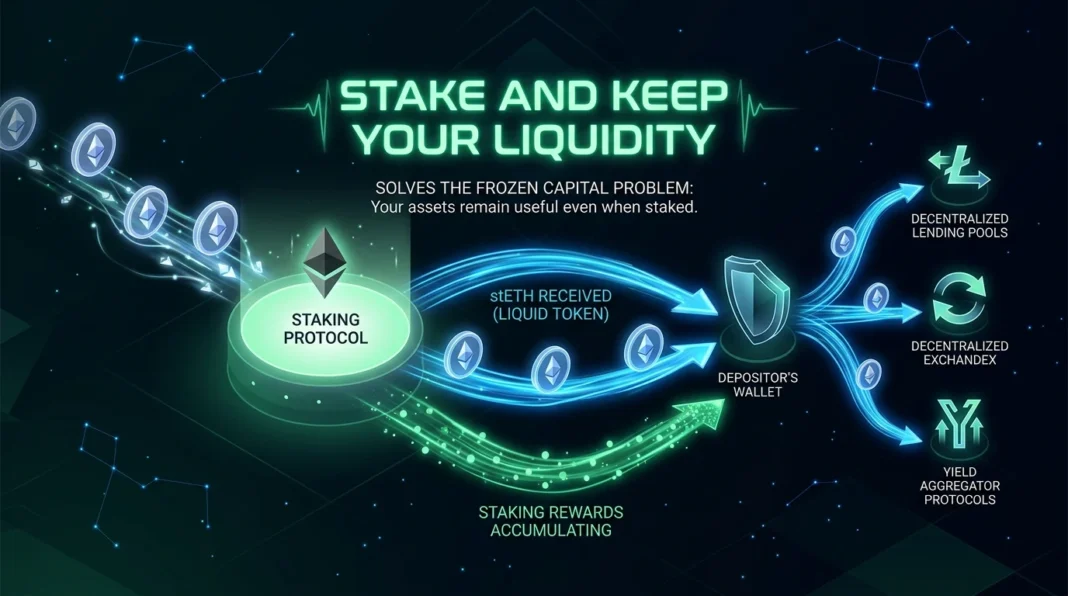
The most significant innovation in staking since PoS itself — liquid staking solves the fundamental problem: staked assets are locked and can’t be used elsewhere.
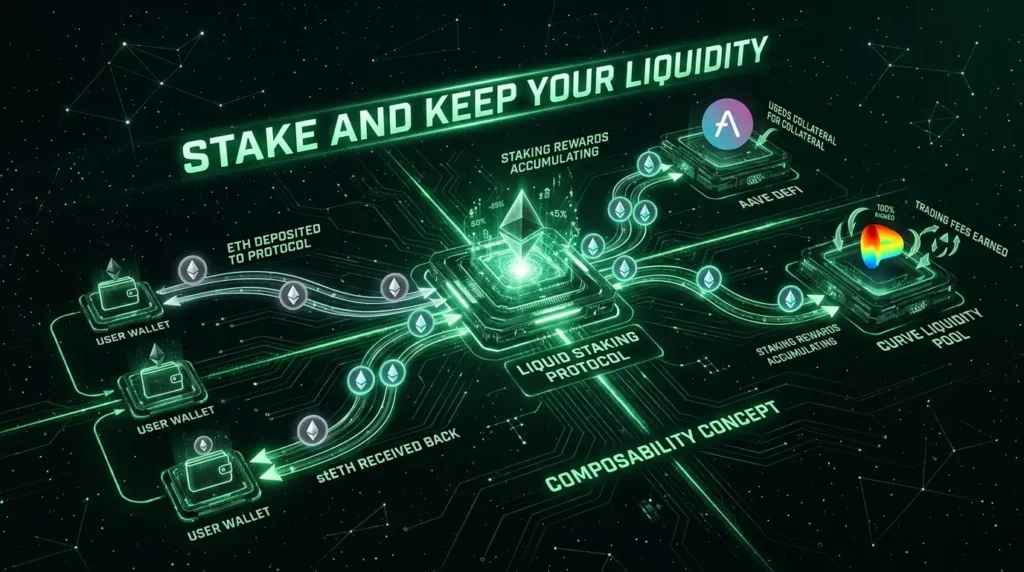
How liquid staking works:
- Deposit ETH (or SOL, etc.) to a liquid staking protocol (Lido, Rocket Pool)
- Receive a liquid staking token (LST) representing your staked position: stETH (Lido), rETH (Rocket Pool), JitoSOL (Jito)
- Your ETH continues staking and earning rewards (~3.5% APY for ETH)
- Your LST can be freely traded, used as DeFi collateral, or deployed in yield strategies
- Withdraw by burning your LST and receiving the underlying ETH (plus accumulated rewards)
Why liquid staking dominates in 2026:
- Lido alone controls ~30% of all staked ETH — $35+ billion
- stETH is the most liquid DeFi collateral on Ethereum
- The composability unlocked by LSTs enables layered DeFi strategies (deposit stETH to Aave, borrow against it, etc.)
Major liquid staking protocols:
Lido Finance (stETH):
- Dominates ETH liquid staking
- Operates across Ethereum, Polygon, Solana
- ~3.4–3.8% APY on ETH in 2026
- Criticism: centralization concerns (Lido controls a large share of staked ETH)
Rocket Pool (rETH):
- More decentralized alternative — anyone can run a node with 8 ETH
- ~3.2–3.6% APY
- rETH can be used across DeFi
Ether.fi (eETH):
- Native restaking integration — staked ETH simultaneously secures EigenLayer AVSs
- Higher potential yield from restaking incentives
- Growing rapidly in 2025-2026
Jito (JitoSOL — Solana):
- Dominant Solana liquid staking
- Captures MEV (Maximal Extractable Value) revenue in addition to staking rewards
- ~7–9% APY (higher than native SOL staking due to MEV boost)
What Can You Stake? Major Assets and Expected Returns (2026)
These are approximate rates as of April 2026 and fluctuate with network conditions. Always verify current rates directly.
| Asset | Staking Method | Approximate APY | Lockup Period |
|---|---|---|---|
| ETH | Liquid staking (Lido) | 3.4–3.8% | None (liquid) |
| ETH | Solo staking | ~3.6–4.0% | Variable |
| ETH | Exchange (Coinbase) | ~2.5–3.2% | Varies |
| SOL | Delegation (Phantom) | 6–8% | ~2–5 days |
| SOL | JitoSOL (liquid) | 7–9% | None (liquid) |
| ADA | Delegation (Yoroi) | 4–5% | None |
| DOT | Nomination pools | 12–15% | 28 days |
| ATOM | Delegation (Keplr) | 15–20% | 21 days |
| AVAX | Delegation | 6–8% | 14 days |
| BNB | Exchange (Binance) | 3–5% | Varies |
Why does Cosmos/Polkadot have higher APY?
Higher APY in these networks reflects higher token inflation — more tokens are minted to pay stakers. This can dilute non-stakers but also means stakers are protected from inflation erosion. The “real yield” (above inflation) is more modest than the headline number suggests.
The Slashing Risk: The Most Misunderstood Staking Risk
Slashing is the penalty mechanism that makes Proof of Stake secure — and it’s what many new stakers don’t consider.
What causes slashing:
- Double signing: A validator signs two different blocks at the same height (usually a technical error, not malicious intent)
- Equivocation: Contradictory attestations submitted by the validator
- Surround votes: A specific form of equivocation in Ethereum’s consensus
Who faces slashing risk:
- Solo stakers (running your own node) — misconfiguration can cause double signing
- Liquid staking protocols — operators of the underlying validators
- Restaking users — additional slashing exposure from AVS failures (EigenLayer)
Who doesn’t face direct slashing risk:
- Delegators on most PoS chains (Cosmos, Solana, Cardano) — your tokens can’t be slashed, only the validator’s own stake
- Exchange stakers — exchange absorbs the risk
- Simple liquid staking token holders (stETH, rETH) — Lido/Rocket Pool manage validator risk
In practice: Slashing events are rare and typically small. Lido, which manages tens of billions in staked ETH, has had very few slashing incidents affecting user funds. However, restaking (EigenLayer) introduces new, additive slashing risk from AVS behavior — an important consideration.
Staking Taxes (US)
The IRS has clear (though sometimes complex) guidance on staking:
Staking rewards are taxable as ordinary income at fair market value when received.
Example: You stake SOL and earn 10 SOL as rewards over the year. Each time rewards are distributed, the value of those SOL at the time of receipt is ordinary income. If you later sell the SOL, you also owe capital gains tax on any appreciation.
For liquid staking tokens:
- Receiving stETH for deposited ETH: This is generally not a taxable event (exchange of like assets)
- stETH appreciating in value (accumulating rewards): This is taxable income as rewards accrue — the exact treatment is still being clarified in IRS guidance
- Selling stETH for more ETH than deposited: Taxable capital gain
Practical advice: Use crypto tax software (CoinTracker, Koinly) that supports staking reward tracking. They automate the calculation of income received and track cost basis. Always consult a tax professional familiar with crypto for significant staking positions.
Staking vs. Yield Farming: When to Use Which
| Staking | Yield Farming | |
|---|---|---|
| Primary purpose | Network security | Capital deployment for returns |
| Yield source | Block rewards + tx fees | Trading fees, lending interest, token incentives |
| Complexity | Low to Moderate | Moderate to High |
| APY range | 3–20% (network-dependent) | 4–50%+ (protocol-dependent) |
| Impermanent loss risk | None | Yes (for LP strategies) |
| Lockup periods | Yes (varies by chain) | Usually no (most DeFi is liquid) |
| Smart contract exposure | Low (native staking) or Moderate (liquid staking) | Moderate to High |
| Best for | Long-term holders wanting passive income from owned assets | More active participants optimizing returns |
The common path in 2026:
- Stake ETH via liquid staking (Lido/Rocket Pool) for base yield
- Use received stETH/rETH in DeFi protocols for additional yield
- The staking provides the foundation; yield farming layers returns on top
Common Staking Mistakes to Avoid
Staking on a low-quality validator (delegation):
Choosing a validator with poor uptime means missed rewards. Choose validators with high uptime (99%+), reasonable commission (5–10%), and a track record. Most staking wallets display validator metrics.
Not considering the lockup period:
Staking DOT locks capital for 28 days. ATOM for 21 days. If you need liquidity, use liquid staking alternatives or shorter-lockup options. Don’t stake funds you might need.
Ignoring APY vs. inflation:
A 20% APY on a token with 15% annual inflation gives you a real yield of only ~5%. Check the network’s inflation rate against staking rewards for a true picture.
Concentrating all stake on one validator:
If your chosen validator gets slashed or has extended downtime, all your rewards suffer. Spread delegation across 2–3 validators on networks that allow it.
Exchange staking for large long-term positions:
Exchange staking is convenient but custodial. For significant holdings you plan to hold long-term, native delegation or liquid staking gives you better rates, non-custodial control, and DeFi composability.
Not compounding rewards:
Staking rewards that sit uncollected don’t compound. On many networks, re-staking (delegating your rewards back) significantly increases long-term returns. Many liquid staking tokens auto-compound (stETH increases in ETH value automatically).
Key Terminology
Proof of Stake (PoS): Consensus mechanism where validators lock (stake) cryptocurrency to earn the right to validate transactions — replacing Proof of Work’s computational competition.
Validator: A node that participates in block production and attestation in a PoS network. Requires a minimum stake.
Delegation: Assigning your staked tokens to an existing validator without running a node yourself. Non-custodial on most networks.
Slashing: Confiscation of a portion of a validator’s stake as penalty for dishonest or faulty behavior.
Lockup/Unbonding Period: The waiting period between initiating unstaking and receiving your tokens back. Varies from 0 (liquid staking) to 28 days (Polkadot).
LST (Liquid Staking Token): Token received when liquid staking (stETH, JitoSOL) — represents staked position and can be used in DeFi.
APY (Annual Percentage Yield): Annualized staking return including compounding effects.
Staking Pool: Aggregation of multiple stakers’ tokens to collectively meet validator requirements — used by exchanges and liquid staking protocols.
Restaking: Using already-staked assets (LSTs) to simultaneously secure additional networks for additional rewards — increases yield but also risk.
The Bottom Line
Staking is one of the most accessible ways to put crypto to work passively. For long-term holders of PoS assets — ETH, SOL, ADA, DOT, ATOM — staking is almost always preferable to simply holding idle tokens that earn nothing.
The recommended approach for most investors:
ETH holders: Use liquid staking (Lido or Rocket Pool) → receive stETH/rETH → optionally deploy in conservative DeFi for additional yield. Simple, non-custodial, and flexible.
SOL holders: Delegate in Phantom or Solflare wallet to a quality validator, or use JitoSOL for liquid staking + MEV rewards.
ADA holders: Delegate from Yoroi/Daedalus — no lockup, no minimum, genuinely simple.
Smaller holders of other assets: Consider liquid staking or exchange staking if native delegation thresholds are prohibitive.
The honest summary: staking won’t make you rich. 3–8% APY on a volatile asset means your fiat value fluctuates far more than your staking returns. But it’s genuine yield on assets you already hold — better than nothing, and significantly better than paying exchange withdrawal fees to hold idle tokens. 🔐
Disclaimer: This article is for informational and educational purposes only and does not constitute financial advice. Staking involves risks including slashing, lockup periods, and smart contract vulnerabilities. Tax treatment of staking rewards varies by jurisdiction. Always conduct your own research before staking.