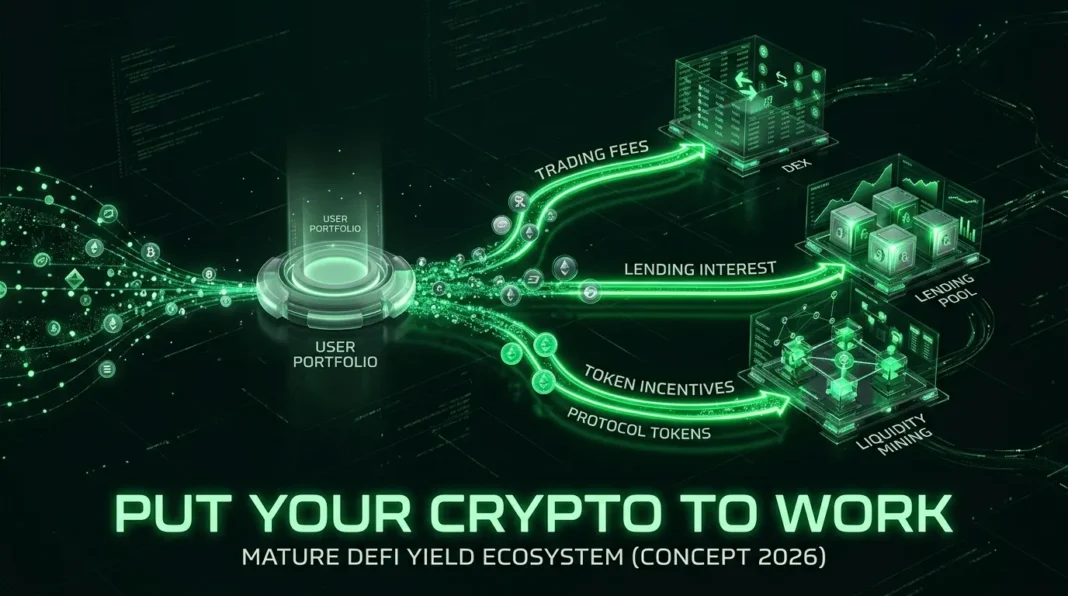
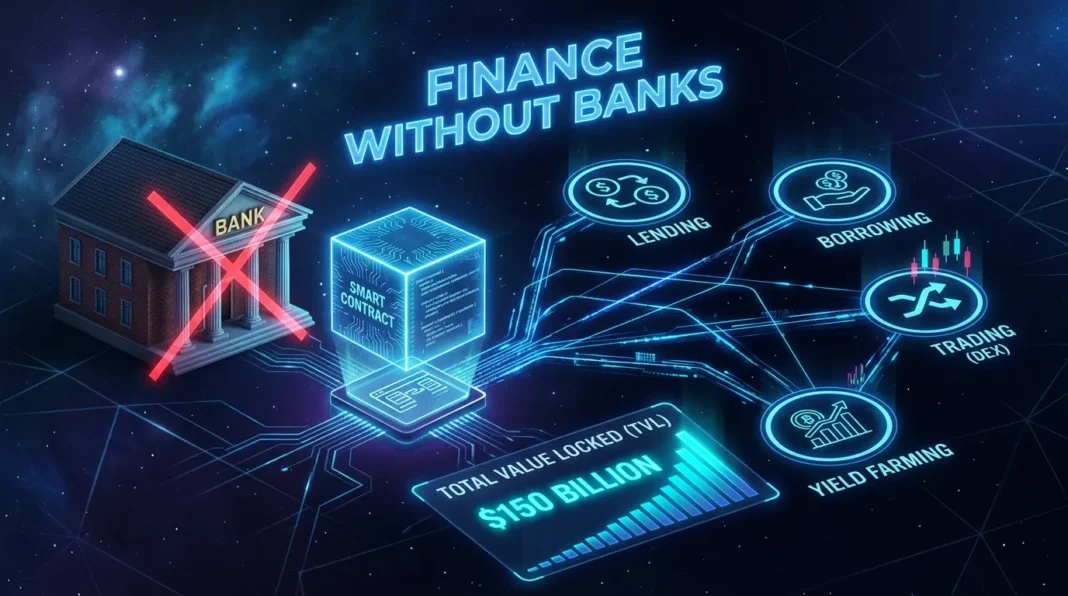
Every time you swap tokens on a decentralized exchange — trading ETH for USDC on Uniswap, or SOL for USDT on Jupiter — your trade doesn’t match against another person’s order. It executes against a liquidity pool: a smart contract holding reserves of both tokens that anyone can trade against, at any time, without a counterparty.
Liquidity pools are the foundational infrastructure of DeFi. Without them, decentralized exchanges couldn’t function at scale. They’re also an income-generating opportunity — liquidity providers earn a portion of every trade fee. But they come with a specific risk — impermanent loss — that anyone providing liquidity must understand.
This guide explains everything: what liquidity pools are, how the mathematics behind them works, how to participate, and what the real risks look like.
Why Liquidity Pools Exist: The Problem They Solve
To understand why liquidity pools were invented, you need to understand the problem they replace.
The Order Book Model (Traditional)
Traditional exchanges — whether stock exchanges or centralized crypto exchanges like Coinbase or Kraken — use an order book. Buyers post bids (the highest price they’ll pay). Sellers post asks (the lowest price they’ll accept). When a bid and ask match, the trade executes.
This works well when there are many active traders posting orders on both sides. But it has a critical weakness: thin markets. If there aren’t enough buyers and sellers, the order book becomes sparse. Trades execute at terrible prices, or don’t execute at all.
Early decentralized exchanges tried to use on-chain order books. The result was terrible:
- On Ethereum, every order placement or cancellation costs gas
- Market makers (who normally maintain liquidity) couldn’t profitably manage on-chain orders given the fees and latency
- Most DEXs were unusable because they had almost no liquidity
The Liquidity Pool Solution
Liquidity pools solve the thin-market problem by aggregating capital from thousands of individual contributors into a single, always-available pool of tokens.
Instead of matching buyers and sellers, traders swap against the pool directly. The price is determined by a mathematical formula based on the ratio of tokens in the pool — not by order matching.
The result: 24/7 trading availability, no counterparty needed, and pricing that automatically adjusts with every trade.
What Is a Liquidity Pool?
A liquidity pool is a smart contract holding reserves of two (or more) tokens that enables decentralized trading.
The participants:
Traders: Swap one token for another by interacting with the pool. They pay a small fee on each trade (typically 0.01%–1% depending on the pool).
Liquidity Providers (LPs): Deposit tokens into the pool to create the liquidity traders use. In return, they earn a proportional share of all trading fees generated by the pool.
The AMM: The Automated Market Maker — the algorithm built into the smart contract that prices every trade based on the pool’s token reserves.
Simple example:
An ETH/USDC pool holds $1 million worth of ETH and $1 million worth of USDC (total $2 million TVL).
When you swap 1 ETH for USDC:
- You send 1 ETH into the pool
- The pool sends you USDC at the current pool-determined price
- The pool now has slightly more ETH and slightly less USDC
- The price of ETH relative to USDC in the pool adjusts upward (more ETH = each ETH is worth slightly less USDC)
The fee you paid (e.g., 0.3%) is distributed proportionally to all LPs.
How AMMs Price Trades: x × y = k Explained
The most important piece of math in DeFi is deceptively simple.
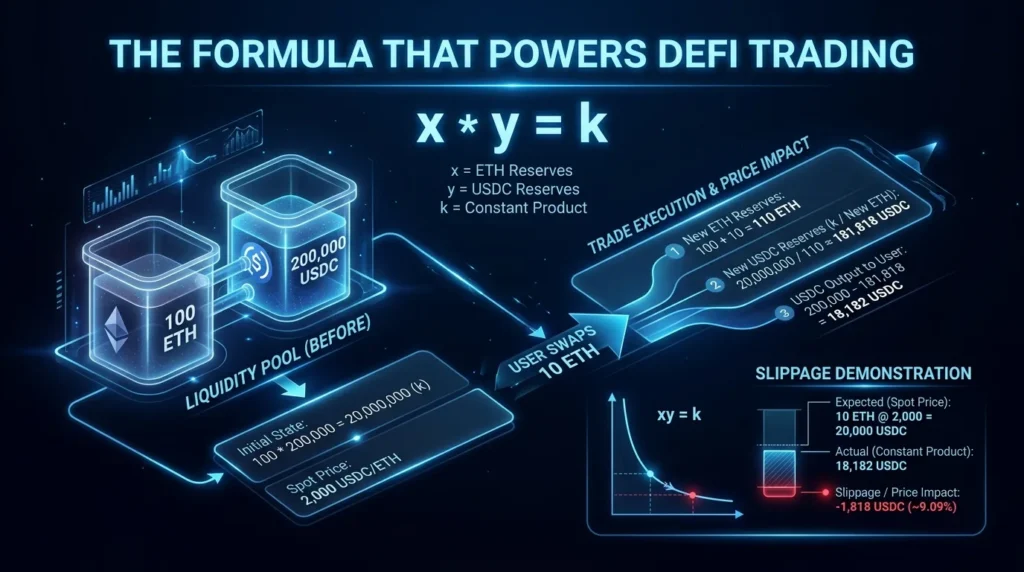
The constant product formula:
x × y = k
Where:
- x = quantity of Token A in the pool
- y = quantity of Token B in the pool
- k = a constant (never changes)
What this means: No matter what trades happen, the product of the two token quantities must always equal the same constant k. This forces the pool to automatically reprice with every trade.
A Step-by-Step Example
Initial state:
- Pool holds: 100 ETH (x) and 200,000 USDC (y)
- k = 100 × 200,000 = 20,000,000
- Implied ETH price: $2,000 per ETH
A trader buys 10 ETH:
- They want 10 ETH out → new x = 100 – 10 = 90 ETH
- To maintain k: 90 × y = 20,000,000 → y = 222,222 USDC
- The trader must put in: 222,222 – 200,000 = 22,222 USDC
- Effective price paid: 22,222 ÷ 10 = $2,222 per ETH (vs initial $2,000)
The 10 ETH purchase cost more than $2,000 each because of slippage — the price impact of the trade on the pool.
New state:
- Pool holds: 90 ETH and 222,222 USDC
- k = 90 × 222,222 = ~20,000,000 ✓ (maintained)
- New implied ETH price: 222,222 ÷ 90 = $2,469 per ETH
The pool has automatically repriced ETH upward after the purchase.
Why the Price Impact Depends on Pool Size
If the same 10 ETH purchase happened against a pool with 10,000 ETH and 20,000,000 USDC:
- New x = 9,990 ETH
- New y = 20,020,040 USDC
- Effective price: ~$2,002 per ETH
The deeper the pool, the less slippage per trade. This is why large, deep liquidity pools are important for efficient DeFi trading.
LP Tokens: Your Claim on the Pool
When you provide liquidity, you receive LP tokens (Liquidity Provider tokens) representing your proportional share of the pool.
How it works:
- Pool total value: $2,000,000
- You deposit: $20,000 (1% of total)
- You receive: 1% of all LP tokens
LP tokens are:
- Your proof of ownership in the pool
- Required to withdraw your liquidity plus earned fees
- Transferable — you can sell or use them elsewhere in DeFi
- Composable — LP tokens can be staked in other protocols to earn additional yield (yield farming)
When you withdraw:
Redeem your LP tokens → receive your proportional share of the pool’s current token quantities plus your accumulated fee earnings.
Types of AMMs: Different Formulas for Different Needs
The constant product formula (x × y = k) is just one approach. DeFi has developed several AMM designs optimized for different situations:
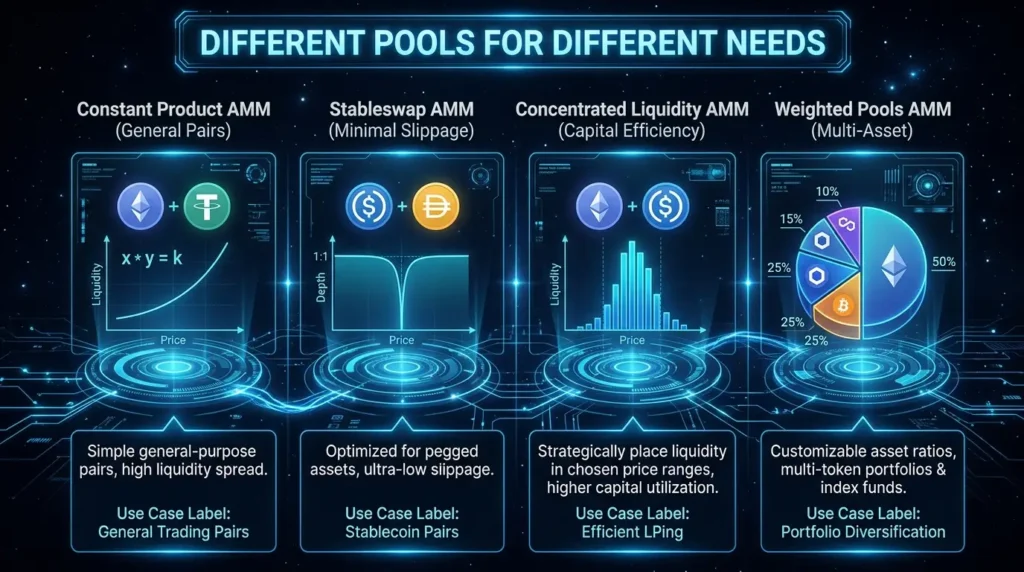
Constant Product AMM (Uniswap v2, most DEXs)
Formula: x × y = k
Best for: General-purpose trading pairs (ETH/USDC, ETH/LINK, etc.)
Limitation: Inefficient for assets that should trade at similar prices (stablecoins) — significant slippage even for small trades
Stable Swap AMM (Curve Finance)
Formula: Modified hybrid combining constant product and constant sum curves
Best for: Trading pairs where assets should maintain roughly equal value: USDC/USDT, USDC/DAI, ETH/stETH, WBTC/cbBTC
Why it’s better for stables: The Curve formula keeps prices extremely stable near 1:1 ratio, allowing much larger trades with minimal slippage. A $10 million USDC/USDT swap on Curve might have 0.01% slippage vs. 2%+ on a standard AMM.
Concentrated Liquidity AMM (Uniswap v3/v4)
Innovation: LPs choose a specific price range within which to provide liquidity — rather than covering the entire 0 to ∞ price range.
Why it matters: Capital efficiency. If ETH is trading at $2,000 and you concentrate all your liquidity between $1,800–$2,200, your capital is ~50x more efficient than spreading it across the entire range. Your share of fees on trades within that range is dramatically higher.
The tradeoff: If price moves outside your range, your position stops earning fees and becomes 100% one token (full exposure to the depreciated asset).
Practical use: Uniswap v3 concentrated liquidity has become standard for professional liquidity provision. Most retail LP participation in 2026 occurs on simpler v2-style pools or via aggregators that manage positions automatically.
Weighted Pool AMM (Balancer)
Innovation: Pools with more than 2 tokens (up to 8) and customizable weight ratios (e.g., 80% ETH / 20% USDC, rather than 50/50).
Best for: Index-like exposure to a basket of tokens, portfolio rebalancing.
Major Liquidity Pools by Platform (2026)
Uniswap (Ethereum, Polygon, Arbitrum, Base, others):
The largest DEX by total volume. Handles hundreds of billions in annual trading volume.
Top pools by TVL:
- ETH/USDC
- ETH/USDT
- WBTC/ETH
- ETH/DAI
Uniswap v4 (launched 2025) introduced “hooks” — customizable logic that runs before/after swaps — enabling new pool types like dynamic fees, TWAMM (time-weighted average market making), and more.
Curve Finance (Ethereum and multichain):
The dominant platform for stablecoin and correlated asset trading. Handles billions in daily stablecoin volume with minimal slippage.
Top pools:
- 3pool (USDC/USDT/DAI) — one of the most historically important DeFi pools
- ETH/stETH — major liquidity for Lido’s stETH
Raydium (Solana):
The primary AMM on Solana. Deep liquidity on SOL-based pairs. Integrated with Jupiter’s aggregation for best-price routing.
PancakeSwap (BNB Chain):
Largest DEX on BNB Chain. Lower fees than Ethereum mainnet. Significant trading volume from BNB-native users.
Aerodrome (Base):
The dominant DEX on Coinbase’s Base L2 network. Rapidly growing TVL and volume as Base expands.
How to Provide Liquidity: Step-by-Step
Before you start: Understand impermanent loss (covered below). For your first LP experience, consider stablecoin pairs to minimize this risk.
Step 1: Choose your pool and platform
For beginners: Curve Finance’s stablecoin pools (3pool, USDC/USDT) carry minimal impermanent loss risk. Uniswap’s ETH/USDC or ETH/USDT pools are the most liquid general pools.
Step 2: Prepare equal values of both tokens
Most AMMs require you to provide both tokens in equal dollar value:
- ETH/USDC pool: Need $500 of ETH and $500 of USDC (for a $1,000 deposit)
- Stablecoin pools: Can often deposit a single stablecoin and the protocol handles conversion
Step 3: Connect your wallet and navigate to the pool
- Go to app.uniswap.org or curve.fi (always use official URLs)
- Connect MetaMask or your preferred wallet
- Navigate to “Pools” or “Liquidity”
Step 4: Approve the tokens and deposit
- You’ll need to approve each token for the smart contract to use (one-time per token per protocol)
- Enter the deposit amounts
- Review the expected LP token share, fee tier, and price range (for v3)
- Confirm the transaction — pay gas
Step 5: Receive LP tokens
After confirmation, your LP tokens appear in your wallet. Your liquidity is now active and earning fees from every trade in the pool.
Step 6: Monitor and manage
- Track your position’s value and accrued fees
- On v3 (concentrated liquidity): if price moves outside your range, rebalance
- Consider using portfolio trackers (Zapper, Zerion) to monitor DeFi positions
Impermanent Loss: The Core Risk of Liquidity Provision
Impermanent loss (IL) is the most important concept for liquidity providers to understand — and the one most frequently misunderstood.
What Is Impermanent Loss?
When you provide liquidity, the AMM constantly rebalances your position as prices change. If the price of one token moves significantly relative to the other, you end up with a different ratio of tokens than you deposited — and often a total value that’s less than if you had simply held the tokens.
The “loss” is called impermanent because it reverses if prices return to the ratio at which you deposited. But if you withdraw while prices are diverged, it becomes a permanent, realized loss.
The Maths of Impermanent Loss
You provide liquidity to an ETH/USDC pool when ETH is $2,000:
- Deposit: 1 ETH + 2,000 USDC = $4,000 total
ETH price doubles to $4,000:
If you had just held:
- 1 ETH × $4,000 + 2,000 USDC = $6,000
What your LP position is worth:
The AMM has rebalanced your position: you now hold approximately 0.707 ETH + 2,828 USDC
- 0.707 × $4,000 + 2,828 = $5,657
Impermanent loss: $6,000 – $5,657 = $343 (5.7%)
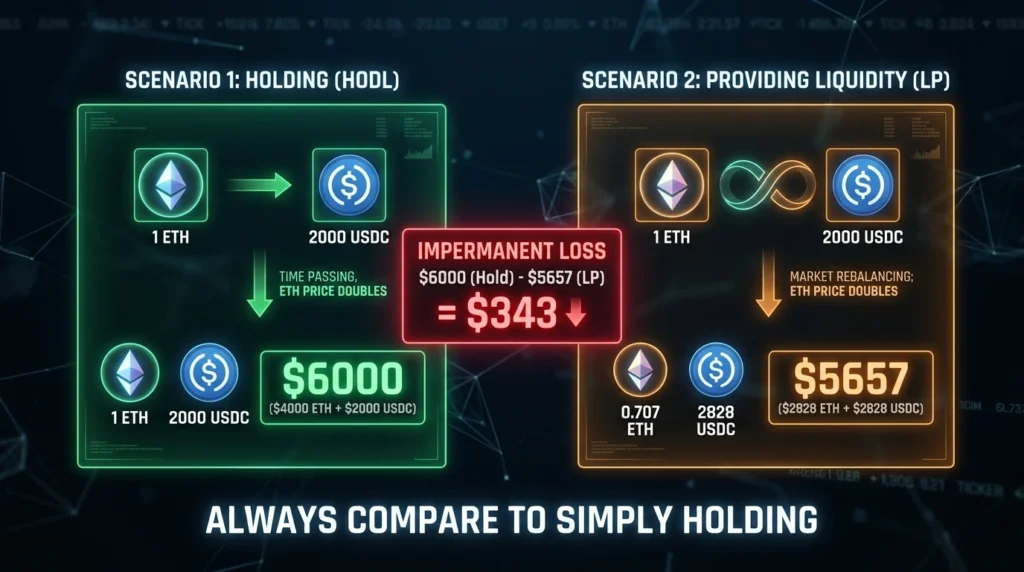
You earned trading fees during this period — but did those fees exceed $343? If yes, LP was profitable. If no, you’d have been better off just holding.
Impermanent Loss by Price Change
| Price change of one asset | Impermanent Loss |
|---|---|
| 25% increase | ~0.6% |
| 50% increase | ~2.0% |
| 100% (2x) increase | ~5.7% |
| 200% (3x) increase | ~13.4% |
| 400% (5x) increase | ~25.5% |
| 1000% (10x) increase | ~42.5% |
The same table applies to decreases — a 50% drop in one asset produces the same ~2% IL as a 50% increase.
The key insight:
- Stablecoin pools (USDC/USDT, USDC/DAI): Prices don’t diverge → near-zero impermanent loss
- Correlated asset pools (ETH/stETH, WBTC/ETH): Low divergence → modest IL
- Volatile asset pools (ETH/SHIB, LINK/ETH): High divergence potential → significant IL risk
For beginners, stablecoin pools are the safest starting point for understanding LP mechanics without significant IL risk.
When LP Is Profitable: The Fee vs. IL Equation
Providing liquidity is profitable when trading fees earned exceed impermanent loss.
Favors LP profitability:
- High trading volume in the pool (more fees)
- Low price volatility between the paired assets (less IL)
- Additional token incentives (governance tokens, liquidity mining rewards)
- Concentrated liquidity position in an active price range
Favors holding instead of LP:
- Strong, sustained directional price move in one asset (large IL)
- Low pool volume relative to TVL (insufficient fees)
- Concentrated position with price moving outside range
The practical test: Before providing liquidity, estimate the annual fee yield at current volume levels. Compare this to your expected IL given the asset pair’s historical volatility. If fee APR significantly exceeds expected IL, LP may be sensible. If not, simply holding may be better.
Liquidity Pools Beyond Trading
While DEX trading is the most common use, liquidity pools serve additional DeFi functions:
Lending liquidity: Aave, Compound, and other lending protocols use pool-based models where depositors provide one-sided liquidity and borrowers access it for variable interest.
Liquidity bootstrapping pools (LBPs): New token launches use LBPs to distribute tokens at fair prices — the initial ratio starts high and decreases over time, discouraging sniping.
NFT liquidity: Protocols like Blur and Uniswap v4 extensions enable liquidity pools for NFTs.
Options and derivatives: Protocols use liquidity pools as collateral and settlement mechanisms for on-chain options and perpetuals.
Key Risks for Liquidity Providers
Impermanent loss: The primary risk. Covered extensively above.
Smart contract risk: The pool contract itself can be hacked or exploited. Q1 2026 alone saw $482 million in DeFi losses across various incidents. Use only well-audited, long-established protocols.
Oracle manipulation: Some pools rely on price oracles that can be manipulated, enabling flash loan attacks.
Rug pull risk (low-quality pools): Anyone can create a liquidity pool on Uniswap — including scammers who create fake token pools and drain LP deposits. Stick to pools with:
- Tokens with real fundamentals
- Locked or burned liquidity (or verifiable LP token distribution)
- Significant TVL from third-party LPs
Low-liquidity slippage on exit: If TVL drops significantly while you’re an LP, your exit can be costly — especially on v3 concentrated positions.
Key Terminology
Liquidity Pool: Smart contract holding reserves of two or more tokens enabling decentralized trading.
Automated Market Maker (AMM): Algorithm that prices trades based on pool token ratios rather than order matching.
Liquidity Provider (LP): User who deposits tokens into a pool and earns trading fees in return.
LP Token: Receipt token representing proportional ownership of a liquidity pool.
x × y = k: The constant product formula maintaining pool balance — the foundation of most AMMs.
Slippage: The difference between expected and actual trade execution price — increases with trade size and decreases with pool depth.
Impermanent Loss: Reduction in LP value compared to simply holding the tokens — caused by price divergence between pooled assets.
Concentrated Liquidity (Uniswap v3/v4): LP positions within a specific price range — more capital-efficient but require active management.
Curve Stable Swap: AMM formula optimized for similarly-priced assets — minimal slippage on stablecoin trades.
TVL (Total Value Locked): Total dollar value deposited in a pool or protocol.
The Bottom Line
Liquidity pools are the engine of decentralized trading — replacing the centralized market makers and order books of traditional finance with open, permissionless smart contracts funded by anyone.
For traders: DEX liquidity pools provide 24/7 token swaps without accounts, KYC, or counterparty risk. Slippage and gas fees are the primary costs.
For liquidity providers: Pools offer genuine yield opportunities — particularly in stablecoin pairs or high-volume volatile pools. The primary risk — impermanent loss — is manageable with the right asset pair selection and strategy.
Start here:
- Swap tokens on Uniswap or Jupiter to understand how trading against a pool feels
- Provide a small amount of USDC/USDT to Curve’s 3pool for near-zero IL, real fee experience
- Graduate to volatile pairs only after understanding IL mechanics thoroughly
The maths is simpler than it looks. The risks are real. Take time to understand both before committing significant capital. 🌊
Disclaimer: This article is for informational and educational purposes only and does not constitute financial advice. DeFi involves significant risks including smart contract vulnerabilities, impermanent loss, and total loss of deposited capital. Always conduct your own research before participating in any DeFi protocol.