Here’s a fact that surprises most people: the blockchain that processes the most USDT transactions in the world is not Ethereum. It’s not Solana. It’s TRON — a network that launched in 2018, was widely dismissed as a copy-paste blockchain, and then quietly became the backbone of global dollar-denominated digital payments.
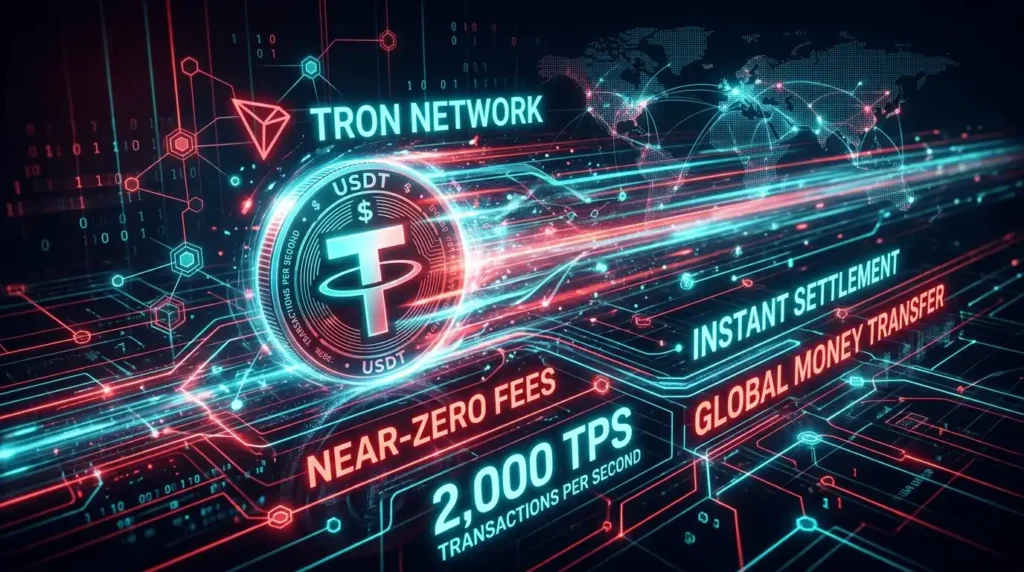
As of early 2026, TRON hosts over $86 billion in USDT — more than any other blockchain on earth. It processes over $21 billion in daily settlement volume. Its network handles 2,000 transactions per second with near-zero fees. And it just landed a strategic payment partnership aimed at enabling TRX and USDT transactions at over 90 million merchants globally.
TRON (TRX) currently trades around $0.31–0.32, has a market cap of approximately $30 billion, and sits at #8 by market cap. It is simultaneously one of the most used blockchains in the world and one of the most controversial — thanks largely to its founder, who makes Elon Musk look like a reclusive introvert.
Let’s break it all down.
The Quick Answer: What Is TRON?
TRON is a high-performance Layer 1 blockchain designed for fast, cheap, global transactions — with a particular focus on stablecoin payments, DeFi, and content distribution. Its native cryptocurrency is TRX (Tronix).
Think of TRON as the highway that most of the world’s USDT travels on. When someone in Argentina sends $500 to a cousin in Nigeria using USDT, there’s a very good chance that transfer is happening on the TRON network — not Ethereum, not Solana. TRON’s combination of speed, near-zero fees, and deep USDT liquidity has made it the default rails for global stablecoin payments.
TRX is used to:
- Pay for network resources (bandwidth and energy)
- Stake to participate in governance and earn rewards
- Vote for Super Representatives who secure the network
- Access DeFi protocols within the TRON ecosystem
Who Created TRON? The Justin Sun Story
TRON was founded in March 2017 by Justin Sun — a Chinese entrepreneur, former Ripple chief representative in China, and graduate of the University of Pennsylvania. Sun is, to put it diplomatically, one of the most colorful characters in crypto.
His promotional style has ranged from audacious to outrageous: paying $4.6 million to have lunch with Warren Buffett, promoting TRON with stunts that generated significant regulatory attention, and making grand partnership announcements that sometimes proved more promotional than substantive.
And yet — the blockchain he built actually works. Extremely well, for its intended purpose.
TRON launched its mainnet in May 2018, migrating from an initial Ethereum-based token to its own blockchain. Shortly after, in 2018, TRON acquired BitTorrent — the peer-to-peer file sharing protocol with hundreds of millions of users — for approximately $140 million. The acquisition gave TRON instant scale and a massive user base.
In 2021, Sun stepped down as CEO of the TRON Foundation, transitioning governance to the TRON DAO — a decentralized autonomous organization that now formally manages the ecosystem. Sun remains deeply involved as a strategic advisor and major TRX holder.
By 2026, Tron Inc. — a Nasdaq-listed company associated with Sun — holds over $200 million worth of TRX in its treasury, making systematic daily purchases and staking most holdings. This corporate buying creates consistent demand and reduces circulating supply.
How Does TRON Actually Work?
Delegated Proof of Stake (DPoS)
TRON uses Delegated Proof of Stake (DPoS) — a consensus mechanism designed for maximum speed and efficiency. Here’s how it works:
- TRX holders stake their tokens and vote for 27 Super Representatives (SRs)
- These 27 SRs are responsible for producing all blocks and validating all transactions
- Super Representatives change every 6 hours based on voting
- SRs earn TRX rewards for block production, which they share with voters
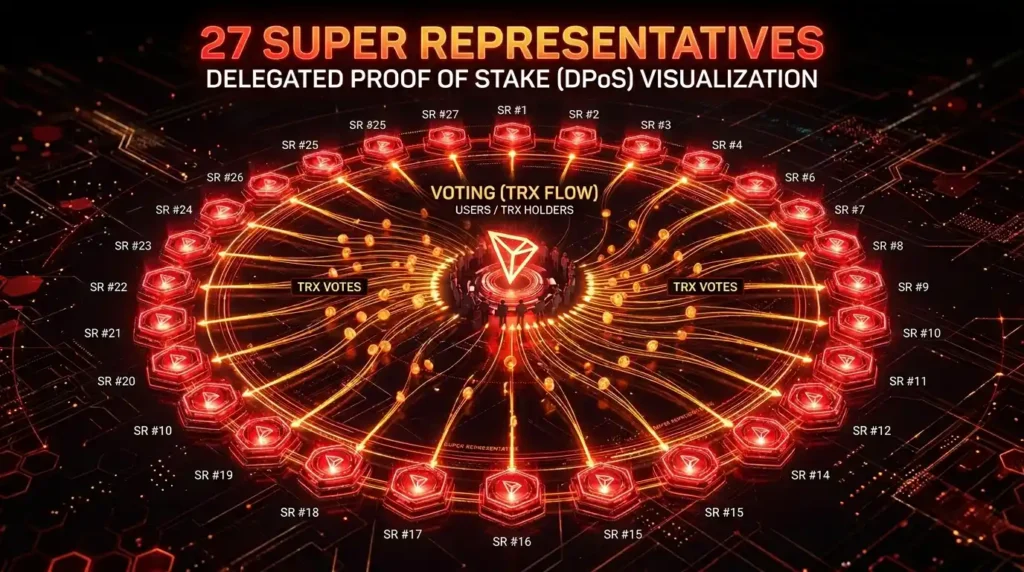
This design achieves extraordinary throughput — up to 2,000 transactions per second with 3-second block times. The tradeoff: only 27 block producers is significantly more centralized than Ethereum’s 1 million+ validators or Cardano’s 3,000+ stake pools. Critics argue that 27 entities controlling block production is not meaningfully decentralized.
Bandwidth and Energy: TRON’s Fee Model
TRON’s fee model is unique and often misunderstood. Most transactions on TRON are essentially free — but not exactly.
The network uses two resources:
- Bandwidth — for regular TRX transfers (every account gets 600 free bandwidth points per day)
- Energy — for smart contract execution (must be obtained by staking TRX)
When you stake TRX, you receive bandwidth and energy points rather than traditional staking rewards. This means: for average users sending USDT, transactions cost nothing. For DeFi users executing smart contracts, staking TRX provides the energy needed.
This fee model is why TRON dominates USDT transfers — sending $10,000 in USDT costs essentially nothing on TRON, versus potentially several dollars on Ethereum.
EVM Compatibility
TRON’s virtual machine (TVM) is compatible with the Ethereum Virtual Machine (EVM) — meaning developers can deploy Ethereum smart contracts on TRON with minimal modifications. This has attracted projects seeking to serve users who want Ethereum-compatible applications without Ethereum-level fees.
TRON Tokenomics: The Numbers That Matter
| Metric | Data |
|---|---|
| Ticker | TRX |
| Current Price | ~$0.31–0.32 (April 2026) |
| Market Cap | ~$30 billion |
| Rank | #8 |
| Circulating Supply | ~95 billion TRX |
| Maximum Supply | 100 billion TRX |
| Block Time | 3 seconds |
| Throughput | 2,000 TPS |
| All-Time High | $0.43 |
| USDT hosted on TRON | ~$86 billion |
| Daily Settlement Volume | $21+ billion |
| Super Representatives | 27 |
The Burn Mechanism
TRON burns TRX tokens through multiple mechanisms:
- A portion of every transaction fee is burned
- Energy consumed by smart contracts results in TRX burns
- The USDD stablecoin mechanism burns TRX to mint USDD
As network usage grows — particularly as more USDT transfers occur on TRON — the burn rate increases. This creates a deflationary pressure that theoretically supports TRX’s value over time as usage scales.
USDD: TRON’s Algorithmic Stablecoin
In 2022, Justin Sun launched USDD — TRON’s own algorithmic stablecoin. USDD requires burning $1 worth of TRX to mint 1 USDD, creating direct deflationary pressure on TRX supply.
USDD drew comparisons to Terra/UST — the algorithmic stablecoin that collapsed spectacularly in 2022. The key difference: USDD is over-collateralized, with the TRON DAO Reserve maintaining collateral in TRX, Bitcoin, USDC, and Tether to back every USDD in circulation.
USDD has maintained its peg through the crypto bear market, though it remains relatively small compared to USDT and USDC.
Why TRON Dominates USDT: The Real Story
The fact that TRON hosts more USDT than any other blockchain deserves deeper explanation.
In the early days of USDT (2018–2020), most USDT lived on Ethereum (ERC-20). But Ethereum’s rising gas fees made small USDT transfers expensive — sending $100 in USDT could cost $10–50 in fees during peak periods. For users in developing markets using USDT as a dollar substitute, this made Ethereum USDT unusable.
TRON offered a solution: TRC-20 USDT, which costs fractions of a cent to send regardless of the amount transferred. The network effect compounded rapidly:
- More people used TRON for USDT → more liquidity on TRON
- More liquidity → more exchanges and services supporting TRC-20 USDT
- More services → more people using TRON for USDT
By early 2021, TRON overtook Ethereum as the primary USDT network. In early 2026, TRON handles approximately 51% of all global USDT-TRC20 volume and over $21 billion in daily settlement.
This is TRON’s real moat: not technology superiority, but network effects in the most important use case for stablecoins — everyday dollar transfers at zero cost.
2026: TRON’s Institutional Moment
Several major developments in early 2026 have given TRON unprecedented institutional legitimacy.
Anchorage Digital Integration (March 2026)
Anchorage Digital — America’s first federally chartered crypto bank — announced support for the TRON network, enabling institutional custody of TRX tokens on a regulated platform. Future phases will add TRC-20 assets and native TRX staking.
This is a landmark moment: for the first time, US regulated institutions can access TRON within a compliant framework. Anchorage’s involvement brings TRON inside the US regulatory perimeter in a meaningful way.
Mastercard PayFi Partnership (2026)
A strategic collaboration between TRON and Mastercard aims to integrate TRX and USDT for everyday purchases at over 90 million global merchants. If fully implemented, this PayFi (Payment Finance) strategy would make TRX and USDT spendable wherever Mastercard is accepted — a transformative development for real-world crypto payment adoption.
Tron Inc. Treasury Buying
Tron Inc. (Nasdaq-listed) systematically acquires TRX daily, staking most holdings within the network. With over $200 million in TRX holdings, this corporate treasury strategy creates consistent buying pressure and reduces circulating supply.
MetaMask Integration (January 2026)
MetaMask — the world’s most popular Ethereum wallet with tens of millions of users — added native TRON support for TRX and TRC-20 trading. This dramatically increases TRON’s accessibility to existing crypto users without requiring dedicated TRON wallets.
What Is TRON Used For?
Stablecoin Transfers: The Dominant Use Case
TRON’s primary utility in 2026 is undeniably stablecoin settlement — particularly USDT. Sending USDT on TRON costs nothing and settles in 3 seconds. For the hundreds of millions of people using USDT as a digital dollar substitute in countries with unstable currencies, TRON is the invisible infrastructure making it possible.
DeFi: JustLend and SunSwap
TRON’s DeFi ecosystem centers on two major protocols:
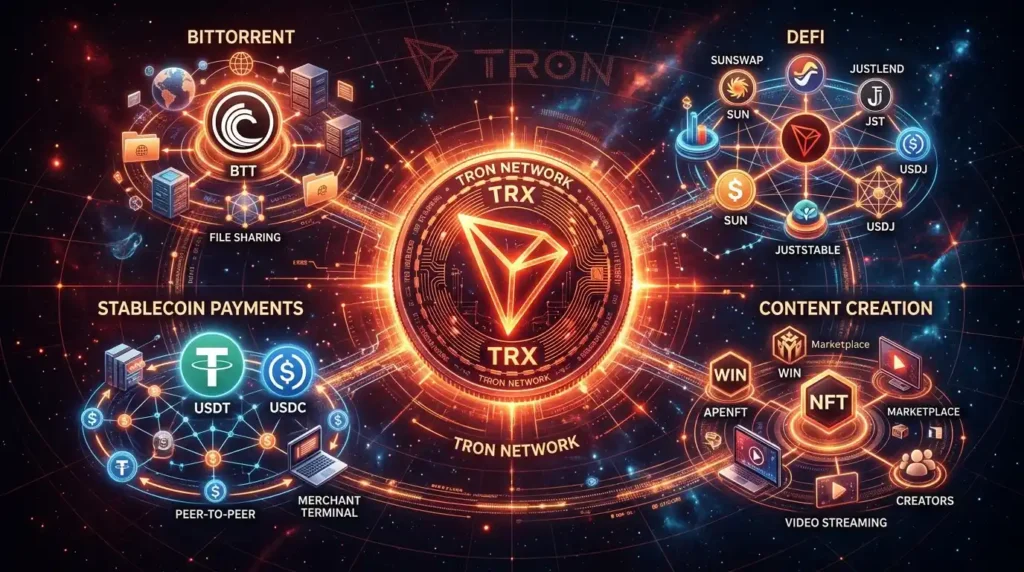
- JustLend DAO — TRON’s lending and borrowing protocol, similar to Aave on Ethereum
- SunSwap — TRON’s decentralized exchange, similar to Uniswap
Combined TVL in TRON’s DeFi ecosystem runs into the billions, though exact figures fluctuate with market conditions.
Content and Entertainment
TRON’s original vision was a decentralized entertainment platform where content creators earn TRX directly from users, without intermediaries like YouTube or Spotify taking large cuts. This use case exists but has not become mainstream.
BitTorrent Ecosystem
TRON’s acquisition of BitTorrent gave it access to a protocol with hundreds of millions of users. BTT (BitTorrent Token) powers an ecosystem of decentralized file-sharing, storage, and streaming services built on TRON’s infrastructure.
The Justin Sun Factor: A Double-Edged Sword
No discussion of TRON is complete without addressing the Justin Sun question: is his continued influence an asset or a liability?
The asset case: Sun is an extraordinarily effective promoter and dealmaker. TRON’s partnerships — BitTorrent, Anchorage Digital, Mastercard — reflect his ability to open institutional doors. His systematic TRX buying creates genuine demand. The network’s growth has occurred under his leadership.
The liability case: Sun’s history includes regulatory investigations, accusations of market manipulation, and promotional activities that have sometimes attracted negative attention from US regulators. In 2023, the SEC filed charges against Sun and TRON-related entities for alleged securities law violations and market manipulation — a case that was still working through the legal system as of early 2026.
For investors: TRON’s infrastructure and utility exist independently of Justin Sun’s legal situation. But his prominence means his legal outcomes could significantly impact TRX’s price and institutional adoption trajectory.
TRON Risks: The Honest Version
Centralization: 27 Super Representatives controlling block production is the most centralized consensus system among major blockchains. If these entities collude or are compromised, the network’s security is at risk.
Justin Sun legal uncertainty: Ongoing SEC proceedings against Sun and TRON-related entities represent a material risk. Adverse rulings could impact TRX significantly.
USDT dependency: TRON’s dominant use case — hosting USDT — creates a dependency risk. If Tether (USDT’s issuer) chose to migrate its primary issuance to another blockchain, or if a competing stablecoin displaced USDT, TRON’s key value proposition diminishes.
Competition: Solana, BNB Chain, and other high-performance blockchains also offer cheap, fast USDT transfers. TRON’s lead in stablecoin infrastructure, while large, is not insurmountable.
Regulatory risk: TRON operates in a complex regulatory environment, particularly in the US. Its historical association with high-volume USDT transfers has drawn scrutiny related to potential use in illicit finance.
How to Buy TRON (TRX) in the US: Step by Step
Note: TRON is not available on Coinbase in the US (as of 2026). Use these alternatives:
Step 1: Choose an exchange supporting TRX
- Kraken — supports TRX, well-regulated in the US
- OKX — largest TRX trading volume globally
- Bybit — strong TRX liquidity
Step 2: Create and verify your account
Standard KYC — government ID required.
Step 3: Deposit funds
Bank transfer or debit card depending on the platform.
Step 4: Buy TRX
Search for TRX or TRON, enter dollar amount, confirm.
Step 5: Storage and staking
- TronLink — the official TRON wallet, browser extension and mobile
- Trust Wallet — supports TRX and TRC-20 tokens
- Ledger — hardware wallet supporting TRX for maximum security
For staking: move TRX to TronLink, freeze TRX to gain Energy/Bandwidth, and vote for Super Representatives to earn staking rewards.
TRON vs Competitors: Where It Fits
| Feature | TRON | Ethereum | Solana |
|---|---|---|---|
| TPS | 2,000 | 15–30 | 1,000+ |
| Block Time | 3 seconds | 12 seconds | 400ms |
| Transaction Fee | Near-zero | $1–20+ | <$0.001 |
| USDT Hosted | $86 billion | ~$75 billion | Growing |
| Consensus | DPoS (27 SRs) | PoS (1M+ validators) | PoH + PoS |
| Decentralization | Low | High | Medium |
| Primary Strength | USDT payments | DeFi and smart contracts | Speed and DeFi |
Key TRON Terminology for Beginners
TRX (Tronix): The native cryptocurrency of the TRON network, used for fees, staking, and governance.
Super Representatives (SRs): The 27 elected block producers who validate transactions on TRON, elected every 6 hours by TRX stakers.
Bandwidth: A TRON resource used for basic TRX transfers — every account gets free daily bandwidth.
Energy: A TRON resource required for smart contract execution, obtained by staking TRX.
DPoS: Delegated Proof of Stake — TRON’s consensus mechanism where token holders vote for a limited number of representatives.
TRC-20: The TRON token standard for fungible tokens, equivalent to Ethereum’s ERC-20. TRC-20 USDT is the most widely used version of USDT globally.
JustLend DAO: TRON’s primary lending protocol — deposit or borrow assets using TRON-based tokens.
SunSwap: TRON’s decentralized exchange — swap TRC-20 tokens with minimal fees.
USDD: TRON’s over-collateralized stablecoin, pegged to $1 and backed by a reserve of TRX, Bitcoin, and other assets.
PayFi: Payment Finance — TRON’s strategic focus on integrating crypto payments into mainstream commerce.
Should You Buy TRON in 2026?
We are not financial advisors. Here’s the most balanced view we can offer.
The case for TRX: TRON is not just a speculative asset — it’s functional infrastructure that processes $21+ billion in daily transactions. The Mastercard partnership could bring TRX and USDT to 90 million merchants. Anchorage Digital’s institutional custody opens regulated access for the first time. Corporate treasury buying creates consistent demand. Near-zero fees and EVM compatibility make it practical for developers and users alike.
The case for caution: 27 Super Representatives is genuinely centralized — institutional investors increasingly care about decentralization. Justin Sun’s ongoing legal situation with the SEC represents a material overhang on the price. TRON’s primary value comes from USDT hosting — a dependency that could shift. The blockchain is functional but not particularly innovative from a technology standpoint.
TRON is the least glamorous token on this list — it doesn’t have Bitcoin’s gold narrative, Ethereum’s smart contract ecosystem, or Solana’s speed story. What it has is unglamorous utility: it’s where most of the world’s USDT actually moves. In crypto, boring infrastructure that actually works at scale is often underappreciated — until it isn’t.
Disclaimer: This article is for informational purposes only and does not constitute financial advice. Cryptocurrency investments carry significant risk, including the potential loss of all invested capital. Always conduct your own research before making any investment decisions.