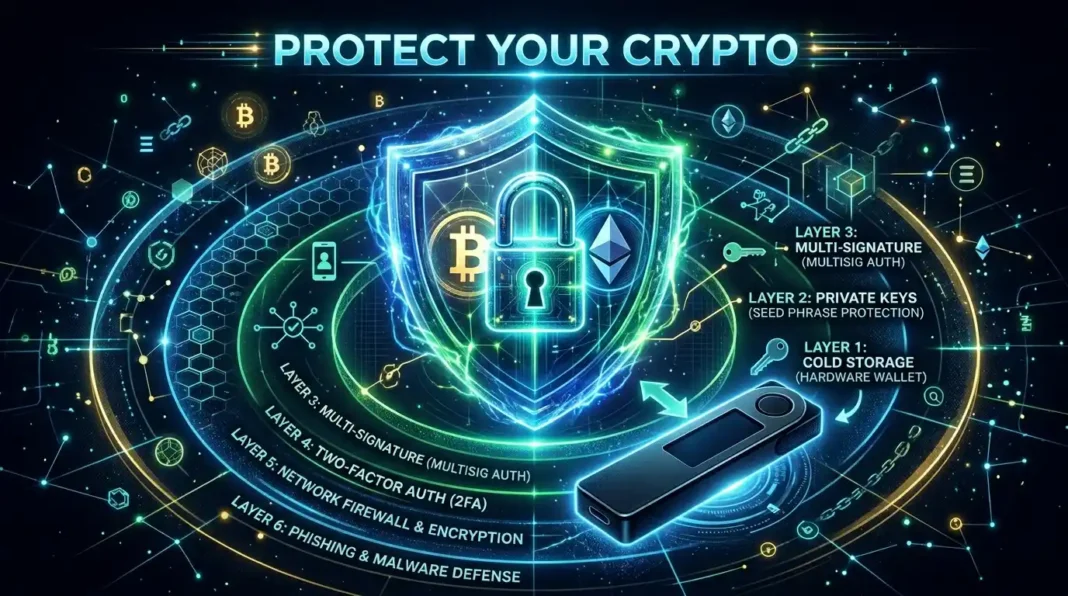
In 2024, cryptocurrency-related scams accounted for $9.3 billion in victim losses — a 66% increase from the previous year, according to the FBI’s Internet Crime Complaint Center. In 2026, that number continues to climb.
The people who lose money to crypto scams aren’t stupid. They’re ordinary investors who encountered sophisticated schemes designed by professionals who study human psychology full-time. Even a bank CEO lost $47 million to a pig butchering scam.
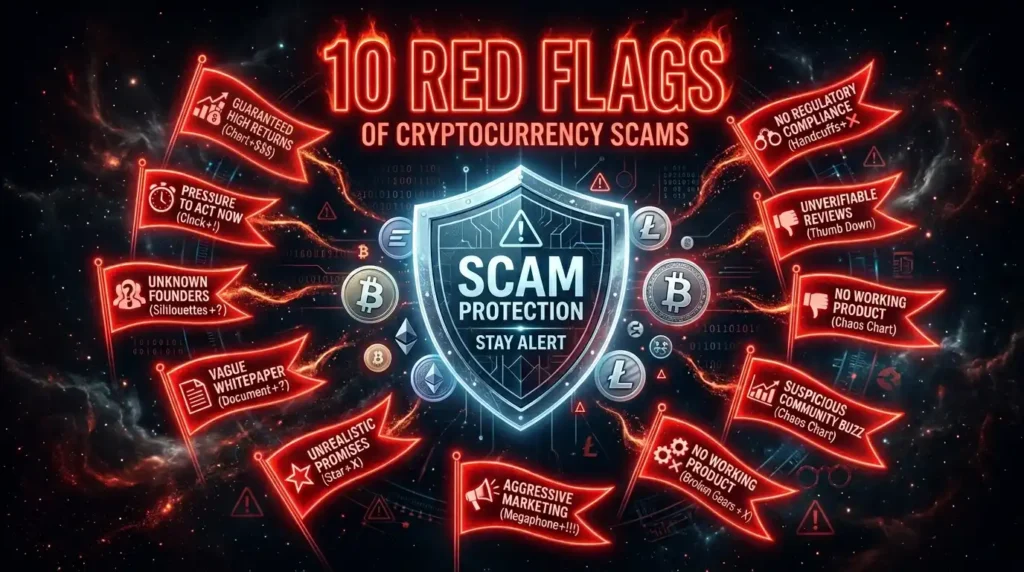
You can’t protect yourself from every threat — but you can dramatically reduce your risk by recognizing the patterns. These 10 red flags cover the vast majority of crypto scams in operation today.
Why Crypto Is the Scammer’s Preferred Tool
Before the red flags, understand why scammers specifically target crypto users:
Irreversibility: Blockchain transactions cannot be reversed. There’s no fraud department to call, no chargeback process. Send crypto to the wrong address — for any reason — and it’s gone.
Speed: Funds can be moved across the world and liquidated within minutes. By the time a victim realizes they’ve been scammed, the money has moved through multiple wallets and crossed multiple blockchains.
Anonymity: While blockchain is public, identifying who controls specific wallets is technically difficult. State-sponsored hacker groups like North Korea’s Lazarus Group (responsible for 61% of platform thefts) operate with near-impunity.
Complexity: Many victims don’t fully understand what they’re approving. Scammers exploit this technical knowledge gap constantly.
The 10 Red Flags

🚩 Red Flag #1: Guaranteed Returns or Risk-Free Profits
The single most reliable indicator of fraud.
No legitimate investment guarantees returns. No one can promise you 10%, 30%, or 500% returns with “no risk.” Crypto is highly volatile — no strategy, algorithm, trading bot, or signal service can eliminate that risk and still generate consistent gains.
If anyone — a person, a platform, or an advertisement — uses phrases like:
- “Guaranteed daily returns”
- “Risk-free investment”
- “100% profit in 30 days”
- “Earn 2% per day on autopilot”
…you are looking at either a Ponzi scheme (paying old investors with new investors’ money until it collapses) or an outright fraud. Walk away immediately.
The psychology: Scammers know that promised certainty is irresistible to people anxious about financial insecurity. They offer what the market genuinely cannot — safety.
🚩 Red Flag #2: A Stranger Offers to Teach You About Crypto Investing
The pig butchering setup.
Pig butchering (“sha zhu pan” in Chinese) is the dominant crypto scam of 2026, having stolen over $75 billion globally since 2020. The FBI considers it a top threat to American investors.
How it works:
A stranger contacts you on social media, a dating app, LinkedIn, or by “wrong number” text. They’re friendly, successful-seeming, often attractive. Over days or weeks they build a genuine relationship — sharing life stories, expressing interest in you, perhaps flirting. They seem wealthy from crypto trading and gradually offer to share their “secret” platform or strategy.
When you invest — initially small amounts that “grow” impressively on a fake interface — you’re encouraged to invest more. Family members and friends get roped in. When you try to withdraw, you’re told you need to pay “taxes,” “fees,” or “upgrade your account.” Every attempt to recover money costs more. Eventually the scammer disappears.
Why it’s so effective: The relationship is real. Victims spend months building genuine emotional connections with people who don’t exist. The FBI found 76% of victims had no idea they were being scammed.
The rule: If someone you met online — regardless of how warm the relationship feels — begins introducing crypto investment opportunities, assume it’s a scam.
🚩 Red Flag #3: Extreme Urgency and Time Pressure
“Act now or miss out forever.”
Scammers manufacture urgency because it prevents you from doing the one thing that would protect you: pausing to research independently.
Warning phrases:
- “Limited spots remaining”
- “Offer expires in 24 hours”
- “Price is about to pump — last chance”
- “The whitelist closes tonight”
- “Don’t miss this once-in-a-lifetime opportunity”
Legitimate investment opportunities don’t evaporate because you took a week to think. Legitimate projects welcome questions and due diligence. Only frauds require instant decisions.
If you feel rushed on a financial decision — especially in crypto — that pressure itself is evidence of a problem. Slow down.
🚩 Red Flag #4: Anyone Asking for Your Seed Phrase or Private Key
Non-negotiable: this is always a scam.
No legitimate wallet, exchange, DeFi protocol, support team, or other service will ever ask for your seed phrase (12 or 24 recovery words) or private key under any circumstances.
These credentials give complete, irrevocable control of your wallet. Anyone who has them can drain every account in seconds.
Common scenarios:
- “Official support” in Discord/Telegram asks for your seed phrase to “fix” a technical issue
- A fake wallet app prompts you to enter your phrase during “setup”
- An email claiming to be from MetaMask/Ledger/Coinbase requests verification
- A “recovery specialist” needs your seed phrase to help you access locked funds
The rule has no exceptions. If anyone asks — regardless of who they claim to be, regardless of how official the interface looks — it is a scam.
🚩 Red Flag #5: Unsolicited Investment Advice or Opportunities
You didn’t ask. They’re offering anyway. That’s a problem.
Legitimate investments don’t need to seek you out unsolicited. If someone contacts you through Telegram, WhatsApp, Discord, email, or social media to offer a crypto investment opportunity — be skeptical by default.
This includes:
- Random DMs offering “insider tips” on upcoming projects
- “Alpha groups” that add you without permission
- Email newsletters promoting obscure tokens
- Social media accounts pushing trading signals
The economics are simple: if someone genuinely had a profitable edge in crypto markets, they wouldn’t share it with strangers. Every “free alpha” either costs you something eventually or is designed to manipulate prices for someone else’s benefit.
🚩 Red Flag #6: Celebrity Endorsements and Giveaway Scams
Elon Musk is not sending you Bitcoin.
Giveaway scams use fake celebrity endorsements to create the illusion of legitimacy. Common formats:
- “Elon Musk is doubling all Bitcoin sent to this address”
- “CZ from Binance is giving away ETH to celebrate the exchange’s anniversary”
- YouTube livestreams with deepfake celebrity faces promoting fake giveaway addresses
- Twitter/X accounts with near-identical names to real celebrities
The model is always the same: send crypto to receive more back. You send. You receive nothing.
In 2026, AI-generated deepfake videos make these scams dramatically more convincing. A video of a celebrity’s face saying exactly what a scammer wants them to say is now simple to produce.
The rule: No legitimate giveaway requires you to send crypto first. This mechanic — “send X to receive 2X back” — has no legitimate version.
🚩 Red Flag #7: Platforms That Show Easy Profits But Block Withdrawals
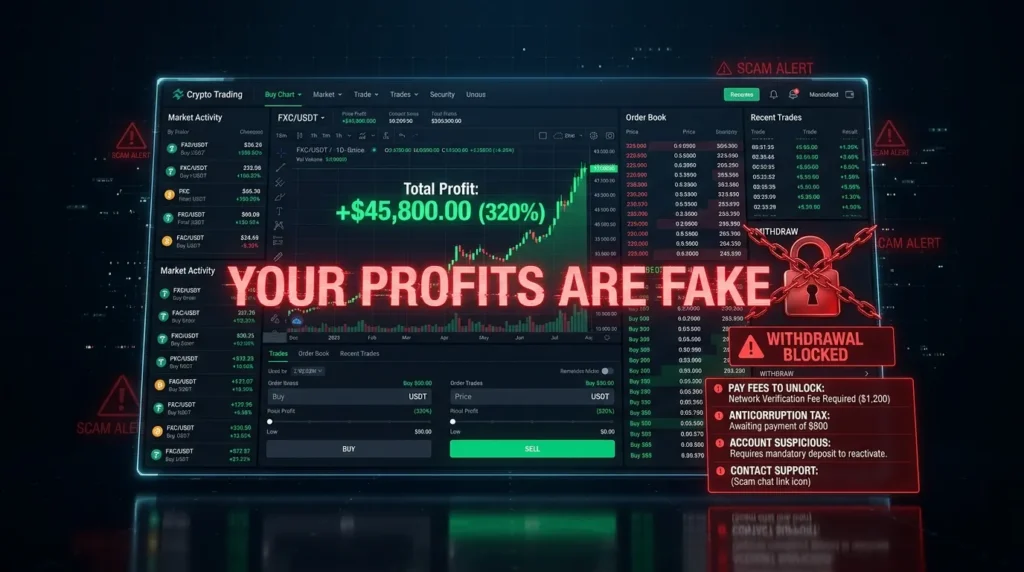
The fake trading platform.
Scammers create convincing fake exchanges and trading platforms that show users accumulating impressive profits. The interface looks real. Charts move. “Profits” grow. But when you try to withdraw — you can’t.
Common excuses for blocked withdrawals:
- “You must pay a 15% tax before withdrawal”
- “Your account needs to reach VIP status first — invest $X more”
- “There’s a technical verification fee”
- “KYC requires a deposit to unlock withdrawals”
None of these are legitimate. Real exchanges never require additional deposits to unlock withdrawals. Every “fee” or “tax” you pay to unlock money is another loss — the funds never existed.
Verification: Before depositing on any exchange or trading platform, search the company name + “scam,” “withdrawal problems,” or “complaint” on Google and Reddit. A few minutes of research prevents enormous losses.
🚩 Red Flag #8: Anonymous Team with No Verifiable History
If they won’t show their faces, ask why.
Legitimate projects have identifiable founders with real professional histories — LinkedIn profiles that predate the project, GitHub contributions, conference appearances, prior work history.
Red flags for team credibility:
- Pseudonymous founders with no prior track record outside this project
- AI-generated headshot photos (detectable with reverse image search)
- Team members whose LinkedIn profiles were created recently
- No team information at all
- Claims of prestigious backgrounds with no verifiable evidence
Some legitimate early-stage projects have privacy concerns, but the standard in serious crypto development is increasing transparency, not decreasing it. Anonymous teams have no accountability if things go wrong.
🚩 Red Flag #9: Promises of Huge Returns from Recruiting Others
The pyramid/MLM structure.
If an investment platform’s returns are primarily generated by recruiting new investors rather than by the platform’s actual product or service — that’s a pyramid scheme structure, which is both a scam and illegal in most jurisdictions.
Warning signs of pyramid structures:
- Bonuses for referring friends and family
- Multi-level commissions on your recruits’ investments
- More emphasis on recruitment than on the product
- Promises that returns increase based on how many people you bring in
- Testimonials focused on people who “made it big” by growing their downline
Legitimate investments pay returns based on the investment itself — not on how many other people you convince to join.
🚩 Red Flag #10: “Recovery Services” After You’ve Been Scammed
The second scam targeting scam victims.
After being defrauded, victims are desperate and vulnerable. Scammers know this and specifically target them with fake recovery services.
The pattern: You post publicly about being scammed (on Reddit, Twitter, a forum). Within hours, you receive DMs from “blockchain investigators,” “crypto recovery specialists,” or “ethical hackers” who claim they can retrieve your stolen funds — for an upfront fee.
These are invariably scams. The stolen funds are either irrecoverable or would require law enforcement action — not private services charging upfront fees. The Chainalysis 2025 report documented victims losing an additional $100,000+ to fake recovery services after initial losses.
The rule: If someone approaches you unsolicited after you’ve been scammed, assume they’re running a second scam.
What to Do If You’ve Been Scammed
Act quickly — time matters.
- Stop sending money immediately. Every additional payment to “unlock” funds, pay “taxes,” or reach “VIP status” is another loss.
- Report to authorities:
- FBI Internet Crime Complaint Center: ic3.gov
- Federal Trade Commission: reportfraud.ftc.gov
- CFTC: cftc.gov/complaint
- Your state’s financial regulatory authority
- Contact your bank or exchange immediately if fiat money is still in transit. Banks can sometimes reverse wire transfers if notified quickly enough. Crypto exchanges may be able to flag destination addresses.
- Document everything: Screenshots of all communications, transaction IDs, wallet addresses, website URLs. This documentation helps law enforcement investigations even if your specific funds aren’t recovered.
- Avoid “recovery” services. Only about 10% of stolen crypto is ever recovered — and that recovery comes through law enforcement action, not paid services.
The Protection Checklist
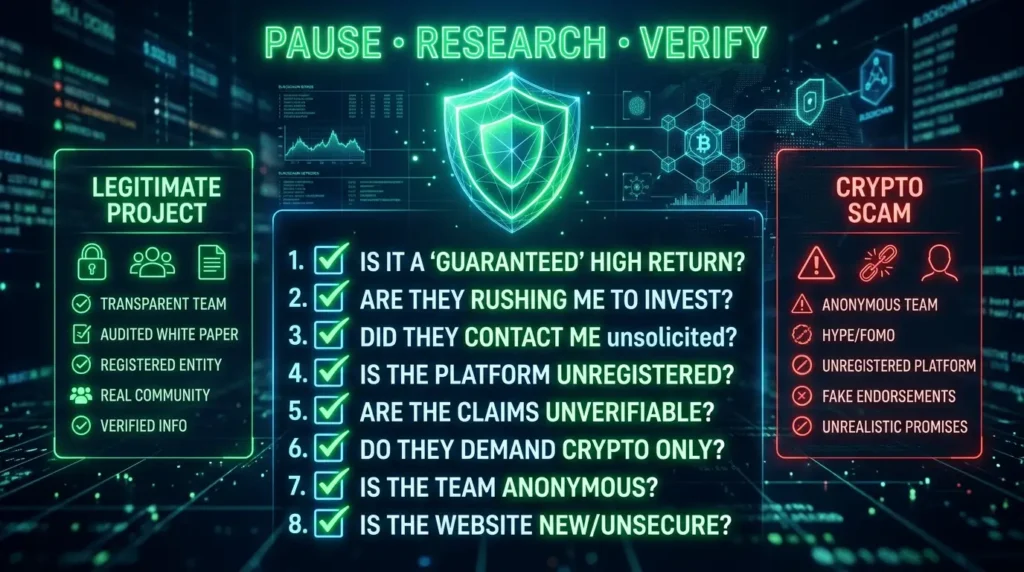
Before any crypto transaction or investment:
- [ ] Did I seek this out, or did someone bring it to me unsolicited?
- [ ] Is there any promise of guaranteed returns?
- [ ] Am I feeling rushed to decide quickly?
- [ ] Have I independently verified this platform/person exists and is legitimate?
- [ ] Has anyone asked for my seed phrase or private key?
- [ ] Have I searched “[platform/project name] + scam” online?
- [ ] Does the team have verifiable real identities?
- [ ] Can I find independent reviews outside the project’s own channels?
- [ ] If something sounds too good to be true — is it?
If multiple questions raise concerns, stop. A legitimate opportunity will still exist after a week of due diligence. A scam won’t wait.
Key Terminology
Pig Butchering: Long-term relationship scam where trust is built over weeks before an investment fraud is introduced.
Phishing: Using fake websites, emails, or messages to trick victims into revealing credentials or approving malicious transactions.
Ponzi Scheme: Investment fraud paying returns to early investors using money from new investors, not from genuine profit.
Pump and Dump: Artificially inflating a token’s price through coordinated buying and fake hype, then selling to retail buyers.
Rug Pull: Crypto project where developers drain liquidity and disappear after raising investor funds.
Recovery Scam: Secondary fraud targeting people who’ve already been scammed, offering fake fund recovery services for upfront fees.
Deepfake: AI-generated video or audio mimicking a real person — used in celebrity endorsement scams.
The Bottom Line
Crypto scams work because they’re psychologically sophisticated, not technically sophisticated. They exploit urgency, trust, authority, greed, and fear. The patterns repeat across thousands of different schemes.
Recognizing those patterns — guaranteed returns, urgency pressure, seed phrase requests, online strangers offering investment help, platforms that take deposits but block withdrawals — is the single most effective defense available.
Pause. Research. Verify independently. Never send more money to get your money back.
The crypto opportunity is real. The scams trying to steal it from you are also real. 🔍🛡️
Disclaimer: This article is for informational purposes only and does not constitute financial advice. Cryptocurrency investments carry significant risk, including the potential loss of all invested capital. Always conduct your own research before making any investment decisions.