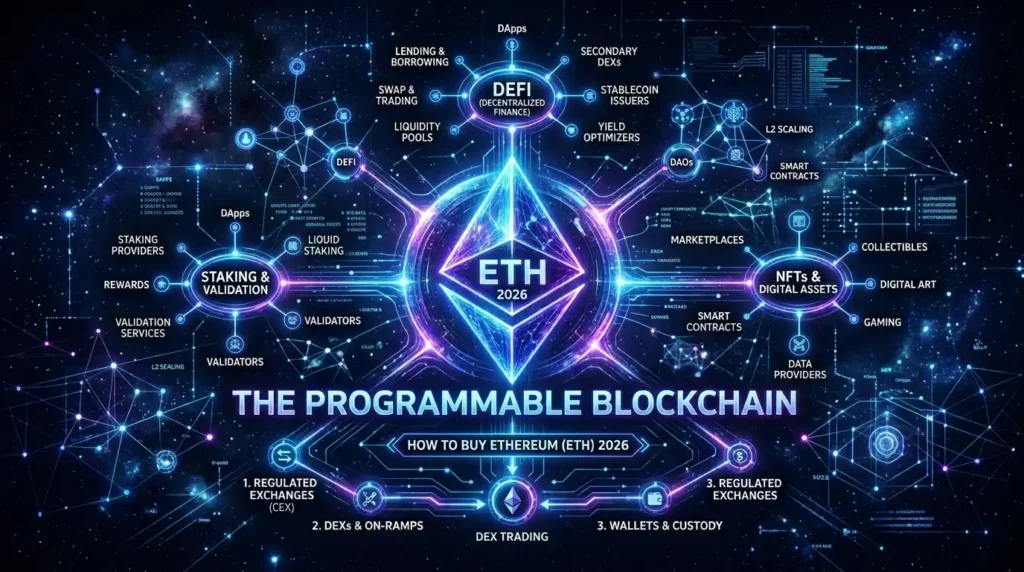
Ethereum is the second-largest cryptocurrency by market capitalization and the most widely used programmable blockchain in the world. Unlike Bitcoin — which is primarily a store of value — Ethereum powers an entire ecosystem: decentralized applications (dApps), DeFi protocols, NFTs, and tokenized real-world assets.
Buying ETH in 2026 is straightforward. What makes Ethereum distinct from Bitcoin is what you can do with it after you buy it — and this guide covers that too.
Ethereum vs Bitcoin: Which Should You Buy First?
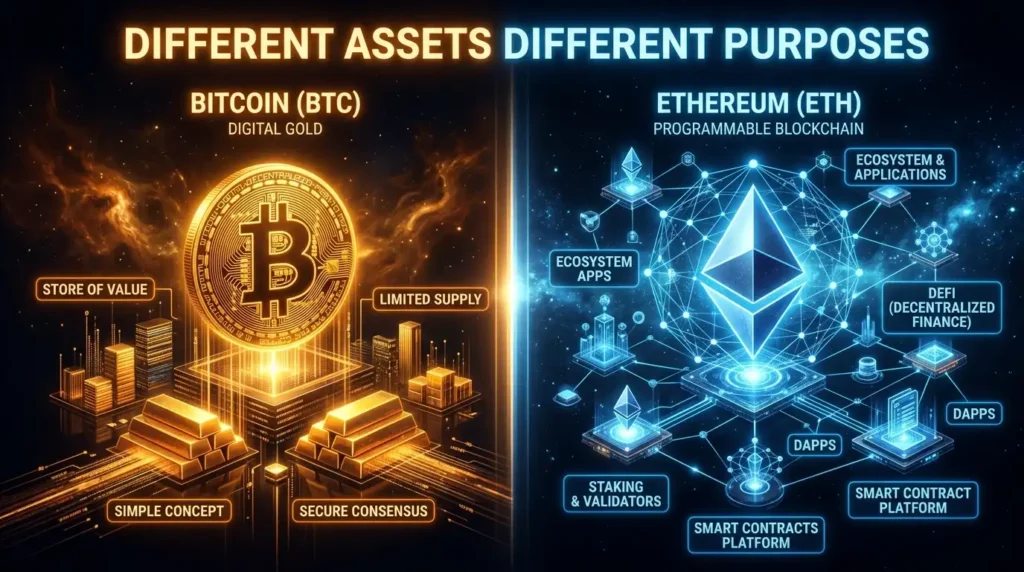
This is the most common question from new crypto investors. The honest answer: they’re different assets serving different purposes.
Bitcoin:
- Digital store of value — “digital gold”
- Simpler, more established, higher liquidity
- Fixed supply of 21 million BTC
- Primary use: hold long-term as an inflation hedge
Ethereum:
- Programmable blockchain — powers applications
- Used to pay gas fees on thousands of apps and DeFi protocols
- Proof of Stake — you can earn passive income by staking
- Broader ecosystem: DeFi, NFTs, Layer 2 networks (Arbitrum, Base, Optimism)
- Deflationary mechanism — ETH can be burned, reducing supply over time
Many investors hold both. Bitcoin as a conservative long-term store of value, Ethereum as exposure to the programmable blockchain ecosystem. Neither is objectively “better” — it depends on your goals.
3 Ways to Get Ethereum Exposure in 2026
Before buying, understand which approach fits your goals:
Option 1: Buy Spot ETH on an Exchange
You own actual Ethereum. You can:
- Transfer it to a personal wallet
- Use it in DeFi applications
- Stake it to earn passive income
- Move it to any compatible address globally
Best for: Anyone who wants to actually own and use Ethereum.
Option 2: Ethereum ETF
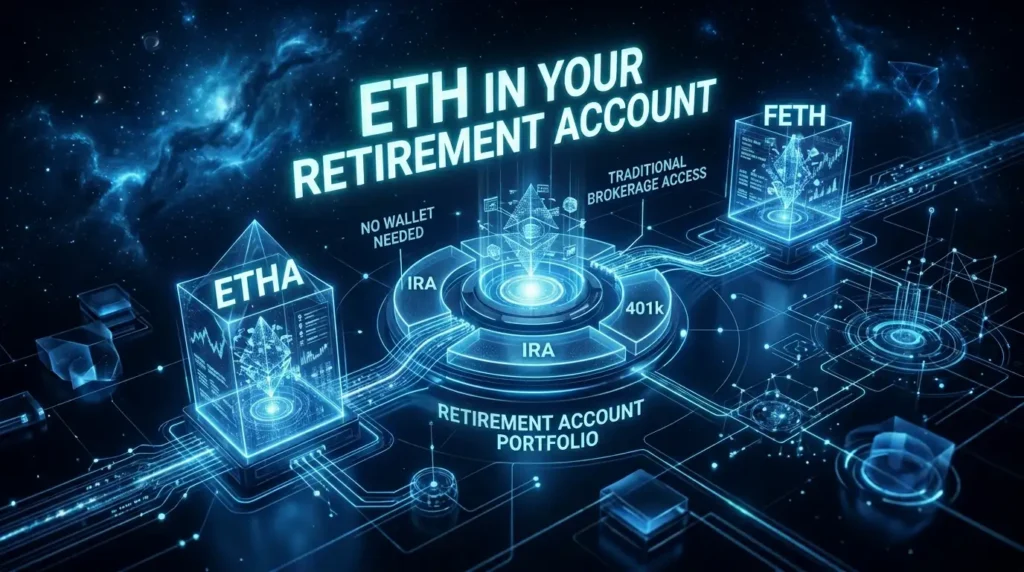
Spot Ethereum ETFs launched in the US in July 2024. As of early 2026, major products include BlackRock’s ETHA ($6B+ in assets) and Fidelity’s FETH.
You buy shares through a standard brokerage (Fidelity, Schwab, etc.) — no wallet required.
Advantages: Available in IRAs, familiar interface, no wallet management
Disadvantages: Annual management fee (0.20–0.25%), no actual ETH ownership, no DeFi access
Staking ETFs: Grayscale’s ETHE participates in Ethereum staking, passing rewards (2–3% net) to shareholders. BlackRock’s ETHB also offers staked exposure.
Best for: Investors who want simple price exposure, especially in retirement accounts.
Option 3: Fintech Apps (Robinhood, PayPal, Cash App)
Quick and familiar, but you typically don’t own actual ETH — you own a price-tracking instrument. Withdrawals to personal wallets may be limited.
Best for: Casual exposure only — not for DeFi or self-custody.
Step-by-Step: How to Buy Ethereum on an Exchange
Step 1: Choose Your Exchange
For US users:
Coinbase — Most beginner-friendly. Clean interface, FDIC on USD, NASDAQ-listed. Simple one-tap ETH purchase. Available in all US states.
Kraken — Excellent security track record, competitive fees on Kraken Pro, strong staking options for ETH. Not available in Maine or New York.
Binance.US — Lowest fees for spot ETH in the US market. Less features but solid for straightforward purchases.
Gemini — Available in New York. Clean interface, strong compliance.
Step 2: Create and Verify Your Account
- Go to the official exchange website (use a bookmark — don’t search)
- Sign up with email + strong password
- Verify your email
- Complete KYC — upload government ID, complete selfie verification
- Enable 2FA — authenticator app (Google Authenticator or Authy), not SMS
Step 3: Fund Your Account
| Method | Fee | Speed |
|---|---|---|
| ACH bank transfer | Free | 1–3 business days |
| Wire transfer | $10–25 | Same or next day |
| Debit card | 2–4% | Instant |
Recommendation: Bank transfer (ACH) for lowest cost. Debit card if you want to buy immediately.
Step 4: Buy ETH
- Navigate to Buy → select Ethereum (ETH)
- Enter the dollar amount (you can buy any fraction — even $20 worth)
- Review the fee and total ETH you’ll receive
- Confirm the purchase
Ethereum is divisible — you don’t need to buy a whole ETH. At current prices (~$2,000–$3,000 range in 2026), even small purchases give you meaningful ETH exposure.
Step 5: Decide What to Do With Your ETH
Once you own ETH, you have several options:
Hold on the exchange: Simplest. Fine for small amounts and beginners. Exchange handles custody.
Transfer to a personal wallet: MetaMask (most popular Ethereum wallet), Rabby, or a hardware wallet (Ledger, Trezor). You control the private keys. Enables DeFi access.
Stake it for passive income: Earn yield on your ETH holdings (more on this below).
ETH Staking: Earning Passive Income on Your Ethereum
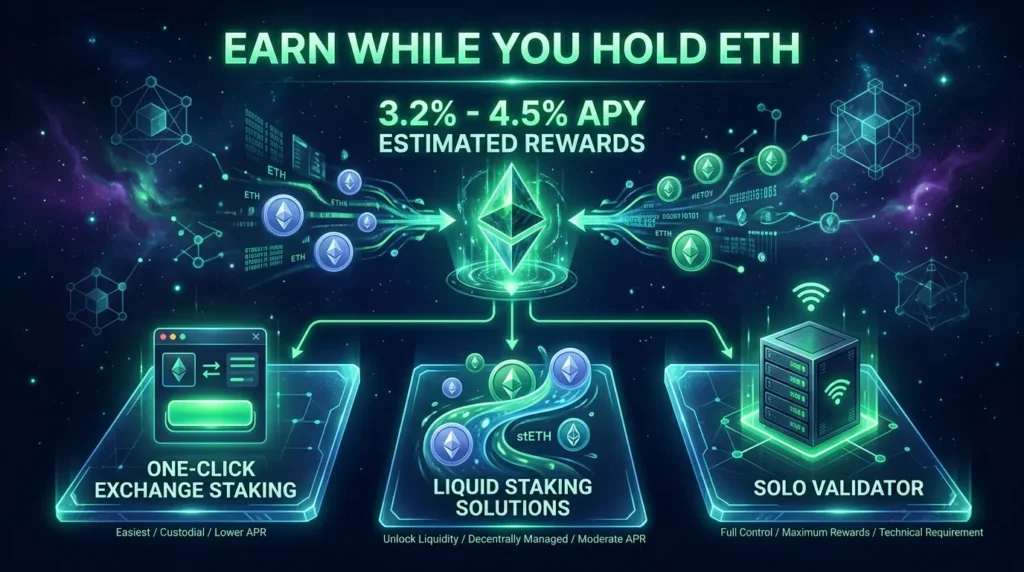
One of Ethereum’s key advantages over Bitcoin is staking — you can earn passive income simply by holding ETH.
Since Ethereum’s Merge in September 2022, the network runs on Proof of Stake. Validators lock up ETH to secure the network and earn rewards in return.
Current staking yields (2026): Approximately 3.2–4.5% APY depending on method and conditions.
Staking Methods
Exchange staking (Easiest)
Coinbase and Kraken offer one-click ETH staking directly in the platform.
- Coinbase: ~2.5–3.2% effective APY (25% commission taken)
- Kraken: Competitive rates, varies by region
- No technical knowledge required
- Funds stay on the exchange (counterparty risk)
Liquid staking (Recommended for self-custody users)
Platforms like Lido (stETH) allow you to stake ETH and receive a liquid token you can still use in DeFi.
- ~3.5–4.0% APY
- stETH can be used in DeFi protocols while staking
- Smart contract risk applies
Solo staking (Advanced)
Run your own validator node. Requires 32 ETH (~$64,000–$96,000), technical setup, dedicated hardware.
- Highest rewards, full control
- Not practical for most retail investors
For beginners: Exchange staking on Coinbase or Kraken is the simplest path to earning yield on ETH.
Gas Fees in 2026: What You Need to Know
Gas fees are the transaction costs paid to Ethereum validators when you do anything on the Ethereum network — transfer ETH, interact with a DeFi protocol, mint an NFT.
Good news for 2026: After multiple network upgrades including EIP-4844 (Proto-Danksharding), gas fees on Ethereum mainnet are significantly lower than in previous years. A simple ETH transfer now typically costs $0.01–$0.50.
Layer 2 networks (Arbitrum, Optimism, Base, zkSync) are even cheaper — often under $0.01 per transaction — while using Ethereum’s security.
Practical implications:
- Buying ETH on a centralized exchange: no gas fees (exchange handles this)
- Withdrawing ETH to MetaMask or another wallet: small gas fee (~$0.01–$0.50)
- Using ETH in DeFi: gas fees vary by network congestion
What Makes Ethereum Unique in 2026
Institutional adoption: BlackRock, Fidelity, and other major financial institutions are actively building on Ethereum. BlackRock’s tokenized money market fund BUIDL runs on Ethereum. Trillions in real-world assets are being tokenized on the network.
Deflationary supply: Ethereum burns a portion of transaction fees (EIP-1559). During periods of high activity, more ETH is burned than is issued — making it deflationary. This is fundamentally different from Bitcoin’s fixed-supply model and from most other cryptocurrencies.
Layer 2 ecosystem: Arbitrum, Base (built by Coinbase), Optimism, and others extend Ethereum’s capacity while reducing costs. Most DeFi activity is increasingly happening on L2s while settling on Ethereum mainnet.
Developer ecosystem: Ethereum has the largest developer community in crypto. More builders = more applications = more demand for ETH.
Ethereum Fees: What You’ll Actually Pay to Buy
On Coinbase Simple Trade: ~1.5% spread + convenience fee
On Coinbase Advanced Trade: 0.40%/0.60% maker/taker
On Kraken standard: 1% flat
On Kraken Pro: 0.25%/0.40% maker/taker base
On Binance.US: 0.38%/0.57% spot base (0% on ETH/USDT pair)
Using the advanced interface saves significantly on fees — particularly for larger purchases.
Taxes on Ethereum (US)
The IRS treats ETH as property — the same rules as Bitcoin:
- Buying ETH: Not taxable
- Selling ETH for profit: Short-term or long-term capital gains
- Trading ETH for another crypto: Taxable event
- Staking rewards: Taxable as ordinary income when received (at fair market value)
- Using ETH to pay gas fees: Technically a disposal — small taxable events
The staking rewards taxation is an important distinction from Bitcoin. Every time you receive staking rewards, the fair market value at receipt is ordinary income. Track this carefully, or use crypto tax software (CoinTracker, Koinly) to automate tracking.
Key Terminology
ETH: Ticker symbol for Ether — the native cryptocurrency of the Ethereum network.
Gas fees: Transaction costs on the Ethereum network — paid to validators.
Staking: Locking ETH to help secure the Ethereum network and earn rewards (3–4.5% APY).
Proof of Stake (PoS): Ethereum’s consensus mechanism since September 2022 — validators stake ETH instead of miners using computing power.
Liquid staking: Stake ETH and receive a tradeable token (stETH) that can still be used in DeFi.
Layer 2 (L2): Networks built on top of Ethereum (Arbitrum, Base, Optimism) that provide faster, cheaper transactions.
DeFi: Decentralized Finance — financial applications built on Ethereum (lending, trading, yield farming).
Gas (unit): The unit measuring computational effort on Ethereum — not the same as “gas fee.”
The Bottom Line
Buying Ethereum in 2026 is straightforward — the same process as buying Bitcoin on the same exchanges. What makes ETH distinct is the ecosystem around it: you can stake it for yield, use it in DeFi, hold it in an ETF for retirement accounts, or simply hold it as a long-term investment.
Quick start:
- Open Coinbase or Kraken account
- Complete KYC + enable 2FA
- Add bank account (ACH for lowest fees)
- Buy your first ETH — start with $50–$200
- Consider staking on the exchange for passive income
- For larger amounts: move to a hardware wallet
Welcome to Ethereum. 💎
Disclaimer: This article is for informational purposes only and does not constitute financial advice. Cryptocurrency investments carry significant risk, including the potential loss of all invested capital. TheHashmark.com may receive a commission if you sign up through affiliate links, at no additional cost to you. Always conduct your own research before making any investment decisions.