Every cryptocurrency you’ve heard of — Bitcoin, Ethereum, Solana — has one thing in common: the price can move 10%, 20%, or 50% in a single day. This volatility makes them exciting as investments but terrible for everyday use.
Imagine trying to price a cup of coffee in Bitcoin when Bitcoin’s value might be completely different by the time you finish drinking it.
Stablecoins solve this problem. They’re cryptocurrencies designed to do something unusual: stay the same price.
And in 2026, they’ve become far more than a trading tool. The total stablecoin market cap exceeds $230 billion. Visa now settles transactions in USDC on the Solana blockchain. Businesses pay salaries in USDT. Billions of people in countries with weak currencies use stablecoins as their primary dollar savings. They’re the infrastructure that makes the entire crypto economy function.
The Quick Answer: What Is a Stablecoin?
A stablecoin is a cryptocurrency pegged to the value of a stable asset — almost always the US dollar. The goal: 1 stablecoin = $1.00, always.
While Bitcoin might trade at $72,000 today and $45,000 next month, 1 USDT should be worth $1 today, next month, and next year.
Think of a stablecoin as a digital dollar that moves on blockchain rails. It has the stability of cash but the speed, programmability, and global reach of cryptocurrency.
The mechanism that maintains this stability varies by type — but the core idea is the same: for every stablecoin in circulation, there must be $1 worth of backing somewhere, held by someone or managed by code.
Why Do Stablecoins Exist? The Problem They Solve
To understand stablecoins, you need to understand the fundamental tension in crypto.
Cryptocurrencies like Bitcoin are excellent stores of value and investment assets — but their volatility makes them impractical for everyday transactions. Nobody wants to accept Bitcoin as payment for a product if it might be worth 20% less tomorrow.
At the same time, traditional dollars can’t be used natively on blockchains. You can’t send USD through a smart contract. You can’t use it in DeFi. You can’t transfer it to someone on the other side of the world in 3 seconds for a fraction of a cent.
Stablecoins bridge this gap. They combine:
- The stability of traditional currency (the US dollar)
- The speed, programmability, and accessibility of cryptocurrency
The result: a digital asset that traders use to park funds during market volatility, that DeFi protocols use as collateral, that workers receive as salaries, and that individuals use to send money internationally without bank accounts or wire fees.
The Three Types of Stablecoins
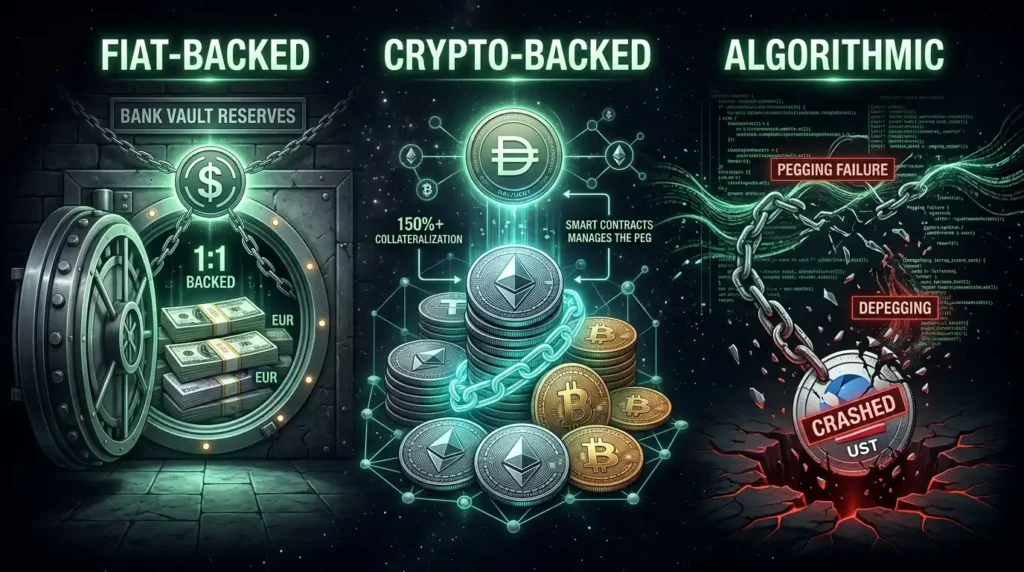
Not all stablecoins work the same way. There are three main mechanisms — each with different tradeoffs.
Type 1: Fiat-Backed Stablecoins
The simplest and most common type. A company holds actual US dollars (or US Treasury bonds) in a bank account and issues one stablecoin token for every dollar held. To redeem, you return the token and receive a dollar back.
Strengths: Simple, highly trusted, deeply liquid. Easy to understand.
Weaknesses: Centralized — the issuing company controls everything. They can freeze tokens, can face regulatory action, and you must trust their reserve claims.
Examples: USDT, USDC
Type 2: Crypto-Backed Stablecoins
Instead of holding dollars, these stablecoins are backed by other cryptocurrencies locked in smart contracts. Because crypto is volatile, the system requires over-collateralization: you deposit $150 worth of ETH to mint $100 in stablecoins. The extra buffer absorbs collateral price swings.
Strengths: Decentralized, transparent (all collateral visible on-chain), no central authority can freeze tokens.
Weaknesses: Capital inefficient, complex, vulnerable to cascading liquidations in extreme crashes.
Example: DAI
Type 3: Algorithmic Stablecoins
The most ambitious and most dangerous type. These hold no reserves — algorithms and token incentive mechanisms automatically expand or contract supply to maintain the $1 peg.
The most famous example is TerraUSD (UST) — which collapsed spectacularly in May 2022, losing its peg and wiping out an estimated $40–50 billion in value within a week. The lesson from UST: without real collateral, stablecoins are only as stable as market confidence — and market confidence can evaporate in hours. We cover this in detail below.
The Big Three: USDT, USDC, and DAI
USDT (Tether) — The Liquidity King
Launched: 2014 | Issuer: Tether Limited | Market Cap: ~$143 billion
USDT is the largest stablecoin and the third-largest crypto asset overall, after Bitcoin and Ethereum. More than 186 billion USDT are in circulation as of early 2026. It’s available on virtually every exchange, in virtually every trading pair, across more than a dozen blockchains — including Ethereum, TRON (where over $86 billion USDT circulates), Solana, and BNB Chain.
Why traders love USDT: Unmatched liquidity. If you want to move in and out of crypto positions quickly, USDT is the default. It’s accepted everywhere.
The controversy: Tether has faced years of scrutiny about its reserves. For a long time, it was unclear whether all USDT was fully backed. Tether has paid regulatory fines and improved reporting over time, but as of 2026 still doesn’t publish fully independent audits. The counterparty is Tether Limited, a private company.
Bottom line: The most liquid and widely used stablecoin. 12+ years of operation without a catastrophic failure provides some confidence. Reserve transparency remains a legitimate concern for large holders.
USDC (USD Coin) — The Compliance Champion
Launched: 2018 | Issuer: Circle | Market Cap: ~$60 billion
USDC was built from day one with regulatory compliance and transparency as core principles. Circle holds reserves primarily in cash and short-term US Treasury bonds, publishes monthly attestation reports verified by independent auditors, and offers daily portfolio reporting through BlackRock fund disclosures. Circle is pursuing a US IPO.
In December 2025, Visa launched USDC settlement for US banks — allowing financial institutions to settle transactions over the Solana blockchain, 7 days a week including weekends. A sign that stablecoins are becoming genuine financial infrastructure.
Why institutions love USDC: Transparency, regulatory clarity, and auditability.
The tradeoff: Because USDC is compliant, Circle can — and does — freeze specific wallet addresses on law enforcement request. Both Tether and Circle have frozen millions of dollars. This makes USDC more trustworthy in terms of reserve backing, but more censurable than decentralized options.
Bottom line: Preferred by institutions, regulated businesses, and DeFi protocols that prioritize transparency. Slightly less liquid than USDT on crypto exchanges but dominant in TradFi-adjacent use cases.
DAI — The Decentralized Alternative
Launched: 2017 | Issuer: MakerDAO/Sky protocol | Market Cap: ~$5 billion
DAI is fundamentally different. There’s no company behind it. No bank accounts. No centralized reserves. DAI is created entirely by smart contracts — users deposit crypto assets (primarily ETH and wBTC) as collateral at 150–200% collateralization ratios, and DAI is minted against that locked collateral.
All collateral is publicly visible on-chain. All governance decisions are made by MKR token holders. No single entity can freeze your DAI. In 2024, MakerDAO rebranded to Sky, introducing USDS as a newer version that can be upgraded from DAI 1:1.
Why DeFi users love DAI: True decentralization, censorship resistance, on-chain transparency. No counterparty risk from a centralized issuer.
The risks: DAI’s stability depends on liquidation mechanisms working correctly. During the March 2020 market crash, DAI briefly lost its peg due to liquidation failures. The system has since been significantly improved. Also, DAI now holds some centralized stablecoins in its collateral mix — a tradeoff some users see as compromising its decentralization.
Bottom line: Smaller market cap and lower liquidity than USDT or USDC, but uniquely valuable for users who need a censorship-resistant, decentralized option. Essential infrastructure for DeFi.
The UST Collapse: The Most Important Stablecoin Story
No stablecoin discussion is complete without TerraUSD (UST).
In May 2022, UST was the third-largest stablecoin with an $18 billion market cap. It was algorithmic — maintaining its $1 peg through a mint-and-burn mechanism with its sister token LUNA. When demand for UST increased, LUNA was burned to mint more UST. When demand fell, UST was burned to mint LUNA.
It worked — until it didn’t.

A series of large UST sells began. The peg started slipping. Users rushed to redeem UST for LUNA, which crashed LUNA’s price, which reduced confidence in the peg, which caused more sells, which caused hyperinflation of LUNA, which destroyed confidence in UST entirely.
Within a week: UST went from $1.00 to near zero. LUNA went from $80+ to fractions of a cent. An estimated $40–50 billion in value was wiped out. Thousands of retail investors lost their life savings. It triggered a broader crypto market crash that lasted throughout 2022.
The lesson is simple: Without real collateral, a stablecoin is only as stable as market confidence. And when confidence breaks in crypto, it breaks fast.
Algorithmic stablecoins are not inherently impossible to build correctly — but UST’s collapse proved that the incentive mechanisms must be extremely robust. Treat any “stablecoin” offering unusually high yields without clear collateral backing as a major red flag.
What Are Stablecoins Actually Used For?
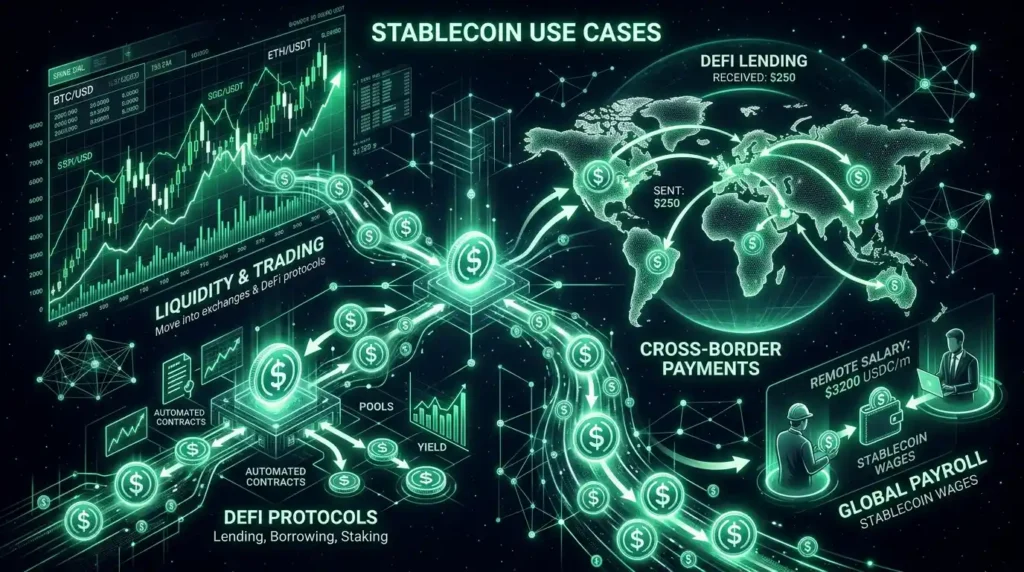
Trading and Portfolio Management
When you want to “exit” a volatile crypto position without going to fiat (which involves bank transfers and tax events), you sell into USDT or USDC. You preserve dollar value while staying in the crypto ecosystem. This is called “going to stables.”
DeFi Lending and Yield
In platforms like Aave and Compound, you can deposit stablecoins and earn interest from borrowers. In 2026, sustainable stablecoin yields on established platforms range from 4–8% APY. Anything offering 15%+ with no clear explanation of the yield source is almost certainly a scam or carrying hidden risks.
Cross-Border Payments and Remittances
Sending $10,000 in USDC on Solana costs a few cents and settles in seconds. Compare this to international wire transfers costing $25–$50 and taking 1–5 business days. Countries with unstable local currencies — Argentina, Nigeria, Turkey — have seen significant grassroots adoption of USDT as a parallel dollar savings system.
DeFi Infrastructure
Virtually every decentralized exchange has stablecoin trading pairs. Providing liquidity to stablecoin pools on platforms like Curve Finance earns trading fees. The USDT/USDC/DAI “3pool” on Curve is one of the most-used liquidity pools in all of DeFi.
Dollar Savings for the Unbanked
Globally, over 1.4 billion adults don’t have bank accounts. Stablecoins allow anyone with a smartphone to hold dollar-denominated savings, earn yield, and send money internationally — without a single bank account required.
The Risks of Stablecoins — The Honest Part
Stablecoins are not risk-free. Here’s what can go wrong:
Depeg Events: Even the best stablecoins can lose their $1 peg temporarily. USDC briefly traded at $0.87 in March 2023 when Circle revealed it had $3.3 billion in deposits at Silicon Valley Bank — which had just collapsed. The peg recovered fully within days, but it showed that even well-backed stablecoins carry real risks.
Centralization and Censorship: USDT and USDC issuers can freeze any wallet address — and have done so hundreds of times in response to law enforcement requests. For users in certain countries or situations, this censorship risk is real and significant.
Reserve Risk: For fiat-backed stablecoins, you’re trusting the issuer’s claims about their reserves. If an issuer overstates reserves or manages them poorly, a “bank run” could expose a shortfall.
Smart Contract Risk: For DAI and similar crypto-backed stablecoins, bugs in the underlying code can drain collateral or break the peg mechanism.
Regulatory Risk: The EU’s MiCA regulation took effect in 2024 and effectively restricts non-compliant stablecoins in Europe. The US GENIUS Act is progressing toward a federal framework. Regulatory changes can affect which stablecoins you can access.
Quick Comparison: USDT vs USDC vs DAI
| Feature | USDT | USDC | DAI |
|---|---|---|---|
| Issuer | Tether Limited | Circle | MakerDAO/Sky |
| Type | Fiat-backed | Fiat-backed | Crypto-backed |
| Market Cap | ~$143B | ~$60B | ~$5B |
| Reserve transparency | Quarterly | Monthly audited | Full on-chain |
| Can freeze wallets? | Yes | Yes | No |
| Decentralized? | No | No | Yes |
| Best for | Trading liquidity | Institutional, DeFi | DeFi, censorship resistance |
| Key risk | Reserve opacity | Regulatory compliance | Liquidation cascade |
Key Stablecoin Terminology
Peg: The target value a stablecoin aims to maintain — usually $1.00 USD.
Depeg: When a stablecoin’s price deviates significantly from its target value.
Fiat-Backed: A stablecoin backed by actual fiat currency held in bank accounts.
Over-Collateralization: Depositing more collateral than the value of stablecoins minted — a safety buffer for crypto-backed stablecoins.
Algorithmic Stablecoin: A stablecoin using code and token mechanisms instead of reserves. High risk — see UST collapse.
Attestation: A third-party verification of reserves. Better than nothing, but not a full audit.
Wallet Freeze: The ability of a centralized stablecoin issuer to render specific tokens non-transferable.
DSR (DAI Savings Rate): A mechanism allowing DAI holders to earn yield by depositing into the MakerDAO protocol.
Going to Stables: The act of selling volatile crypto positions for stablecoins during uncertain market conditions.
The Bottom Line
Stablecoins are not exciting. They don’t go up 100x. They’re designed specifically to not do that.
But they are arguably the most important innovation in crypto after Bitcoin itself. They’re the bridge between the old financial world and the new one. They’re why DeFi can function. They’re why someone in Argentina can hold dollar savings on their phone without a bank account. They’re why a startup in Singapore can pay a contractor in Brazil instantly for a few cents.
In 2026, stablecoins process more transaction volume than many traditional payment networks. Major banks are using them for settlement. Governments are debating how to regulate them. The world is slowly, quietly, being rewired around digital dollars.
Understanding stablecoins isn’t optional for anyone serious about crypto. They’re not the most glamorous topic — but they’re the floor everything else stands on.
Boring is beautiful when the floor is $230 billion. 💵
Disclaimer: This article is for informational purposes only and does not constitute financial advice. Cryptocurrency investments carry significant risk, including the potential loss of all invested capital. Always conduct your own research before making any investment decisions.