In March 2021, a digital artwork sold for $69.3 million at Christie’s auction house. The buyer received no physical painting, no sculpture, no canvas. They received a digital file — and a blockchain record proving they owned it.
The artist was Beeple. The work was “Everydays: The First 5000 Days.” And the format was an NFT.
Three years later, 95% of all NFT collections had zero monetary value. The market had collapsed more than 90% from its peak.
So: what actually happened? What are NFTs? Were they a scam? Are they dead? And is there anything real underneath the hype?
The answers are more nuanced than either the peak excitement or the crash narrative suggest.
The Quick Answer: What Is an NFT?
NFT stands for Non-Fungible Token.
The word “fungible” means interchangeable. A dollar bill is fungible — you can swap it for any other dollar bill and have the exact same thing. One Bitcoin is fungible — it’s identical to any other Bitcoin.
“Non-fungible” means the opposite: each one is unique and not interchangeable.
An NFT is a unique digital record stored on a blockchain that proves ownership of a specific item — digital or physical. Think of it as a digital certificate of authenticity, or a deed of ownership, recorded permanently on a public ledger.
The item might be:
- A digital artwork
- A music file
- A collectible card
- A game item (sword, skin, character)
- A ticket to an event
- A membership pass
- A physical object (with the NFT as its digital proof of ownership)
The NFT itself doesn’t contain the item — it contains proof that you own it.
The Crucial Distinction: The NFT Is Not the File
This confuses almost everyone, so let’s be direct about it.
When you buy most NFTs, you are not buying the image, video, or music file itself. You are buying a blockchain record that says “this wallet address owns this specific token.”
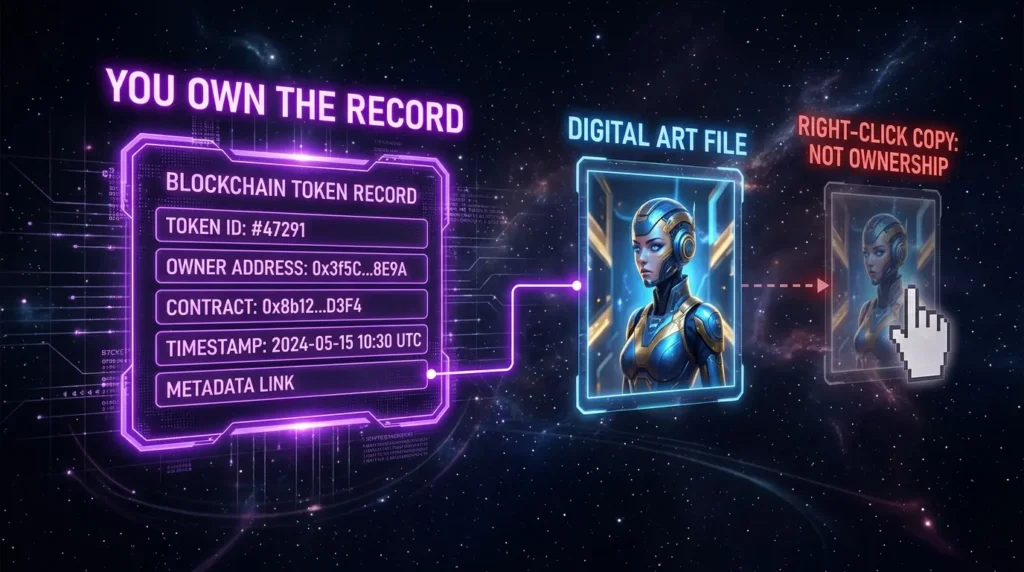
The actual file (the JPEG, the video, the audio) is usually stored separately — either on a decentralized storage network like IPFS (InterPlanetary File System), on a permanent storage solution like Arweave, or sometimes on a regular server.
This matters for two reasons:
1. You can’t copy-paste your way to ownership.
Yes, anyone can right-click and save a copy of Bored Ape #7090’s image. But that copy isn’t the NFT. The blockchain record says exactly one wallet owns that specific token. It’s like taking a photo of the Mona Lisa — you have a copy, but not the original with its provenance and auction history.
2. The file can disappear while the NFT remains.
If an NFT’s image is stored on a regular server and the company goes bankrupt, the image could disappear — but the blockchain token still exists. This is why storage method matters, and why reputable NFT projects use IPFS or Arweave.
How Are NFTs Created? Minting Explained
“Minting” is the process of creating an NFT — publishing it onto a blockchain.
Here’s what happens technically:
- A creator uploads a digital file and defines the NFT’s properties: name, description, number of copies (most NFTs are 1-of-1 or have a specific limited number), royalty percentage for future resales
- A smart contract is deployed on a blockchain (typically Ethereum, using the ERC-721 standard for unique NFTs, or ERC-1155 for semi-fungible gaming items)
- The smart contract generates a unique token ID and records the creator’s address
- This creates a permanent, public record: “Token #X was created by wallet address Y at timestamp Z”
- The NFT can now be sold, transferred, or held
Royalties are one of the genuinely innovative aspects of NFTs. Creators can program automatic royalties — say, 5% — that pay to the original artist every time the NFT is resold on a secondary market. This is something physical art doesn’t have: Van Gogh’s heirs don’t receive a cut when his paintings change hands for millions. NFT creators can.
In practice, royalty enforcement has been contested — some marketplaces in 2022–2023 made royalties optional to attract volume — but the underlying capability remains a meaningful innovation for creators.
The NFT Boom: What Happened in 2021
To understand where NFTs are in 2026, you need to understand 2021.
Several factors converged:
- COVID-19 lockdowns kept people online and bored
- Government stimulus checks gave retail investors fresh capital
- Crypto bull market created general wealth effects
- Several major NFT collections went viral simultaneously
CryptoPunks: 10,000 pixel-art characters algorithmically generated in 2017, originally given away for free. By 2021, floor price (cheapest available) exceeded $100,000. Individual Punks sold for millions.
Bored Ape Yacht Club (BAYC): 10,000 cartoon apes launched in April 2021 for ~$190 each. By January 2022, floor price exceeded $300,000. Celebrity owners included Jimmy Fallon, Steph Curry, Paris Hilton. Owning a Bored Ape became a social status signal.
Beeple’s $69.3M sale: The Christie’s auction in March 2021 brought NFTs into mainstream financial news. Traditional auction houses, previously skeptical of digital art, suddenly wanted in.
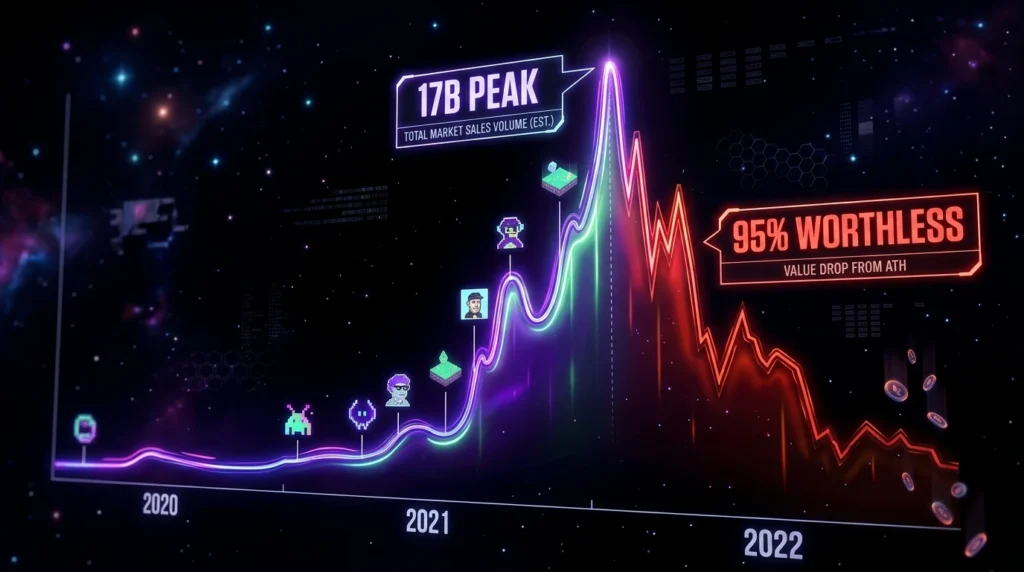
The total NFT market traded $17 billion in 2021, up from $82 million in 2020 — a 200x increase in a single year.
The Crash: What Happened After
By early 2022, the music had stopped.
Crypto bear market began. Interest rates rose. Stimulus money ran out. The “yield farming” DeFi strategies that had generated the wealth funding NFT purchases collapsed. The speculative fever broke.
By the numbers:
- NFT trading volume dropped more than 90% from peak to trough
- By September 2023, estimates suggested over 95% of all NFT collections had zero monetary value
- Bored Ape floor prices fell from $300,000+ to under $50,000
- Celebrities who had publicly bought expensive NFTs went quiet
Was it a scam? Partly. Many NFT projects were launched with no genuine art, no utility, and teams who disappeared after mint — classic rug pulls. Others were wash trading — buying and selling between controlled wallets to manufacture fake volume and price history.
But much of it was also genuine speculative mania — the same pattern that drove dot-com stocks in 1999 or tulip bulbs in 1636. Real technology, genuine community enthusiasm, and completely disconnected prices from any rational value.
The dot-com comparison is apt: the crash killed thousands of terrible projects, but it didn’t kill the internet. Amazon survived. Google survived. The survivors built real things.
Are NFTs Dead in 2026?
No — but the hype is gone, and what remains is different.
The speculative PFP (profile picture) market — buying a cartoon ape hoping someone will pay more later — has largely deflated. Most of those collections are worth a fraction of their peak.
What remains and is growing:
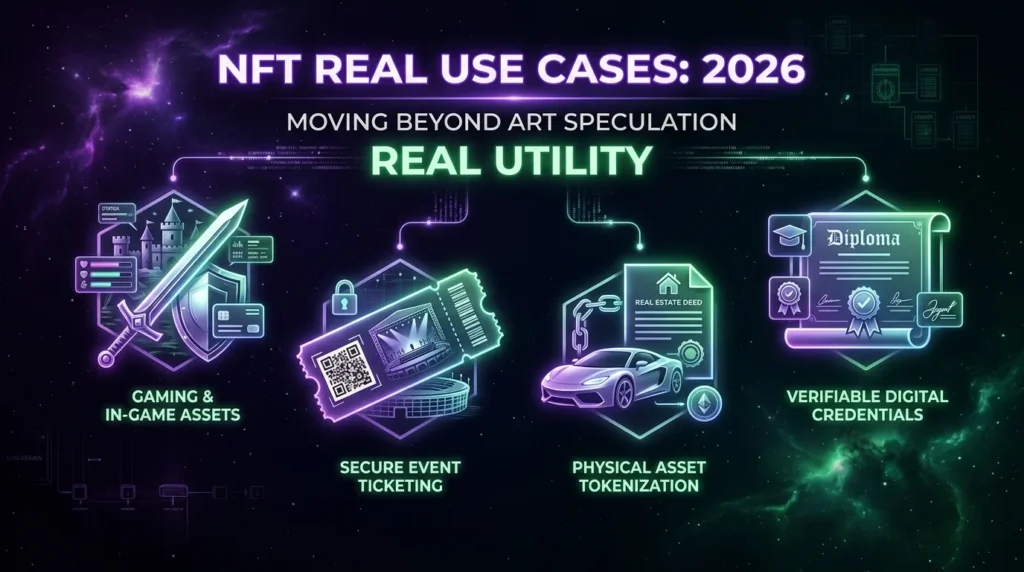
Gaming: NFTs as genuine in-game assets — items you own, can trade, and can take between games (theoretically). Projects like Sorare (licensed digital sports cards used in fantasy competitions, with 231,000+ active managers) show real product-market fit. The key difference from 2021 hype: the NFT serves a function within a product people actually use.
Real-World Asset Tokenization: Physical items represented by NFTs. Courtyard.io allows users to buy and sell tokenized physical trading cards — the card is vaulted, the NFT represents ownership. DappRadar’s Q1 2025 data showed RWA NFTs as a breakout trend.
Ticketing: Concert and event tickets as NFTs eliminate scalping and fake tickets (since ownership history is transparent), enable artists to capture secondary market value, and provide post-event collectibles. Several major event companies are experimenting with this.
Digital Identity and Credentials: NFTs as verifiable credentials — degrees, certifications, membership passes — that can be verified instantly without calling an institution.
Art with genuine collectors: The 1-of-1 digital art market for serious collectors didn’t disappear. Platforms like SuperRare and Foundation still facilitate sales between genuine art collectors at reasonable prices.
The pattern mirrors every technology cycle: the initial hype attracts speculators, the crash eliminates the weakest use cases, and the genuine utility quietly continues building.
The Right-Click Problem (and Why It’s More Complex Than It Sounds)
The most common criticism of NFTs: “Why would I pay $300,000 for a jpeg when I can right-click and save it for free?”
It’s a fair question. The honest answer:
You’re not paying for the image. You’re paying for the record of ownership.
Most people don’t grasp why that matters because we’re accustomed to digital things being infinitely copyable. NFTs create a layer of verifiable digital scarcity for the first time.
Whether that scarcity is worth money depends entirely on what it enables:
- If enough people value being recognized as the “official” owner of a culturally significant digital artifact — that’s value
- If the NFT grants access to an exclusive community, experiences, or commercial rights — that’s value
- If the NFT represents a game item with real utility — that’s value
- If it’s a JPEG of a cartoon ape with no utility and a team that might disappear — that’s largely speculative value dependent on others buying higher
The technology works. The question is always: what does this particular NFT actually enable or represent?
Key NFT Terminology
NFT (Non-Fungible Token): A unique digital record on a blockchain proving ownership of a specific item.
Fungible: Interchangeable. One Bitcoin equals any other Bitcoin. Non-fungible means each one is unique.
Minting: The process of creating an NFT by publishing it on a blockchain.
ERC-721: The Ethereum token standard for unique, non-fungible tokens. The technical foundation of most NFTs.
ERC-1155: A more flexible Ethereum standard allowing a single contract to manage both fungible and non-fungible tokens — commonly used in gaming.
IPFS (InterPlanetary File System): A decentralized file storage network used to store NFT media files more permanently than centralized servers.
Floor Price: The lowest price at which any NFT in a collection is currently listed for sale. A key metric for tracking collection health.
PFP (Profile Picture): A type of NFT collection designed to be used as social media profile pictures. CryptoPunks, Bored Apes, and Pudgy Penguins are examples.
Royalties: Automatic payments to NFT creators programmed into smart contracts, triggered on secondary sales.
Wash Trading: Artificially inflating NFT trading volume by buying and selling between wallets you control — a form of market manipulation.
Metadata: The data associated with an NFT (name, description, image link, traits) stored on-chain or in associated files.
The Bottom Line
NFTs were simultaneously a genuine technological innovation, a vehicle for meaningful creator empowerment, a speculative mania, and a fraud vector — all at the same time.
The manic phase is over. The genuine use cases remain and are quietly maturing: gaming assets with real utility, physical-to-digital asset representation, event ticketing, verifiable credentials.
Most of the NFTs minted in 2021–2022 are worth nothing. The underlying technology — verifiable digital ownership on a public ledger — is real and will likely be embedded in systems most people use without ever knowing it’s there.
The question for any NFT isn’t “is the technology valid?” but “does this specific NFT represent something I value owning or using?”
Answer that question honestly, and NFTs become much less confusing. 🖼️
Disclaimer: This article is for informational purposes only and does not constitute financial advice. Cryptocurrency investments carry significant risk, including the potential loss of all invested capital. Always conduct your own research before making any investment decisions.