Not everyone has a bank account, credit card, or wants to link their financial information to a crypto exchange. Buying cryptocurrency with physical cash is a legitimate option — and in 2026, it’s more accessible than ever with over 42,000 Bitcoin ATMs operating worldwide.
This guide covers every method for buying crypto with cash, what it costs, and what to watch out for.
Methods to Buy Crypto with Cash
Method 1: Bitcoin ATM (Most Common)
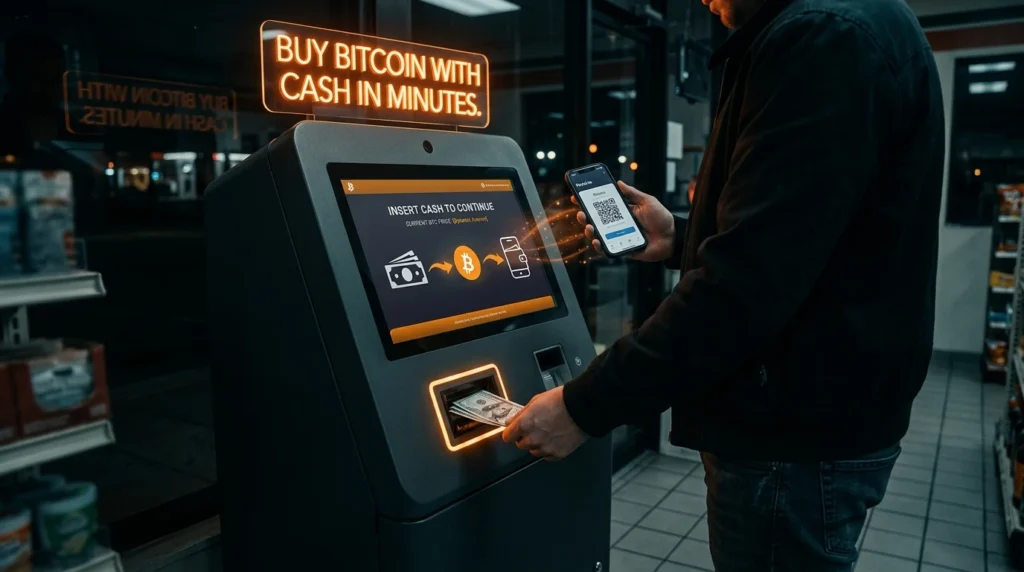
Physical kiosks in stores, gas stations, pharmacies, and shopping centers that let you insert cash and receive crypto directly to your wallet. Fast, accessible, no bank account needed.
Method 2: P2P Platforms (Peer-to-Peer)
Buy directly from another person using platforms like LocalBitcoins, Paxful, or Bisq. Agree on a price, meet in person or use escrow, exchange cash for crypto.
Method 3: Retail Crypto Kiosks
Services like Coinme (available at Coinstar kiosks in supermarkets) and similar providers that let you convert cash to crypto at select retail locations.
Method 1: Bitcoin ATM — Step-by-Step Guide
What Is a Bitcoin ATM?
A Bitcoin ATM (also called a BTM or crypto kiosk) is a physical machine that exchanges paper cash for cryptocurrency. It connects directly to the blockchain — not to your bank. Most machines support Bitcoin; many also support Ethereum, Litecoin, and others.
Two types:
- One-way (buy-only): Insert cash, receive crypto. Most machines.
- Two-way: Also allows selling crypto for cash. Less common (~30% of machines).
What You Need
Before going to a Bitcoin ATM, prepare:
- A crypto wallet on your phone — Download before you go. Options: Trust Wallet, Coinbase Wallet, MetaMask (for ETH), or any wallet that generates a QR code receive address
- Cash — The amount you want to spend (bills, not coins)
- Your phone — For verification codes and wallet QR code
- ID — May be required for larger purchases (typically $500+ in the US, varies by operator and state)
How to Find a Bitcoin ATM Near You
CoinATMRadar.com — The most comprehensive global directory. Enter your city or zip code to see nearby machines, their supported coins, fees, and hours.
Coinmap.org — Alternative locator covering many countries.
Google Maps — Search “Bitcoin ATM near me” for quick results.
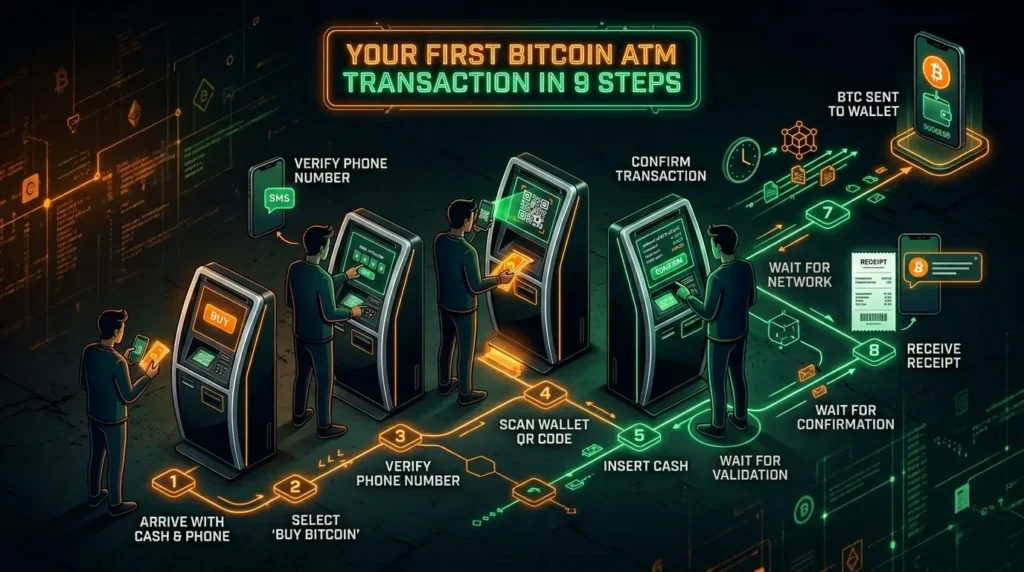
Step-by-Step: Using a Bitcoin ATM
Step 1: Arrive at the machine with cash and your phone ready.
Step 2: Select “Buy Bitcoin” (or your preferred cryptocurrency) on the screen.
Step 3: Identity verification — Depending on the amount and operator:
- Small purchases (typically under $200–$500): Phone number only — you’ll receive a verification code via SMS
- Larger purchases: Government-issued ID scan may be required
- Requirements vary by operator, state, and jurisdiction
Step 4: Scan your wallet QR code — Open your crypto wallet, go to “Receive,” and display the QR code for the machine to scan. This is the address where your crypto will be sent.
Important: Generate the QR code yourself from your own wallet. Never scan a QR code given to you by another person at or near the machine.
Step 5: Insert cash — Feed bills into the machine one at a time. The screen updates to show the running total.
Step 6: Review the fee — The machine displays:
- Total cash inserted
- Exchange rate applied
- Operator fee (percentage)
- Estimated crypto you’ll receive
Review this carefully before confirming.
Step 7: Confirm the transaction — Press “Buy” or “Confirm.”
Step 8: Take your receipt — Keep it. It contains your transaction ID (TXID) — useful if you need to track the transaction or resolve any issues.
Step 9: Wait for blockchain confirmation — Bitcoin typically confirms in 10–60 minutes. Some machines send immediately with 0 confirmations; others wait for 1+ confirmations. Check your wallet.
Bitcoin ATM Fees: The Honest Picture
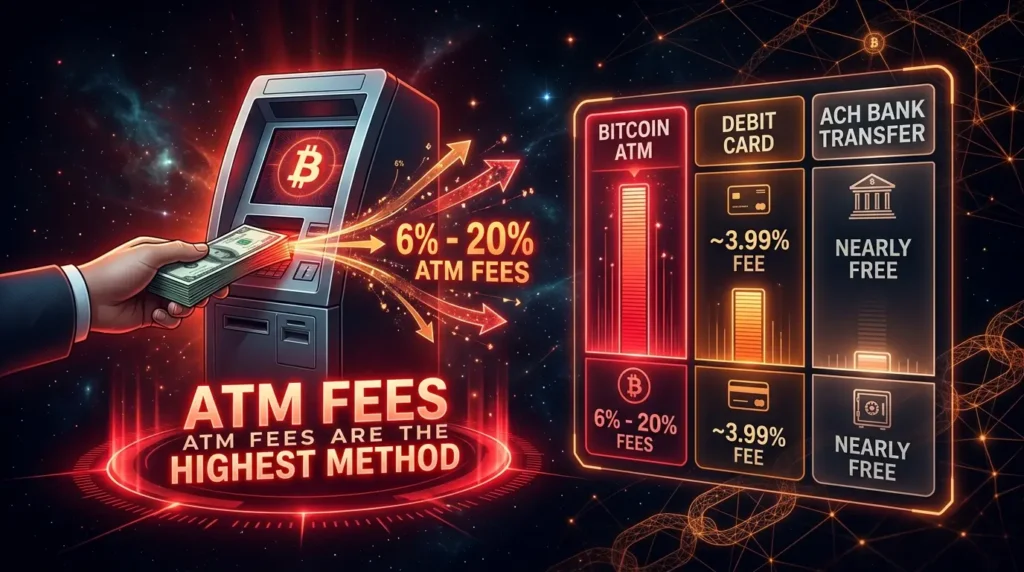
This is where you need to be informed before inserting money.
Typical fee range: 6–20% of the purchase amount
Average in 2026: Approximately 8–12% at most US machines
What this means in practice:
- You insert $100 in cash
- After a 10% fee: you receive ~$90 worth of Bitcoin
- At current prices, that’s less BTC than you’d get on an exchange
Comparison:
| Method | Typical Fee |
|---|---|
| Bitcoin ATM | 6–20% |
| Debit card on Coinbase | 3.99% |
| ACH bank transfer on Kraken | ~0–1% |
| Credit card | 3–5% |
Bitcoin ATMs are the most expensive way to buy crypto. The premium pays for physical infrastructure, cash handling, compliance, and immediate access — not a better deal.
How to find lower fees:
- Use CoinATMRadar to compare fees between nearby machines before going
- MoneyGram partner locations (using Coinme) may offer more competitive rates (~4% + $2.75 flat fee)
- Machines at higher-traffic locations (supermarkets vs. gas stations) sometimes have lower fees
KYC and Verification at Bitcoin ATMs
US regulations generally require Bitcoin ATM operators to collect identity information at certain transaction thresholds. These thresholds vary by:
- Operator
- State regulations
- Transaction size
As a general guide (verify with the specific operator):
- Small amounts: Phone number typically sufficient
- Mid-range amounts ($500–$1,000): Often requires ID scan
- Larger amounts: Full identity verification
The specific requirements are displayed by each machine at the start of the transaction.
Method 2: P2P Cash Trades
Peer-to-peer platforms let you buy Bitcoin directly from another person who accepts cash payment.
How it works:
- Create an account on a P2P platform (LocalBitcoins, Paxful, Bisq)
- Browse listings for sellers in your area accepting cash
- Agree on price, amount, and meeting location
- The seller’s Bitcoin is held in escrow by the platform
- You meet, hand over cash, the seller confirms payment
- Platform releases Bitcoin to your wallet
Advantages:
- Potentially lower fees than ATMs (prices are negotiated)
- More privacy than exchanges
- Accessible without a bank account
Risks:
- Meeting strangers carries personal safety considerations — always meet in public places (bank lobbies, police stations)
- Scam risk from unverified sellers
- No recourse if the counterparty acts in bad faith outside the escrow system
- Platform quality varies; use well-established platforms with escrow
Safety rules for P2P cash trades:
- Meet in a public, preferably crowded location
- Bring a friend if possible
- Only release payment after verifying the crypto is in escrow
- Never meet at a private residence for a first trade
- Check the seller’s reputation and trade history on the platform
Method 3: Retail Crypto Kiosks
Coinme / Coinstar: Available in many US supermarkets (Albertsons, Kroger, Safeway chains). Insert cash at the Coinstar machine, receive a voucher, redeem for Bitcoin through the Coinme app.
Fees: Approximately 4% exchange fee + $2.75 transaction fee — generally lower than standalone Bitcoin ATMs.
Limitations: Bitcoin only (typically), requires Coinme account, limited coin selection.
⚠️ Critical Warning: Bitcoin ATM Scams
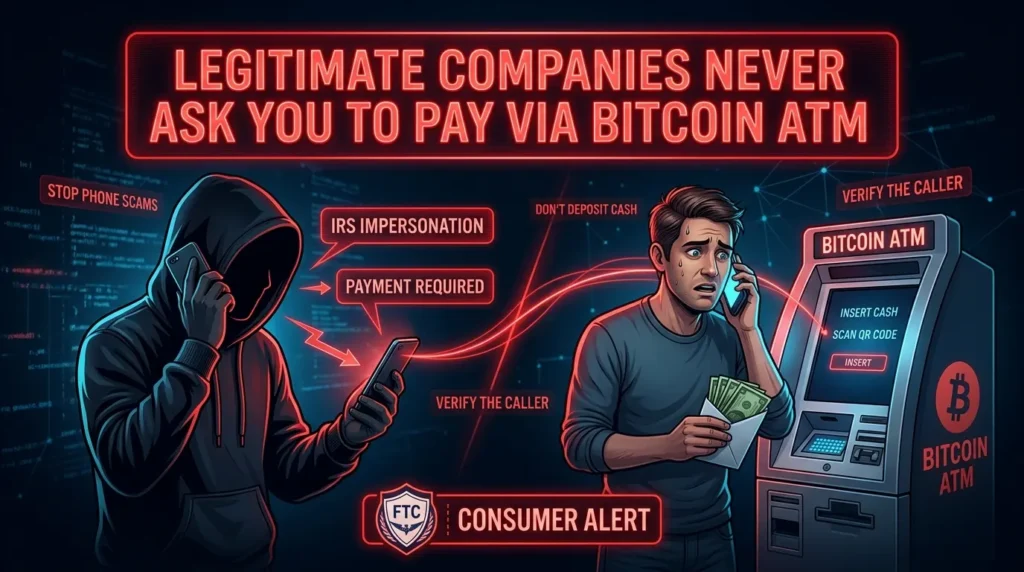
The US Federal Trade Commission (FTC) has identified Bitcoin ATMs as a primary tool used in fraud schemes. This warning is important — please read it.
How Bitcoin ATM scams work:
Someone contacts you — by phone, email, or social media — claiming to be:
- The IRS or Social Security Administration
- A tech support agent
- A utility company threatening to cut service
- A lottery saying you’ve won a prize
- A romance partner you’ve met online
They ask you to pay or “protect your funds” by going to a Bitcoin ATM and sending crypto to an address they provide.
The rule is simple:
No legitimate government agency, company, utility, or financial institution will ever ask you to pay via Bitcoin ATM. If someone asks you to use a Bitcoin ATM to pay for anything, it is a scam.
Only use a Bitcoin ATM to buy crypto for your own personal wallet address that you generated yourself. Never scan a QR code given to you by someone else.
When Does Buying with Cash Make Sense?
Good reasons:
- You don’t have a bank account and need to enter the crypto ecosystem
- You want to use existing cash without linking bank accounts
- You’re making a small one-time purchase and convenience outweighs the higher fee
- You need crypto immediately and other methods have delays
When to use an exchange instead:
- Regular purchases — ATM fees of 8–15% compound quickly over time
- Larger amounts — the fee difference becomes very significant
- You have a bank account — ACH transfer costs essentially nothing
Key Terminology
Bitcoin ATM (BTM): A physical kiosk that exchanges cash for cryptocurrency, connecting directly to the blockchain.
One-way ATM: Buy crypto only (most machines).
Two-way ATM: Buy and sell crypto for cash (less common, ~30% of machines).
Operator fee: The Bitcoin ATM provider’s charge for the transaction — typically 6–20% of the amount.
CoinATMRadar: The primary global directory for finding Bitcoin ATMs by location, with fee comparisons.
P2P (Peer-to-Peer): Trading directly with another individual rather than through an exchange or ATM.
Escrow: A third-party holding service — on P2P platforms, the seller’s crypto is held until payment is confirmed, protecting both parties.
The Bottom Line
Buying crypto with cash is possible and increasingly accessible — but it’s the most expensive method available. Bitcoin ATMs typically charge 6–20%, which can represent a significant portion of your investment.
Quick decision guide:
- Have a bank account + want to save money → use an exchange with ACH transfer
- Have a debit card + want instant purchase → use Coinbase or Kraken with card (3–4%)
- No bank account or want cash privacy → Bitcoin ATM is a valid option, just compare fees first
- Comfortable with in-person meeting → P2P can offer better prices
Whatever method you use: keep your receipt, track the transaction ID, and never respond to anyone who asks you to use a Bitcoin ATM to “pay” them. 💵
Disclaimer: This article is for informational purposes only and does not constitute financial advice. Cryptocurrency investments carry significant risk, including the potential loss of all invested capital. Always conduct your own research before making any investment decisions.