Every financial activity in crypto happens in one of two environments: CeFi (Centralized Finance) or DeFi (Decentralized Finance). Understanding the difference between them is one of the most important frameworks for navigating crypto safely.
CeFi looks familiar. It operates like traditional financial institutions — companies with employees, customer support, compliance teams, and terms of service. You trust the company to custody your assets and execute your financial activities.
DeFi looks alien to most newcomers. It operates through smart contracts — self-executing code on a blockchain. There’s no company to call, no customer service, no password reset. But there’s also no company that can freeze your account, lose your funds to mismanagement, or go bankrupt with your assets locked inside.
Both have genuine advantages. Both have genuine risks. This guide breaks down the differences clearly.
What Is CeFi (Centralized Finance)?
CeFi refers to crypto financial services provided by centralized companies — entities with legal structures, employees, and regulatory relationships.
Examples of CeFi platforms:
- Exchanges: Coinbase, Kraken, Binance, Bybit
- Lending platforms: BlockFi (defunct), Celsius (defunct), Nexo
- Custodians: Coinbase Custody, BitGo, Anchorage
- Brokers: Robinhood Crypto, PayPal Crypto
- Payment networks: Strike, Cash App
How CeFi works:
- You create an account and complete KYC (identity verification)
- You deposit assets — the company holds them on your behalf
- You use the company’s interface to trade, earn yield, borrow, etc.
- The company executes operations behind the scenes
- Your balance is a number in their database, not crypto you directly control
The key characteristic: You trust the company. Your assets are in their custody. The company is responsible for security, operations, and compliance.
What Is DeFi (Decentralized Finance)?
DeFi refers to financial services built on blockchain smart contracts — operating without a central company controlling the system.
Examples of DeFi protocols:
- DEXs: Uniswap, Curve, Jupiter
- Lending: Aave, Compound, Morpho
- Liquid staking: Lido, Rocket Pool
- Yield aggregators: Yearn Finance, Beefy
- Derivatives: GMX, dYdX
How DeFi works:
- You connect a non-custodial wallet (MetaMask, Phantom) — no account, no KYC required on most protocols
- Your assets stay in your wallet — you retain custody
- You interact with smart contracts directly from your wallet
- Smart contracts execute automatically based on their code
- Your assets are on the blockchain — verifiable by anyone
The key characteristic: You trust the code. Your assets remain under your control (in your wallet). No company can freeze your account or misappropriate your funds.
The Core Differences: Head-to-Head
1. Custody: Who Controls Your Assets?
CeFi: The company holds your assets. When you deposit to Coinbase, your crypto moves to Coinbase’s wallets. You have a balance in their system — a liability the company owes you.
DeFi: You hold your assets in your own non-custodial wallet. Smart contracts interact with your tokens only when you authorize specific transactions. You never give up control of your private keys.
Why this matters: FTX’s collapse in November 2022 demonstrated what happens when a CeFi company fails. Approximately $8 billion in customer funds were lost — customers had balances in FTX’s system, but those assets had been misused. Had those customers held their assets in non-custodial wallets, FTX’s collapse would have had no direct impact on them.
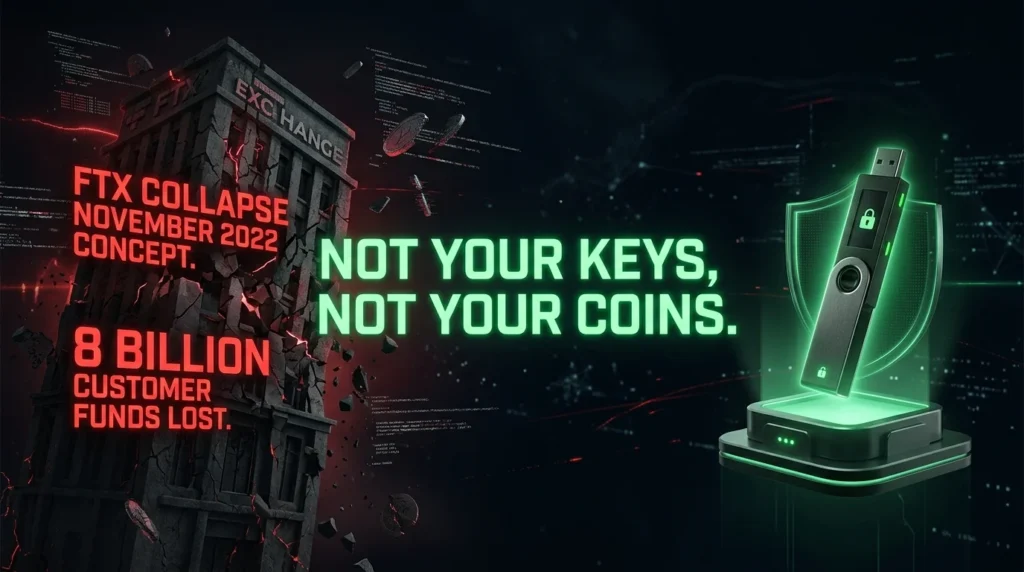
The phrase: “Not your keys, not your coins” — popularized after FTX — captures this perfectly.
2. Identity: KYC vs. Permissionless
CeFi: Full KYC required. Government ID, selfie verification, sometimes proof of address. The company knows who you are, collects and stores your data, and reports to regulators.
DeFi: Most protocols require no identity verification whatsoever. You connect a wallet — the protocol sees a blockchain address, not a person. No data collected, no reporting.
The nuance in 2026: Regulatory pressure is increasing. Some DeFi frontends now geo-block certain jurisdictions. Some DeFi protocols with governance tokens have implemented limited compliance measures. The landscape is evolving — but DeFi remains significantly more permissionless than CeFi by design.
3. Yields: Who Sets the Rate?
CeFi yields: Set by the company. CeFi platforms decide what interest rate to offer depositors — and that rate is often lower than what the platform earns by deploying your assets. The spread is company profit.
DeFi yields: Set by algorithms responding to supply and demand. On Aave, the rate you earn for supplying USDC rises automatically when borrowing demand is high and falls when demand is low. No human discretion — just market mechanics.
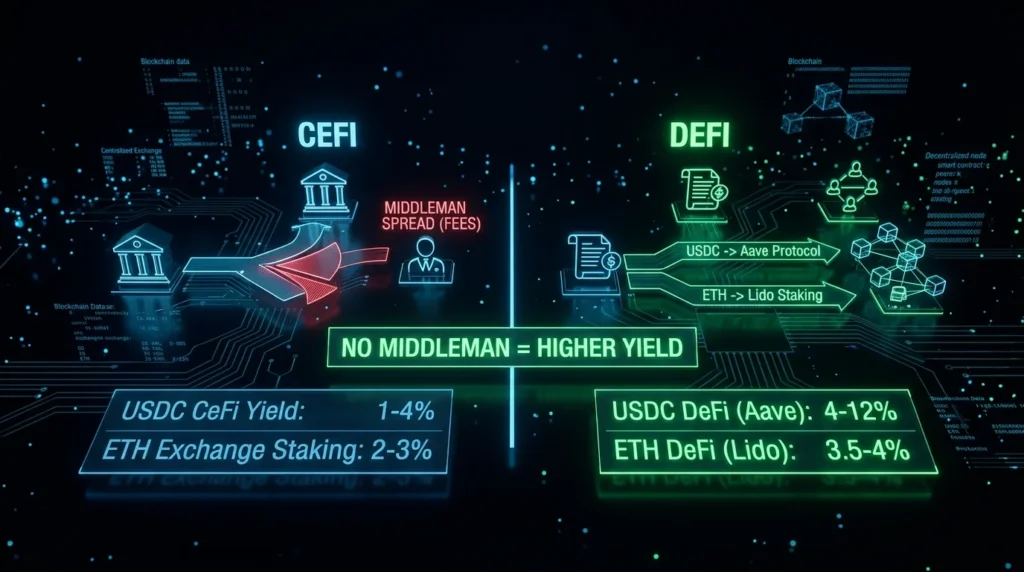
2026 yield comparison (approximate):
| Asset | CeFi Yield (Exchange) | DeFi Yield (Protocol) |
|---|---|---|
| USDC | 1–4% | 4–12% (Aave, variable) |
| ETH | 2–3% (exchange staking) | 3.5–4% (Lido staking) |
| BTC | 0.5–2% | 1–3% (lending protocols) |
DeFi yields are generally higher — because there’s no middleman taking a spread. The risk difference partly explains this gap as well.
4. Transparency: Open vs. Opaque
CeFi: Operates like a traditional company — internal operations are not publicly visible. You trust their reported reserves, audits, and balance sheets. The FTX collapse revealed how misleading this can be.
DeFi: Everything is on-chain and publicly verifiable. Anyone can inspect Aave’s total deposits, total borrows, interest rates, and reserve levels in real time. Protocol code is open-source and auditable.
Proof of Reserves: After FTX, many CeFi platforms began publishing Proof of Reserves — cryptographic attestations of their holdings. This is an improvement, but still represents one snapshot in time rather than the continuous on-chain transparency of DeFi.
5. Access: Geographic Restrictions vs. Global
CeFi: Platforms must comply with laws in each jurisdiction they serve. US exchanges must obtain money transmitter licenses, comply with FinCEN requirements, and restrict services to certain regions. Coinbase isn’t available in all countries; many exchanges restrict US customers from certain products.
DeFi: Smart contracts don’t have geographic awareness. Anyone with internet access and a wallet can interact with Uniswap, Aave, or Lido — regardless of country, passport, or bank account. DeFi frontends (websites) sometimes geo-block users, but the underlying contracts are globally accessible.
The implication: DeFi provides financial access to anyone globally — including unbanked populations who can’t access CeFi platforms.
6. Risk Profile: Different Failure Modes
CeFi risks:
- Counterparty risk: The company may mismanage, misuse, or lose your funds (FTX, Celsius, BlockFi all collapsed)
- Regulatory risk: Governments can restrict or shut down CeFi operations
- Custodial risk: Exchange hacks (Bitfinex 2016, Mt. Gox 2014) can result in fund loss
- Operational risk: Technical failures, system downtime, withdrawal freezes
DeFi risks:
- Smart contract risk: Code vulnerabilities can be exploited — $1.5B+ in DeFi losses in 2024 alone
- User error: Sending funds to wrong address, losing seed phrase — irreversible
- Oracle risk: Price feed manipulation can trigger wrong liquidations
- Protocol risk: Governance attacks, rug pulls on new protocols
- No safety net: No FDIC insurance, no customer support to recover mistakes
The key difference in risk character:
- CeFi failures tend to be systemic — when a platform fails, all users lose simultaneously
- DeFi failures tend to be per-protocol — a specific contract exploit affects depositors of that contract, while adjacent protocols may be unaffected
7. Regulation and Consumer Protection
CeFi: Subject to financial regulation in jurisdictions they operate. US-licensed exchanges must comply with FinCEN, SEC, and CFTC requirements. Some customer protections exist — though crypto is not FDIC-insured.
DeFi: Largely unregulated at the protocol level. No consumer protection infrastructure. No recourse if something goes wrong. The EU’s MiCA framework is beginning to address some DeFi activities, and US regulators are increasingly scrutinizing DeFi. But in 2026, DeFi remains largely outside traditional regulatory frameworks.
The Custody Spectrum
CeFi vs DeFi isn’t binary — there’s a spectrum:
Full Custody (CeFi):
Coinbase, Kraken, Binance — company holds all keys
Partial Custody / Hybrid:
Exchanges offering self-custody wallets (Coinbase Wallet separate from Coinbase exchange), custodial + non-custodial options side by side
Non-Custodial (DeFi):
MetaMask + Uniswap, Phantom + Jupiter — you hold all keys, interact directly with protocols
Hardware Wallet:
Maximum security non-custodial — Ledger, Trezor store private keys offline, completely outside any company’s control
CeFi Collapsed: The Lessons from 2022
2022 was the year that exposed CeFi’s critical weakness at scale:
Terra/LUNA (May 2022): The algorithmic stablecoin ecosystem collapsed. Celsius and other CeFi lenders who had deployed customer funds into Terra strategies experienced catastrophic losses.
Celsius (July 2022): Filed for bankruptcy. $4.7 billion in customer funds frozen. Customers discovered their “yield” was being funded by risky strategies with their own assets.
Three Arrows Capital (June 2022): Major crypto hedge fund collapsed, taking lenders with it.
FTX (November 2022): The second-largest exchange collapsed overnight. ~$8 billion in customer funds missing. Founder Sam Bankman-Fried convicted of fraud.
The common thread: All were CeFi entities where customers trusted the company with their assets. When the companies failed, customers had limited recourse — they were creditors in bankruptcy proceedings, not holders of actual crypto.
What survived 2022: Ethereum, Bitcoin, and well-audited DeFi protocols like Aave, Uniswap, and Curve continued operating without interruption. Their smart contracts executed exactly as programmed regardless of the chaos in CeFi markets.
When to Use CeFi vs DeFi

Use CeFi when:
- You’re new to crypto and want a simpler experience with customer support
- You’re making large purchases with fiat currency (CeFi has better fiat on-ramps)
- You need regulated custodial services (institutional requirements)
- You prefer a familiar interface with account recovery options
- You’re trading on regulated US exchanges for tax compliance purposes
- You want exposure to crypto without managing wallets (ETFs, brokerages)
Use DeFi when:
- You want full control and custody of your assets
- You’re seeking higher yields than CeFi offers
- You want to participate in DeFi-native activities (yield farming, liquidity provision, restaking)
- You want to access assets or markets unavailable on CeFi
- You’re comfortable managing your own wallet security
- Privacy from data collection is a priority
The practical reality in 2026: Most sophisticated crypto participants use both. CeFi for fiat on/off ramps and trading major markets; DeFi for yield generation, liquidity provision, and asset custody.
The Hybrid Layer: CeDeFi
An emerging category blurs the lines. CeDeFi (Centralized-Decentralized Finance) describes products that use DeFi protocols under the hood but present a CeFi-like interface:
- Coinbase Wrapped ETH (cbETH): A CeFi-wrapped liquid staking product
- Exchange-integrated DeFi: Coinbase Wallet integrating with Uniswap, Binance DEX integration
- Institutional DeFi: Banks and asset managers using DeFi protocols through custodial interfaces
CeDeFi attempts to offer DeFi yields with CeFi convenience — but users should understand which risks they’re actually taking on: smart contract risk still exists even through a familiar interface.
Key Terminology
CeFi (Centralized Finance): Crypto financial services provided by centralized companies that custody your assets and manage operations.
DeFi (Decentralized Finance): Financial services built on smart contracts where users retain custody and interact directly with protocols.
Custodial: A service that holds your private keys — CeFi platforms are custodial by definition.
Non-custodial: You hold your own private keys — DeFi is non-custodial by design.
KYC (Know Your Customer): Identity verification required by regulated CeFi platforms — typically not required in DeFi.
Counterparty risk: The risk that the other party in a financial relationship (the CeFi company) fails to fulfill its obligations.
Smart contract risk: The risk that the code governing a DeFi protocol contains exploitable vulnerabilities.
Permissionless: Anyone can interact without approval — DeFi protocols are permissionless; CeFi platforms are permissioned.
On-chain: Data or activity recorded directly on a blockchain — publicly visible and verifiable.
The Bottom Line
CeFi and DeFi represent two fundamentally different philosophies:
CeFi: “Trust us with your assets. We’ll handle the complexity and take responsibility.”
DeFi: “Don’t trust anyone. The code is the law. You remain in control.”
Neither is universally superior. CeFi is simpler and more consumer-friendly but carries counterparty risk. DeFi offers greater control and transparency but demands user responsibility and carries smart contract risk.
For most investors in 2026, the practical approach:
- Use regulated CeFi exchanges (Coinbase, Kraken) for fiat on-ramps and major market trading
- Move assets to a non-custodial wallet (MetaMask, hardware wallet) for longer-term storage
- Explore DeFi gradually — starting with established, audited protocols for yield generation
- Never keep more on any single CeFi platform than you can afford to lose
“Not your keys, not your coins” remains the defining principle of crypto self-sovereignty. How much of your portfolio lives under that principle is the most important decision you’ll make. 🔑
Disclaimer: This article is for informational and educational purposes only and does not constitute financial advice. Both CeFi and DeFi carry significant risks. Always conduct your own research before using any platform.