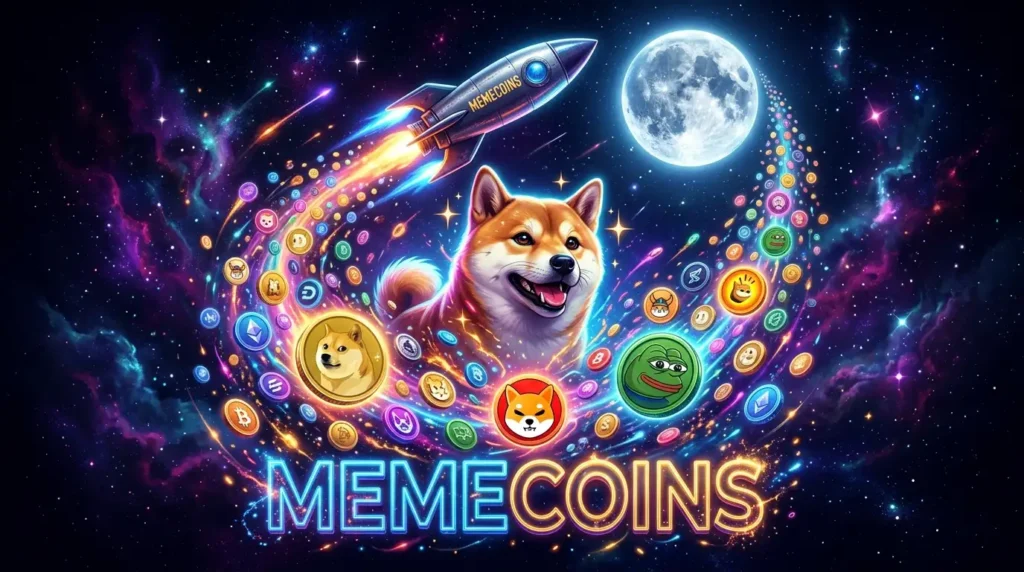
In December 2013, two software engineers — Billy Markus and Jackson Palmer — decided to make fun of the Bitcoin craze. They took a viral internet meme of a Shiba Inu dog making a surprised face, slapped it on a cryptocurrency, and called it Dogecoin.
It was a joke. A parody. An experiment in absurdity.
In 2021, that joke reached a market capitalization of $62 billion.
This is the story of memecoins — one of the strangest, most entertaining, most dangerous, and somehow most persistent corners of the crypto universe.
The Quick Answer: What Is a Memecoin?
A memecoin is a cryptocurrency inspired by an internet meme, joke, or viral cultural moment — rather than by any specific technological innovation or financial purpose.
Where Bitcoin was designed as digital money and Ethereum as a programmable blockchain, memecoins are typically created for entertainment, community building, or pure speculation. Their value comes not from technology or utility — but from attention, hype, and community belief.
The short version: memecoins are the internet’s ability to collectively decide something is valuable, expressed as a tradeable financial asset.
Sometimes that collective belief creates real, lasting value. Usually it doesn’t. The gap between those two outcomes is where fortunes are made and lost.
How Did Memecoins Start? The Dogecoin Origin Story
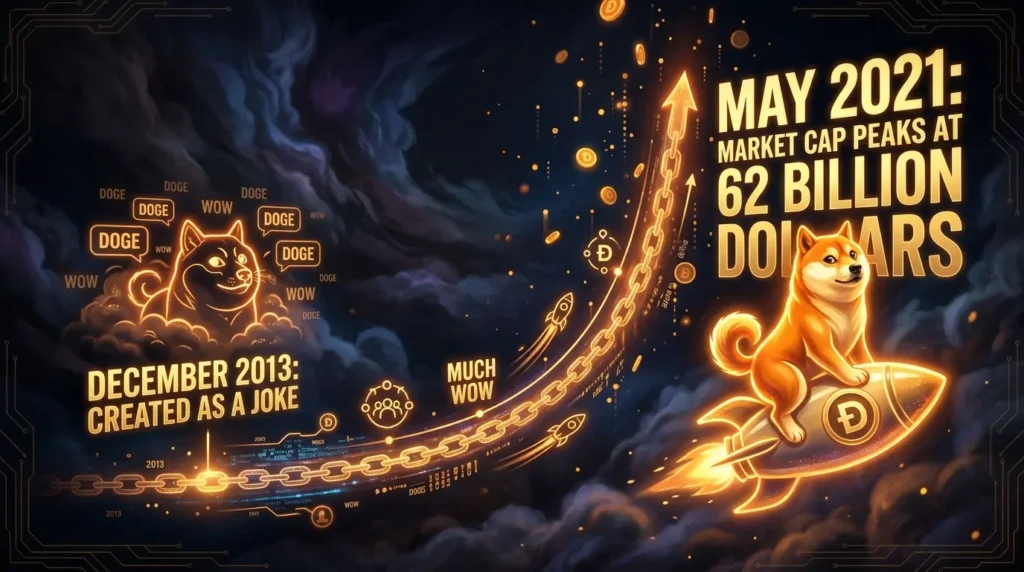
Dogecoin was born on December 6, 2013, as a deliberate joke.
Billy Markus was a software engineer at IBM who wanted to create a cryptocurrency that felt more approachable and fun than Bitcoin. Jackson Palmer, a product manager, had already tweeted the idea as satire. Markus found the tweet, reached out, and together they built DOGE over a single weekend.
The “Doge” meme — a Shiba Inu dog surrounded by multicolored comic sans text (“such wow,” “very money,” “much crypto”) — was the perfect mascot for a coin designed not to be taken seriously.
The irony: People took it seriously.
Dogecoin quickly developed one of the most enthusiastic communities in crypto. The community funded the Jamaican bobsled team’s trip to the 2014 Winter Olympics. They raised $55,000 to sponsor a NASCAR driver. They tipped Reddit posts and Twitter creators with DOGE, establishing it as the internet’s first true “tipping currency.”
Then Elon Musk discovered it.
From 2019 onward, Musk’s sporadic tweets about Dogecoin became market-moving events. His posts drove Dogecoin’s price up hundreds of percent within hours. When he appeared on Saturday Night Live in 2021, DOGE hit its all-time high — then crashed 30% during the broadcast when he called it “a hustle” on air.
The “Dogefather” dynamic — a single person’s social media activity determining the value of an asset worth billions — tells you almost everything you need to know about how memecoins work.
Why Do Memecoins Have Any Value at All?
This is the question that confuses traditional investors most. There’s no revenue. No product. Often no real development team. How can something with no intrinsic utility be worth billions of dollars?
The answer challenges our assumptions about what “value” means.
Value from community: Millions of people believe Dogecoin is worth something, are willing to buy it, and will defend it enthusiastically online. That collective belief creates real liquidity and real market activity. In a financial market, sustained belief by enough participants is value — at least for as long as the belief holds.
Value from cultural relevance: Memecoins tap into something human that serious financial instruments don’t: humor, identity, belonging, and the pleasure of being part of an inside joke. People buy DOGE because they enjoy being part of the Doge community, not because they’ve analyzed its financial fundamentals.
Value from accessibility: At fractions of a cent, memecoins give small investors the psychological thrill of owning millions of tokens. “I own 10 million SHIB” feels very different from “I own 0.0001 BTC” — even if the dollar value is identical.
The honest truth: Most memecoin value is speculative — it exists because people expect other people to buy at higher prices later. This makes memecoins more like a game of hot potato than a long-term investment. When the music stops and sentiment shifts, prices can collapse 80–95% in days.
The Most Famous Memecoins in 2026
Dogecoin (DOGE)
The original. Still the king.
Market cap: ~$20–30 billion (varies significantly)
Created: December 2013
What started as a joke became the prototype for an entire asset class. DOGE is the only memecoin with its own proof-of-work blockchain (a fork of Litecoin). Unlike most memecoins, it has no supply cap — about 5 billion new DOGE are created every year, making it intentionally inflationary.
In 2024, Elon Musk’s Department of Government Efficiency was branded “DOGE” — giving the coin another cultural boost. In 2026, Dogecoin remains the most liquid and widely held memecoin, listed on every major exchange and accepted as payment by some merchants including Tesla merchandise.
Shiba Inu (SHIB)
The Doge killer that became an ecosystem
Market cap: ~$3.4 billion (April 2026)
Created: August 2020
SHIB launched anonymously, with a quadrillion (1,000,000,000,000,000) token supply. Its founder “Ryoshi” sent half the supply to Vitalik Buterin as a publicity stunt — Buterin later donated most of it to Indian COVID relief and burned the rest, removing over 400 trillion SHIB from circulation.
SHIB rode the 2021 bull run to a peak market cap exceeding $40 billion, briefly making it the 10th largest cryptocurrency. Unlike DOGE, SHIB has built out an ecosystem: ShibaSwap (DEX), Shibarium (Layer 2 blockchain), and multiple token burns. It has one of the most dedicated communities in crypto, calling themselves the “SHIB Army.”
PEPE (Pepe the Frog)
The meme that built a cult
Market cap: ~$3–8 billion (fluctuates widely)
Created: April 2023
Based on the iconic Pepe the Frog internet meme, PEPE launched on Ethereum in 2023 and exploded into the top 50 cryptocurrencies within weeks — purely on meme energy and community momentum. Its success proved that even in a more mature crypto market, a new memecoin with the right cultural timing can achieve billions in market cap.
TRUMP (Official Trump)
Politics meets speculation
Market cap: peaked at ~$27 billion (January 2025)
Created: January 2025
Launched on Solana just days before Donald Trump’s second inauguration, $TRUMP is perhaps the most controversial memecoin in history. It was officially endorsed by Trump himself — the first sitting president to have an associated memecoin. The token hit massive market caps on launch excitement, then fell significantly as token unlock schedules raised concerns about insider selling. 800 million of the 1 billion total supply were allocated to CIC Digital LLC, a Trump Organization affiliate.
Pump.fun memecoins (Ongoing wave)
The factory floor
Created: Continuously on Solana
Since 2024, Solana’s Pump.fun platform has launched thousands of memecoins daily — literally anyone can create one in minutes for a few dollars. Most die within 24 hours. A handful catch viral attention and briefly generate millions in trading volume. An even smaller fraction survive more than a few weeks.
This is where the “degens” play — ultra-high-risk speculation on brand-new tokens that could 100x or go to zero within the same day.
What Makes a Memecoin Pump?
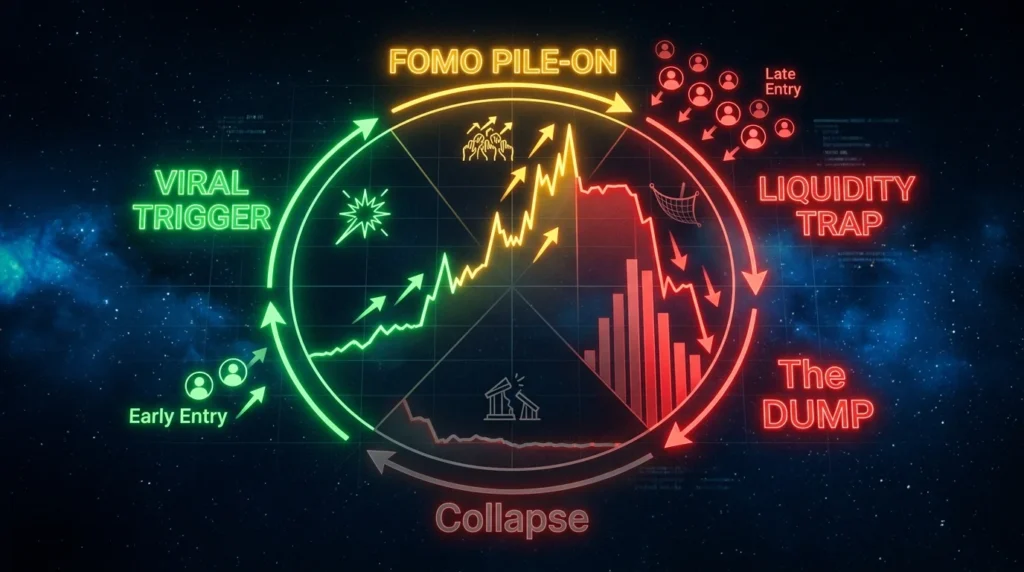
Understanding the mechanics helps you recognize patterns — and recognize when you’re being manipulated:
The viral trigger: A tweet, a meme, a celebrity mention, a news reference, an Elon Musk post. Memecoins live and die by attention. The initial spike is almost always caused by something spreading on social media.
The FOMO pile-on: Once a token starts moving, algorithms, influencers, and opportunists amplify the signal. Telegram groups, Twitter threads, and Discord servers coordinate buying. People see others getting rich and rush in.
The liquidity trap: As more buyers enter, the price rises rapidly. This creates the chart pattern that attracts even more buyers. Trading volume explodes.
The dump: Early holders — whether the developers, whales, or savvy traders — sell into the rising price. If it’s a coordinated pump-and-dump, this happens systematically. If it’s organic speculation, it happens gradually as profit-taking kicks in.
The collapse: Price falls. FOMO reverses into panic selling. Late buyers are left holding tokens worth a fraction of what they paid.
This cycle happens thousands of times per day across the memecoin market. The vast majority of participants lose money. A small minority — those who got in early and got out in time — profit significantly.
Memecoins vs. “Real” Crypto Projects
| Feature | Memecoins | Utility Tokens (ETH, SOL, etc.) |
|---|---|---|
| Purpose | Entertainment, speculation | Technology, specific use case |
| Value driver | Hype, community, social media | Adoption, utility, fundamentals |
| Technology | Usually minimal | Significant innovation |
| Volatility | Extreme | High but less extreme |
| Survival rate | Very low | Higher for established projects |
| Investment horizon | Short-term speculation | Can be long-term |
| Team | Often anonymous | Usually identified |
| Roadmap | Usually vague or absent | Usually detailed |
The Survivorship Bias Problem
This is the most important thing to understand about memecoins, and it’s almost never said clearly enough:
You hear about Dogecoin because it survived. You don’t hear about the tens of thousands of memecoins that died.
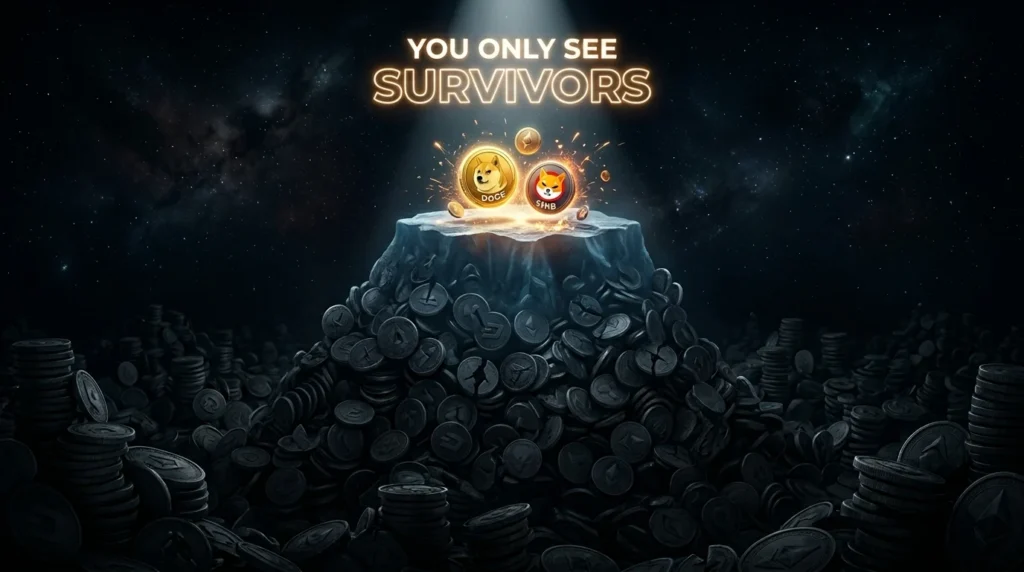
For every DOGE that grew from a joke to $62 billion, there are 50,000 memecoins that launched, briefly attracted a few thousand dollars, and then disappeared without trace. For every person who turned $500 into $50,000 on a memecoin, there are hundreds who turned $500 into $5.
Survivorship bias makes the memecoin market look like an opportunity when it’s actually much closer to a lottery. The tickets are cheap, the jackpots are real, and the vast majority of tickets are losers.
How to Approach Memecoins Safely (If At All)
If you want to participate in the memecoin market, here are the principles that separate educated speculation from gambling:
Only use money you can afford to lose completely. Not “money you can afford to lose some of” — money you’d be genuinely fine never seeing again. Treat it like entertainment spending.
Established over new. DOGE and SHIB carry far less risk than newly launched Pump.fun tokens. They’re still volatile, but they’re too liquid for a single actor to rug pull and have survived multiple market cycles.
Take profits. The single most common regret in memecoin trading is holding through a 10x gain waiting for 100x — and watching it all go to zero. Define a target, sell a portion when you hit it, and don’t look back.
Avoid insider hype. If someone is pushing a specific memecoin in your DMs, Telegram, or Twitter mentions — they’re almost certainly trying to sell their holdings to you.
Know you’re speculating, not investing. Memecoins have no fundamentals to fall back on during bear markets. There’s no “underlying value” to return to. If sentiment turns, the price goes to zero and stays there.
Key Memecoin Terminology
Memecoin: A cryptocurrency inspired by internet memes or pop culture, deriving value from community attention rather than technical utility.
Degen: Short for “degenerate” — a term used affectionately for traders who take extreme risks on volatile assets like memecoins.
Pump.fun: A Solana platform allowing anyone to create and launch a memecoin in minutes with minimal cost.
Altcoin Season: A market phase when altcoins and memecoins significantly outperform Bitcoin — typically in the middle to late bull market.
Diamond Hands: Holding a position through extreme volatility without selling.
Paper Hands: Selling at the first sign of trouble.
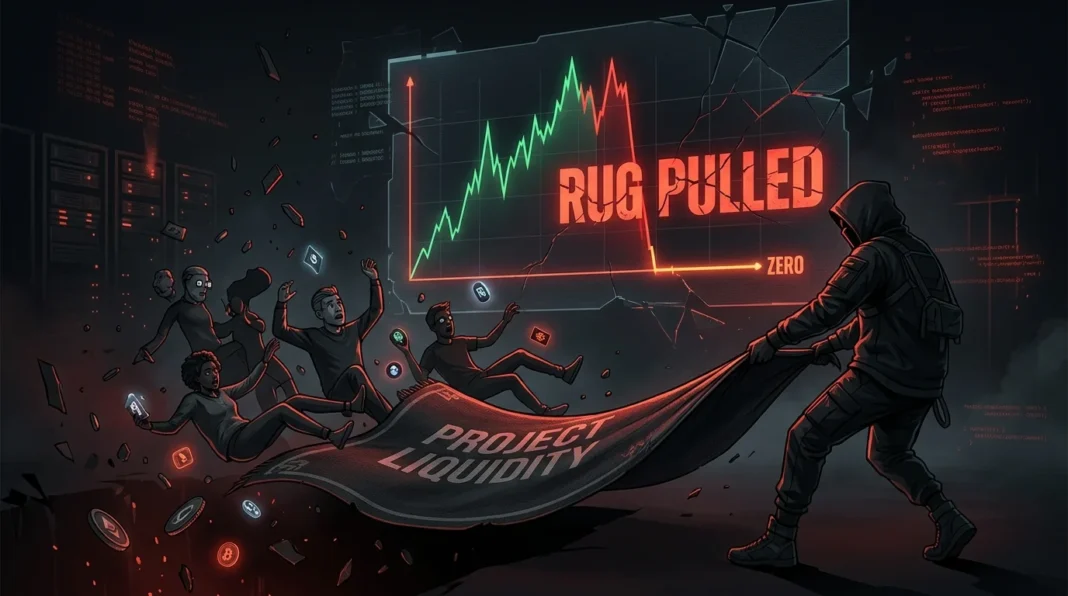
Rug Pull: When memecoin developers drain the liquidity pool and disappear with investor funds.
Survivorship Bias: The cognitive error of focusing on successful memecoins (Dogecoin, SHIB) while ignoring the vast majority that failed.
Market Cap Trap: The mistake of thinking a low-priced token is “cheap” without considering total market cap. A token at $0.000001 with a trillion supply has the same market cap as a token at $1 with one million supply.
The Bottom Line
Memecoins are the id of the crypto market — pure speculation, pure community, pure chaos. They’re built on jokes that somehow became financial instruments, powered by internet culture that somehow moves billions of dollars.
Dogecoin is a 12-year-old joke worth tens of billions. Shiba Inu was a stunt that built a real ecosystem. PEPE the Frog became a multibillion-dollar asset because enough people decided it should be. A president launched a coin days before his inauguration.
None of this makes sense by conventional financial logic. But crypto doesn’t operate by conventional financial logic. And memecoins are where that truth is most nakedly obvious.
If you approach them as entertainment — fun, speculative, using only money you’d spend on other entertainment — they can be part of a healthy relationship with crypto.
If you approach them as a serious investment strategy, they will eventually humble you.
Much wow. Very risk. Such volatility. 🐶
Disclaimer: This article is for informational purposes only and does not constitute financial advice. Cryptocurrency investments carry significant risk, including the potential loss of all invested capital. Always conduct your own research before making any investment decisions.