Here’s a question that paralyzes almost every new crypto investor: When should I buy?
Right now? What if it drops more? Should I wait for a dip? What if the dip never comes? What if I buy today and it crashes 40% tomorrow?
This mental loop — trying to find the perfect moment to enter the market — is one of the most common reasons people either never invest at all, or invest emotionally at exactly the wrong moment.
Dollar-cost averaging (DCA) is the strategy designed specifically to break that loop. And the data behind it in crypto is striking.
The Quick Answer: What Is DCA?
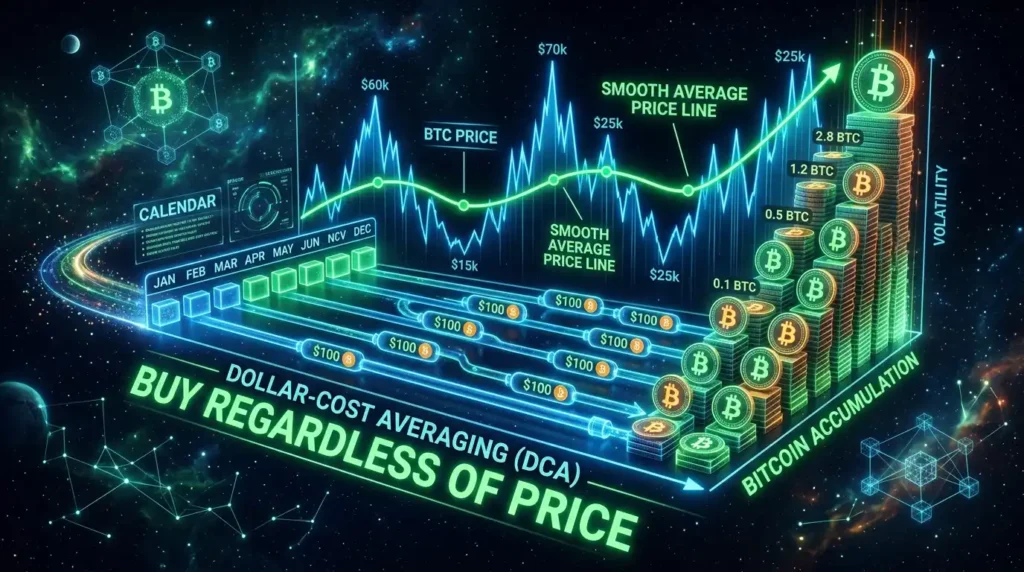
Dollar-cost averaging (DCA) is an investment strategy where you invest a fixed dollar amount into an asset at regular intervals — weekly, biweekly, or monthly — regardless of the current price.
That’s it. The entire strategy.
- You decide: $50 every week into Bitcoin
- You set it up to happen automatically
- You stop thinking about timing
When the price is high, your $50 buys fewer BTC. When the price is low, your $50 buys more BTC. Over time, your average purchase price naturally settles between the highs and lows — you never buy everything at the top, but you also never miss the bottom.
The math works in your favor in volatile markets. The psychology works in your favor everywhere.
The DCA Math: Why It Works
Let’s use a real example to show the mechanics.
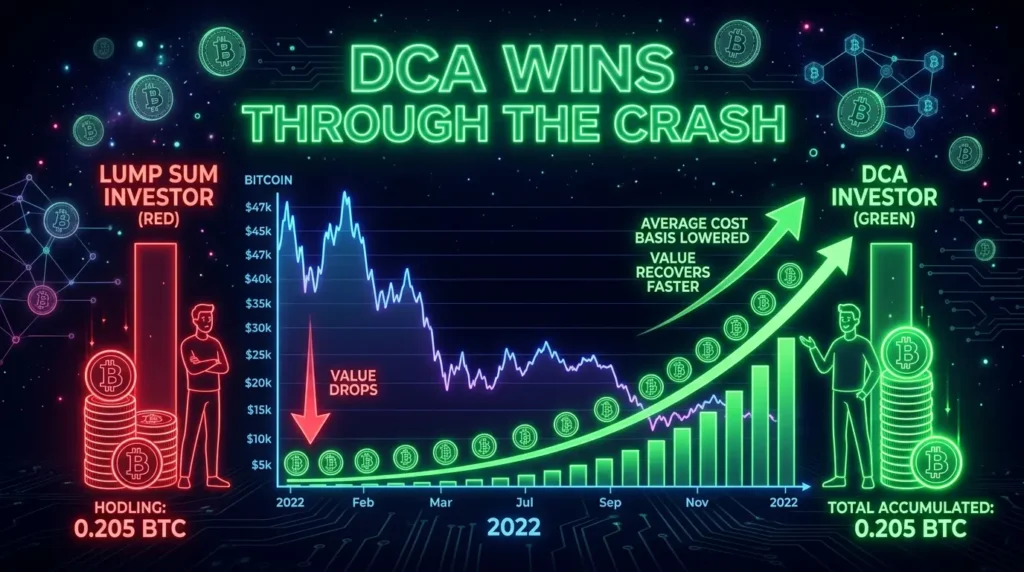
Scenario: $500/month DCA into Bitcoin throughout 2022
2022 was the worst year in recent crypto history — Bitcoin fell from $47,500 in January to below $16,000 by December. A nightmare year for anyone who bought and held.
But for a DCA investor who bought $500 every month regardless of price:
| Month | BTC Price | BTC Purchased |
|---|---|---|
| January | $47,500 | 0.0105 BTC |
| February | $43,500 | 0.0115 BTC |
| March | $45,000 | 0.0111 BTC |
| April | $40,000 | 0.0125 BTC |
| May | $31,000 | 0.0161 BTC |
| June | $20,000 | 0.0250 BTC |
| July | $23,000 | 0.0217 BTC |
| August | $23,500 | 0.0213 BTC |
| September | $19,500 | 0.0256 BTC |
| October | $20,000 | 0.0250 BTC |
| November | $17,000 | 0.0294 BTC |
| December | $16,500 | 0.0303 BTC |
Result: $6,000 invested → ~0.205 BTC accumulated. Average purchase price: ~$29,000.
Compare to lump-sum in January: $6,000 at $47,500 = 0.105 BTC.
The DCA investor accumulated nearly double the Bitcoin — not by being smarter, not by predicting the bottom, just by buying consistently through the crash. When Bitcoin recovered, their larger BTC position gained proportionally more.
Real DCA Performance Data
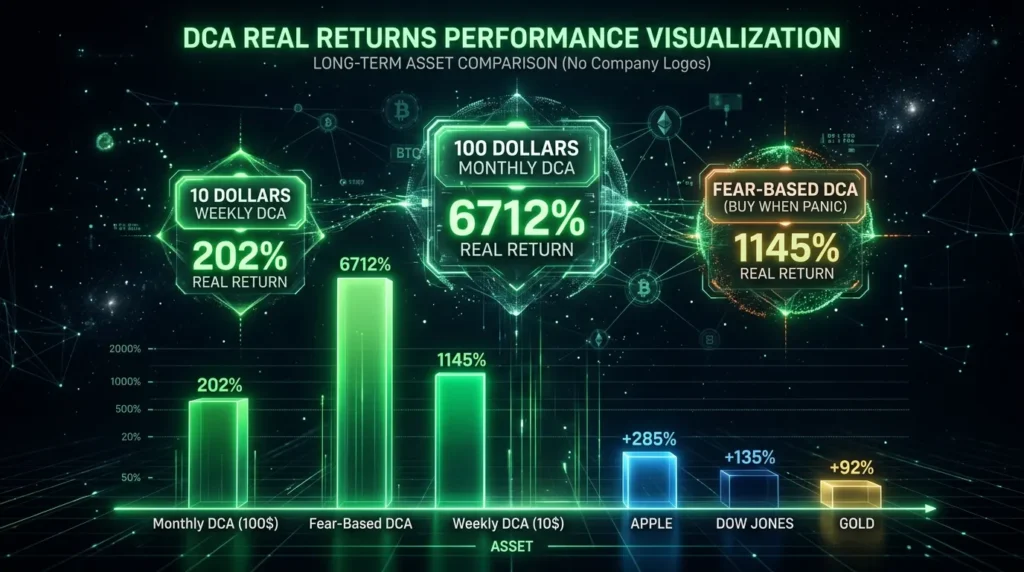
$10/week Bitcoin DCA (2019–2024, 5 years)
- Total invested: $2,620
- Portfolio value by end of 2024: ~$7,913
- Return: 202%
- Comparison: Gold returned 34%, Apple stock 79%, Dow Jones 23% over same period
$100/month Bitcoin DCA (January 2014 – early 2026, 12 years)
- Total invested: $14,600
- Portfolio value: ~$994,950
- Return: ~6,712%
Fear-based contrarian DCA (2018–2025, 7 years)
- Strategy: buy more during “Extreme Fear” on the Fear & Greed Index, less during “Greed”
- Return: 1,145%
- vs buy-and-hold over same period: 1,046%
These numbers aren’t guarantees — past performance doesn’t predict the future. But they illustrate a consistent pattern: disciplined, regular buying through crypto’s violent cycles has historically produced strong long-term results for patient investors.
DCA vs Lump Sum: Which Is Better?
This is the most common DCA debate, and the honest answer is nuanced.
In traditional markets (stocks, ETFs): Lump-sum investing beats DCA approximately 66% of the time. If you have $10,000 to invest and the market trends upward over time (which US stocks have historically), putting it all in immediately gives you more time in the market — and time in the market beats timing the market.
In crypto: The calculus shifts significantly.
Crypto is 3–5x more volatile than stocks. Bitcoin regularly experiences 30–50% drawdowns within bull markets, and 77–84% crashes in bear markets. The risk of investing a lump sum at the wrong moment — the top of a cycle — is substantially higher.
DCA in crypto provides something valuable beyond just returns: risk-adjusted peace of mind. A $10,000 lump sum at Bitcoin’s November 2021 peak of $69,000 is still underwater in April 2026. A DCA investor who kept buying through the crash owns more BTC at a lower average cost.
The practical conclusion:
- If you have a large sum and high conviction that the market is near a bottom → lump sum might make sense
- If you’re investing from regular income, are new to crypto, or want to remove emotion from the equation → DCA is the more practical and psychologically sustainable strategy
- If you’re not sure → DCA is almost always the right default
What to DCA Into: Asset Selection Matters
DCA is a strategy, not a guarantee. Its effectiveness depends entirely on what you’re buying.
DCA works best with:
- Bitcoin (BTC): Every historical DCA study uses Bitcoin as the benchmark, and for good reason. It’s the most liquid, most established, and has survived every bear market to reach new highs.
- Ethereum (ETH): Second-largest crypto with fundamental utility (smart contracts, DeFi, NFTs). Reasonable long-term DCA candidate.
DCA with caution:
- Blue-chip altcoins (SOL, LINK, etc.): Higher potential returns but also higher risk. Can underperform BTC over full cycles.
DCA is not appropriate for:
- Memecoins: DCA into DOGE, SHIB, or pump.fun tokens isn’t an investment strategy — it’s gambling on a schedule. Most memecoins go to zero.
- Low-cap altcoins: High failure rate. Many won’t exist after the next bear market.
The principle: DCA into assets you believe will exist and have value in 5–10 years. If you’re not confident in an asset’s 5-year survivability, DCA won’t save a bad investment.
How to Set Up a Crypto DCA in 2026
Most major exchanges make recurring purchases simple:
Coinbase (US, beginner-friendly)
Settings → Recurring Buy → Select asset → Set amount and frequency (daily/weekly/biweekly/monthly) → Done. Coinbase charges a small fee per purchase (varies, typically 1.49% for bank purchases).
Binance (global)
Auto-Invest feature → Select crypto → Set amount, frequency, start date. Binance offers very competitive fees for recurring buys.
Kraken (US, security-focused)
Recurring Orders → Select pair → Set amount and schedule. Kraken has strong security reputation.
Coinbase, Kraken, Bybit — all partners of TheHashmark — support recurring buy features.
For DCA on DEXes:
Jupiter on Solana offers on-chain DCA — you can set up automated purchases of Solana-based tokens directly from your wallet, with no centralized exchange.
Practical setup tip: Link a dedicated bank account or set aside a specific monthly budget. Treat it like a subscription — money leaves your account automatically, you don’t think about it, you accumulate over time.
The DCA Mindset: Why Psychology Matters
The strategy is simple. The execution requires discipline.
The biggest DCA mistake: Stopping during bear markets. The investor who DCA’d every month through 2022’s brutal crash and accumulated at $18,000–$22,000 Bitcoin was positioned for extraordinary gains when BTC hit $100,000 in late 2024. The investor who panicked, sold, and stopped buying was not.
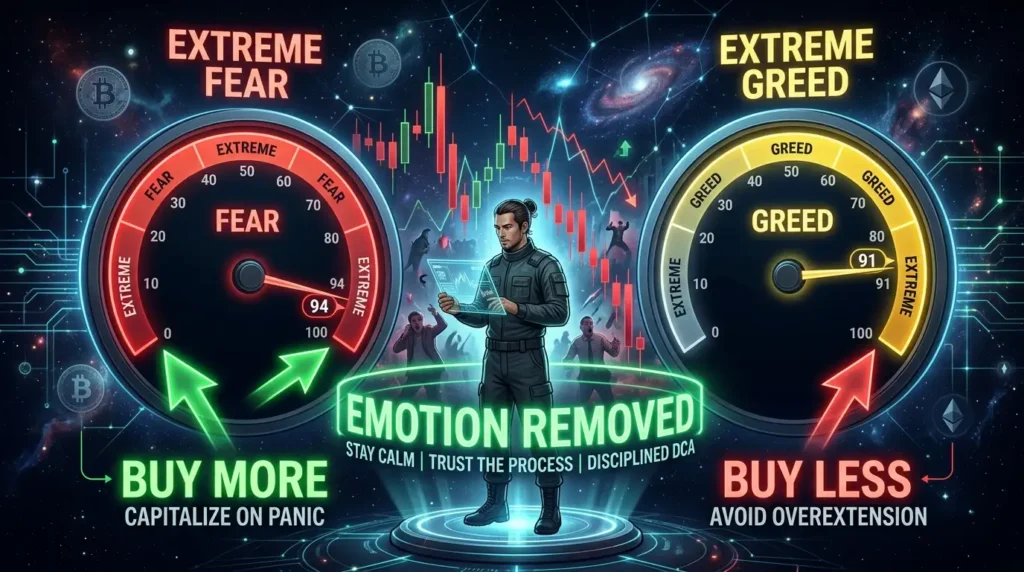
Fear is a feature, not a bug. When the Fear & Greed Index hits Extreme Fear (0–25), markets are statistically oversold. These are often the best DCA entry windows — you’re buying more BTC per dollar, and the emotional pressure to sell is highest. Disciplined DCA inverts the psychology: the worse the headlines, the more BTC your fixed dollar amount buys.
DCA removes the question “should I buy now?” The answer is always yes — because you’ve already decided in advance.
The Downsides of DCA: Honest Limitations
DCA isn’t perfect. Here’s where it doesn’t shine:
In relentlessly rising markets: If Bitcoin goes from $30,000 to $100,000 in a straight line, DCA buyers collect fewer BTC than someone who put everything in at $30,000. In strongly trending up markets, lump sum wins.
More fees: Each purchase incurs a transaction fee. Weekly DCA generates 52 fee events per year versus 1 for lump sum. On exchanges with high per-transaction fees, this adds up. Solution: use exchanges with flat percentage fees and larger, less frequent purchases.
Doesn’t protect against permanently failing assets: If you DCA into a crypto that goes to zero (a collapsed exchange token, a rugged project, a fundamentally broken blockchain), DCA accelerates your losses. Asset selection remains critical.
Not a short-term strategy: DCA requires at least 1–2 years to meaningfully average out purchase prices. If you need the money within 6 months, DCA into volatile crypto is not appropriate.
Key DCA Terminology
Dollar-Cost Averaging (DCA): Investing a fixed dollar amount at regular intervals regardless of price.
Average Cost Basis: The average price you paid per unit across all your purchases. DCA aims to keep this below current market price over time.
Lump Sum Investing: Investing a large amount all at once rather than spreading it over time.
Recurring Buy: The automated purchase feature offered by most exchanges — set the amount, frequency, and let it run.
DCA Plus (Value Averaging): A variant where you increase purchase amounts during significant market dips, maintaining your baseline DCA but adding more during “Extreme Fear” events.
Cost Averaging Effect: The mathematical result of buying more units when prices are low and fewer when prices are high — naturally lowering your average purchase price over time.
The Bottom Line
Dollar-cost averaging won’t make you rich overnight. It won’t protect you from all losses. It won’t find you the perfect entry point.
What it will do: remove the paralysis of timing, accumulate assets systematically through market cycles, and historically outperform most retail investors who try to be clever about when to buy.
The data is clear: a $10/week Bitcoin DCA over 5 years turned $2,620 into nearly $8,000 — beating gold, Apple, and the Dow Jones. A $100/month DCA started 12 years ago became nearly $1 million.
You don’t need to predict the market. You need to show up, every week, every month, regardless of what the headlines say.
Boring. Disciplined. Historically very profitable. 📅💰
Disclaimer: This article is for informational purposes only and does not constitute financial advice. Cryptocurrency investments carry significant risk, including the potential loss of all invested capital. Always conduct your own research before making any investment decisions.