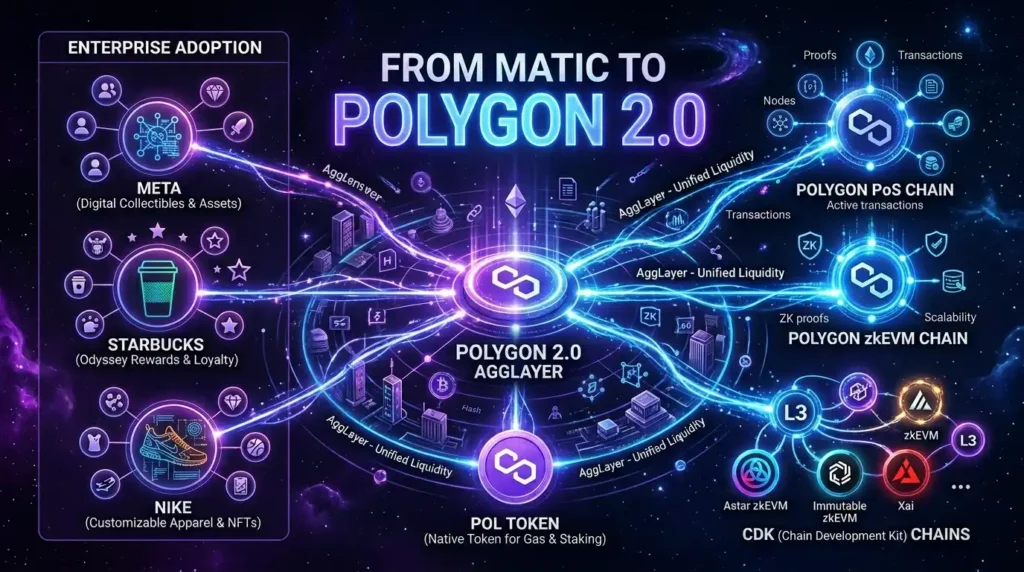
Few projects in crypto have reinvented themselves as dramatically as Polygon. What started in 2017 as Matic Network — a simple sidechain for Ethereum — has transformed into one of the most ambitious multi-chain scaling ecosystems in the industry, powered by a new token (POL), zero-knowledge proof technology, and a vision to become the internet’s value settlement layer.
In May 2026, POL trades around $0.09–0.10, sits in the top 85 cryptocurrencies by market cap, and powers an ecosystem processing billions in transaction volume — including stablecoin payments, tokenized assets, DeFi, gaming, and enterprise integrations with brands like Meta and Starbucks.
What Is Polygon? A Brief History
The Matic Network Era (2017–2021)
Polygon began as Matic Network, co-founded in 2017 by Jaynti Kanani, Sandeep Nailwal, Anurag Arjun, and Mihailo Bjelic — four developers from India with backgrounds in software engineering and blockchain.
The original Matic Network was a Plasma-based sidechain — a simpler scaling approach that processed transactions on a separate chain and periodically settled to Ethereum. Plasma had significant limitations (complex exit mechanisms, poor smart contract support), but it worked well enough to build traction.
In 2019, Matic launched its mainnet. In 2020, despite a low-profile start, MATIC became one of the breakout performers of the DeFi summer — growing from under $0.01 to meaningful valuations as Ethereum fees exploded and alternatives became urgently needed.
The Polygon Rebrand (2021)
In February 2021, Matic Network rebranded as Polygon — reflecting a dramatically expanded vision. The team announced a multi-chain scaling framework supporting multiple Ethereum scaling technologies simultaneously: Proof of Stake chain, Plasma, Optimistic Rollups, ZK Rollups, and more.
The MATIC token retained its ticker but now powered a much broader ecosystem. The rebranding coincided with one of MATIC’s most explosive price runs — from under $0.02 in early 2021 to an all-time high of $2.92 in December 2021 — a rise of more than 14,000% from its early lows.
Polygon 2.0 and the MATIC to POL Migration (2023–2024)
In 2023, Polygon announced its most ambitious transformation yet: Polygon 2.0 — a complete architectural overhaul built around zero-knowledge technology. The centerpiece: migrating from MATIC to a new token, POL.
The MATIC to POL migration occurred officially on September 4, 2024 — a 1:1 conversion allowing MATIC holders to exchange for POL at no cost. POL was designed with expanded utility: powering not just one chain but an entire ecosystem of ZK-based chains through a new architectural layer called the AggLayer.
How Polygon Works in 2026
Polygon PoS Chain
The original Proof of Stake chain — still operational and the network’s workhorse for everyday transactions. Processes millions of transactions daily at fractions of a cent. Powers a significant portion of Polygon’s stablecoin volume (now over $4 billion on-chain stablecoin supply).
Polygon zkEVM
Polygon’s flagship ZK rollup — a fully EVM-compatible zero-knowledge Layer 2 that settles to Ethereum mainnet. Unlike Polygon PoS (which is a sidechain), zkEVM inherits Ethereum’s full security through cryptographic proofs rather than validators.
Why it matters: ZK proofs mathematically verify every transaction batch before posting to Ethereum — no trust required, no 7-day fraud proof window. Withdrawals are processed faster than optimistic rollups.
Polygon CDK (Chain Development Kit)
A framework allowing any team to build their own ZK-powered blockchain that connects to Polygon’s ecosystem. CDK chains can be customized (privacy, throughput, fee token) while sharing security and liquidity through the AggLayer.
The AggLayer (Aggregation Layer)
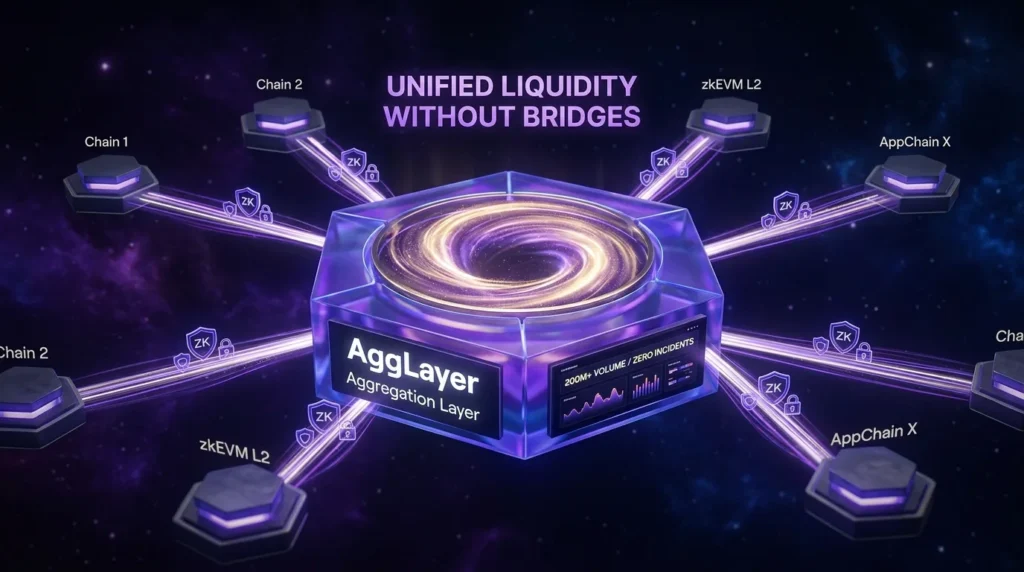
The most ambitious component of Polygon 2.0 — a protocol layer designed to unify liquidity and state across all Polygon CDK chains and beyond.
The problem it solves: DeFi currently suffers from liquidity fragmentation — each chain has its own isolated liquidity pools, requiring bridges to move assets between them. Bridges are slow, expensive, and have been a major hack vector ($1B+ lost to bridge hacks historically).
How AggLayer works: Instead of bridging, the AggLayer uses ZK proofs to allow chains to share a unified liquidity layer and state. A user on Chain A can interact with liquidity on Chain B as if they were on the same chain — without a traditional bridge.
April 2026 milestone: The AggLayer processed $200 million in bridge volume with zero incidents following the KelpDAO hack — demonstrating its ZK security model under real-world stress.
The vision: Polygon Labs describes the AggLayer as the “unified highway” of crypto — eventually connecting not just Polygon chains but other blockchains into a single interoperable liquidity network.
Optimistic Rollups vs ZK Rollups: Where Polygon Stands
Understanding the broader scaling debate is essential context for Polygon’s ZK-first strategy.
Optimistic Rollups (Arbitrum, Base, Optimism)
Assume transactions are valid by default. Only verify if challenged during a ~7-day window.
Pros: Full EVM compatibility is straightforward, larger existing DeFi ecosystems, proven at scale.
Cons: 7-day withdrawal delay, security relies on honest challengers, capital inefficiency for bridges.
ZK Rollups (Polygon zkEVM, zkSync, StarkNet, Scroll, Linea)
Mathematically prove every transaction’s validity using zero-knowledge cryptography before Ethereum submission.
Pros: Withdrawals in minutes to hours (no challenge window), cryptographic security (not assumption-based), better bridge security through ZK proofs, no fraud monitors needed.
Cons: Generating ZK proofs is computationally expensive, full EVM compatibility harder to achieve, ecosystems less mature than optimistic rollups.
Polygon’s Bet
Polygon has placed its entire Polygon 2.0 vision on ZK technology — betting that ZK rollups’ superior security model and faster finality will win over optimistic rollups as the technology matures.
The AggLayer amplifies this bet: it uses ZK proofs to solve cross-chain interoperability at the protocol level, potentially eliminating the need for traditional bridges entirely. If successful, this positions Polygon not just as a single Layer 2 but as the connective tissue of a multi-chain Ethereum ecosystem.
The risk: ZK proof generation is complex and expensive. EVM equivalence in ZK environments is harder to achieve than in optimistic rollups. Competitors like Arbitrum, Base, and OP Stack chains currently have deeper ecosystems. Polygon’s ZK pivot is technologically ambitious — execution risk is real.
The POL Token: From MATIC to a Hyperproductive Asset
The MATIC Era
MATIC launched in 2019 and served as:
- Gas fee token for Polygon PoS transactions
- Staking token for validators securing the PoS chain
- Governance token for network decisions
The POL Upgrade
When Polygon 2.0 launched, the team designed POL as a “hyperproductive” token — meaning it does more than MATIC did. A single staked POL token can simultaneously:
- Secure the Polygon PoS chain
- Secure Polygon zkEVM
- Secure any CDK chain that opts in
- Earn fees from multiple networks simultaneously
This is a form of restaking native to Polygon’s architecture — validators can earn from multiple chains without needing to split their stake.
POL Tokenomics (May 2026)
| Metric | Data |
|---|---|
| Price | ~$0.09–0.10 |
| Market cap | ~$950M–$1.06B |
| Circulating supply | ~10.6 billion POL |
| Max supply | 10 billion (initial) + 2% annual inflation |
| Annual inflation | 2% (1% validator rewards, 1% community treasury) |
| All-time high (MATIC) | $2.92 (December 2021) |
| POL all-time high | $1.29 |
| POL all-time low | ~$0.08 |
| CoinMarketCap ranking | ~#85 |
The inflation note: Unlike Bitcoin’s fixed supply, POL has a 2% annual inflation rate — split between validator incentives and a community treasury. This creates ongoing sell pressure that the community can address through governance (buybacks, burns, or emission adjustments).
Liquid Staking: sPOL
In 2026, Polygon launched sPOL — a liquid staking token allowing stakers to use their staked POL in DeFi simultaneously. The launch unlocked over $330 million in previously illiquid staked capital, significantly expanding DeFi composability on Polygon.
Price History: From MATIC’s Explosive Rise to POL’s Grind
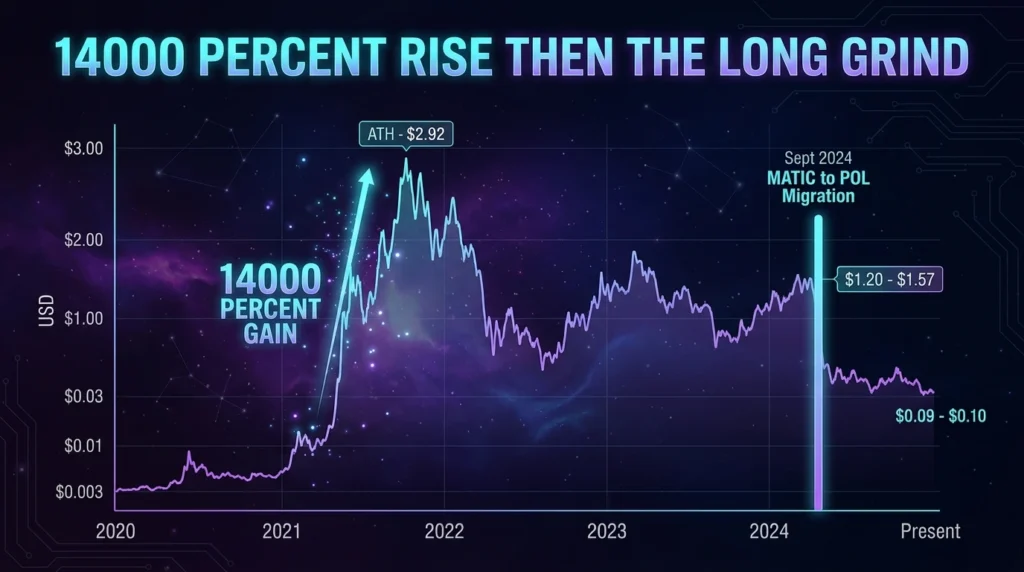
MATIC’s Meteoric Rise (2020–2021)
MATIC was one of the defining altcoin success stories of the 2020–2021 bull market:
- Early 2020: Under $0.01 — largely unknown
- Mid 2020: DeFi summer brought attention to cheap Ethereum alternatives
- Early 2021: Polygon rebranded from Matic; major institutions began integrating
- May 2021: MATIC surged past $2 for the first time
- December 2021: All-time high of $2.92 — a rise of 14,000%+ from 2020 lows
This run was driven by genuine adoption: Ethereum fees made Polygon PoS the practical choice for many DeFi users and NFT collectors, with major protocols (Aave, Curve, SushiSwap) deploying on Polygon to offer cheaper alternatives.
The Bear Market (2022)
MATIC fell with the broader market in 2022 — declining roughly 80–90% from ATH alongside most altcoins. Unlike many projects, Polygon continued building aggressively through the bear market — announcing major partnerships with Meta (Instagram NFTs), Disney, Starbucks, Reddit, and Nike, and making several significant acquisitions including ZK technology company Mir Protocol and Hermez Network.
The MATIC-to-POL Transition (2023–2024)
The announcement of Polygon 2.0 and the POL migration generated excitement — MATIC recovered partially from lows, rallying in early 2023 alongside broader market sentiment. The formal MATIC-to-POL migration happened in September 2024 at 1:1 ratio.
POL’s post-migration price history has been a slow grind lower:
- POL at launch (late 2023/early 2024): ~$1.20–1.57 (ATH for POL as a standalone token)
- 2024: Gradual decline through the year despite ongoing development
- 2025: Continued weakness — POL fell below $0.20, then $0.10
- May 2026: ~$0.09–0.10 — approximately 93% below MATIC’s ATH of $2.92
The character of the decline: Not a dramatic crash but a slow, grinding erosion — characteristic of a project with genuine technology but facing 2% annual token inflation, intense L2 competition, and a market environment favouring Bitcoin over altcoins. POL has shown multiple bounces (30–50% rallies during risk-on periods) before resuming its downward trajectory — a persistent pattern of two steps down, one step up.
Who Built Polygon and Who Backed It?
The founding team:
- Jaynti Kanani — CEO, former data engineer at Housing.com
- Sandeep Nailwal — COO/Co-founder, prominent crypto thought leader in India
- Anurag Arjun — Co-founder
- Mihailo Bjelic — Co-founder, researcher
Institutional backing:
Polygon raised significant capital from leading crypto-native and mainstream venture capital firms — including some of the most prominent names in Silicon Valley and dedicated blockchain investment. The investor list spans early-stage rounds that valued Polygon’s technology before it became a household name in crypto. High-profile institutional investors conducted deep technical and market due diligence before committing to the project. Total funding across multiple rounds reached hundreds of millions of dollars, providing substantial runway for the ambitious Polygon 2.0 development program.
Strategic partnerships:
Major global corporations have validated Polygon’s technology through real-world deployments — Meta integrated Polygon for Instagram NFTs, Starbucks built their Odyssey loyalty program on Polygon, Reddit deployed community tokens on Polygon, Nike used Polygon for digital collectibles. These enterprise partnerships represent genuine institutional adoption beyond pure DeFi.
Key 2026 Developments
Giugliano Hard Fork (April 2026): Network upgrade improving transaction confirmation speed and fee transparency, supporting high-throughput payments and tokenized assets.
AggLayer $200M Milestone: Processed $200M in cross-chain volume with zero incidents during the KelpDAO exploit crisis — demonstrating ZK security under stress.
sPOL Launch: Liquid staking for POL released, unlocking $330M+ in staked capital for DeFi deployment.
$100M Stablecoin Payments Initiative: Polygon Labs negotiating a $100M raise to build enterprise stablecoin payment infrastructure. On-chain stablecoin supply exceeded $4 billion — a meaningful payments use case beyond DeFi speculation.
Gigagas Roadmap: Targeting 100,000+ TPS — positioning Polygon PoS as “Visa-level rails for global payments.”
Upcoming Hard Fork (April 29, 2026): Additional network upgrade for scalability and security as part of the ongoing MATIC-to-POL ecosystem transition.
Enterprise Adoption: Polygon’s Differentiator
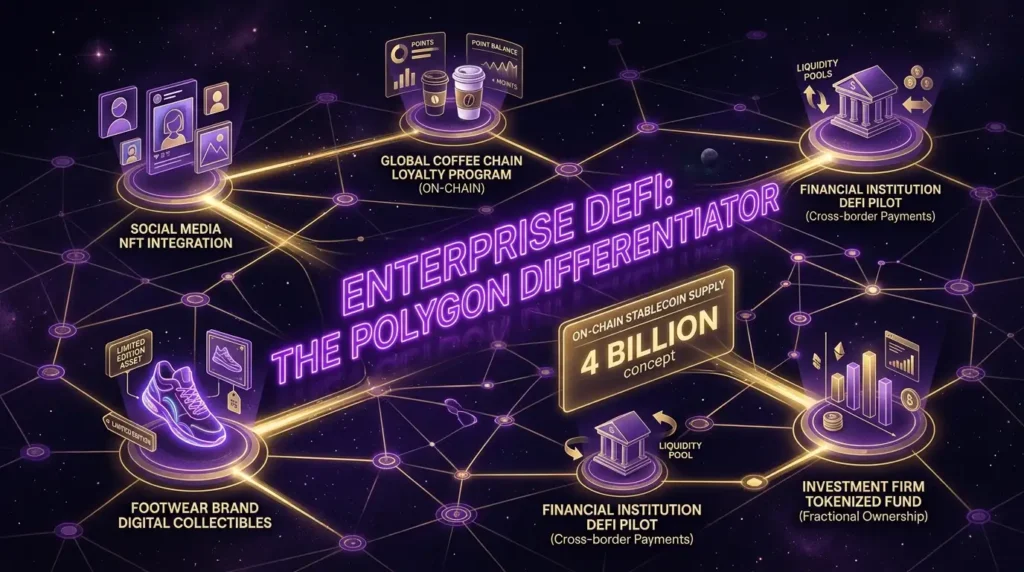
One area where Polygon genuinely stands out from other Layer 2 competitors: enterprise and brand adoption.
Major deployments:
- Meta (Instagram/Facebook): NFT integration using Polygon
- Starbucks Odyssey: Loyalty and collectibles program
- Reddit Community Points: Distributed to millions of Reddit users
- Nike .SWOOSH: Digital collectibles platform
- JPMorgan Onyx: Institutional DeFi pilot on Polygon
- Franklin Templeton: Tokenized fund on Polygon
This breadth of enterprise adoption — spanning consumer brands, financial institutions, and social media platforms — gives Polygon a real-world use case moat that pure DeFi-focused Layer 2s lack.
Polygon vs. The Competition
| Polygon PoS / zkEVM | Arbitrum | Base (Optimism) | zkSync / StarkNet | |
|---|---|---|---|---|
| Technology | PoS sidechain + ZK rollup | Optimistic rollup | Optimistic rollup | ZK rollup |
| TVL (2026) | ~$500M–1B (all chains) | ~$1.8–2B | ~$2–3B | ~$200–500M |
| Withdrawal speed | zkEVM: minutes-hours; PoS: fast | ~7 days | ~7 days | Minutes-hours |
| EVM compatibility | Full (PoS); High (zkEVM) | Full | Full | Improving |
| Security model | ZK proofs (zkEVM); PoS validators | Fraud proofs | Fraud proofs | ZK proofs |
| Enterprise adoption | Very strong (Meta, Starbucks, Nike) | Moderate | Growing (Coinbase) | Limited |
| Key advantage | AggLayer interop vision, enterprise | DeFi depth, GMX | Retail/consumer, Coinbase | ZK security |
Where Polygon leads: Enterprise adoption, ZK technology ambition, AggLayer interoperability vision, stablecoin payments use case.
Where Polygon trails: Pure DeFi TVL (significantly behind Arbitrum and Base), retail DeFi ecosystem depth, near-term token price performance.
Is There a POL ETF?
As of May 2026, no POL-specific ETF exists in the United States or major international markets. POL (formerly MATIC) is available on all major exchanges including Coinbase, Kraken, Binance, and Bybit.
How to Buy POL
Available on: Coinbase, Kraken, Binance, Bybit, OKX
POL is an ERC-20 token on Ethereum compatible with MetaMask, Ledger, and Trezor. It is also the native gas token on Polygon PoS and Polygon zkEVM.
Key Terminology
Polygon PoS: The original Polygon Proof of Stake chain — a sidechain processing millions of daily transactions at low cost.
Polygon zkEVM: Polygon’s flagship ZK rollup — EVM-compatible, settles to Ethereum with ZK proofs.
POL: The current native token replacing MATIC — used for gas, staking, and governance across Polygon’s ecosystem.
MATIC: Polygon’s previous token — migrated 1:1 to POL in September 2024.
AggLayer: Polygon’s aggregation layer using ZK proofs to unify liquidity across chains without traditional bridges.
CDK (Chain Development Kit): Polygon’s framework for building custom ZK-powered blockchains.
sPOL: Polygon’s liquid staking token — stake POL, receive sPOL, use sPOL in DeFi.
ZK Proof: Cryptographic proof mathematically verifying transaction validity without revealing transaction details.
Hyperproductive token: Polygon’s concept for POL — a single staked token securing and earning from multiple chains simultaneously.
Disclaimer: This article is for informational and educational purposes only and does not constitute financial advice. Cryptocurrency investments carry significant risk, including the potential loss of all invested capital. Always conduct your own research before making any investment decisions.