Crypto exchanges love advertising low fees. What they rarely advertise is the final cost.
A 0.1% trading fee can easily become 2% or more once spreads, payment method charges, and withdrawal fees are factored in. Understanding the full fee structure — not just the headline number — is one of the most practical skills any crypto user can develop.
This guide breaks down every type of fee you encounter on crypto exchanges, explains the hidden costs most traders miss, and shows you exactly how to reduce what you pay.
The 5 Types of Crypto Exchange Fees
Most exchanges charge across five distinct areas. They prominently display one or two of these, while the others remain quietly embedded in the fine print.
1. Trading Fees: Maker vs Taker
The most visible fee — charged every time you buy or sell.
The maker-taker model is used by virtually every major exchange with an order book. Understanding it is the key to paying less:
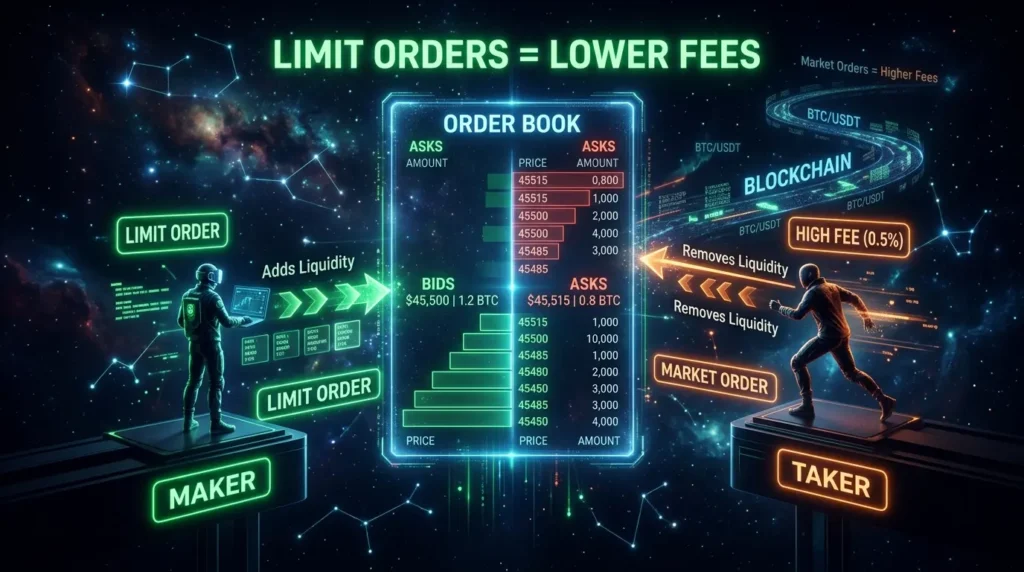
Makers place limit orders that don’t execute immediately. Your order sits in the order book, waiting for a buyer or seller. By placing this order, you’re adding liquidity to the market — making it easier for others to trade. Exchanges reward this with lower fees.
Takers place market orders that execute immediately against existing orders. You’re removing liquidity from the order book. Exchanges charge more for this convenience.
In practice:
- A limit order at a specific price = maker (lower fee)
- A market order at current price = taker (higher fee)
Typical rates at major exchanges (2026):
| Exchange | Maker Fee | Taker Fee |
|---|---|---|
| Binance | 0.10% | 0.10% |
| Kraken Pro | 0.25% | 0.40% |
| Coinbase Advanced | 0.40% | 0.60% |
| Bybit Spot | 0.10% | 0.10% |
| Binance.US | 0.38% | 0.57% |
Volume discounts: Almost every exchange reduces these rates as your 30-day trading volume increases. High-volume traders can reach near-zero maker fees.
Native token discounts: Several exchanges offer fee reductions for paying in their own token — Binance offers 25% off with BNB, reducing the 0.10% base to 0.075%.
2. The Spread: The Most Commonly Hidden Cost
The spread is the difference between the price you buy at and the price you sell at. It doesn’t appear as a line-item fee — it’s embedded in the price itself.
Example:
- Bitcoin’s actual market price: $95,000
- Exchange’s buy price (what you pay): $95,950
- Exchange’s sell price (what you’d receive): $94,100
- Total spread: ~2%
This 2% is exchange profit — invisible until you check the real-time market price elsewhere.
Where spreads are highest:
- Simple/instant buy interfaces (Coinbase Simple Trade, app-based “buy now” features)
- Beginner-oriented platforms
- Stablecoin conversions
- Low-liquidity altcoin pairs
Where spreads are tightest:
- Advanced trading interfaces with order books (Kraken Pro, Coinbase Advanced Trade)
- Major trading pairs (BTC/USD, ETH/USD)
- High-volume exchanges
The practical reality: An exchange advertising 0% fees may be generating 1–3% revenue from spreads. Always check both the trading fee AND the displayed price versus the real market price before trading.
3. Deposit Fees
These apply when you move fiat currency or crypto into your exchange account.
Crypto deposits: Almost universally free — you pay only the blockchain network fee to send.
Fiat deposit fees vary significantly by method:
| Deposit Method | Typical Fee |
|---|---|
| ACH bank transfer (US) | Free |
| SEPA bank transfer (EU) | Free |
| Wire transfer | $0–$15 |
| Debit card | 1.5–3.99% |
| Credit card | 2–5% |
| PayPal | Varies |
The key lesson: Using a debit card to buy $1,000 in Bitcoin at 3.99% costs you $39.90 before you’ve made a single trade. A bank transfer costs $0. The choice of deposit method is often the largest fee decision you make.
4. Withdrawal Fees
Crypto withdrawal fees are charged when you move crypto from the exchange to a personal wallet or another platform.
These fees have two components:
- Exchange fee: The exchange’s own charge, which may include markup above the actual network cost
- Network fee: The blockchain transaction fee (gas), which varies with network congestion
Critical insight — choose the right network:
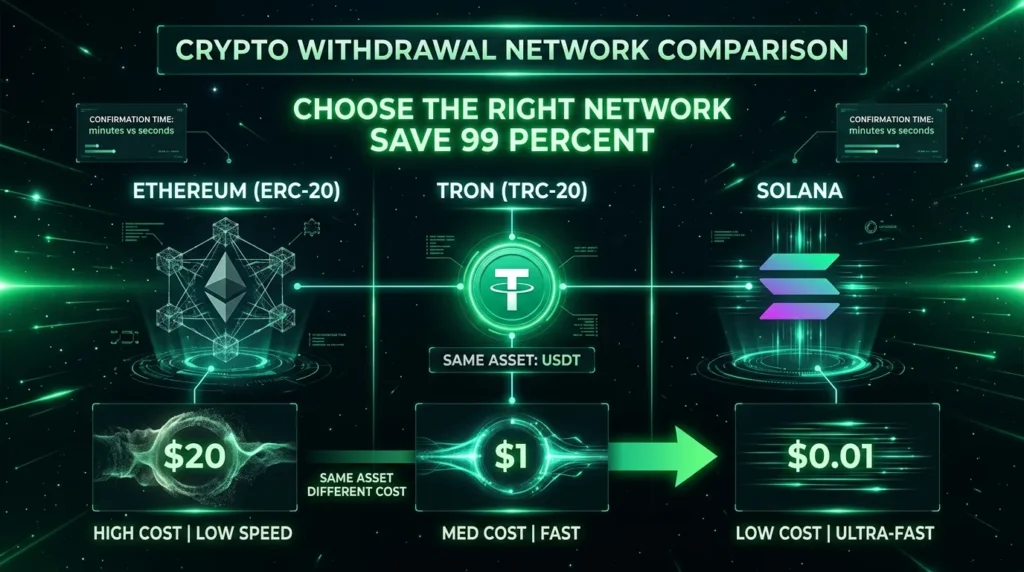
Many stablecoins and tokens are available on multiple blockchains. The same $1,000 in USDT can be withdrawn via:
- Ethereum (ERC-20): ~$5–20+ depending on congestion
- Tron (TRC-20): ~$1–2
- BNB Chain (BEP-20): ~$0.10–0.50
- Solana: ~$0.01
Choosing the wrong network for a stablecoin withdrawal can cost 10–50x more than necessary. Always check which network options are available and what the receiving wallet supports.
Bitcoin withdrawal example (2026):
Binance charges approximately 0.0005 BTC for Bitcoin withdrawals (~$47 at $95,000 BTC). Withdrawing 0.01 BTC (worth $950) would see $47 go to fees — nearly 5% of the transfer. Batching larger withdrawals reduces this impact significantly.
Fiat withdrawal fees apply when cashing out to a bank account. Rates vary by currency and method. ACH withdrawals in the US and SEPA in the EU are typically free or very cheap. Wire transfers often cost $15–25.
5. Other Fees to Know
Futures and margin fees: Perpetual futures contracts carry a “funding rate” — a periodic payment (typically every 8 hours) between long and short positions to keep the contract price aligned with spot. This can be a significant cost for positions held over time. Additionally, opening margin positions carries interest charges.
Conversion/swap fees: Many exchanges charge a flat percentage (typically 0.5–1%) for quick conversions between assets rather than trading on the order book. Coinbase’s “Convert” feature, Binance’s basic swap — these are convenient but cost more than placing a limit order on the full exchange.
Inactivity or maintenance fees: Rare but worth checking. Some smaller platforms charge fees if an account is inactive for an extended period.
The True Cost Calculation
Here’s how to calculate what you actually pay for a round-trip trade (buy + sell):
Example: Buying and selling $5,000 in Bitcoin on Coinbase
| Cost Item | Amount |
|---|---|
| Deposit via debit card (3.99%) | $199.50 |
| Buy order (0.60% taker fee) | $30.00 |
| Spread on buy (~0.5%) | $25.00 |
| Sell order (0.60% taker fee) | $30.00 |
| Spread on sell (~0.5%) | $25.00 |
| Crypto withdrawal fee | ~$5.00 |
| Total costs | ~$314.50 (6.3%) |
The same trade using ACH deposit and Advanced Trade limit orders:
| Cost Item | Amount |
|---|---|
| Deposit via ACH | $0 |
| Buy limit order (0.40% maker fee) | $20.00 |
| Spread (tighter on order book, ~0.1%) | $5.00 |
| Sell limit order (0.40% maker fee) | $20.00 |
| Spread (~0.1%) | $5.00 |
| Crypto withdrawal fee | ~$5.00 |
| Total costs | ~$55 (1.1%) |
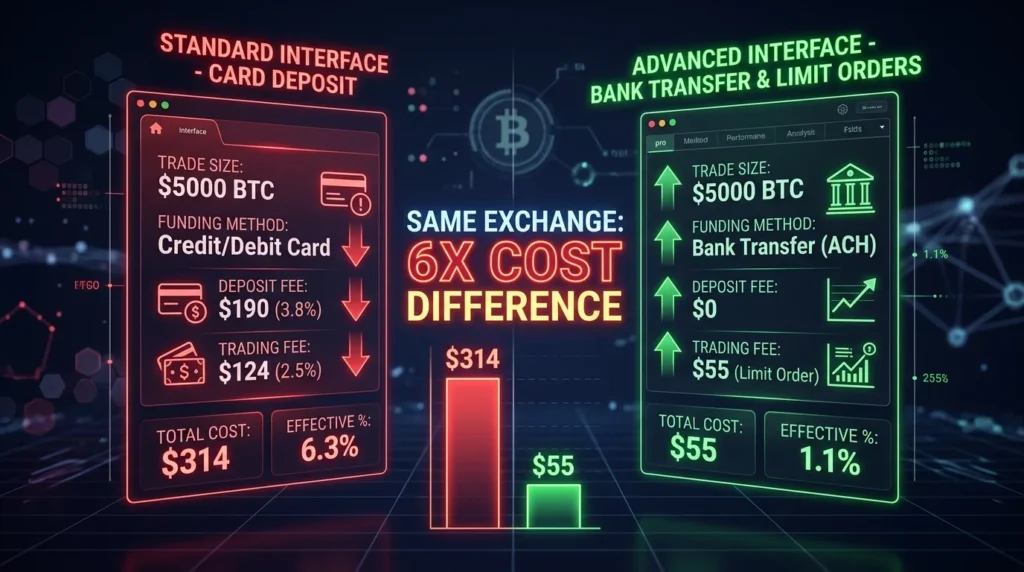
Same exchange. Same trade size. Nearly 6x difference in cost — entirely from method choices.
7 Ways to Pay Less in Fees
1. Use ACH or Bank Transfer, Not Cards
The single most impactful change for most users. Card deposits cost 2–4%. ACH/SEPA bank transfers are typically free. For a $1,000 purchase, this saves $20–40 upfront.
2. Use Limit Orders Instead of Market Orders
On exchanges with maker-taker pricing, limit orders qualify for maker fees (lower) instead of taker fees (higher). On Kraken Pro: 0.25% maker vs 0.40% taker. On Coinbase Advanced: 0.40% maker vs 0.60% taker. Use limit orders whenever you’re not urgently executing.
3. Use the Advanced Interface, Not the Simple One
Simple/instant buy flows have higher fees and wider spreads. Coinbase Simple Trade vs Advanced Trade. Kraken standard vs Kraken Pro. The advanced interface typically cuts your total cost by 50–80%.
4. Choose the Cheapest Withdrawal Network
For stablecoins (USDT, USDC), always use Tron (TRC-20), BNB Chain, or Solana networks when the receiving wallet supports them. Avoid ERC-20 for routine stablecoin withdrawals unless you specifically need the Ethereum version.
5. Batch Withdrawals
Fixed-fee withdrawals hit harder on small amounts. If you withdraw $100 and pay a $5 fee, that’s 5%. If you withdraw $1,000 and pay the same $5 fee, that’s 0.5%. Consolidate transfers when possible.
6. Use Native Token Discounts
On exchanges that offer them — Binance (BNB: 25% off), Bybit (various discounts) — holding and using the native token reduces trading fees. Evaluate whether the discount justifies holding the token based on your trading volume.
7. Check the Spread Before Buying
Before executing any trade, look up the current Bitcoin (or other asset) price on CoinMarketCap or CoinGecko. Compare it to what the exchange is quoting as the buy price. The difference is the spread — your first sanity check before committing.
Fee Comparison: Major Exchanges at a Glance
| Exchange | Instant Buy Fee | Advanced/Pro Spot | Derivatives (Base) | BTC Withdrawal |
|---|---|---|---|---|
| Coinbase | 1.5–4% + spread | 0.40%/0.60% | N/A (futures only) | ~$5 |
| Kraken | 1% flat | 0.25%/0.40% | 0.02%/0.05% | ~$2 |
| Binance | 2% + spread | 0.10%/0.10% | 0.02%/0.05% | ~$5 |
| Bybit | ~1.5% | 0.10%/0.10% | 0.02%/0.055% | ~$1 |
| Binance.US | ~0.5% + spread | 0.38%/0.57% | N/A | ~$5 |
Rates as of Q1 2026. All fees subject to change.
Key Terminology
Maker: Places a limit order that waits to be filled — adds liquidity, pays lower fees.
Taker: Places a market order that fills immediately — removes liquidity, pays higher fees.
Spread: The gap between buy and sell price — exchange revenue embedded in the price, not displayed as a separate fee.
Gas/Network Fee: Blockchain transaction cost paid to miners or validators, separate from exchange fees.
VIP Tier: Higher trading volume unlocks lower fee rates — most exchanges use 30-day volume to determine tier.
Funding Rate: Periodic payment on perpetual futures contracts between long and short positions, charged every 8 hours.
Native Token Discount: Fee reduction for paying in the exchange’s own token (BNB, BGB, etc.).
The Bottom Line
The cheapest exchange on the marketing page and the cheapest exchange in practice are often different. Your total fee depends on:
- Which interface you use (simple vs. advanced)
- How you deposit (card vs. bank transfer)
- Whether you use limit or market orders
- Which network you choose for withdrawals
- Whether you qualify for volume discounts or use native token discounts
Master these five variables and you can reduce your total trading costs by 70–80% compared to using default settings — often on the same exchange.
Disclaimer: This article is for informational purposes only and does not constitute financial advice. Cryptocurrency investments carry significant risk, including the potential loss of all invested capital. Always conduct your own research before making any investment decisions.