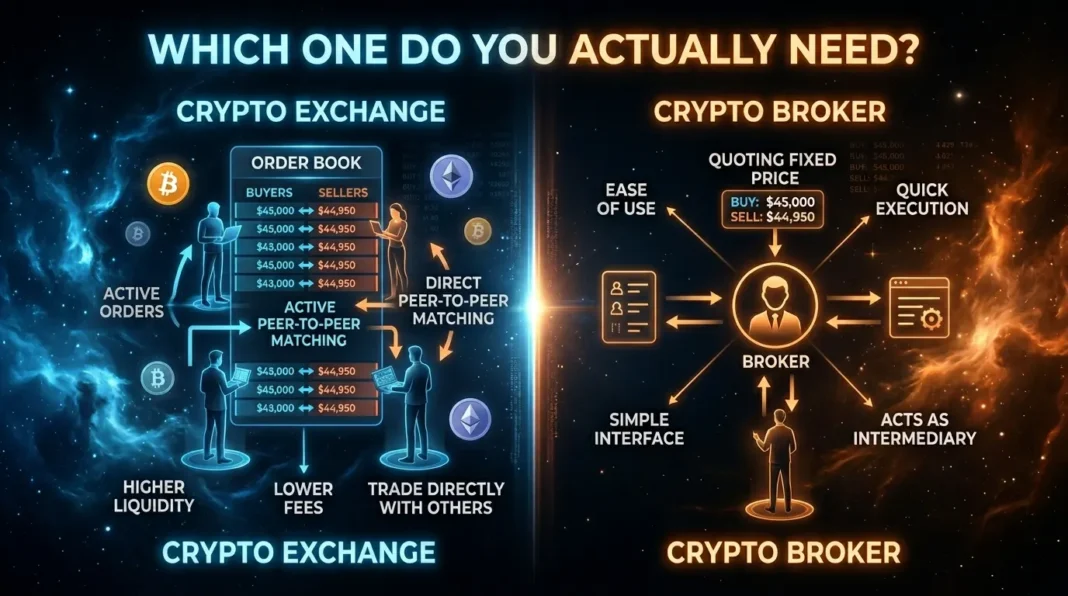
When you switch to an advanced trading interface on any major crypto exchange, one of the first things you’ll see is a live, constantly updating display of numbers — the order book.
To beginners, it looks like a wall of scrolling data. To experienced traders, it’s one of the most informative real-time tools available — showing not just where the market is, but where buyers and sellers are positioned, how much liquidity exists, and where price is likely to find support or resistance.
This guide explains every component of a crypto order book from the ground up.
What Is a Crypto Order Book?
An order book is a real-time, continuously updating list of all open buy and sell orders for a specific trading pair on an exchange.
It answers one question: at what prices, and in what quantities, are traders currently willing to buy or sell this asset?
Every limit order placed on an exchange enters the order book. When a matching order appears on the opposite side, they execute — the trade happens, both orders are removed from the book, and the price updates.
Important: Only limit orders appear in the order book. Market orders (buy/sell immediately at current price) don’t sit in the book — they execute instantly against existing orders.
The Structure of an Order Book
Every order book has the same basic structure, displayed consistently across Coinbase Advanced, Kraken Pro, Binance, and virtually every other exchange:
The Two Sides
Bids (Buy Orders) — typically displayed in green
All the open orders from traders who want to BUY. Listed in descending order — the highest price a buyer is willing to pay sits at the top.
Asks (Sell Orders) — typically displayed in red
All the open orders from traders who want to SELL. Listed in ascending order — the lowest price a seller is willing to accept sits at the top (closest to the current market price).
The Three Columns
Each side of the order book shows three columns:
| Column | What It Shows |
|---|---|
| Price | The price level of the order |
| Size / Amount | How much crypto is available at this price |
| Total | Cumulative amount from the best price to this level |
Reading a Live Example
Imagine Bitcoin’s order book shows:
Ask side (sellers):
| Price | Size (BTC) | Total (BTC) |
|---|---|---|
| $95,200 | 0.5 | 0.5 |
| $95,150 | 1.2 | 1.7 |
| $95,100 | 2.8 | 4.5 |
| $95,050 | 3.1 | 7.6 ← Lowest ask |
Bid side (buyers):
| Price | Size (BTC) | Total (BTC) |
|---|---|---|
| $95,000 | 4.2 | 4.2 ← Highest bid |
| $94,950 | 1.8 | 6.0 |
| $94,900 | 0.9 | 6.9 |
| $94,850 | 2.3 | 9.2 |
Reading this:
- The best ask (lowest price someone will sell) = $95,050
- The best bid (highest price someone will buy) = $95,000
- The spread = $95,050 − $95,000 = $50
- If you place a market buy order right now, you’ll pay $95,050
- If you place a market sell order right now, you’ll receive $95,000
The Spread: The Most Important Number
The spread is the gap between the best ask and the best bid. It represents the immediate cost of trading — the difference between what you’d pay to buy right now vs. what you’d receive to sell right now.
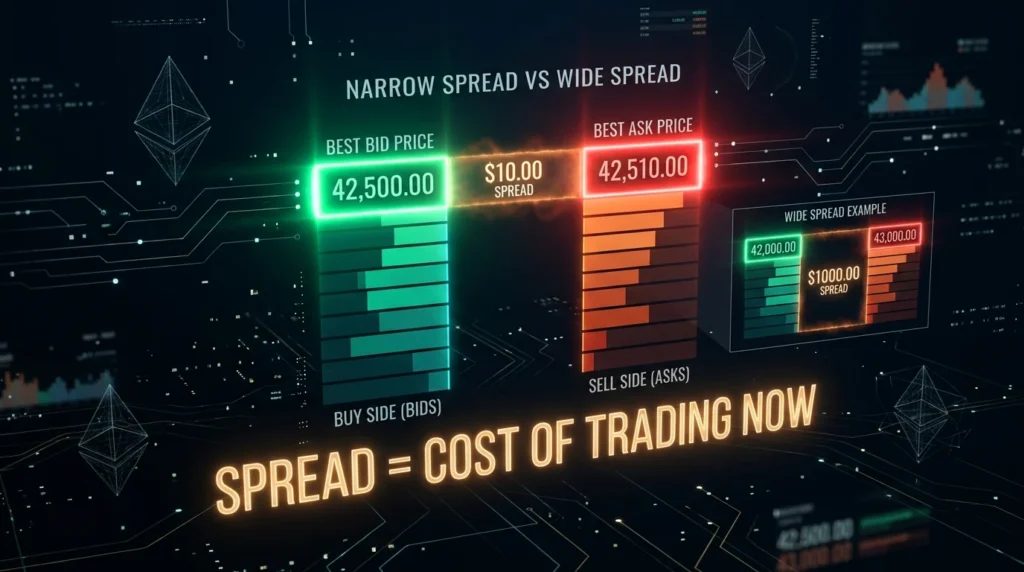
Narrow spread ($5–$50 on BTC): High liquidity market. Many buyers and sellers close to the same price. Low cost to execute immediately.
Wide spread ($100–$500+ on BTC): Lower liquidity. Fewer participants. Higher implicit cost to trade immediately.
Why it matters:
- On major pairs like BTC/USDT on Binance, the spread is typically $1–$10 (essentially zero cost)
- On low-cap altcoins with thin order books, the spread can be 1–5% of the price
- When exchanges display “0% trading fee,” they almost always make revenue through the spread
Using the spread strategically:
Placing a limit order between the best bid and best ask narrows the spread and often qualifies for maker fees (lower). For example, if the best bid is $95,000 and best ask is $95,050, placing a limit buy at $95,020 gets a better price than the market and earns maker fee rates.
Market Depth: How Much Liquidity Exists
Market depth refers to the total volume of orders at various price levels — how much the market can absorb before price moves significantly.
Deep order book: Large volumes of orders spread across many price levels. Large trades execute without significantly moving the price.
Shallow order book: Few orders, or orders concentrated at only a few levels. Even modest-sized trades can cause significant price movement.
Why depth matters for you:
If you want to buy 10 BTC and the order book only has 0.5 BTC available at $95,050, your order will “walk up” through multiple price levels to get filled — you’ll pay $95,050 for the first 0.5 BTC, then $95,100 for the next available amount, then $95,150, and so on. This is called slippage.
Slippage: When Your Order Moves the Market
Slippage is the difference between the price you expected to pay and the price you actually paid — caused by insufficient liquidity at your target price.

Example:
You want to buy $50,000 worth of a small altcoin. The order book shows:
- 0.5% of your order available at the current price
- The rest spread across price levels 2–8% higher
Your market order will fill at an average price 3–4% above the displayed price. That’s slippage.
How to minimize slippage:
- Use limit orders instead of market orders — you set the exact price
- Break large orders into smaller pieces executed over time
- Check the depth before large trades — enough volume at your target level?
- Trade on exchanges with deeper liquidity for the specific asset
- Avoid trading low-liquidity pairs during volatile market hours
Buy Walls and Sell Walls
Large concentrations of orders at specific price levels create visible “walls” in the order book — and on the depth chart.
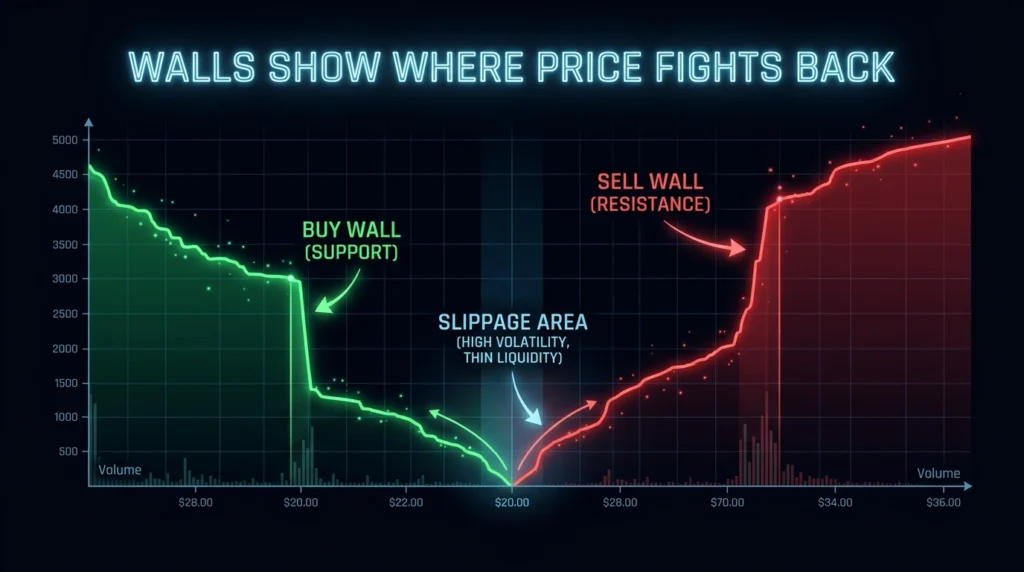
Buy Wall: A very large cluster of buy orders at a specific price. Visually appears as a steep step on the green (bid) side of the depth chart.
What it may indicate:
- Strong demand at this price — buyers are protecting a support level
- A large holder (whale) is accumulating at this price
- It may act as a floor — the price struggles to fall below this level because buy orders absorb selling pressure
Sell Wall: A very large cluster of sell orders at a specific price. Visually appears as a steep step on the red (ask) side.
What it may indicate:
- Heavy supply — many sellers waiting at this price
- Resistance — the price struggles to break above this level
- A large holder distributing (selling) their position
Important caveat — spoofing:
Large orders can be placed and then immediately cancelled before they execute. This is called spoofing — placing fake walls to manipulate other traders’ behavior. A massive buy wall that disappears the moment price approaches it is likely spoofing. Never trade solely based on order book walls without additional confirmation.
The Depth Chart: A Visual View of the Order Book
Most exchanges display the order book data as a visual depth chart alongside the numerical order book.
How to read the depth chart:
- X-axis: Price, increasing left to right
- Y-axis: Cumulative volume of orders
- Green curve (left/bid side): Total buy orders accumulating as price decreases from center
- Red curve (right/ask side): Total sell orders accumulating as price increases from center
- Center point: The current market price / spread
Reading the shape:
- Gradual slope: Deep, liquid market. Large trades won’t dramatically move price.
- Steep/cliff shape: Shallow market. Price can gap quickly through thin areas.
- Large step (wall): Concentrated orders at one level.
- Gap: Price range with almost no orders — price may move rapidly through these zones.
Practical Use: How Traders Use the Order Book
Finding better entry prices:
Instead of buying at market (paying the ask), place a limit order between the bid and ask. You may get filled at a better price and pay lower maker fees.
Identifying support and resistance:
Large bid clusters below current price = potential support. Large ask clusters above = potential resistance. These aren’t guarantees — they’re signals worth noting.
Assessing liquidity before large trades:
Before buying $100,000+ of any asset, check the depth. If there’s only $20,000 in orders within 1% of current price, your trade will cause significant slippage. Either split the order or choose a different exchange with deeper liquidity.
Detecting order flow direction:
If the bid side is consistently larger than the ask side (more buy orders than sell orders), it suggests bullish short-term pressure. The reverse suggests bearish pressure. This is called order book imbalance.
Order Types and Their Relationship to the Order Book
Market Order: Executes immediately at the best available price. Never enters the order book — it takes from it. Guarantees execution, not price.
Limit Order: Enters the order book and waits until the market reaches your specified price. Guarantees price (or better), not execution timing. You become a maker — adding liquidity.
Stop-Loss / Stop-Limit: Triggered when price reaches a level, then converts to a market or limit order. Not visible in the order book until triggered.
Key Terminology
Bid: A buy order — the price and quantity a trader wants to purchase.
Ask: A sell order — the price and quantity a trader wants to sell.
Spread: The gap between the best bid and best ask.
Best Bid: The highest price any buyer is currently willing to pay — the top of the green side.
Best Ask: The lowest price any seller is currently willing to accept — the top of the red side.
Market Depth: The total volume of orders across price levels — indicates liquidity.
Slippage: The difference between expected and actual execution price, caused by insufficient liquidity.
Buy Wall / Sell Wall: A large concentration of orders at a specific price level.
Depth Chart: A visual representation of order book data — cumulative buy and sell volume by price.
Spoofing: Placing large orders with no intention of executing them, to manipulate other traders’ behavior — illegal in most markets.
Order Book Imbalance: Significant difference in volume between bid and ask sides — a short-term directional signal.
The Bottom Line
The order book is a live window into market supply and demand. Learning to read it well doesn’t require complex analysis — it starts with three simple questions:
- What is the spread? (How liquid is this market?)
- How deep is the book? (Can I execute my order without significant slippage?)
- Are there any notable walls? (Where is significant support or resistance?)
For casual buyers making periodic purchases, the order book matters less — just use limit orders at reasonable prices and you’ll typically do better than market orders.
For active traders, the order book is one of the most direct real-time signals available — showing where other participants are actually committing capital, not just where they think price might go. 📊
Disclaimer: This article is for informational purposes only and does not constitute financial advice. Cryptocurrency investments carry significant risk, including the potential loss of all invested capital. Always conduct your own research before making any investment decisions.