When you want to buy Bitcoin, you have two fundamentally different types of platforms to choose from: a crypto exchange and a crypto broker. Most people use one without realizing the distinction — but understanding it helps you choose the right platform and avoid paying more than necessary.
The difference is structural. It affects how your order is executed, what price you pay, what happens to your assets after purchase, and what you can do with them.
What Is a Crypto Exchange?
A crypto exchange is a marketplace where buyers and sellers trade directly with each other.
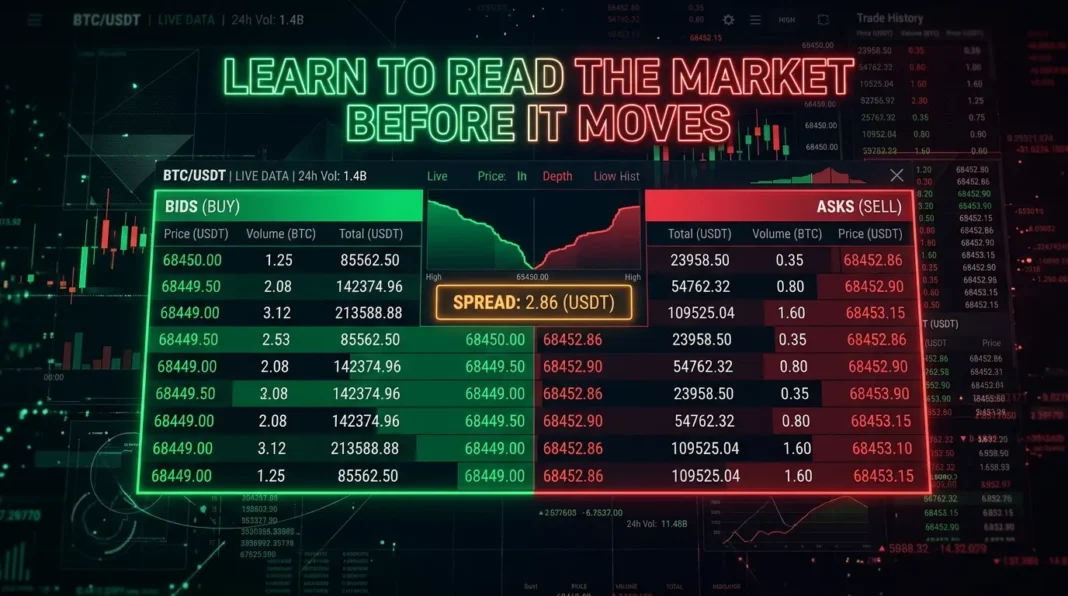
When you buy Bitcoin on Coinbase Advanced Trade, Kraken Pro, or Binance, your order goes into an order book — a real-time list of all open buy and sell orders. Your order matches with another user’s order. The exchange doesn’t set the price — supply and demand do.
Key characteristics of exchanges:
- Dynamic pricing: Prices change in real-time based on market activity
- Order book: Buyers and sellers matched against each other
- Maker/taker fees: Separate fee rates for orders that add vs. remove liquidity
- Self-custody option: You can withdraw purchased crypto to your own wallet
- Wide asset selection: Hundreds or thousands of trading pairs
- Advanced tools: Limit orders, stop-losses, charts, technical indicators
Examples: Coinbase (Advanced Trade), Kraken Pro, Binance, Bybit, OKX
What Is a Crypto Broker?
A crypto broker is an intermediary that executes trades on your behalf at a fixed or quoted price.
When you buy Bitcoin on eToro or through Coinbase’s Simple Trade interface, you’re buying from the broker — not directly from another user. The broker sources the asset from markets and quotes you a price that includes their margin. You click buy, the transaction completes instantly at a quoted price, and you’re done.
Key characteristics of brokers:
- Fixed or quoted pricing: You see a price and accept or reject it — no order book
- Simplicity: No order types to learn, no charts required
- Spread-based revenue: Broker earns from the difference between buy and sell price
- Often custodial: Many brokers hold your crypto on your behalf (you may not be able to withdraw actual crypto)
- Limited asset selection: Usually focused on major cryptocurrencies
- Beginner-friendly: Designed for simple “buy and hold” investing
Examples: eToro, Robinhood (crypto), PayPal (crypto), Trade Republic, Bitpanda
The Key Differences Side by Side
| Feature | Exchange | Broker |
|---|---|---|
| How price is set | Market (supply & demand) | Broker quotes a price |
| Order execution | Matched against other users | Executed by the broker |
| Fee structure | Maker/taker % + spread | Spread-only (often higher) |
| Asset custody | Withdraw to your own wallet | Often held by broker (no withdrawal) |
| Complexity | Higher — order types, interfaces | Lower — simple buy/sell |
| Asset selection | Hundreds to thousands | Typically 20–100 |
| Advanced tools | Charts, limit orders, indicators | Basic or none |
| Best for | Active traders, experienced users | Beginners, simple investors |
The Custody Difference: The Most Important Distinction
The most significant practical difference between exchanges and brokers is what happens to your crypto after you buy it.
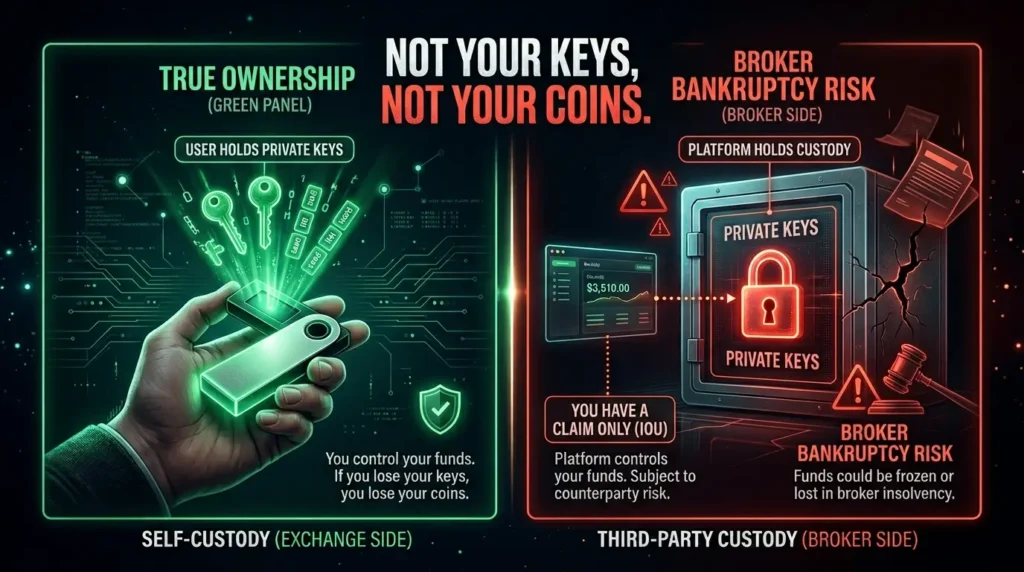
On an exchange: You typically own the actual cryptocurrency. You can withdraw it to your personal wallet — a hardware wallet, MetaMask, Phantom, or any compatible address. You hold the private keys. You control the asset.
On a broker: In many cases, you own a claim on cryptocurrency — not the cryptocurrency itself. eToro, for example, holds assets in custody on your behalf. In some configurations, users can’t withdraw crypto to external wallets at all.
This matters because:
- If the broker goes bankrupt, your “crypto” may be a creditor claim, not an asset you hold
- You can’t use broker-held crypto in DeFi, as collateral, or in Web3 applications
- You don’t receive airdropped tokens or staking rewards that go to actual wallet holders
Not your keys, not your coins applies even more strongly to brokers than to exchanges.
The Fee Difference
Exchanges and brokers charge differently — and the total cost isn’t always obvious.
Exchanges use maker/taker fees:
- Coinbase Advanced Trade: 0.40%/0.60% at base tier
- Kraken Pro: 0.25%/0.40% at base tier
- Binance: 0.10%/0.10% at base tier
Plus a spread (typically tighter on advanced interfaces with order books).
Brokers typically use spread-only pricing — no separate trading fee, but the spread is built into the quoted price:
- eToro: 0.75%–5% spread depending on asset (Bitcoin at 0.75%, smaller coins higher)
- Robinhood: Spread-based (0.10%–0.85%)
- Coinbase Simple Trade: ~0.5%–2% spread plus a separate convenience fee
The counterintuitive reality: Brokers that advertise “no commission” often have higher total costs than exchanges that charge explicit fees — because the spread is embedded in the price rather than shown separately.
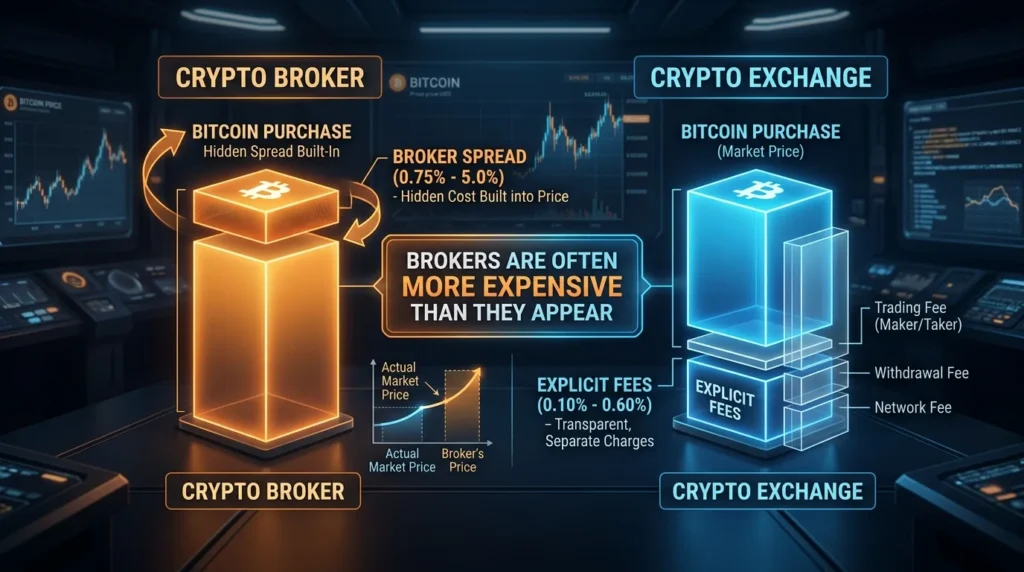
For a $1,000 Bitcoin purchase:
- eToro (0.75% Bitcoin spread): you pay ~$7.50 in spread
- Kraken Pro (0.40% taker): you pay ~$4 in explicit fee, tighter spread
- Binance (0.10% + 0.1% spread): ~$2 total
The smaller and less liquid the asset, the bigger the spread advantage exchanges typically hold.
When a Broker Makes More Sense
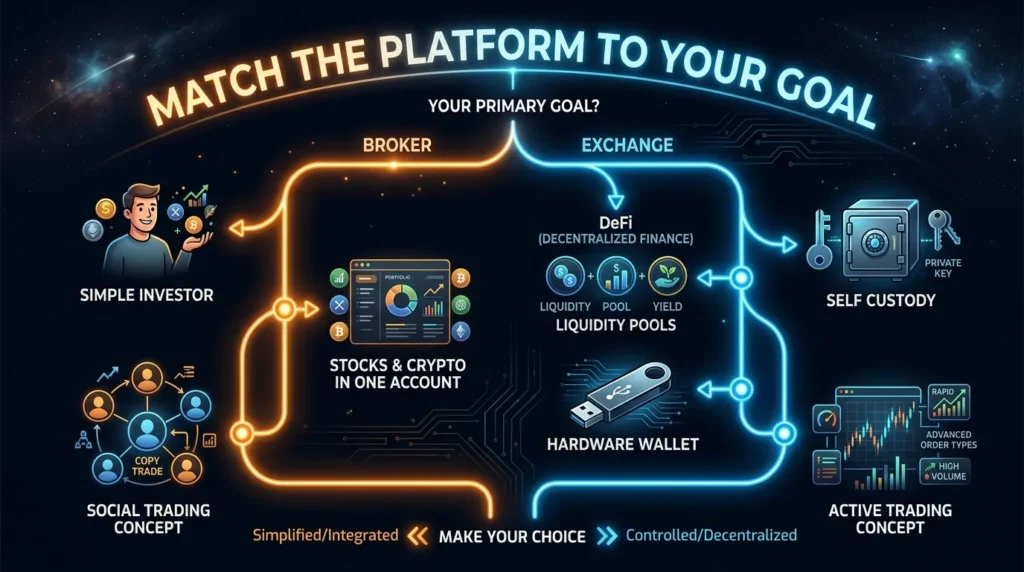
Brokers aren’t inferior — they serve a specific use case well.
Use a broker if:
- You’re a complete beginner who wants to buy Bitcoin or Ethereum without learning exchange mechanics
- You want to hold crypto alongside stocks, ETFs, and other assets in one account
- Simple “buy and hold” is your entire strategy
- You don’t need to withdraw crypto to an external wallet
- You want copy trading or social trading features (eToro’s core strength)
- Speed of onboarding matters more than fee optimization
Real scenario: An investor who wants 5% of their portfolio in Bitcoin alongside stocks and ETFs — using eToro means one account, one interface, no separate wallet management.
When an Exchange Makes More Sense
Use an exchange if:
- You want to own actual crypto you control
- You plan to use DeFi, NFTs, or Web3 applications
- You want access to more than 20–100 major coins
- You’re actively trading or using limit orders
- Long-term self-custody is your plan
- You want staking rewards credited to your own wallet
- You want lower effective fees on higher volumes
Real scenario: A crypto investor holding Bitcoin and Solana long-term, moving holdings to a Ledger hardware wallet, using Solana DeFi occasionally — needs an exchange, not a broker.
The Hybrid: Platforms That Are Both
The lines between broker and exchange are blurring in 2026. Several major platforms now offer both models:
Coinbase: Simple Trade = broker model (quoted price, no order book visible). Advanced Trade = exchange model (order book, maker/taker fees). Same account, two modes.
eToro: Primarily a broker, but has been expanding toward offering actual crypto withdrawal capabilities in some regions.
Robinhood: Added more exchange-like features including crypto wallets and withdrawals — partially bridging the gap.
Interactive Brokers: Traditional brokerage that added crypto trading — broker model with self-custody option for eligible assets.
The practical advice: even on “hybrid” platforms, understand which mode you’re in. Simple/instant buy = broker mechanics. Advanced/pro interface = exchange mechanics.
Key Terminology
Order Book: A real-time list of all open buy and sell orders on an exchange — the mechanism through which prices are determined by market supply and demand.
Spread: The difference between the buy price and sell price — how brokers (and exchanges on simpler interfaces) earn revenue.
Custodial: A platform that holds your assets on your behalf — you don’t control the private keys.
Non-Custodial: You hold the private keys to your assets — your ownership is cryptographically provable.
Copy Trading: Feature offered by some brokers (notably eToro) that lets you automatically mirror the positions of other traders.
CFD (Contract for Difference): A derivative product offered by some brokers that lets you speculate on crypto price movements without owning the underlying asset — used in some international markets.
The Bottom Line
| Your Goal | Best Fit |
|---|---|
| Simple BTC/ETH exposure alongside stocks | Broker (eToro, Robinhood) |
| Active trading with competitive fees | Exchange (Kraken, Binance) |
| Self-custody and hardware wallet | Exchange |
| DeFi and Web3 access | Exchange |
| Copy trading / social investing | Broker (eToro) |
| First-time buyer, maximum simplicity | Broker or beginner exchange (Coinbase Simple) |
Both have legitimate uses. The mistake is using one when you need the other — buying crypto through a broker when you actually need to control the asset, or using an exchange when a broker’s simplicity would serve you better and save you onboarding time.
Know which you’re using. Know what you own. 🔑
Disclaimer: This article is for informational purposes only and does not constitute financial advice. Cryptocurrency investments carry significant risk, including the potential loss of all invested capital. Always conduct your own research before making any investment decisions.