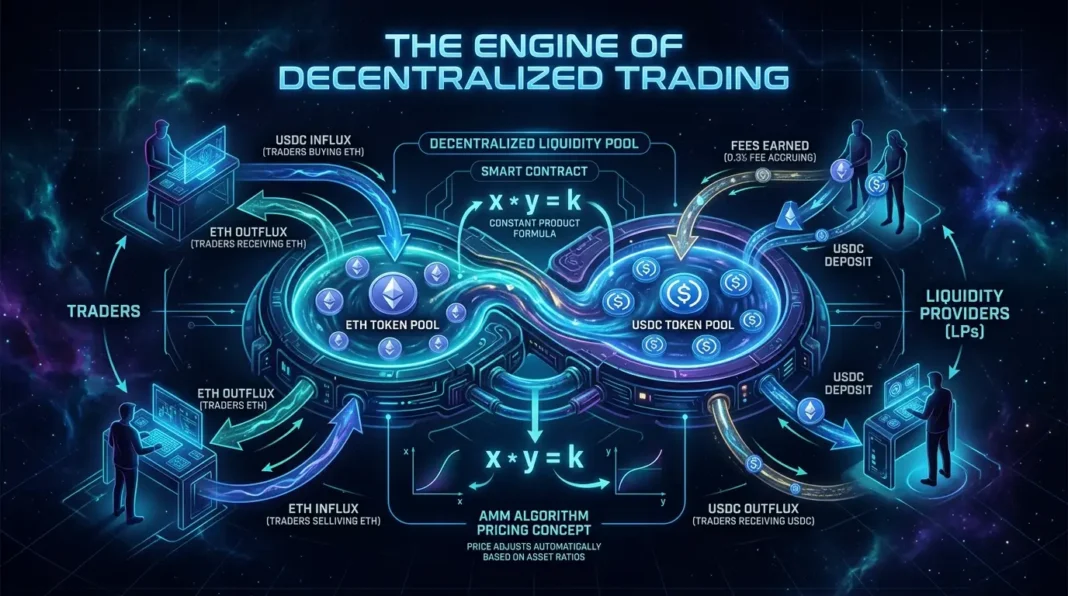
Yield farming is how DeFi participants put their crypto to work — deploying assets across protocols to earn returns beyond simple price appreciation.
In traditional finance, your bank pays 0.5% on savings. In DeFi, the same dollar-denominated assets can earn 4–15% through lending protocols, liquidity provision, or a combination of both. The tradeoff: the complexity and risks are significantly higher than a savings account.
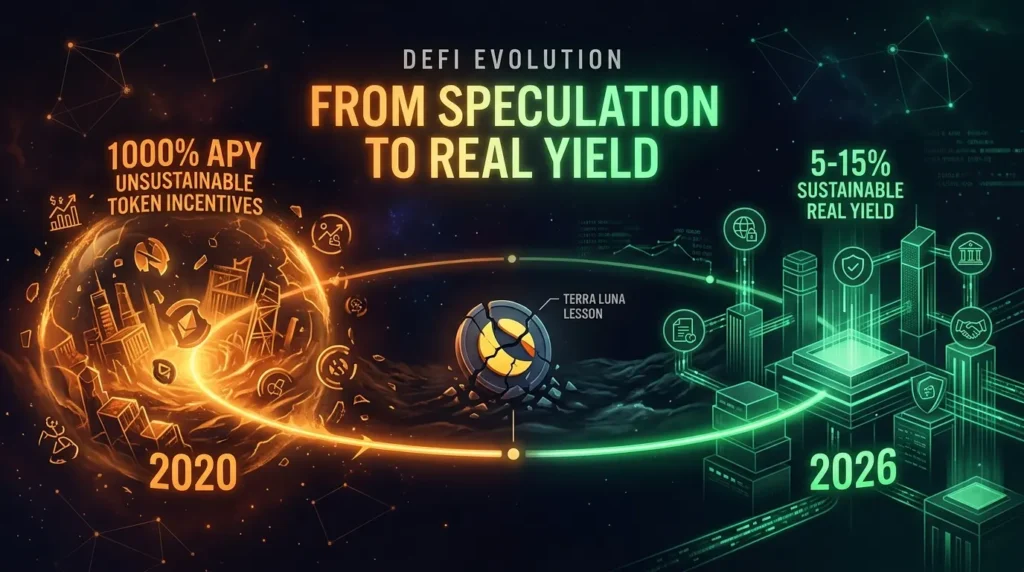
The term “yield farming” became famous in 2020’s DeFi Summer — a period of astronomical, unsustainable returns where some protocols offered 1,000%+ APY through token incentives. In 2026, the landscape is fundamentally different: more mature, more sustainable, and more nuanced. Understanding this evolution is essential for anyone entering the space now.
What Is Yield Farming?
Yield farming is the practice of deploying crypto assets into DeFi protocols to earn returns. Those returns come from one or more of three sources:
1. Trading fees: When you provide liquidity to a DEX pool (Uniswap, Curve), you earn a percentage of every trade executed against your liquidity. This is real, sustainable yield — generated from actual protocol usage.
2. Lending interest: When you lend assets through a protocol like Aave or Compound, borrowers pay interest. A portion goes to you. Also real yield from real usage.
3. Token incentives (liquidity mining): Protocols often distribute their governance tokens to users who deposit capital — a way of bootstrapping liquidity and rewarding early participants. Example: Uniswap once distributed UNI tokens to historical LPs; Curve distributes CRV to active liquidity providers.
The original yield farming definition focused primarily on #3 — farming governance token rewards from new protocols. In 2026, the more sustainable definition encompasses all three sources, with emphasis on fee and interest-based yield rather than inflationary token emissions.
Yield Farming vs Staking: What’s the Difference?
These terms are frequently confused — even by people already in crypto.
Staking:
- Locking cryptocurrency to participate in a blockchain network’s consensus mechanism (Proof of Stake)
- Validators secure the network and earn block rewards in return
- Example: Staking ETH on Ethereum → earn ~3.5% APY in ETH
- Primary purpose: network security, not liquidity provision
Yield Farming:
- Deploying assets into DeFi protocols to earn returns from protocol activity
- Includes liquidity provision, lending, borrowing optimization, and strategy combinations
- Example: Depositing USDC into Aave to earn lending interest → earn 5–10% APY in USDC
- Primary purpose: generating yield from capital deployment
The overlap: Liquid staking (depositing ETH to Lido to receive stETH) is technically staking, but the stETH received can then be deployed in yield farming strategies — making it both. In practice, the lines blur significantly in 2026 with restaking, LST loops, and composable DeFi strategies.
Simple mental model:
- Staking = helping secure a blockchain, earning network rewards
- Yield Farming = deploying capital in DeFi markets, earning from protocol activity
The Evolution of Yield Farming: 2020 to 2026
Understanding where yield farming came from helps you evaluate what’s real and what’s unsustainable today.
DeFi Summer 2020: The Wild West
Compound launched its COMP token distribution in June 2020 — rewarding users who borrowed and lent on the protocol. Suddenly, borrowing money could be profitable because the COMP rewards exceeded the interest paid. This kicked off a frenzy.
Every new protocol competed for liquidity by distributing their governance token. Yields of 100%, 500%, even 1,000%+ APY appeared — not because the protocols were generating that much real revenue, but because the governance tokens being distributed were rapidly appreciating in price.
The problem: these yields were entirely dependent on:
- The governance token’s price remaining high
- New users continuously entering to support the token price
- Inflationary token emissions continuing indefinitely
When token prices collapsed, the “yields” collapsed with them. Many early yield farmers lost significant capital chasing unsustainable APYs.
2021–2023: Maturation and Pain
The Terra/LUNA collapse in May 2022 — where Anchor Protocol had offered 20% stable APY on UST backed by nothing but token incentives — became the definitive lesson in unsustainable yield. $40 billion evaporated.
Simultaneously, legitimate DeFi continued maturing. Real-yield protocols emerged, focusing on distributing actual protocol revenue rather than inflationary token emissions.
2026: The Real-Yield Era
The DeFi landscape of 2026 is defined by:
- Real yield: Revenue from actual fee generation, not token inflation
- Institutional participation: Major financial institutions using DeFi protocols
- Real-World Asset (RWA) integration: Tokenized treasuries, bonds, and real assets providing yield backed by traditional finance
- Sustainable APYs: 5–15% for stablecoins, 3–10% for ETH-based strategies, 10–30% for volatile pairs
- “Too good to be true” threshold: Any yield above ~30–40% on established assets deserves extreme skepticism
The Major Yield Farming Categories in 2026
Category 1: Lending and Borrowing (Lowest Risk)
How it works: Deposit assets into a lending protocol → borrowers pay interest → you earn a portion.
Key protocols:
- Aave V3: The market leader. Multi-chain (Ethereum, Arbitrum, Base, Optimism, Polygon). Variable and stable rate options.
- Compound V3: Focus on USDC markets. Cleaner, simpler than Aave.
- Morpho: Optimizes rates by matching lenders and borrowers directly when possible.
Expected APYs (April 2026, variable — verify current rates):
- USDC/USDT: 4–12% APY (depends on borrowing demand)
- ETH: 2–5% APY
- WBTC: 1–3% APY
- Rates fluctuate significantly with market conditions
Risk level: Low to moderate
- Smart contract risk (use audited, established protocols)
- Rate risk (variable APY can drop significantly in low-demand periods)
- Borrower liquidation doesn’t affect lenders — protocol handles this
Best for: Beginners wanting real DeFi yield with manageable complexity.
Category 2: Liquidity Provision (Moderate Risk)
How it works: Provide two-token liquidity to a DEX pool → earn a percentage of trading fees from every swap in the pool.
(Detailed mechanics covered in our guide: What Is a Liquidity Pool?)
Stablecoin LP (lowest IL risk):
- Curve Finance 3pool (USDC/USDT/DAI): 4–8% APY from fees + CRV incentives
- Near-zero impermanent loss
- Highly liquid, easy to exit
Major asset LP (moderate IL risk):
- Uniswap ETH/USDC: Variable, depends on volume; typically 5–15% APY in high-volume periods
- Impermanent loss risk if ETH price moves significantly
Volatile pair LP (higher IL risk):
- Higher fee APYs (15–50%+) but significant impermanent loss exposure
- Only suitable after thoroughly understanding IL mechanics
Risk level: Moderate (stablecoin pairs) to High (volatile pairs)
- Impermanent loss is the primary risk
- Smart contract risk
Category 3: Liquid Staking + DeFi Composability
How it works: Stake ETH → receive stETH → deploy stETH in additional DeFi protocols to layer returns.
The basic strategy:
- Stake ETH via Lido → receive stETH (~3.5% APY base)
- Deposit stETH into Aave as collateral (~2% supply APY additionally)
- Total: ~5–6% on the same ETH capital
The leveraged LST loop (more complex, more risk):
- Stake ETH → stETH
- Deposit stETH on Aave as collateral
- Borrow ETH against stETH collateral
- Stake borrowed ETH → more stETH
- Repeat
This amplifies the staking yield but introduces liquidation risk if stETH depegs from ETH or if ETH price falls significantly against the borrowed amount.
Risk level: Moderate (simple LST DeFi) to High (leveraged loops)
- Liquidation risk in leveraged positions
- stETH depeg risk (rare but possible)
- Smart contract risk (multiple protocols involved)
Category 4: Real World Asset (RWA) Yield
One of the most significant DeFi developments of 2025-2026 is the integration of real-world assets — tokenized US Treasury bills, money market funds, and bonds — into DeFi protocols.
How it works: Protocols like Maple Finance, Ethena, and BlackRock’s BUIDL offer tokenized exposure to traditional yield-bearing instruments within DeFi.
Expected APYs (variable — verify current rates):
- Tokenized Treasury products: 4–5% APY (tracks the risk-free rate)
- More structured products: 8–15% APY with additional smart contract/counterparty risk
Why it matters: This provides DeFi yield backed by traditional financial assets rather than crypto-native token inflation — a fundamentally different and more stable yield source.
Risk level: Moderate
- Counterparty risk (the institution holding the real assets)
- Smart contract risk
- Regulatory risk (most RWA products have KYC requirements)
Category 5: Yield Aggregators (Automation)
Rather than manually moving capital between protocols to chase the best rates, yield aggregators do this automatically.
How they work: Deposit into a yield aggregator → the protocol’s strategy automatically deploys your capital into the highest-yielding available opportunities → fees are compounded automatically.
Major aggregators:
- Yearn Finance: The OG yield aggregator. Offers “vaults” for various strategies, automatically optimizing between lending protocols.
- Beefy Finance: Multi-chain aggregator with hundreds of auto-compounding strategies.
- Convex Finance: Boosts CRV rewards for Curve LPs — maximizes Curve yield without requiring users to manage CRV locking themselves.
Expected APYs: Variable — aggregator yields reflect underlying protocol yields plus optimization gains.
Risk level: Moderate to High (depends on underlying strategy complexity)
- Additional smart contract layer on top of underlying protocols
- Strategy risk — automated rebalancing can fail in edge cases
What Makes Yield “Real” vs “Fake” in 2026
This is the most important framework for evaluating any yield opportunity:
Real Yield (Sustainable)
Generated from actual economic activity — fees paid by users for a service.
Examples:
- Uniswap trading fees: Real. Traders pay 0.01–1% per swap. LPs receive this.
- Aave lending interest: Real. Borrowers pay interest. Lenders receive a portion.
- Tokenized Treasury yield: Real. Backed by US government debt.
Characteristics:
- APY roughly correlates with traditional finance rates or real market demand
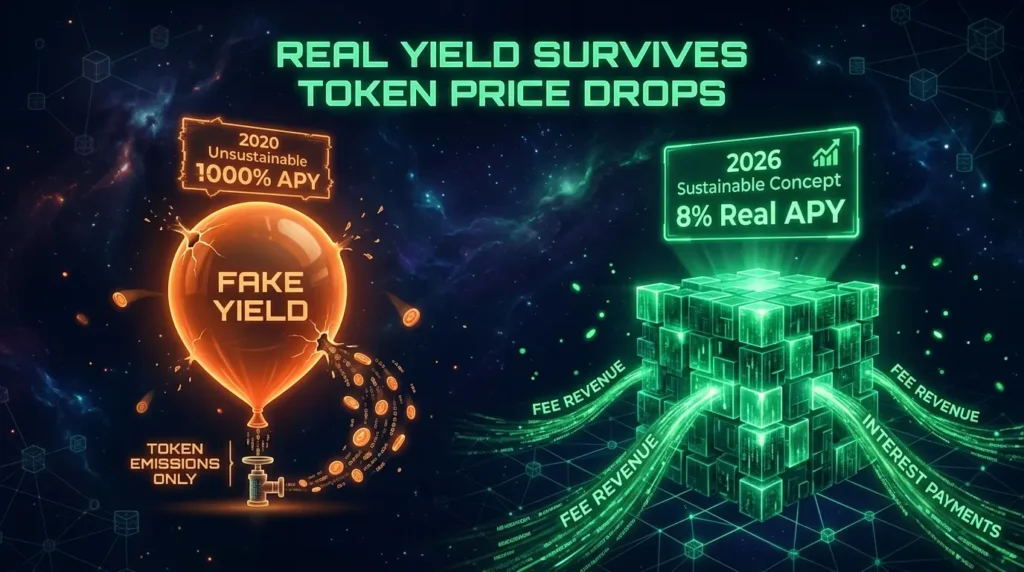
- Yield exists even if the protocol’s token loses value
- Sustainable over time without constant new capital inflow
Fake/Inflationary Yield (Unsustainable)
Generated by distributing tokens that were newly minted — not from real economic activity.
Examples:
- “New protocol offers 500% APY” — distributing its own newly created token as incentive
- Ponzi-like structures where early participants are paid with capital from new participants
Red flags:
- APY dramatically exceeds anything comparable in traditional or mature DeFi
- Yield is primarily or entirely in the protocol’s own governance token
- Protocol has no sustainable revenue model beyond token emissions
- Token has launched recently with no track record
The test: Remove the token incentive. If the underlying yield (from fees, interest) is still meaningful — it’s real yield. If it drops to near zero — the APY was entirely incentive-driven inflation.
Calculating Your Real Yield: The Full Picture
Headline APY is rarely the number that matters. The complete yield calculation includes:
Gross APY
Minus: Gas costs (entering, managing, exiting positions — particularly significant on Ethereum mainnet for smaller positions)
Minus: Protocol fees (some aggregators charge performance or management fees)
Minus: Impermanent loss (if applicable)
Minus: Token price depreciation (if yield is paid in volatile governance tokens)
= Net Effective Yield
Example:
- Pool advertises 20% APY in governance tokens
- Gas to enter and exit: $50
- Governance token drops 60% over the period
- Real yield on $1,000 invested over 3 months: $200 × 0.4 (60% token drop) = $80 – $50 gas = $30 actual return (3%)
Always calculate net effective yield accounting for token price risk.
Position size minimums:
On Ethereum mainnet, gas fees can make positions under $5,000–$10,000 unprofitable for active yield farming strategies. Ethereum Layer 2s (Arbitrum, Base, Optimism) and Solana have dramatically lower gas costs, making smaller positions viable.
Yield Farming Risks: The Complete Picture
1. Impermanent Loss
For LP-based strategies. Covered in depth in our Liquidity Pool guide. Summary: price divergence between paired assets reduces LP position value versus simply holding.
2. Smart Contract Risk
Every DeFi protocol carries the risk that its code contains exploitable vulnerabilities. Q1 2026 saw $482 million in DeFi losses. Even audited protocols have been exploited.
Mitigation: Use protocols with years of track record, multiple audits, and significant existing TVL. New protocols with high APYs and no audit history are highest risk.
3. Liquidation Risk
In leveraged or borrowing-based strategies, collateral value dropping below the liquidation threshold triggers automatic position closure — potentially at a loss.
Mitigation: Maintain conservative collateralization ratios. Monitor positions actively. Use protocols with gradual liquidation mechanisms rather than all-at-once liquidations.
4. Token Price Risk
If your yield is paid in governance tokens, and those tokens lose value, your effective APY is much lower than advertised.
Mitigation: Sell governance token rewards regularly rather than holding. Or focus on strategies where yield is denominated in stablecoins or ETH/BTC.
5. Protocol/Regulatory Risk
DeFi protocols can face regulatory action, or teams can abandon projects. More established protocols with decentralized governance are generally safer.
6. Gas Cost Risk
On Ethereum mainnet, gas price spikes can significantly erode returns on smaller positions, or trap you in a position until gas returns to manageable levels.
Mitigation: Use L2s for active yield farming. Keep Ethereum mainnet for larger, longer-duration positions.
A Practical Yield Farming Starter Path (2026)
This progression moves from lowest to highest complexity and risk:
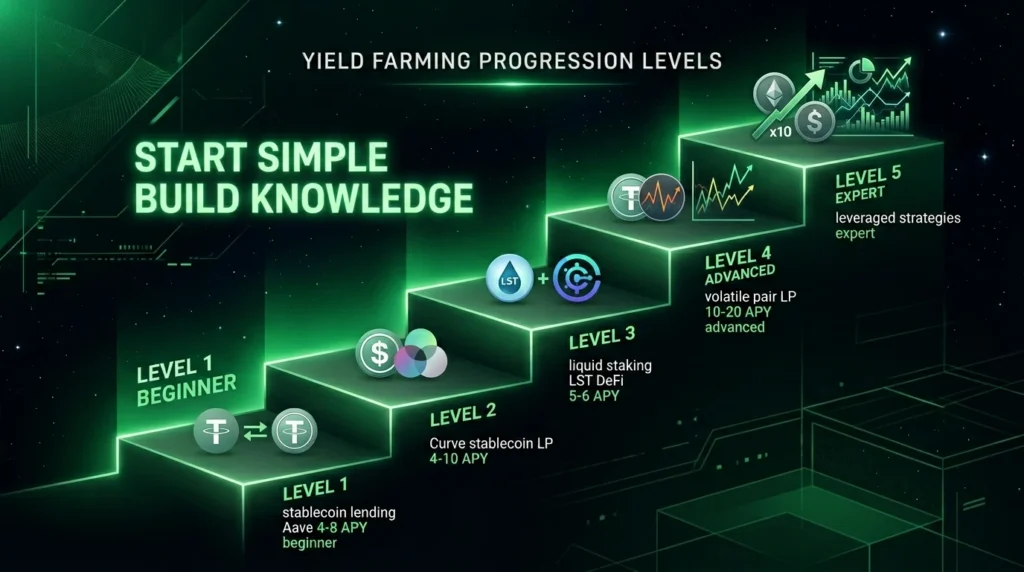
Level 1 — Stablecoin lending on Aave (Beginner):
Deposit USDC or USDT → earn 4–8% APY
- Minimal price risk (stablecoins)
- No impermanent loss
- Single protocol, simple exit
- Real yield from borrowing demand
Level 2 — Stablecoin LP on Curve (Beginner-Intermediate):
Provide USDC/USDT/DAI to Curve 3pool → earn 4–10% APY from fees + CRV incentives
- Near-zero impermanent loss
- Understanding of LP mechanics required
- CRV reward management (sell or stake for more yield)
Level 3 — Liquid staking + basic DeFi (Intermediate):
Stake ETH via Lido → deposit stETH on Aave as collateral
- Understanding of liquidation mechanics required
- Multiple protocols (more smart contract exposure)
- ~5–6% effective APY on ETH capital
Level 4 — Volatile pair LP on Uniswap (Intermediate-Advanced):
Provide ETH/USDC liquidity → earn trading fees
- Significant impermanent loss risk requires management
- Concentrated liquidity (v3) positions require active rebalancing
- Higher potential returns with higher complexity
Level 5 — LST loops, leveraged strategies (Advanced):
Complex combinations of borrowing, staking, and re-deployment
- Liquidation risk
- Multiple protocol dependencies
- Requires deep understanding of all underlying mechanics
Key Terminology
Yield Farming: Deploying crypto assets across DeFi protocols to earn returns from trading fees, lending interest, and token incentives.
Liquidity Mining: Earning a protocol’s governance token as a reward for providing liquidity — a subset of yield farming.
Real Yield: Returns generated from actual protocol revenue (fees, interest) rather than inflationary token emissions.
APY (Annual Percentage Yield): Annualized return including compound interest — the standard metric for DeFi yield comparison.
TVL (Total Value Locked): Total assets deposited in a protocol — a proxy for protocol trust and liquidity depth.
Governance Token: Protocol-issued token granting voting rights — often distributed as yield farming rewards.
LST Loop: Leveraged yield strategy using liquid staking tokens as collateral to borrow and restake repeatedly.
Yield Aggregator: Protocol that automatically optimizes and compounds yield across multiple DeFi strategies (Yearn, Beefy).
RWA (Real World Assets): Tokenized traditional financial instruments (bonds, treasuries) used as DeFi yield sources.
Liquidity Mining: Depositing tokens into DeFi protocols to earn protocol governance tokens as incentives.
The Bottom Line
Yield farming in 2026 is fundamentally different from its 2020 origins — more mature, more sustainable, and more nuanced.
The honest framework:
- Real yields (from fees and interest) of 5–15% on stablecoins and established assets are achievable and legitimate
- Yields above 30–40% on established assets almost always involve proportionally higher risks — new protocols, concentrated liquidity management, leverage, or inflationary token incentives
- The sequence matters: learn mechanics → start simple → add complexity gradually
Where to start:
- Set up MetaMask, fund with ETH
- Deposit USDC on Aave on Arbitrum or Base (low gas, real yield)
- Understand the mechanics before adding complexity
The best yield farmers in 2026 aren’t chasing the highest APY. They’re finding the best risk-adjusted return relative to what they understand and can manage. 🌾
Disclaimer: This article is for informational and educational purposes only and does not constitute financial advice. DeFi yield farming involves significant risks including smart contract vulnerabilities, impermanent loss, liquidation, and total loss of capital. Always conduct your own research before participating.