Traditional staking has a fundamental problem: when you stake your ETH, SOL, or other assets, they’re locked. You can’t sell them, trade them, or use them as collateral while they’re earning staking rewards. Your capital is frozen.
Liquid staking solves this problem by giving you a Liquid Staking Token (LST) that represents your staked position — while your original assets continue earning staking rewards in the background.
The result: you stake ETH, receive stETH, earn ~3.5% staking APY automatically, and can simultaneously use your stETH in DeFi protocols, as collateral, or sell it if you need liquidity. Your capital is no longer frozen.
In 2026, liquid staking has become one of DeFi’s most important innovations — with Lido alone managing $35+ billion in staked ETH, and liquid staking tokens becoming the backbone of sophisticated DeFi strategies.
The Problem Liquid Staking Solves
To appreciate liquid staking, you need to understand what it replaces.
Traditional (Native) Staking Limitations
Ethereum solo staking:
- 32 ETH minimum (~$50,000–80,000)
- Funds locked until unstaking (variable period)
- Capital is idle — can’t be used anywhere else while staking
- Technical complexity of running a validator node
Delegation on other chains:
- Lockup periods: 21 days (Cosmos), 28 days (Polkadot), 2–5 days (Solana)
- Assets unavailable during the unbonding period
- No composability with DeFi protocols
The core problem: You choose between earning staking rewards OR having liquid capital for other uses. You can’t do both simultaneously with native staking.
The Liquid Staking Solution
Liquid staking protocols accept your ETH (or SOL, etc.), stake it on your behalf through a validator infrastructure, and issue you a derivative token (LST) representing:
- Your staked principal
- Your accumulated rewards to date
This LST is freely tradeable, transferable, and usable in DeFi — just like any other token. When you want to unstake, you redeem your LST for the underlying asset plus all earned rewards.
How Liquid Staking Works: Step by Step
Using Lido Finance as the example:
Step 1: Deposit ETH
You send ETH to the Lido smart contract (app.lido.fi). No minimum — you can deposit any amount of ETH.
Step 2: Receive stETH
The contract mints stETH at a 1:1 ratio with your deposited ETH. 1 ETH deposited = 1 stETH received. This transaction happens instantly.
Step 3: Staking happens in the background
Lido aggregates ETH from all depositors and delegates it to a curated set of professional validators. These validators earn Ethereum’s staking rewards on your behalf.
Step 4: Rewards accumulate automatically
Here’s where it gets clever: stETH uses a rebasing mechanism. Rather than the stETH price increasing, the quantity of stETH in your wallet increases daily to reflect accumulated rewards.
If you deposited 1 stETH and staking APY is 3.6%:
- After 1 year: you hold ~1.036 stETH
- Each stETH still worth ~1 ETH
- Your ETH equivalent has grown by 3.6%
(Note: Rocket Pool’s rETH uses a different mechanism — the price of rETH increases in ETH terms rather than quantity increasing. Both approaches achieve the same economic result.)
Step 5: Use stETH in DeFi
While rewards accumulate, your stETH is fully liquid:
- Deposit stETH on Aave as collateral to borrow stablecoins
- Add stETH/ETH liquidity to Curve Finance to earn trading fees
- Use stETH as collateral in other lending protocols
- Simply hold stETH and let rewards accumulate passively
- Sell stETH on a DEX if you need ETH liquidity immediately
Step 6: Unstake when ready
To get your ETH back: go to Lido’s unstaking interface → submit your stETH for withdrawal → wait for the withdrawal to process (typically 1–5 days on Ethereum, depending on validator queue) → receive ETH + all accumulated rewards.
OR: Sell stETH directly on a DEX for ETH immediately — no waiting, just a small swap fee.
The Major Liquid Staking Protocols (2026)
Lido Finance — The Market Leader
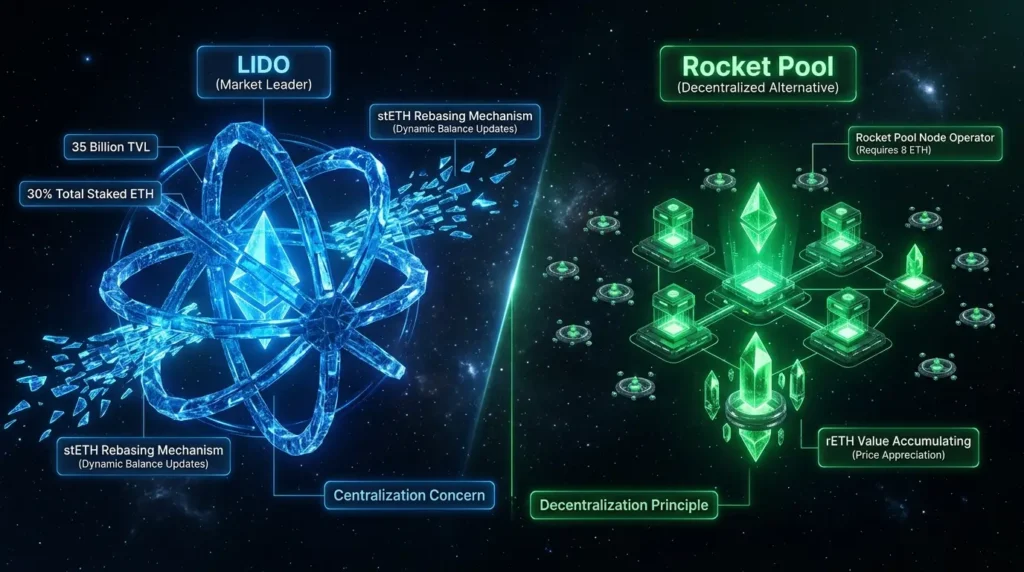
TVL: ~$35 billion (ETH), approximately 30% of all staked ETH
LST: stETH (Ethereum), stSOL (Solana), and others
APY (ETH, April 2026): ~3.4–3.8%
Mechanism: Rebasing (quantity of stETH increases daily)
How Lido works:
Lido uses a curated set of professional node operators selected through DAO governance. These operators run the actual validators. Lido’s smart contracts aggregate deposits, distribute to operators, and pass rewards to stETH holders (minus a 10% cut — 5% to operators, 5% to Lido DAO treasury).
stETH’s DeFi dominance:
stETH is the most liquid and widely integrated LST in DeFi:
- Deep liquidity on Curve, Uniswap, and other DEXs
- Accepted as collateral on Aave, Compound, MakerDAO, and dozens of other protocols
- Used as collateral in restaking protocols (EigenLayer)
The centralization concern:
Lido’s dominance (~30% of all staked ETH) raises legitimate decentralization concerns. If Lido’s validators misbehave or experience coordinated slashing, the impact on Ethereum’s consensus could be significant. This is an active discussion in the Ethereum community.
Rocket Pool — The Decentralized Alternative
TVL: ~$3.5 billion
LST: rETH
APY (ETH, April 2026): ~3.2–3.6%
Mechanism: Accumulating (rETH price increases in ETH terms)
How Rocket Pool differs:
- Anyone can run a node with only 8 ETH (vs 32 ETH for solo staking)
- Node operators must also stake RPL tokens as additional collateral — insurance against slashing
- Significantly more decentralized validator set than Lido
- Smaller scale means slightly lower APY due to less MEV optimization
rETH vs stETH:
Both represent ETH staking exposure, but differently:
- stETH: 1.0000 stETH today → 1.0360 stETH in one year (rebasing)
- rETH: 1.0000 rETH today → 1 rETH still, but each rETH is worth 1.036 ETH (price appreciation)
For DeFi usage, both work similarly as collateral. For tax purposes, the distinction may matter — rETH’s price appreciation model may trigger different tax events than stETH’s rebasing. Verify with a tax professional.
Ether.fi — The Restaking-Native LST
TVL: ~$6 billion
LST: eETH (or weETH for wrapped version)
APY (ETH, April 2026): ~3.5–4.5% (base staking + restaking incentives)
What makes Ether.fi unique:
Ether.fi was purpose-built with EigenLayer restaking integration. When you deposit ETH to Ether.fi:
- ETH is staked on Ethereum (base ~3.5% staking rewards)
- Simultaneously restaked on EigenLayer to secure AVSs (additional rewards)
- eETH holders benefit from both layers of yield
The tradeoff: Additional restaking rewards come with additional slashing risk — eETH holders have more complex risk exposure than simple stETH holders.
Jito — Solana’s Dominant LST
TVL: ~$3 billion
LST: JitoSOL
APY (SOL, April 2026): ~7–9%
Chain: Solana
What makes Jito unique:
Jito captures MEV (Maximal Extractable Value) — additional value extracted by ordering transactions optimally — and distributes it to JitoSOL holders. This is why JitoSOL APY (~7–9%) consistently exceeds native SOL staking APY (~6–8%).
JitoSOL is widely accepted across Solana’s DeFi ecosystem — as collateral on Marginfi, in liquidity pools on Orca, and across other Solana protocols.
Other Notable Liquid Staking Protocols
Rocket Pool (rETH): Covered above. Most decentralized ETH option.
StakeWise (osETH): Over-collateralized stETH alternative with unique vault design. Growing in 2026.
Frax Ether (frxETH/sfrxETH): Two-token system offering boosted yields for long-term stakers through the sfrxETH mechanism.
Marinade Finance (mSOL): Second-largest Solana liquid staking protocol after Jito.
Stader (ETHx, MaticX, BNBx): Multi-chain liquid staking protocol covering Ethereum, Polygon, and BNB Chain.
Using LSTs in DeFi: The Composability Advantage
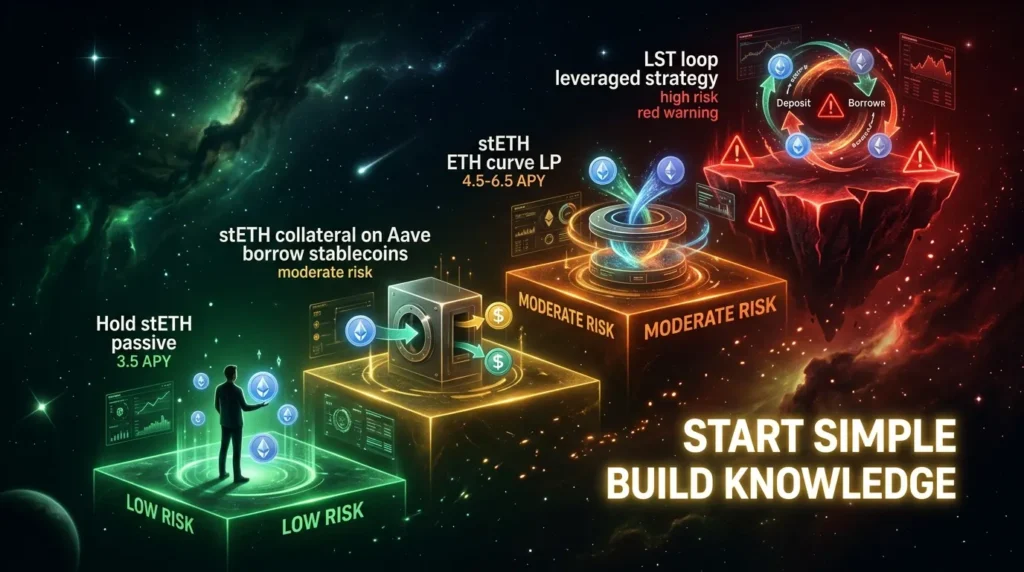
The real power of liquid staking tokens is their composability — the ability to use them across multiple DeFi protocols simultaneously.
Strategy 1: Simple Passive Yield (Lowest Risk)
Action: Hold stETH or rETH in your wallet
Yield: ~3.4–3.8% APY automatically (rewards accumulate without any action)
Risk: Smart contract risk (Lido/Rocket Pool), ETH price exposure
Best for: Long-term ETH holders who want passive yield without any active management
Strategy 2: LST as DeFi Collateral (Low-Moderate Risk)
Action: Deposit stETH on Aave as collateral → borrow stablecoins (USDC, DAI) → deploy borrowed stablecoins in other yield strategies
Yield: ~3.5% (stETH staking) + variable (what you do with borrowed stablecoins) – ~4–6% (USDC borrowing cost)
Example:
- Deposit 10 stETH (~$32,000) on Aave
- Borrow $12,000 USDC (conservative 37% LTV)
- Deposit USDC on Aave for supply APY (~6%)
- Net: ~3.5% staking + 6% USDC supply – 5% USDC borrow ≈ ~4.5% total on 10 ETH capital
Risk: Liquidation if ETH price drops significantly against the borrowed position
Strategy 3: LST Liquidity Provision (Moderate Risk)
Action: Provide stETH/ETH liquidity on Curve Finance
Yield: ~3.5% (staking rewards) + 1–3% (Curve trading fees + CRV incentives)
Total: ~4.5–6.5% APY
Risk: Low impermanent loss (stETH/ETH prices are highly correlated), Curve smart contract risk
The stETH/ETH pool on Curve is one of DeFi’s most historically profitable and safest LP positions due to the near-perfect price correlation between stETH and ETH.
Strategy 4: LST Loop (Advanced — High Risk)
Action: Stake ETH → get stETH → borrow ETH on Aave → stake borrowed ETH → get more stETH → repeat
Example of 2x loop:
- Start: 10 ETH
- Stake → 10 stETH (earning 3.5%)
- Borrow 8 ETH (80% LTV, not recommended — illustration only)
- Stake borrowed ETH → 8 stETH (earning 3.5%)
- Total staking exposure: 18 ETH equivalent
- Gross staking yield: 18 × 3.5% = 63% on 10 ETH… MINUS borrowing cost (~4%)
- Net: Much more complex than it appears, with significant liquidation risk
Reality check: This strategy magnifies both yield and liquidation risk dramatically. The stETH/ETH “peg” historically stays close to 1:1 but has deviated — during the Terra/LUNA crash in May 2022, stETH temporarily traded at a 5% discount to ETH, causing cascading liquidations for heavily leveraged loop users. Not recommended for beginners.
The stETH Peg: What It Is and Why It Matters
stETH is designed to trade at approximately 1:1 with ETH — but it’s a derivative, not a direct equivalent.
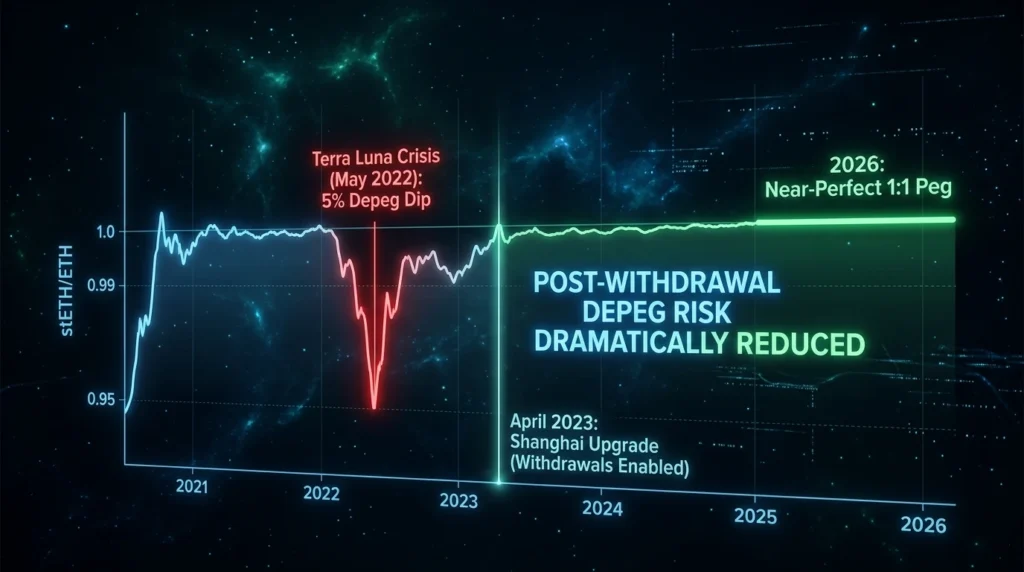
Why stETH occasionally trades at a discount to ETH:
- Withdrawal demand exceeds available exit liquidity in the short term
- Market stress events (like the Terra/LUNA crash) cause panic selling
- Before Ethereum enabled withdrawals (pre-Shanghai upgrade), stETH had no guaranteed redemption — only DEX liquidity. Post-Shanghai (April 2023), stETH can be redeemed directly for ETH through Lido.
Current peg status (April 2026): stETH trades at essentially 1:1 with ETH with minimal spread, reflecting the mature withdrawal mechanism. The discount risk has decreased significantly since Shanghai enabled withdrawals.
Why the peg matters for users:
- If you need to sell stETH quickly via DEX → small spread applies (currently tiny)
- If you’re using stETH as collateral on Aave → sudden depeg could trigger liquidation if you’re at high LTV
- For long-term holders who plan to use the Lido withdrawal portal → no peg risk
Liquid Staking Risks
Smart Contract Risk
Multiple smart contracts are involved (Lido/Rocket Pool + validator contracts + any additional DeFi protocols). Each is an exploit surface. Lido’s contracts manage $35B+ and have undergone multiple audits — but no contract is hack-proof.
Validator Slashing Risk
If Lido’s validators are slashed, stETH holders bear a proportional loss. Lido maintains a small insurance buffer (funded from protocol fees) to cover minor slashing events, but large-scale slashing could affect users directly.
Centralization Risk (Lido-specific)
Lido controlling ~30% of staked ETH creates systemic risk. If Lido validators became compromised or coordinated to attack Ethereum’s consensus, the consequences could affect the entire network. This is why Rocket Pool’s decentralized model is valued by those prioritizing Ethereum’s health over maximizing APY.
Depeg/Liquidity Risk
LSTs can temporarily trade at a discount to the underlying asset during market stress. For users with leveraged positions using LSTs as collateral, a significant depeg could trigger liquidation before they can respond.
Restaking Risk (Ether.fi/EigenLayer)
For LSTs integrated with restaking, additional slashing risk exists from AVS behavior. This is a newer, less battle-tested risk surface.
Liquid Staking vs Native Staking: Which to Choose?
| Native Staking | Liquid Staking | |
|---|---|---|
| Minimum amount | 32 ETH (solo) or delegation minimum | No minimum |
| Technical requirement | High (solo) or Low (delegation) | Low |
| APY | Slightly higher (no protocol fee) | Slightly lower (protocol cut) |
| Lockup | Yes (unstaking periods) | No (sell LST anytime) |
| DeFi composability | None | Full |
| Decentralization | Best (solo staking) | Varies by protocol |
| Smart contract risk | Low (native) | Additional layer |
| Best for | Technical users, decentralization maximalists | Most DeFi participants |
The practical answer for most users:
Liquid staking (Lido or Rocket Pool) is almost always preferable to doing nothing with idle ETH. The choice between Lido and Rocket Pool depends on whether you prioritize:
- Liquidity and DeFi integration → Lido (stETH) has better DEX liquidity and wider protocol acceptance
- Decentralization and Ethereum’s health → Rocket Pool (rETH) is the principled choice
Key Terminology
Liquid Staking Token (LST): Derivative token received when liquid staking — represents staked position and accumulated rewards (stETH, rETH, JitoSOL).
Rebasing: Mechanism where LST quantity in your wallet increases to reflect rewards — used by stETH. Balance increases, token price stays ~1:1 with underlying.
Accumulating: Mechanism where LST price increases in terms of the underlying — used by rETH. Balance stays the same, token price increases.
Validator operator: Entity running actual validator nodes for a liquid staking protocol — manages the technical work of block production and attestation.
Slashing insurance: Buffer maintained by some protocols (Lido) to cover minor slashing losses before they affect user funds.
MEV (Maximal Extractable Value): Additional value from optimal transaction ordering — captured by some validators and distributed to stakers (Jito on Solana).
Depeg: When an LST trades at a discount to its underlying asset — can trigger liquidations for leveraged users.
Withdrawal queue: Time required to unstake through a protocol’s redemption mechanism — distinct from selling on a DEX.
The Bottom Line
Liquid staking is one of DeFi’s most genuinely useful innovations for most crypto participants. It solves the core problem of traditional staking — frozen capital — while maintaining full staking rewards.
When to use liquid staking:
- You hold ETH, SOL, or other stakeable assets long-term
- You want staking rewards without locking capital
- You want to use staking position as DeFi collateral
- You don’t meet the technical or minimum requirements for native staking
Protocol recommendations:
- ETH — maximum liquidity and integration: Lido (stETH)
- ETH — prioritizing decentralization: Rocket Pool (rETH)
- ETH — want restaking exposure: Ether.fi (eETH)
- SOL: Jito (JitoSOL) for highest yield; Marinade (mSOL) as alternative
Start here: Deposit 0.1 ETH to Lido on app.lido.fi → receive stETH → watch your stETH balance increase daily. The mechanic becomes intuitive immediately. 🌊
Disclaimer: This article is for informational and educational purposes only and does not constitute financial advice. Liquid staking involves smart contract risk, validator slashing risk, depeg risk, and other DeFi-specific risks. Always conduct your own research before depositing.