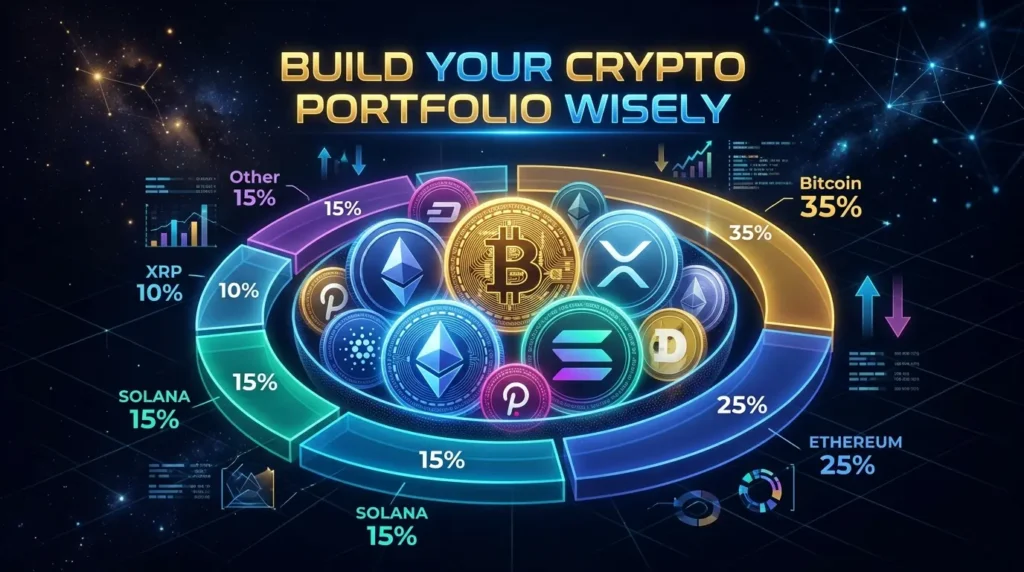
A crypto portfolio is your collection of cryptocurrency holdings — every coin, token, and digital asset you own, considered together as a whole.
The concept matters because how you combine assets is often more important than any single investment decision. A portfolio with only one coin rises and falls entirely with that coin. A thoughtfully constructed portfolio distributes risk, balances growth potential with stability, and gives you more ways to participate in different parts of the crypto market.
What Makes a Crypto Portfolio Different from Traditional Investing
In traditional investing, a portfolio typically mixes asset classes: stocks, bonds, real estate, cash, commodities. Each behaves differently under different economic conditions.
Crypto portfolios present a unique challenge: most cryptocurrencies are highly correlated. When Bitcoin drops 20%, most altcoins drop 30–50%. This means diversification within crypto works differently than diversification across asset classes.
True crypto diversification isn’t just owning 20 different coins. It’s about:
- Balancing stability (Bitcoin, stablecoins) with growth potential (altcoins)
- Spreading across different use cases and sectors
- Matching allocation to your risk tolerance and time horizon
- Maintaining liquidity to act when opportunities emerge
The Building Blocks of a Crypto Portfolio
Large-Cap Assets (The Foundation)
Bitcoin (BTC) and Ethereum (ETH) form the core of most serious crypto portfolios. They have the longest track records, deepest liquidity, and broadest institutional adoption.
- Bitcoin: Digital store of value, “digital gold,” most recognized cryptocurrency globally. Fixed supply of 21 million coins.
- Ethereum: The dominant smart contract platform powering DeFi, NFTs, and tokenized assets.
Most portfolio frameworks suggest 40–70% allocation to BTC and ETH combined as the anchor.
Mid-Cap Assets (Growth Layer)
Established altcoins with proven use cases and meaningful adoption — Solana (SOL), XRP, Cardano (ADA), Chainlink (LINK), Litecoin (LTC), Avalanche (AVAX), and others.
These carry more risk than BTC/ETH but have demonstrated resilience across market cycles. A typical allocation: 20–35% of portfolio.
Stablecoins (Liquidity Buffer)
USDC, USDT, or other dollar-pegged stablecoins held within the portfolio serve multiple purposes:
- Buffer against market volatility
- Dry powder to buy during dips
- Earn yield through lending or liquidity provision
- Reduce overall portfolio volatility
A common allocation: 5–10% in stablecoins.
Small-Cap/Speculative Assets (High Risk, High Potential)
Newer projects, DeFi tokens, sector-specific plays — these can generate outsized returns but also go to zero. Only allocate what you’re prepared to lose entirely.
Typical allocation for risk-tolerant investors: 10–20% maximum.
Portfolio Allocation Models for 2026
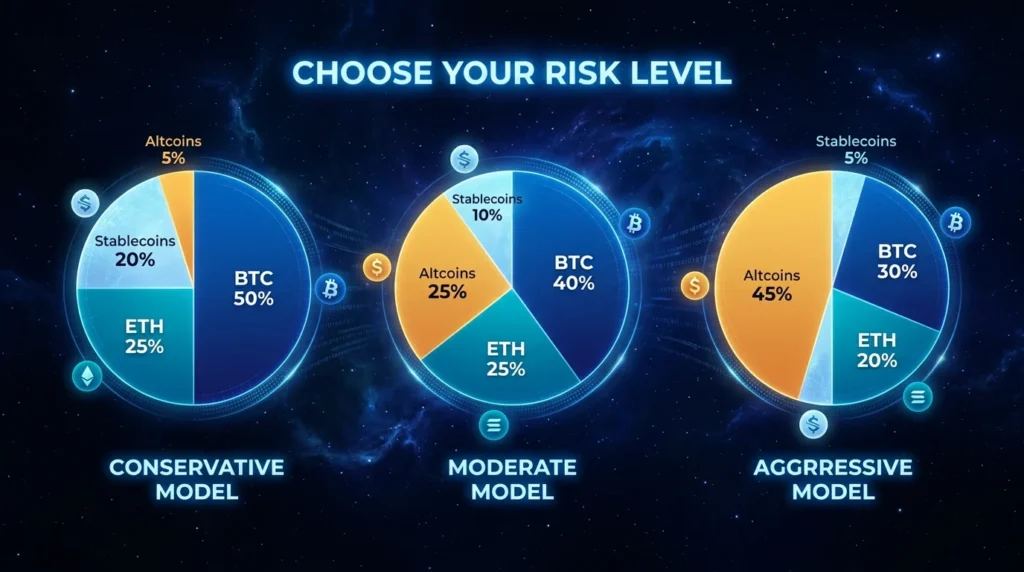
These are illustrative frameworks — not financial advice. Your allocation should match your risk tolerance, time horizon, and financial situation.
Conservative (Lower Risk)
- Bitcoin: 50%
- Ethereum: 25%
- Stablecoins: 20%
- Established altcoins: 5%
Best for: New investors, those close to needing the funds, people with low tolerance for volatility.
Moderate (Balanced)
- Bitcoin: 40%
- Ethereum: 25%
- Established altcoins (SOL, XRP, ADA, etc.): 25%
- Stablecoins: 10%
Best for: Investors with a 3–5 year time horizon comfortable with significant volatility.
Aggressive (Higher Risk)
- Bitcoin: 30%
- Ethereum: 20%
- Mid-cap altcoins: 30%
- Small-cap/speculative: 15%
- Stablecoins: 5%
Best for: Experienced investors with long time horizons who can absorb significant drawdowns.
A note on “how much crypto overall”: Most financial guidance suggests limiting total crypto exposure to 5–10% of your overall investment portfolio. Crypto is a high-risk asset class — the rest of your financial life (emergency fund, retirement savings, etc.) should not depend on it.
Sector Diversification: Thinking Beyond Market Cap
Another way to diversify is across sectors within the crypto ecosystem:
Store of Value: Bitcoin — primarily held as a long-term inflation hedge.
Smart Contract Platforms: Ethereum, Solana, Avalanche — the infrastructure powering applications. Growth depends on developer activity and ecosystem adoption.
Payments: XRP, Litecoin, Stellar — focused on fast, cheap value transfer.
DeFi: Tokens associated with decentralized lending, trading, and yield protocols.
Real World Assets (RWAs): Tokenized treasuries, real estate, bonds — an emerging sector with growing institutional interest in 2026.
Stablecoins: USDC, USDT, PYUSD — dollar-pegged assets for stability and liquidity.
Spreading across sectors means you’re not entirely dependent on one narrative or use case performing well.
How to Track Your Crypto Portfolio
Keeping track of what you hold, what it’s worth, and how it’s performing requires some infrastructure:
Exchange dashboards: If your holdings are on Coinbase or Kraken, the exchange shows your portfolio value and history. Convenient but only shows what’s on that exchange.
Portfolio tracker apps: Tools like CoinGecko Portfolio, CoinMarketCap Portfolio, Delta, or Zerion aggregate holdings across multiple exchanges and wallets in one view. Enter your holdings manually or connect via API.
Spreadsheet: Simple and fully private. Track coin, quantity, purchase price, current price, total value. Requires manual updates but gives complete control.
The tax consideration: Whatever tracker you use, maintain records of every purchase, sale, and trade — including dates and prices. You’ll need this for tax reporting. Some trackers (CoinTracker, Koinly) connect directly to exchanges and wallets to automate tax report generation.
Rebalancing: Keeping Your Portfolio on Target
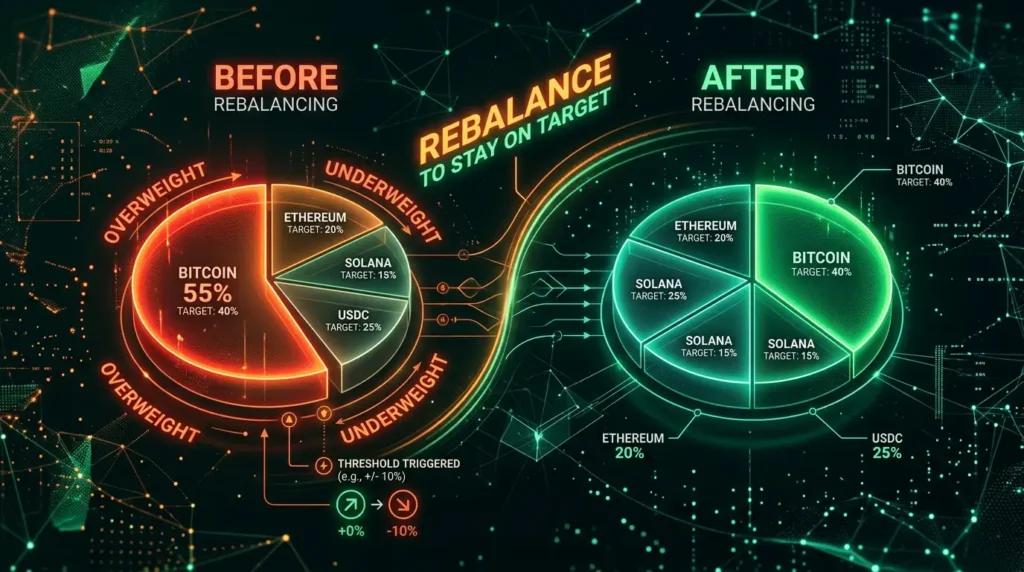
Over time, some assets will grow faster than others. If Bitcoin doubles while altcoins stay flat, your Bitcoin allocation may grow from 40% to 55% — more concentrated than you intended.
Rebalancing means periodically adjusting your holdings back to your target allocations.
How often to rebalance:
- Time-based: Monthly or quarterly — review and adjust regardless of market movements
- Threshold-based: Adjust when any asset deviates more than 5–10% from its target allocation
How to rebalance:
- Sell the overweight asset(s) to bring them back to target
- Buy the underweight asset(s) to top them up
- Or direct new purchases toward underweight assets without selling
Tax note: In the US, selling crypto to rebalance is a taxable event — capital gains tax applies on any appreciation. Factor this into your rebalancing strategy. Some investors prefer only buying underweight assets with new capital to avoid triggering taxes.
Common Crypto Portfolio Mistakes
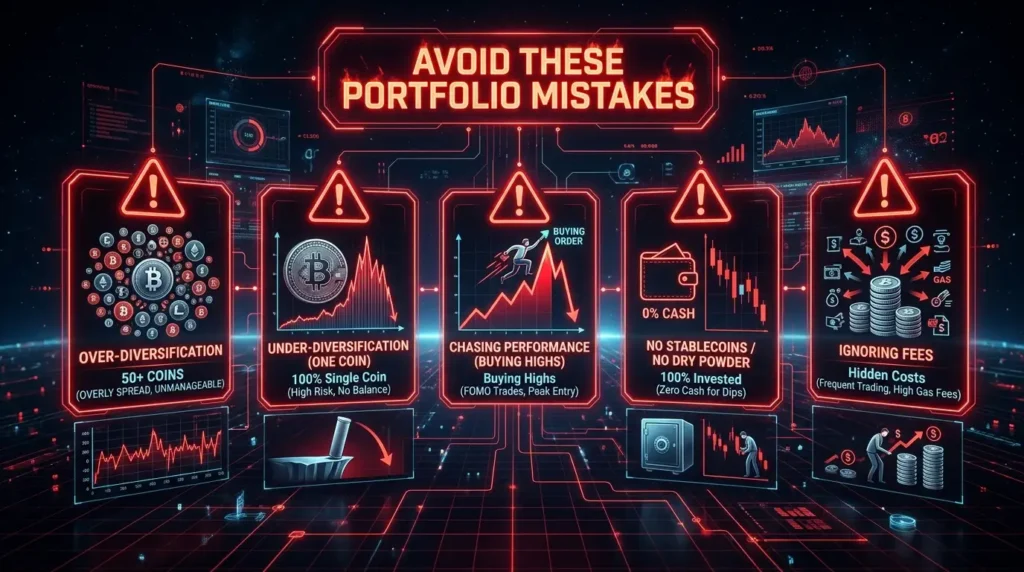
Over-diversification: Owning 50+ coins doesn’t reduce risk proportionally — it makes management complex and dilutes your conviction bets. Most professional crypto investors hold 5–15 positions meaningfully.
Under-diversification: Putting 100% into a single coin amplifies both gains and losses. If that coin fails or underperforms, your entire portfolio does.
Chasing performance: Buying what performed best last month and selling what underperformed is a well-documented way to buy high and sell low. Past performance doesn’t predict future returns.
Ignoring stablecoins: Having no stablecoins means you have nothing to deploy during market crashes. The investors who do best in crypto often have dry powder ready when everything is down 50–70%.
Not accounting for fees: Frequent trading to rebalance creates cumulative fee costs. Use limit orders on advanced exchange interfaces to minimize this.
Portfolio Trackers Worth Knowing
CoinGecko Portfolio: Free, no account required for basic use, supports manual entry and exchange API connections.
CoinMarketCap Portfolio: Similar functionality, clean interface, widely used.
Delta: Mobile-focused portfolio tracker with DeFi support.
Zerion: Strong for tracking DeFi positions and multi-chain wallet activity.
Koinly / CoinTracker: Specifically designed for tax reporting — connects to exchanges and generates tax forms automatically.
Key Terminology
Portfolio: Your total collection of crypto holdings considered as a whole.
Diversification: Spreading holdings across multiple assets to reduce the impact of any single asset’s performance.
Allocation: The percentage of your portfolio assigned to each asset or category.
Rebalancing: Adjusting your portfolio back to target allocations when assets drift due to price changes.
Large-cap: Cryptocurrencies with market capitalizations above $10 billion — Bitcoin, Ethereum, BNB, XRP, etc.
Market correlation: The degree to which assets move together. High correlation means they rise and fall together, reducing diversification benefits.
Stablecoin: Dollar-pegged cryptocurrency used for liquidity, stability, and yield within a portfolio.
DCA (Dollar-Cost Averaging): Investing a fixed amount at regular intervals regardless of price — a common strategy for building a portfolio over time.
The Bottom Line
A crypto portfolio is more than a list of coins you own. It’s a deliberate structure — designed to match your goals, time horizon, and risk tolerance.
The most common advice from experienced investors:
- Anchor with Bitcoin and Ethereum
- Add altcoins selectively and within a defined allocation
- Keep stablecoins for flexibility
- Avoid speculative positions larger than you can afford to lose entirely
- Track everything, rebalance periodically, and keep records for taxes
Start simple. A two-asset portfolio of Bitcoin and Ethereum has outperformed the vast majority of more complex crypto strategies over most multi-year periods. Complexity is optional. Discipline is not. 📊
Disclaimer: This article is for informational purposes only and does not constitute financial advice. Cryptocurrency investments carry significant risk, including the potential loss of all invested capital. Portfolio allocations shown are illustrative examples only and do not constitute investment recommendations. Always conduct your own research and consider consulting a qualified financial advisor before making investment decisions.