Most people who lose money in crypto don’t lose it because they picked the wrong coin at the wrong time.
They lose it because they had no plan for when things went wrong. No defined exit. No limit on how much they were willing to lose. No system that prevented one bad trade from damaging their entire portfolio.
Risk management is that system. It’s the collection of rules, habits, and frameworks that determine how much you can lose — and ensure you’re still in the game to participate in the next opportunity.
What Is Risk Management in Crypto?
Risk management is the process of identifying, measuring, and controlling potential losses before they happen.
The goal is not to eliminate risk — that would eliminate returns. The goal is to ensure that no single trade, market crash, or bad decision can destroy your portfolio or prevent you from continuing to invest.
Professional traders don’t succeed by never losing. They succeed because their losses are controlled and their system survives bad periods.
Why Crypto Needs Specific Risk Management
Crypto presents risks that traditional markets don’t:
Extreme volatility: Bitcoin dropped from its ~$126,000 all-time high to below $80,000 in October 2025 — a 36% crash in weeks. Altcoins regularly drop 50–80% in bear markets.
24/7 markets: There’s no closing bell. Bad news can hit at 3 AM. Positions can be liquidated while you sleep.
No safety nets: Unlike bank accounts, there’s no FDIC insurance for crypto. If you lose funds through a bad trade or hack, there’s typically no recovery mechanism.
High leverage availability: Many exchanges offer 10x, 50x, even 100x leverage. Without risk management, leverage turns manageable losses into account-ending ones.
The Core Principles of Crypto Risk Management
1. Never Invest More Than You Can Afford to Lose
The first rule isn’t a trading technique — it’s a mindset.
Crypto should represent a portion of your overall financial picture that you could lose entirely without affecting your core financial stability. This means:
- Emergency fund remains intact
- Retirement contributions continue
- Basic living expenses are covered regardless of crypto performance
Most financial guidance suggests limiting crypto exposure to 5–10% of your total investment portfolio. For higher-risk tolerance, perhaps 15–20%. Never 100%.
The reason: crypto can and does drop 80%+ in bear markets. If your entire savings are in crypto during a bear market, you may be forced to sell at the worst possible time due to financial pressure.
2. Position Sizing: The 1–2% Rule
This is the single most important risk management technique for active traders.
The rule: Never risk more than 1–2% of your total trading capital on any single trade.
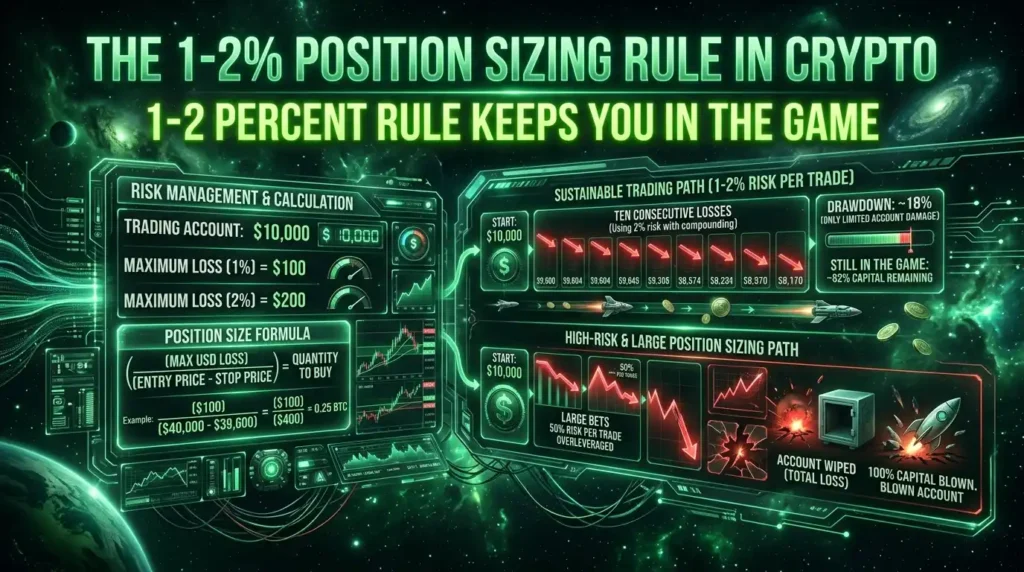
Why it works: If you risk 2% per trade and experience 10 consecutive losing trades (an unusual but possible streak), you’ve lost approximately 20% of your capital — painful, but survivable. You can recover. If you risk 25% per trade, four consecutive losses wipe your account.
How to calculate position size:
The formula:
Position Size = (Account Size × Risk %) ÷ Distance to Stop-Loss %
Example:
- Account size: $10,000
- Risk per trade: 1% = $100 maximum loss
- You buy Bitcoin at $80,000 with a stop-loss at $76,000 (5% below entry)
- Position size = $100 ÷ 5% = $2,000
So you buy $2,000 worth of Bitcoin. If your stop-loss hits, you lose $100 (1% of account). If Bitcoin drops more, you’re already out.
This approach removes emotion from position sizing — the math determines your exposure, not your conviction.
3. Stop-Loss Orders: Your Mandatory Exit Plan
A stop-loss is an automatic order that closes your position when price falls to a predetermined level.
Why stops are essential:
Without a stop-loss, a losing position can keep losing. Many traders “hold and hope” a losing position will recover — sometimes it does, but sometimes it falls 80% further. A stop-loss forces discipline.
Setting effective stop-losses:
Too tight: A stop placed 1–2% below entry will be triggered by normal market noise. You’ll be stopped out of good trades constantly.
Too wide: A stop 50% below entry defeats the purpose — you’ve already lost too much.
General guidelines for crypto:
- Major assets (BTC, ETH): 8–15% below entry at key technical levels
- Altcoins: 10–20% depending on volatility
- Base stops on support levels from the chart — not arbitrary percentages
The golden rule: Set your stop-loss BEFORE entering a trade. Never adjust it further away just because you don’t want to take the loss — that’s how small losses become large ones.
Trailing stop-loss: A stop that moves up with the price as your trade goes in your favor. If Bitcoin rises from $80,000 to $90,000 and you have a 10% trailing stop, it moves from $72,000 to $81,000 — locking in some profit while staying in the trade.
4. Risk-Reward Ratio: Only Take Trades That Make Mathematical Sense
Before entering any trade, calculate the potential reward vs. the risk you’re taking.
Risk-Reward Ratio (R:R):
- Risk = distance from entry to your stop-loss
- Reward = distance from entry to your profit target
Minimum recommended ratio: 2:1 (potential reward at least twice the risk)
Example:
- Entry: $80,000
- Stop-loss: $76,000 (risk = $4,000)
- Profit target: $88,000 (reward = $8,000)
- Risk-reward ratio: 2:1 ✅
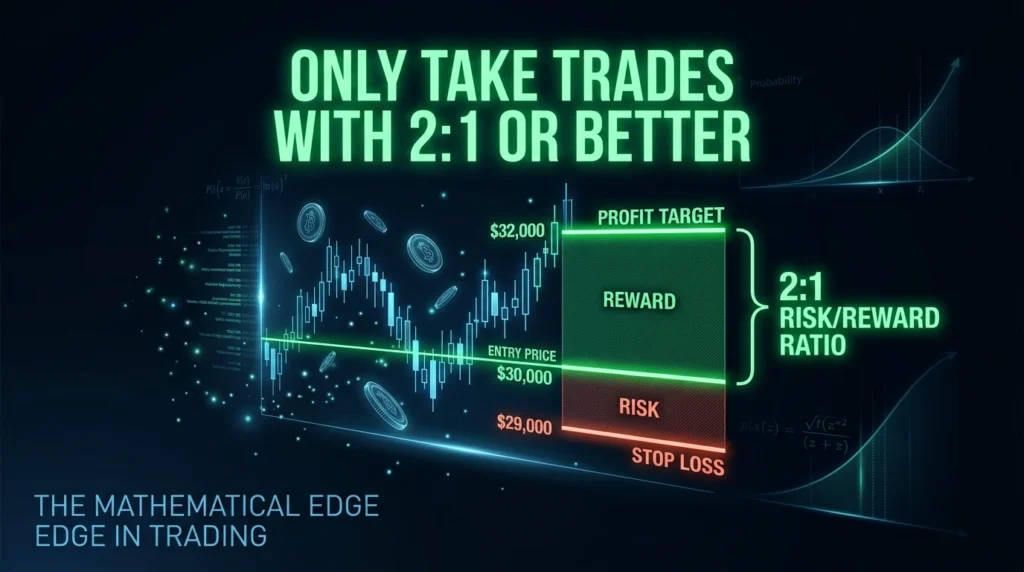
With a 2:1 ratio, you only need to be right 34% of the time to be profitable. With a 1:1 ratio, you need to win more than 50% of trades just to break even.
The math of risk-reward is why experienced traders can be profitable with a 40% win rate — because their winners are significantly larger than their losers.
5. Diversification: Don’t Concentrate Risk in One Asset
As covered in the portfolio guide, diversification spreads risk across multiple assets. Important context for risk management:
In crypto, diversification has limits. During broad market crashes, Bitcoin and most altcoins fall together — correlation approaches 1.0. Holding 10 altcoins doesn’t protect you when the whole market drops 50%.
True diversification includes:
- Stablecoins as a buffer (5–10% of portfolio)
- Different asset categories (large-cap, mid-cap, sector exposure)
- Non-crypto assets in your overall portfolio (stocks, bonds, cash)
6. Manage Leverage — Or Avoid It Entirely as a Beginner
Leverage amplifies both profits and losses. A 10x leveraged position on a 10% price move either doubles or wipes your position.
Liquidation risk: When using leverage, if the market moves against you by a certain percentage, the exchange automatically closes your position and you lose your entire margin — not just a stop-loss amount.
The recommendation for beginners: Avoid leverage entirely until you have:
- Consistent profitability in spot trading
- Deep understanding of position sizing and stop-losses
- Clear understanding of liquidation mechanics
If you use leverage: start with 2–3x maximum, never 50x or 100x.
The Psychology of Risk Management
Risk management is not just mathematics — it’s emotional discipline.
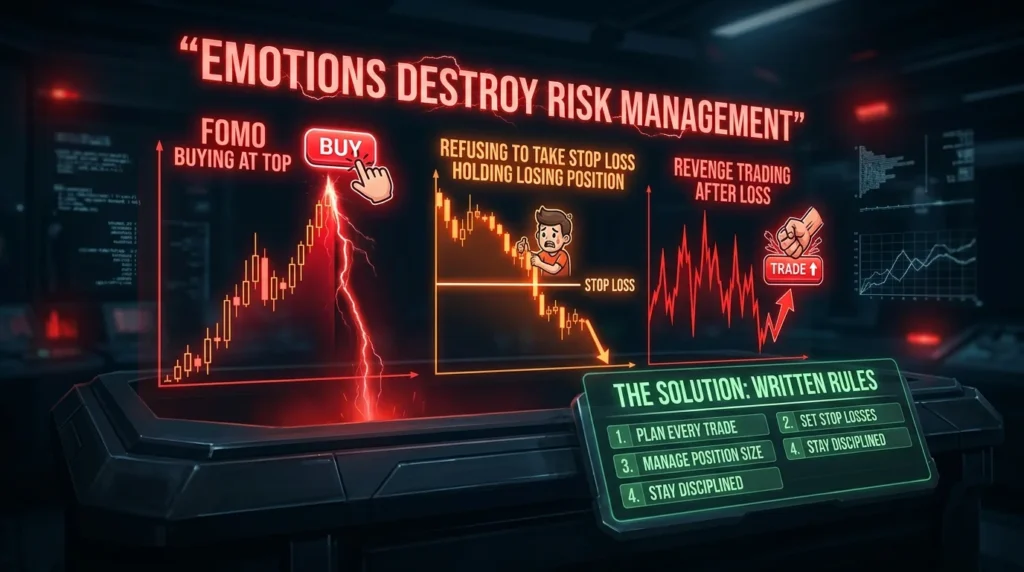
Fear and Greed are the two emotions that destroy most traders’ risk management:
FOMO (Fear of Missing Out): Seeing Bitcoin rally 20% and buying impulsively at the top, ignoring your entry criteria and position sizing rules.
Loss aversion: Refusing to take a stop-loss because “it might come back” — holding a losing position until it’s down 60% instead of the planned 8%.
Revenge trading: After a loss, immediately entering a new, larger trade to “win back” what you lost — bypassing all your rules.
The solution: Write your rules down before you need them. Define entry criteria, stop-loss levels, and position sizes in advance. When markets are moving fast and emotions are running high, consult your written plan — not your gut.
Risk Management for Long-Term Investors vs. Traders
Long-term investors (HODLers):
- Primary risk management is portfolio allocation — how much total capital is in crypto
- DCA (regular fixed purchases) to reduce timing risk
- Cold storage to eliminate exchange risk
- Not selling during bear markets
Active traders:
- Position sizing (1–2% rule) on every trade
- Stop-losses on every position
- Risk-reward ratio calculated before entry
- Daily/weekly loss limits — if down 5–6% in a day, stop trading for the day
Common Risk Management Mistakes
Moving stop-losses further away: The #1 account-killer. “I’ll just give it a bit more room” turns a managed loss into a disaster.
Over-trading: More trades = more fees, more emotional decisions, more risk. Quality over quantity.
Ignoring correlation: Owning 10 altcoins isn’t diversification if they all drop 60% together in a bear market.
No plan for profits: Risk management applies to taking profits too. Define at what price or percentage gain you’ll reduce a position.
Investing borrowed money: Credit cards, loans, margin used to buy crypto is one of the fastest ways to financial distress. Only invest capital you can genuinely afford to lose.
Key Terminology
Position sizing: Determining how much capital to allocate to each trade based on account size and defined risk percentage.
Stop-loss: An automatic order that closes a position when price reaches a predetermined level, limiting potential loss.
Risk-reward ratio: The ratio of potential loss (to stop-loss) vs. potential gain (to profit target) for a trade.
Trailing stop-loss: A stop that moves up with price as a trade moves in your favor, locking in profits while staying in the trend.
Leverage: Trading with borrowed capital to amplify position size — also amplifies potential losses.
Liquidation: When a leveraged position’s losses consume the entire margin, causing automatic position closure.
FOMO: Fear of Missing Out — making impulsive trading decisions based on price action, bypassing planned strategy.
Drawdown: The peak-to-trough decline in portfolio value from a high point. Maximum drawdown is a key measure of risk over time.
The Bottom Line
Risk management is what separates investors who build wealth over time from those who experience excitement followed by ruin.
The core framework:
- Only invest what you can genuinely afford to lose
- Size positions so no single trade can significantly damage your portfolio (1–2% rule)
- Set stop-losses before entering every trade — and honor them
- Only enter trades with favorable risk-reward ratios (minimum 2:1)
- Diversify — but understand that crypto assets often fall together
- Avoid leverage until you’ve demonstrated consistent profitability
- Keep emotions out of decisions — use written rules made in calm moments
The best traders aren’t those who never lose. They’re those who lose small and recover quickly. Your job is to protect your capital well enough to still be participating when the big opportunities arrive. 🛡️
Disclaimer: This article is for informational purposes only and does not constitute financial advice. Cryptocurrency investments carry significant risk, including the potential loss of all invested capital. Always conduct your own research before making any investment decisions.