KYC — Know Your Customer — is the identity verification process required by most regulated crypto exchanges. Uploading a government ID, submitting a selfie, and waiting for approval is standard practice on platforms like Coinbase, Kraken, and Binance.
Not everyone wants to do this. Some people value financial privacy as a principle. Others don’t yet have access to traditional banking infrastructure. Whatever the reason, options exist to buy crypto without full identity verification — though each comes with trade-offs worth understanding.
Important: What No KYC Doesn’t Mean
Before covering the methods, two critical points:
1. No KYC doesn’t mean tax-free.
In the United States and most other jurisdictions, crypto gains are taxable regardless of how you purchased them. Using a no-KYC method does not eliminate your tax reporting obligations. Capital gains tax applies whether you bought Bitcoin through Coinbase or a Bitcoin ATM. Always consult your local tax rules.
2. No KYC is generally legal.
In most jurisdictions, purchasing cryptocurrency without providing identity documents is not illegal in itself. KYC requirements exist for platform operators under AML (Anti-Money Laundering) regulations — not as a prohibition on individual buyers. However, individual circumstances and jurisdictions vary. Verify the legal landscape in your specific location.
Why People Buy Crypto Without KYC
Legitimate reasons include:
- Privacy — not wanting financial activity linked to personal identity
- Unbanked access — no government ID or bank account available
- Geographic restrictions — exchange not available in their country
- Data security concerns — not wanting ID documents stored by a third party
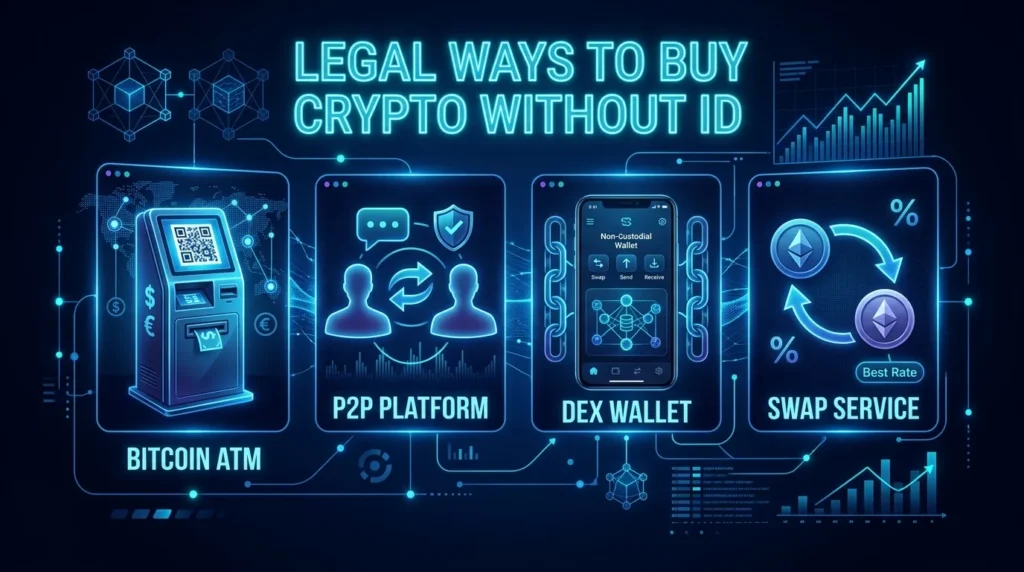
Method 1: Bitcoin ATMs (Most Accessible)
As covered in our Bitcoin ATM guide, many machines allow purchases below a certain threshold without full identity verification. Typically:
- Under $200–$500: Phone number only (varies by operator and jurisdiction)
- $500–$1,000: May require government ID scan
- Above $1,000: Generally requires full KYC
How it works: Insert cash → scan your wallet QR code → receive Bitcoin. No account created, no email required for smaller purchases.
Trade-offs:
- ✅ Fiat-to-crypto — no prior crypto needed
- ✅ Widely available (42,000+ machines globally)
- ❌ High fees: typically 6–20%
- ❌ Camera surveillance at most machines
- ❌ Limits on amounts without ID
Important: Even without providing ID documents, most Bitcoin ATMs record the transaction, your phone number, and surveillance footage. They are not fully anonymous.
Method 2: P2P Platforms (Peer-to-Peer)
P2P platforms connect buyers and sellers directly, with escrow protection. Some platforms allow trading without mandatory platform-level KYC.
Notable P2P options:
Bisq — Fully decentralized, open-source, desktop application. Runs over Tor. No central operator, no KYC required by the platform. Supports Bitcoin and Monero. Trades take longer and require understanding the software.
Hodl Hodl — Non-custodial web-based Bitcoin P2P platform. Uses multisig escrow — funds never held by the platform. Minimal identity requirements for most transactions. Bitcoin only.
AgoraDesk — Privacy-focused P2P platform supporting multiple coins and payment methods including cash. No mandatory KYC.
Paxful — Larger P2P marketplace with many payment methods. Some verification may be required depending on trade size and payment method.
How P2P works:
- Browse offers from sellers accepting your preferred payment method
- Agree on amount and price
- Platform holds seller’s crypto in escrow
- You make payment (cash, bank transfer, gift card, etc.)
- Seller confirms receipt → platform releases crypto to you
Trade-offs:
- ✅ Flexible payment methods including cash
- ✅ Potentially better rates than ATMs
- ✅ Platform-level KYC often not required
- ❌ Individual sellers may request verification
- ❌ Counterparty risk — always use platforms with escrow
- ❌ Lower liquidity, slower execution (30 min to several hours)
- ❌ Personal safety considerations for in-person cash trades
Method 3: Decentralized Exchanges (DEX)
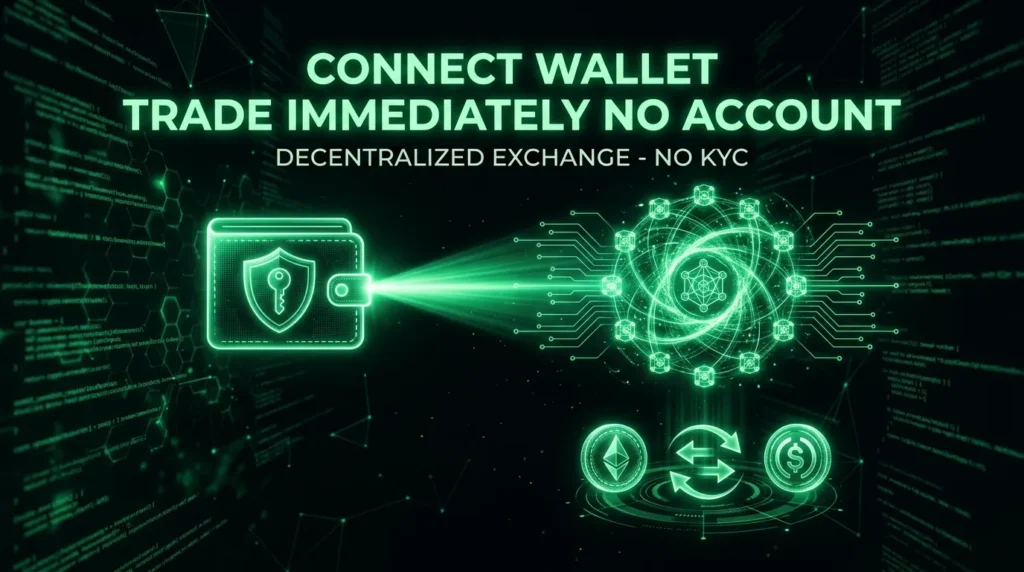
DEXs are smart-contract-based trading platforms where you trade directly from your wallet — no account, no registration, no KYC. Examples include Uniswap (Ethereum), PancakeSwap (BNB Chain), Jupiter (Solana).
How it works: Connect your wallet → select tokens to swap → confirm transaction. That’s it.
Key limitation: DEXs are crypto-to-crypto only. They have no fiat on-ramp. You cannot buy Bitcoin with US dollars on a DEX — you need to already hold some cryptocurrency to use one.
Practical workflow for no-KYC buying:
- Get your first crypto via Bitcoin ATM or P2P (fiat → crypto)
- Transfer to a personal non-custodial wallet (MetaMask, Phantom, etc.)
- Use a DEX to swap between any tokens without any KYC
Trade-offs:
- ✅ True no KYC — no registration whatsoever
- ✅ Access to thousands of tokens
- ✅ Non-custodial — your keys, your crypto
- ❌ No fiat on-ramp
- ❌ Gas fees apply
- ❌ Smart contract risk — use audited, established DEXs
- ❌ Steeper learning curve
Method 4: No-KYC Swap Services
Services like ChangeNOW, Changelly, and similar instant swap platforms allow crypto-to-crypto exchanges without account creation or KYC, generally up to certain daily limits.
How they work: Select the coins you want to swap (e.g., LTC → BTC), enter your receiving address, send from your wallet, receive the swap. No account needed.
Use case: If you acquired Litecoin via a cash P2P trade, you could swap it to Bitcoin or Ethereum via a no-KYC swap service without providing any personal information.
Trade-offs:
- ✅ Fast, simple
- ✅ No registration
- ✅ Works for crypto-to-crypto
- ❌ Higher spread than DEX or exchange
- ❌ Daily limits may apply before KYC kicks in
- ❌ Centralized operators — service quality varies
Comparing No-KYC Methods
| Method | Fiat to Crypto? | Fees | Privacy Level | Difficulty |
|---|---|---|---|---|
| Bitcoin ATM | ✅ Yes | 6–20% | Medium (phone, camera) | Easy |
| P2P (Bisq, Hodl) | ✅ Yes | 1–5% | High | Medium |
| DEX (Uniswap) | ❌ No | 0.3% + gas | Very High | Medium-High |
| Swap Services | ❌ No (crypto only) | 1–3% | Medium-High | Easy |
Privacy Reality Check: Bitcoin Is Not Anonymous
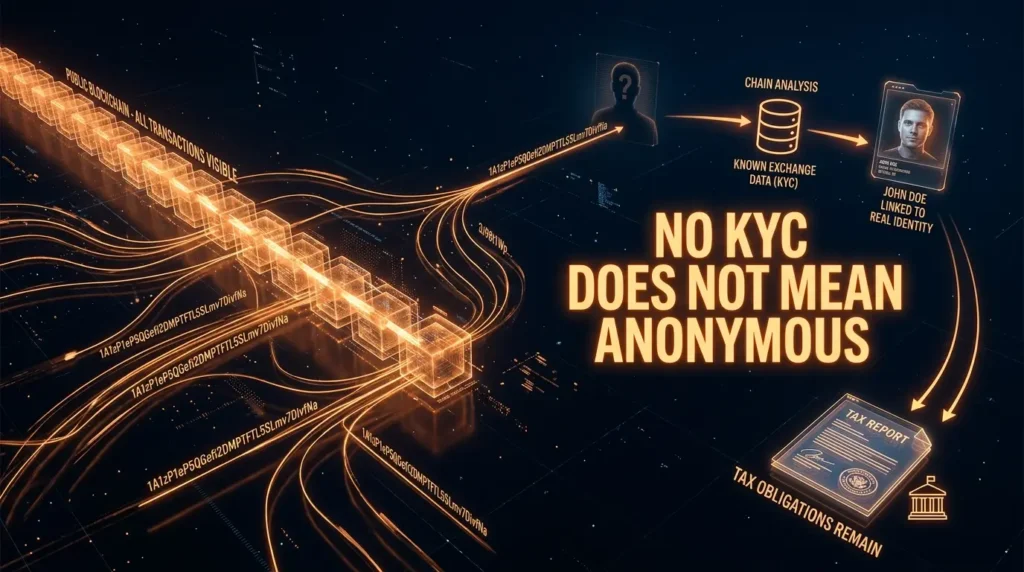
An important misconception: buying Bitcoin without KYC doesn’t make your transactions private.
Bitcoin is pseudonymous, not anonymous. Every transaction is permanently recorded on the public blockchain. If your wallet address ever becomes linked to your identity — through an exchange withdrawal, a purchase, or a data breach — your entire transaction history is visible.
What no KYC reduces:
- The link between your identity documents and a specific wallet address
- The data held by a centralized platform about you
What no KYC doesn’t eliminate:
- On-chain transaction visibility
- The trail created if you reuse wallet addresses
- Tax obligations
For stronger privacy, additional steps are sometimes discussed in the space: using different addresses for each transaction, privacy-focused cryptocurrencies, and other technical measures. These topics go beyond the scope of this guide.
Practical Advice for No-KYC Buyers
Start small: Test any new method with a small amount before committing larger sums.
Use a non-custodial wallet: Hardware wallet (Ledger, Trezor) or reputable software wallet (MetaMask, Trust Wallet). You control your keys.
Verify escrow on P2P platforms: Only trade on P2P platforms that use escrow to hold the seller’s crypto — never pay without confirmed escrow protection.
Check limits before going to an ATM: Use CoinATMRadar to check the specific machine’s verification requirements and fees before making the trip.
Remember tax obligations: In the US, IRS guidance treats crypto transactions as taxable regardless of the purchase method. Keep records.
The Regulatory Landscape in 2026
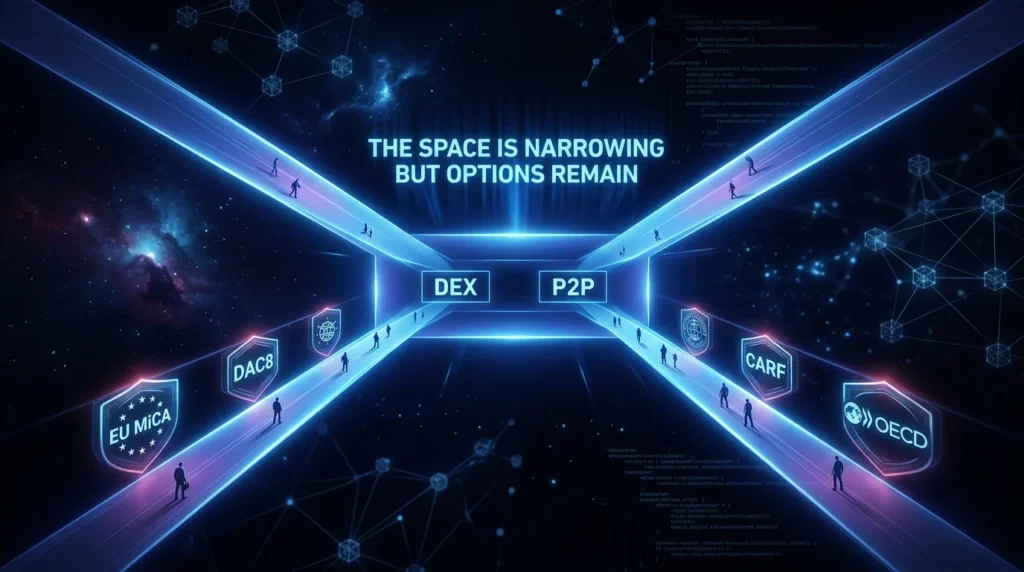
The space for no-KYC crypto is narrowing globally. Key developments:
EU (MiCA + DAC8): European crypto service providers now report transaction data to tax authorities under DAC8. Most EU-based platforms require full KYC.
US: All major centralized exchanges operating in the US require full KYC. DEXs and P2P platforms remain accessible but regulators are monitoring the space.
Global CARF (OECD): 48+ countries have adopted frameworks requiring crypto businesses to report user data, similar to banking reporting standards.
The practical effect: major regulated exchanges globally are all KYC-required. The no-KYC options (Bitcoin ATMs, Bisq, DEXs) remain available but are subject to continuing regulatory evolution.
Key Terminology
KYC (Know Your Customer): Identity verification process — typically ID document upload plus selfie — required by regulated financial platforms.
AML (Anti-Money Laundering): Regulatory framework requiring financial institutions to verify customers and report suspicious activity. KYC is part of AML compliance.
DEX (Decentralized Exchange): Smart contract-based exchange requiring no account or KYC — crypto-to-crypto only.
Non-custodial wallet: Wallet where you hold the private keys — Ledger, Trezor, MetaMask.
Escrow: Third-party holding service used in P2P trades to hold seller’s crypto until payment is confirmed.
Pseudonymous: Transactions linked to wallet addresses rather than real names — traceable but not directly identifying.
The Bottom Line
Buying crypto without full KYC is possible in 2026 through Bitcoin ATMs, P2P platforms, DEXs, and swap services. Each method involves genuine trade-offs: higher fees, lower liquidity, technical complexity, or personal safety considerations.
For most users, a regulated exchange remains the simpler, cheaper, and safer path. No-KYC methods are most relevant for specific use cases: users without banking access, those in jurisdictions where exchanges don’t operate, or those with genuine privacy needs who understand the trade-offs.
Whatever method you use — your tax obligations remain. Privacy from exchanges does not mean privacy from tax authorities. 🔑
Disclaimer: This article is for informational purposes only and does not constitute financial or legal advice. Cryptocurrency investments carry significant risk, including the potential loss of all invested capital. Always verify local laws and tax obligations in your specific jurisdiction. Always conduct your own research before making any investment decisions.