Buying cryptocurrency for the first time is easier than most people expect — if you choose the right exchange.
The wrong choice means navigating a confusing interface, paying unnecessarily high fees, or landing on a platform that isn’t regulated in your country. The right choice means a clean onboarding experience, clear pricing, and a platform you can trust while you’re still learning.
This guide focuses on one question: which exchanges are genuinely best for someone buying crypto for the first time in 2026?
What Makes an Exchange Good for Beginners?
Not every feature that matters to experienced traders matters to a beginner. Here’s what actually counts:
Simple onboarding: Can you create an account, verify your identity, and make a first purchase in under 30 minutes without confusion?
Clear fees: Are costs displayed transparently before you confirm a trade — not buried in small print?
Fiat on-ramp: Can you deposit dollars, euros, or your local currency directly? (You can’t buy crypto without this unless you already own some.)
Low minimum trade: Can you start with $10 or $20 to try the platform before committing more?
Regulated and reputable: Is the exchange licensed in your country, with a track record of operating responsibly?
Educational resources: Does the platform help you understand what you’re buying?
Customer support: If something goes wrong with your first transaction, can you reach someone?
Best Crypto Exchanges for Beginners 2026
1. Coinbase — Best Overall for Beginners
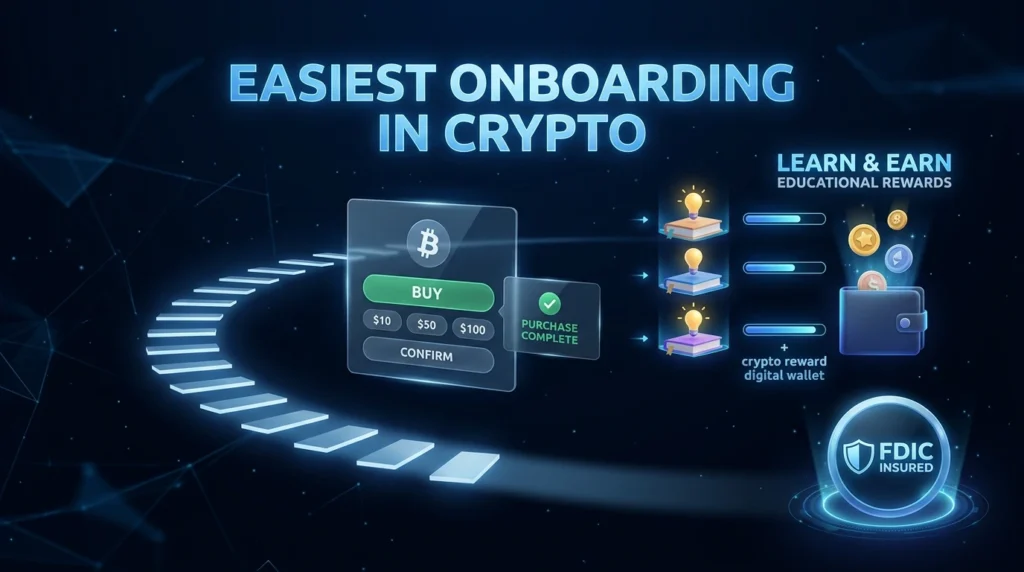
Why it’s #1 for beginners: Coinbase built its entire reputation on making crypto accessible. The onboarding flow is the smoothest in the industry — from signup to first purchase takes around 15 minutes. The interface is clean, the language is plain, and nothing requires prior crypto knowledge.
What beginners get:
- Clean, app-like interface designed for first-time buyers
- Clear fee display before every trade confirmation
- Coinbase Learn & Earn — watch short videos about cryptocurrencies, earn small amounts of crypto as reward — a genuinely useful way to learn while building a small portfolio
- Recurring buys — set up automatic weekly or monthly Bitcoin purchases in a few taps
- 250+ cryptocurrencies including all major assets
- FDIC pass-through insurance on USD balances (up to $250,000)
- 98% of assets in cold storage
- Strong mobile app (4.7/5 App Store)
The honest trade-off: Coinbase’s standard Simple Trade interface charges higher fees than most competitors (typically 1.5–4% depending on payment method). Once you’re comfortable with the platform, switching to Coinbase Advanced Trade reduces fees to 0.40%/0.60% maker/taker — competitive with any exchange.
Minimum trade: $1
Available: 100+ countries; US (all states except some restrictions)
Verdict: The clearest, most beginner-friendly path from “I want to buy Bitcoin” to “I own Bitcoin.” Worth the slightly higher initial fees for the quality of the experience.
2. Kraken — Best for Beginners Who Want Room to Grow
Why beginners love it: Kraken offers a genuinely simple standard interface while having Kraken Pro available the moment you’re ready for it. The platform has an outstanding 14-year security record with no customer fund losses — reassuring for someone new to crypto.
What beginners get:
- Standard interface with flat 1% fee — clearly displayed
- Simple buy, sell, and convert flow
- Recurring investment — dollar-cost average automatically
- 500+ cryptocurrencies
- 24/7 live phone support — rare in crypto, invaluable for first-time users with questions
- Strong regulatory standing (Wyoming SPDI banking charter, FinCEN registered)
- Staking available on 21+ assets with Auto-Earn
- Kraken Pro available whenever you’re ready to upgrade
The honest trade-off: Not available in Maine or New York. Some users find the app slightly less polished than Coinbase.
Minimum trade: $1
Available: 190+ countries; US (except Maine and New York)
Verdict: Excellent for beginners who want a trustworthy platform with room to grow into advanced features. The 24/7 phone support is a genuine differentiator when you’re just starting out.
3. Crypto.com — Best Mobile Experience for Beginners
Why it works for beginners: The Crypto.com app is one of the most polished crypto mobile experiences available — intuitive, fast, and visually clean. For beginners who primarily manage their finances from a phone, it’s a natural fit.
What beginners get:
- Highly intuitive mobile-first app
- Simple buy/sell interface with clear pricing
- Crypto.com Visa Card — spend crypto directly with cashback rewards in CRO token
- Staking and earn features with straightforward interface
- 250+ cryptocurrencies
- Strong security with Proof of Reserves and cold storage
The honest trade-off: Base fees are comparable to Coinbase’s standard interface. Advanced features require learning CRO tokenomics to maximize value.
Minimum trade: $1
Available: 90+ countries
Verdict: Best choice for mobile-first beginners, particularly those interested in a crypto debit card alongside basic trading.
4. Gemini — Best for US Beginners Who Value Security
Why it works for beginners: Gemini is one of the most heavily regulated crypto exchanges in the US, with a clean interface designed for accessibility. Founded by the Winklevoss twins, it’s New York-licensed and has a reputation for compliance rigor.
What beginners get:
- SOC 2 Type 2 certified security
- Available in New York — one of the few regulated options for NY residents
- Gemini Earn — simple yield product for idle crypto
- Clean educational content
- Strong customer service
- FDIC insurance on USD balances
The honest trade-off: Higher fees than Coinbase or Kraken. More limited asset selection.
Minimum trade: $0.01 equivalent
Available: US (all states), select international markets
Verdict: Best regulated option for New York residents and US users prioritizing maximum compliance. The fee premium is the main consideration.
Side-by-Side Comparison for Beginners
| Exchange | Beginner UX | Base Fee | US Available | Phone Support | Fiat Deposit | Min. Trade |
|---|---|---|---|---|---|---|
| Coinbase | ⭐⭐⭐⭐⭐ | 1.5–4% (Simple) | Yes (most states) | Limited | Yes | $1 |
| Kraken | ⭐⭐⭐⭐ | 1% flat | Yes (not ME/NY) | Yes 24/7 | Yes | $1 |
| Crypto.com | ⭐⭐⭐⭐ | ~1.49% | Yes | Chat/Email | Yes | $1 |
| Gemini | ⭐⭐⭐⭐ | ~1.49%+ | Yes (all states) | Yes | Yes | $0.01 |
The 5 Mistakes Beginners Make When Choosing an Exchange
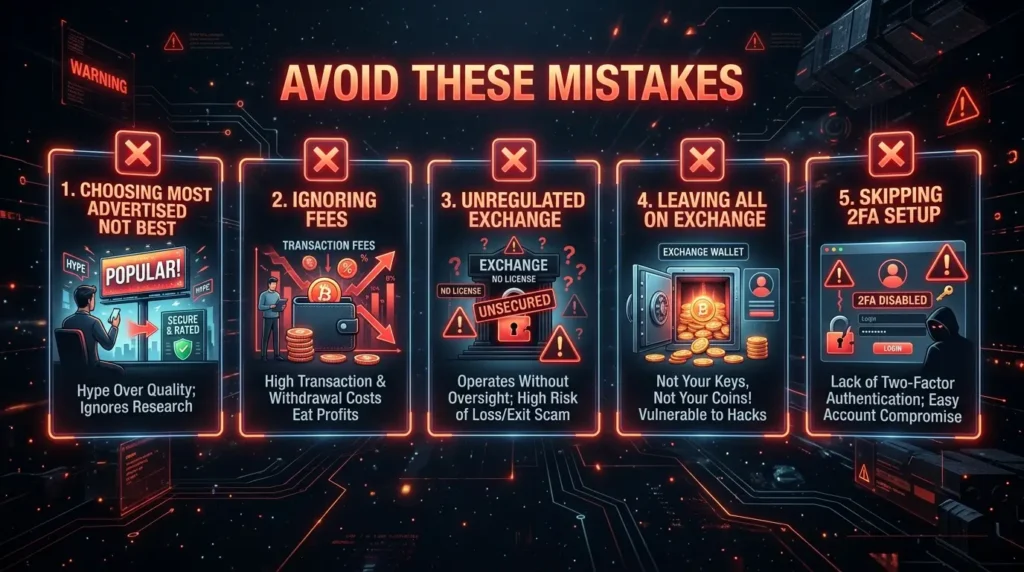
1. Using the most advertised exchange, not the best exchange.
Marketing budget does not equal quality. The biggest ads don’t always lead to the best platform for your situation.
2. Ignoring fees until they add up.
A 3.99% credit card fee on your first $500 purchase costs you $20 immediately. Always check the full fee structure before depositing.
3. Picking an unregulated exchange to access more coins.
Starting on an unregulated platform for obscure tokens before you understand the basics is unnecessary risk. Major coins (Bitcoin, Ethereum, Solana) are available on every reputable regulated exchange.
4. Leaving everything on the exchange forever.
Exchanges are for buying and trading — not for long-term storage. Once you understand hardware wallets, moving significant holdings to cold storage is worth the effort.
5. Skipping 2FA setup.
Your exchange account is only as secure as you make it. Enable authenticator app 2FA on day one — it takes five minutes.
How to Buy Crypto for the First Time: Step by Step
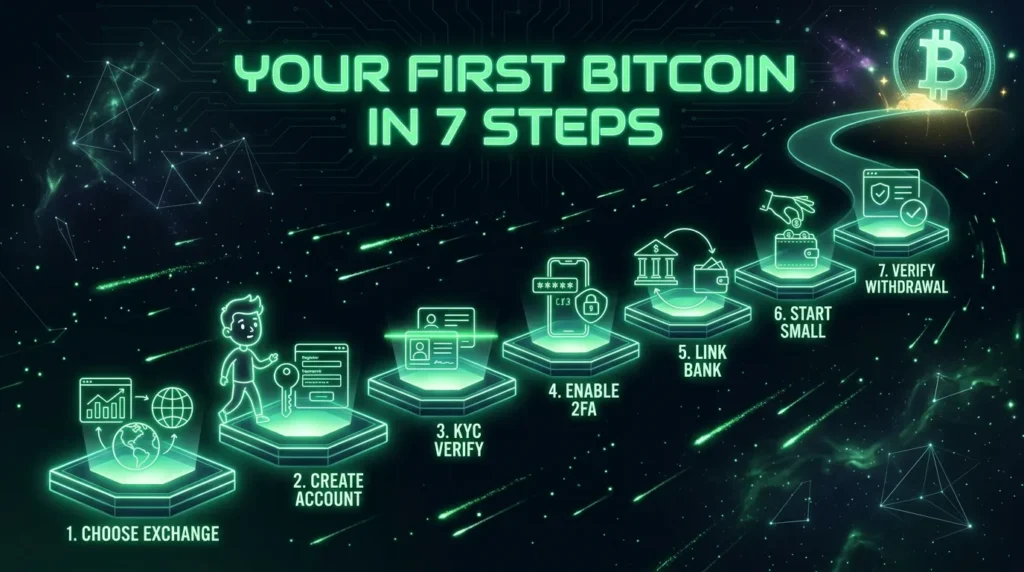
- Choose your exchange — Coinbase or Kraken are the safest starting points for most new buyers
- Create your account — email, strong password, verify email
- Complete KYC — upload government ID (required on all regulated exchanges)
- Enable 2FA — authenticator app, not SMS
- Link a bank account — ACH bank transfer is almost always cheaper than card
- Start small — make a $20–$50 test purchase before committing larger amounts
- Verify you can withdraw — confirm a small withdrawal to a personal wallet before sending large amounts
Key Terminology for First-Time Buyers
KYC (Know Your Customer): Identity verification process required by regulated exchanges — submitting government ID to confirm your identity.
Fiat: Traditional government-issued currency (USD, EUR, GBP). You need a fiat on-ramp to buy crypto with cash.
Market Order: Buys or sells immediately at the current market price.
Limit Order: Sets a specific price at which you want to buy or sell — executes when the market reaches that price.
Maker/Taker: The fee model used by advanced trading interfaces. Makers add liquidity (limit orders), takers remove it (market orders). Makers typically pay lower fees.
Spread: The difference between the buy price and sell price. All exchanges include some spread in their pricing, even when listed fees appear low.
Cold Storage: Storing crypto offline in a hardware wallet — the safest option for significant long-term holdings.
The Bottom Line
For most beginners in 2026, the choice comes down to two platforms:
Start with Coinbase if you want the smoothest possible first experience and don’t mind paying a small premium for that simplicity.
Start with Kraken if you value 24/7 live phone support, a slightly lower standard fee, and the security of 14 years without a customer fund loss.
Both are excellent. Either is a solid foundation for your crypto journey.
The most important thing isn’t which exchange you choose — it’s that you choose a reputable, regulated one and take the time to secure your account properly from day one. 🚀
Disclaimer: This article is for informational purposes only and does not constitute financial advice. Cryptocurrency investments carry significant risk, including the potential loss of all invested capital. TheHashmark.com may receive a commission if you sign up through affiliate links, at no additional cost to you. Always conduct your own research before making any investment decisions.