Before you can own cryptocurrency, you need a place to buy it. Before you can trade it, you need a platform to trade on. Before you can swap one coin for another, you need a marketplace that matches buyers with sellers.
That place, platform, and marketplace is a crypto exchange.
In 2026, there are two fundamentally different types of crypto exchanges — and understanding the difference between them isn’t optional. It affects how your funds are stored, how much you pay in fees, what tokens you can access, how much privacy you have, and crucially: what happens if something goes wrong.
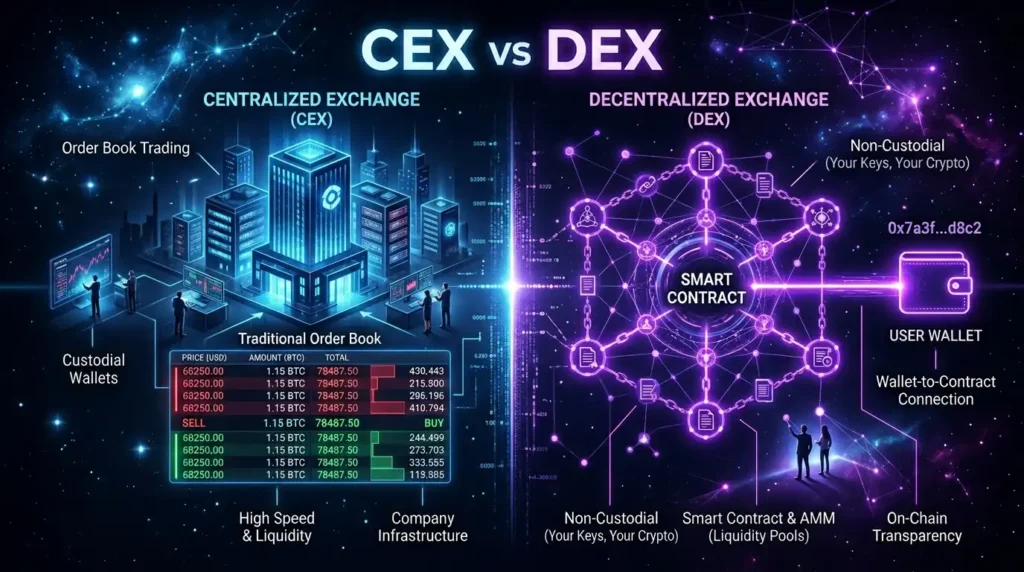
The two types are Centralized Exchanges (CEX) and Decentralized Exchanges (DEX). They’re built on completely different philosophies about who should control your money.
The Quick Answer: What Is a Crypto Exchange?
A crypto exchange is a marketplace where you can buy, sell, and trade cryptocurrencies.
At its most basic, it’s doing the same job as a traditional stock exchange — matching buyers and sellers, setting prices based on supply and demand, and facilitating transactions. The difference is that instead of stocks, you’re trading Bitcoin, Ethereum, Solana, and thousands of other digital assets.
But here’s where crypto diverges from traditional finance: there are two completely different ways to build a cryptocurrency exchange. One uses a company as the intermediary. The other uses code.
Centralized Exchanges (CEX): The Traditional Approach
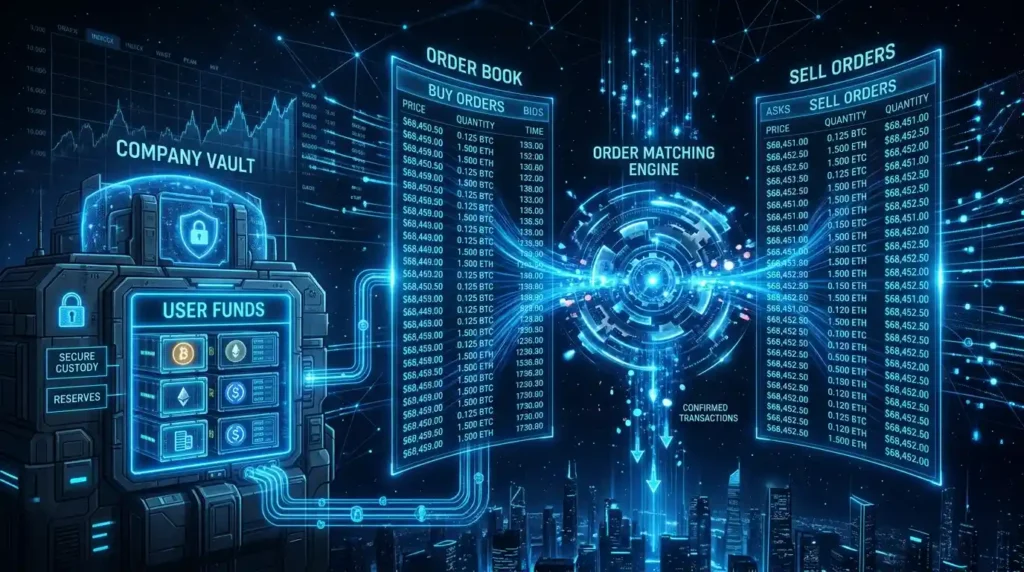
A centralized exchange (CEX) is a company — a business with employees, offices, a legal structure, and regulatory oversight — that operates a platform where users deposit funds, trade, and withdraw.
Think of it like a bank combined with a stock brokerage, but for crypto. You create an account, verify your identity, deposit money, and trade through the company’s interface. The exchange holds your funds in its own wallets and matches your orders against other users through an internal system called an order book.
The order book model: An order book is a real-time list of all open buy and sell orders on the exchange. When you place a “buy Bitcoin at $72,000” order, it sits in the order book until a seller is willing to match it. When a match occurs, the trade executes. This is exactly how stock exchanges like the NYSE work.
Major CEXes in 2026:
- Coinbase — US-based, publicly listed (NYSE: COIN), most beginner-friendly, fully regulated
- Kraken — US-based, strong security reputation, wide fiat support
- Binance — Largest by volume globally, widest token selection, complex regulatory history
- Bybit — Popular for derivatives and futures trading
- OKX — Major global exchange with both CEX and integrated DEX features
How a typical CEX trade works:
- You create an account and verify your identity (KYC — Know Your Customer)
- You deposit USD via bank transfer or debit card
- You place an order: “Buy 0.01 BTC at market price”
- The exchange matches your order with a seller from its order book
- Bitcoin appears in your exchange account balance
- You can withdraw to your personal wallet or leave it on the exchange
What CEX controls: Everything. Your funds, your keys, your access. If the exchange decides to freeze your account, restrict your country, or gets hacked, your funds are at risk.
The FTX Warning: Why “Not Your Keys, Not Your Crypto” Matters

In November 2022, FTX — the world’s third-largest crypto exchange at the time, valued at $32 billion — collapsed in days.
FTX’s CEO had secretly moved billions in customer funds to a trading firm he controlled. When withdrawals surged, there was no money left. Customers who had left funds on the exchange lost everything. Over a million users had their assets frozen or permanently lost.
FTX wasn’t an isolated incident. Celsius, Voyager, BlockFi — multiple major platforms collapsed around the same period, all trapping customer funds.
The lesson: When you leave crypto on an exchange, you don’t own that crypto. The exchange does. You own an IOU. If the exchange fails — through fraud, insolvency, or hack — your funds go with it.
This is why hardware wallets and self-custody matter. CEXes are convenient for trading, but they’re not safe for long-term storage of significant amounts.
Decentralized Exchanges (DEX): The Crypto-Native Approach
A decentralized exchange (DEX) is fundamentally different from a CEX. There’s no company. No employees. No custodian. No order book (usually). No KYC. No account creation.
A DEX is a smart contract — code deployed on a blockchain — that allows users to swap one cryptocurrency for another directly from their own wallets. No middleman ever holds your funds.
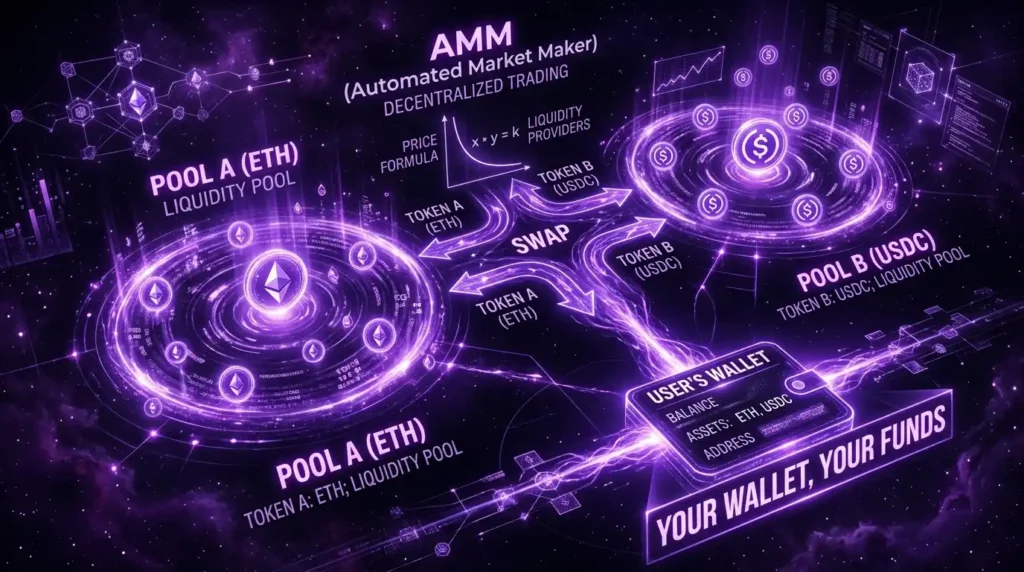
The most common DEX model in 2026 is the Automated Market Maker (AMM). Instead of an order book matching buyers with sellers, AMMs use liquidity pools — reserves of two tokens locked in a smart contract. Traders swap against these pools, and an algorithm automatically adjusts prices based on the ratio of tokens in the pool.
Major DEXes in 2026:
- Uniswap — The dominant Ethereum DEX, the blueprint for AMMs, processes billions weekly
- Jupiter — The leading DEX aggregator on Solana
- PancakeSwap — The largest DEX on BNB Chain
- Curve Finance — Specialized for stablecoin swaps with minimal slippage
- Raydium — Major Solana AMM with deep liquidity
How a typical DEX trade works:
- You open the DEX website (e.g., app.uniswap.org)
- You connect your wallet (e.g., MetaMask) — no account creation
- You select which token to swap from and which token to receive
- The DEX shows you the expected price and fee
- You approve the transaction in your wallet
- The smart contract executes the swap — tokens go directly in and out of your wallet
- Done. You never gave anyone custody of your funds.
What DEX controls: Nothing. The smart contract executes as coded. Your funds stay in your wallet throughout.
How AMMs and Liquidity Pools Work
This is the mechanism that makes DEXes possible — and it’s worth understanding even as a beginner.
Traditional market: A buyer wants ETH. A seller has ETH. They agree on a price. Transaction happens. This requires matching two parties with opposite needs simultaneously.
AMM model: Instead of matching buyers and sellers, AMMs use pools of tokens. Liquidity providers (LPs) deposit pairs of tokens (say, ETH and USDC) into a pool. When a trader wants to swap ETH for USDC, they swap against the pool — they put ETH in, and USDC comes out.
The price is determined algorithmically: as ETH is removed from the pool and USDC added, ETH becomes relatively scarcer in the pool, so its price rises. This is called the constant product formula (x × y = k), and it keeps the pool balanced without any human intervention.
LPs earn trading fees — typically 0.05% to 0.3% on each swap — distributed proportionally to their share of the pool. This is how people earn passive income from DEX liquidity provision.
CEX vs DEX: The Complete Comparison
| Feature | CEX | DEX |
|---|---|---|
| Who holds your funds? | The exchange (custodial) | You (non-custodial) |
| Account required? | Yes, with KYC/identity verification | No — just connect a wallet |
| Fiat (USD) support? | Yes — bank transfers, debit cards | No — crypto only |
| Token selection | Hundreds (vetted listings) | Thousands (any token can be listed) |
| Trading fees | 0.02–0.5% per trade | 0.05–1% swap fee + gas fees |
| Speed | Near-instant (off-chain matching) | Depends on blockchain (seconds to minutes) |
| Privacy | Low — full KYC required | High — no personal information needed |
| Beginner-friendly? | Very — customer support, simple UI | Learning curve — requires wallet knowledge |
| Hack risk | Exchange can be hacked, funds lost | Smart contract risk; your wallet is your security |
| Access to new tokens | Weeks/months after launch | Immediately at launch |
| Derivatives/futures | Available on major CEXes | Available on specialized DEXes (dYdX, Hyperliquid) |
| Regulation | Heavily regulated | Largely unregulated |
CEX: Pros and Cons
Pros:
- Easiest way to buy crypto with dollars — the front door to crypto
- Familiar interface similar to online banking or brokerage apps
- High liquidity for major coins — easy to execute large trades
- Customer support exists (though often limited)
- Regulated and insured in some jurisdictions
- Advanced trading features: margin, futures, staking
Cons:
- Custodial — the exchange holds your keys, your funds
- KYC required — full identity verification
- Can freeze accounts, restrict countries, or fail entirely (FTX)
- Limited token selection — new projects often not listed for months
- Fees can be higher for small trades
- Your trading history is visible to the exchange
DEX: Pros and Cons
Pros:
- Non-custodial — you keep your keys, your funds, always
- No KYC — swap any amount anonymously
- Access to new tokens immediately at launch
- No company that can freeze your funds or go bankrupt
- Composability — integrates directly with DeFi protocols
- Available to anyone with internet and a wallet
Cons:
- No fiat on-ramp — you must already own crypto
- Learning curve — wallets, gas fees, slippage, token approvals
- Gas fees can be expensive on Ethereum mainnet
- No customer support — mistakes are permanent
- Smart contract risk — bugs can drain liquidity pools
- Scam tokens — anyone can list anything, including worthless copies of real tokens
- Lower liquidity for obscure pairs
Which One Should You Use?
Use a CEX if:
- You’re buying crypto for the first time with dollars
- You want a simple, supported experience
- You’re not ready to manage your own wallet
- You want to trade futures or derivatives
- You’re dealing with large amounts where liquidity matters
Use a DEX if:
- You want to swap tokens while keeping custody of your funds
- You want to access a new token that isn’t on major exchanges yet
- You value privacy and don’t want to provide personal information
- You’re participating in DeFi (lending, liquidity provision)
- You already have crypto in a self-custody wallet
The honest truth: Most experienced crypto users use both. CEX for fiat entry/exit and large-volume trading. DEX for new tokens, privacy, and DeFi integration. The two types serve different needs and aren’t truly competing.
A Note on DEX Safety: The Scam Token Problem
Because anyone can list any token on a DEX without vetting, scam tokens are rampant. A fraudster can create a token called “USDT2” or a fake copy of any legitimate token, list it on Uniswap, and wait for unsuspecting buyers.
How to protect yourself on DEXes:
- Always verify the official contract address of any token you’re buying (find it on the project’s official website or CoinMarketCap/CoinGecko)
- Never buy tokens you found through unsolicited messages or social media
- Use DEX aggregators (like 1inch) that help route to legitimate pools
- Be very cautious with tokens not listed on major data sites
- A “rug pull” happens when developers drain the liquidity pool after attracting buyers — if a new token’s liquidity isn’t locked, it’s extremely risky
Key Crypto Exchange Terminology
Order Book: A real-time list of all open buy and sell orders on an exchange, with prices and quantities. The standard model for CEXes.
Market Order: An order to buy or sell immediately at the current market price.
Limit Order: An order to buy or sell at a specific price you set. Executes only when the market reaches that price.
KYC (Know Your Customer): Identity verification required by regulated exchanges — typically ID upload and sometimes video verification.
AMM (Automated Market Maker): A DEX mechanism that uses liquidity pools and algorithms to set prices, replacing the need for an order book.
Liquidity Pool: A reserve of two or more tokens locked in a smart contract, used by AMM-based DEXes to facilitate swaps.
Slippage: The difference between the expected price of a trade and the actual price at execution — happens when trading large amounts in a small pool.
Gas Fee: The fee paid to blockchain validators for processing a DEX transaction. Varies enormously — pennies on Solana/L2s, dollars on Ethereum mainnet.
Trading Fee: The fee charged by an exchange for executing a trade. Typically 0.05–0.5% on CEXes, 0.05–1% on DEXes.
Rug Pull: A DEX scam where developers create a token, attract buyers, then drain the liquidity pool and disappear with all the funds.
DEX Aggregator: A tool (like 1inch or Jupiter) that scans multiple DEXes simultaneously and routes your trade through the best combination for price and fees.
The Bottom Line
Crypto exchanges are the gateway between traditional money and the crypto economy. Centralized exchanges are the front door — familiar, supported, connected to your bank account. Decentralized exchanges are the native infrastructure of Web3 — no gatekeepers, no custodians, no permission required.
Neither is inherently better. They solve different problems for different situations. The CEX gets you in. The DEX keeps you sovereign.
Understanding both — when to use each, what risks each carries, and how to protect yourself — is one of the most practical skills in all of crypto.
Your money, your rules. Know where your crypto lives. 🔄
Disclaimer: This article is for informational purposes only and does not constitute financial advice. Cryptocurrency investments carry significant risk, including the potential loss of all invested capital. Always conduct your own research before making any investment decisions.