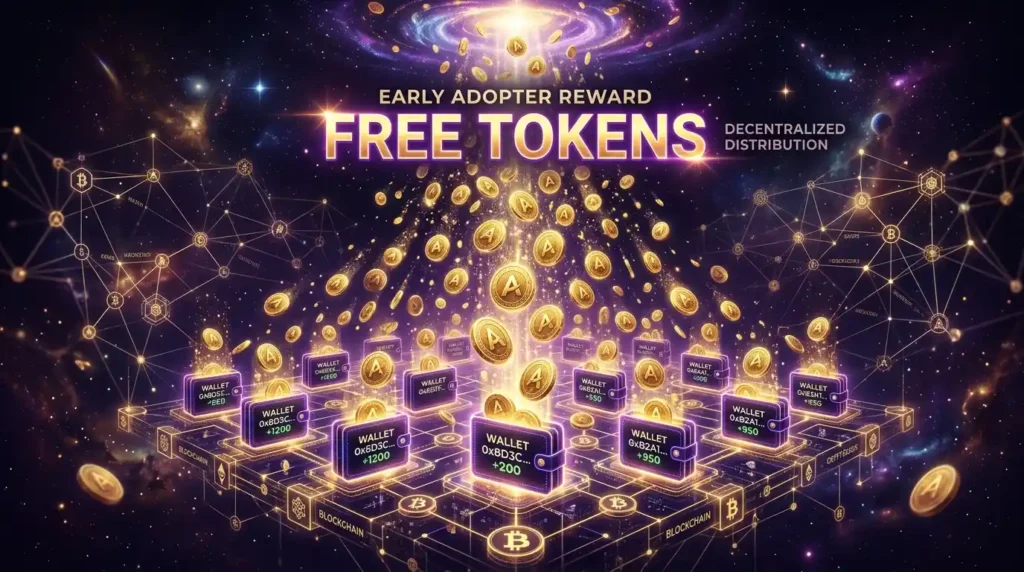
In September 2020, anyone who had ever used Uniswap — even just once — woke up to find 400 free UNI tokens in their wallet. At peak value, those tokens were worth over $6,000.
They didn’t apply for anything. They didn’t fill out a form. They simply used a product, and months later the product rewarded them for it.
This is a crypto airdrop — one of the most genuinely interesting (and genuinely dangerous) phenomena in the crypto world. Done right, participating in airdrops can build a meaningful portfolio as a reward for early adoption. Done carelessly, it can result in losing everything to sophisticated scammers.
This guide covers everything you need to know.
The Quick Answer: What Is a Crypto Airdrop?
A crypto airdrop is a distribution of free tokens by a blockchain project directly to users’ wallet addresses — either as a reward for past activity, to promote the project, or to distribute governance tokens to the community.
The word “airdrop” is borrowed from the military term for dropping supplies by air — tokens falling from the sky into wallets. The difference from a giveaway is that airdrops typically have a purpose beyond promotion: they’re a mechanism for decentralizing token ownership, rewarding genuine users, and building an active community.
Why do projects give away tokens for free?
Launching a new crypto project is incredibly competitive. Getting real users to try your product is hard. Airdrops solve this by creating a powerful incentive loop: early users receive tokens, tokens gain value as the project grows, early users tell friends, more users come, the project grows further.
The best airdrops aren’t charity — they’re a calculated growth strategy that aligns the interests of the project with the interests of its earliest community.
The Legendary Airdrops: Real Money From Free Tokens
Before diving into how they work, it’s worth understanding what’s at stake with real examples:
Uniswap (UNI) — September 2020
Every wallet that had ever used Uniswap received 400 UNI tokens. At peak, those were worth $6,000+. At the time of the airdrop, they were worth about $1,200. Total value distributed: over $6 billion. This single event defined what a “retroactive airdrop” could be and set expectations for the entire industry.
Arbitrum (ARB) — March 2023
Arbitrum, a leading Ethereum Layer 2 network, distributed 1.1 billion ARB tokens to early users. Active users received between a few hundred to thousands of dollars worth. A blockchain activity score determined allocations — more usage, more tokens.
Optimism (OP) — Multiple rounds
Optimism rewarded users of its Layer 2 network with OP tokens. Multiple distribution rounds rewarded both historical usage and ongoing participation in governance.
Hyperliquid (HYPE) — November 2024
The largest token distribution in crypto history. Average recipients received $20,000–$50,000 worth of HYPE tokens. Active traders on the Hyperliquid platform received the most. This airdrop created instant millionaires from people who had simply been using a trading platform.
Jupiter (JUP) — January 2024
Solana’s leading DEX aggregator distributed tokens to active users. Amounts ranged from $200 to $2,000+ depending on usage history.
The pattern is consistent: use real products genuinely and early, get rewarded when the token launches.
The 5 Types of Crypto Airdrops
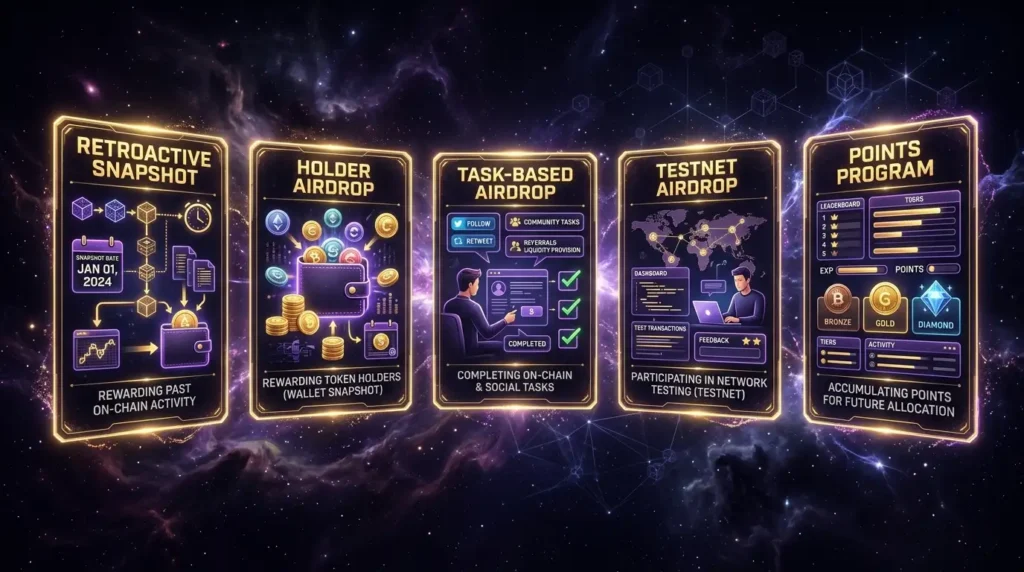
Not all airdrops work the same way. Understanding the types helps you identify legitimate opportunities.
1. Retroactive Airdrops (Most Valuable)
The most lucrative type. The project takes a “snapshot” of blockchain activity at a specific moment in time. Anyone who had interacted with the protocol before the snapshot — traded on it, provided liquidity, bridged assets — receives tokens proportional to their activity.
You can’t retroactively qualify — by definition, it rewards what you already did. The strategy is to identify promising protocols before they launch tokens and use them genuinely.
Examples: Uniswap, Arbitrum, Optimism, Hyperliquid, Jupiter
2. Holder Airdrops
A snapshot is taken of everyone holding a specific token. Anyone holding the required token at the snapshot moment receives new tokens automatically — no action required.
Example: Bitcoin Cash was created as a fork of Bitcoin in 2017 — every BTC holder received an equivalent amount of BCH. Stellar (XLM) airdropped billions of dollars to Bitcoin holders in 2019.
3. Standard/Task-Based Airdrops
The simplest type. Complete basic tasks — follow on Twitter/X, join Telegram, retweet an announcement, register an email — and receive a small token allocation. These are common for early-stage projects building their community.
Value: Usually small. The low barrier to entry means thousands of people qualify, diluting the reward.
4. Testnet Airdrops
Projects need real users to test their technology before launch. Testnet participants interact with a beta version of the product, report bugs, and provide feedback. In exchange, they often receive token allocations when the mainnet launches.
Value: Can be significant. Starknet, zkSync, and many Layer 2 networks rewarded testnet users.
5. Points-Based Airdrops
Increasingly common in 2026. Instead of a single snapshot, projects run ongoing “points” programs — users earn points for trading, providing liquidity, referring friends, or other actions. Points convert to tokens at the Token Generation Event (TGE).
Examples: Blur NFT marketplace, Blast L2, many DeFi protocols
How to Position Yourself for Future Airdrops
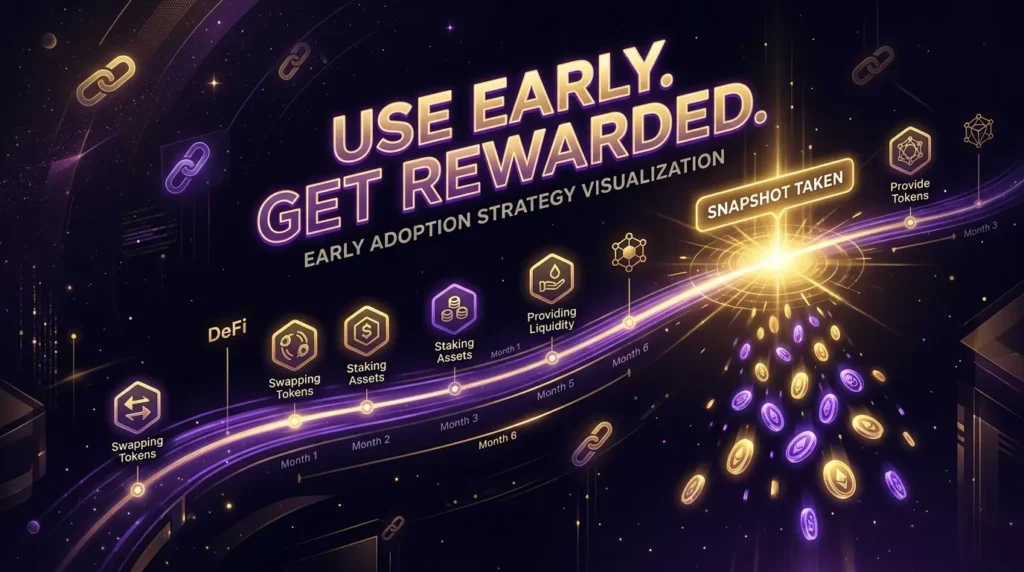
The honest reality of 2026: the “golden age” of effortless free money is over. Projects now use sophisticated sybil detection (identifying fake/duplicate wallets), require genuine engagement, and reward quality activity over quantity.
The strategy that works:
1. Identify promising protocols early
Look for well-funded projects that don’t yet have a token but are building real products. Signs of a potentially valuable future airdrop: significant VC funding, growing user base, active development, multi-chain ambitions.
2. Use the product genuinely
Don’t just click buttons to check boxes. Trade on the DEX. Provide liquidity. Vote in governance. Bridge assets. Lend and borrow. The more genuinely you use the protocol, the more valuable your activity history becomes.
3. Be early and consistent
Retroactive airdrops heavily weight early, consistent usage over one-time interactions. Monthly usage over 6+ months typically earns more than 10 transactions in one day.
4. Use a dedicated wallet
Keep a separate wallet for airdrop activity. Never expose your main holdings wallet to new protocols. This limits your risk if something goes wrong.
5. Track your activity
Keep notes on which protocols you’ve used, when, and what you did. This helps when projects announce snapshot dates and you need to verify eligibility.
The Airdrop Scam Problem: Why 2026 Is Dangerous
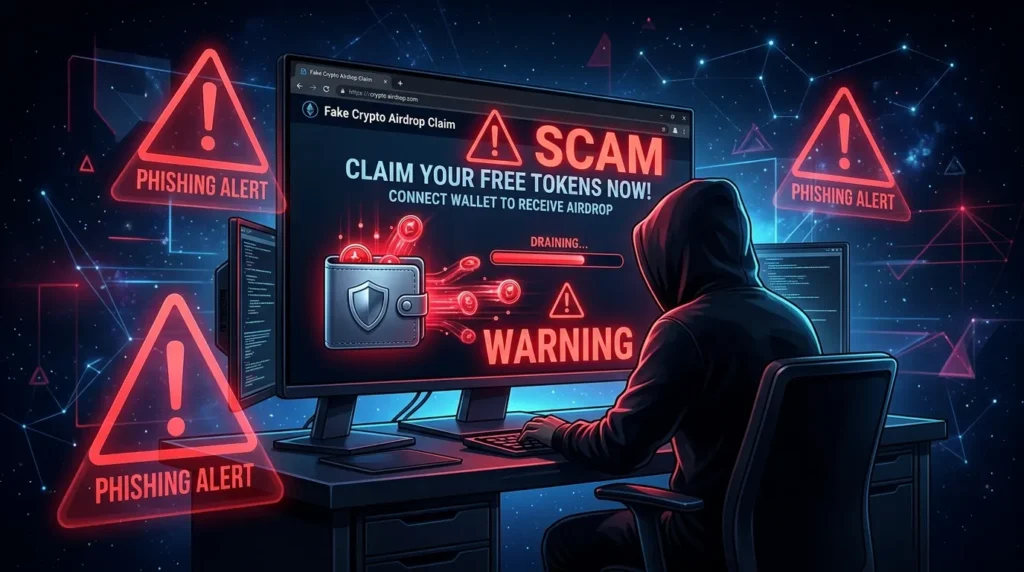
Here’s the brutal reality: crypto scam losses hit $14–17 billion in 2025, with airdrop scams among the fastest-growing categories. Impersonation scams grew by 1,400% year-over-year, driven by AI tools that make fake sites indistinguishable from real ones.
The FBI issued a warning in March 2026 about a fake “FBI Token” TRC-20 airdrop on Tron — unsolicited tokens appearing in wallets, linked to phishing sites that drained funds when users connected.
Understanding the attack vectors is essential:
Fake Claim Websites
When a major legitimate airdrop is announced (Uniswap, OpenSea, etc.), attackers register near-identical domain names within hours — changing one character, adding a hyphen, or swapping .com for .io. These sites are visually perfect copies. When you connect your wallet and approve a transaction, your funds are drained instantly.
Malicious Token Approvals
The most technically sophisticated scam. You click “Claim 500 tokens” on what looks like an official page. The transaction shows a harmless confirmation. But what you’re actually signing is an approval granting an attacker unlimited access to your USDC or ETH. They wait, then drain your wallet.
Dusting Attacks
Scammers send tiny amounts of unknown tokens to thousands of wallets — sometimes fractions of a cent worth. If you try to interact with these tokens (swap them, explore the associated website), you may connect to a malicious contract. The safe response: completely ignore unknown tokens you didn’t earn.
Seed Phrase Requests
The oldest scam, still effective. A fake “support agent,” “official airdrop team,” or spoofed social media account asks for your seed phrase or private key to “verify eligibility” or “fix a claiming issue.” No legitimate airdrop ever requires your seed phrase.
How to Tell Real Airdrops From Scams: The Rules
Signs of a LEGITIMATE airdrop:
- ✅ Announced on the project’s official website and verified social accounts
- ✅ You used the protocol and have on-chain history to prove it
- ✅ Claim link matches the official domain exactly
- ✅ Never asks for seed phrase, private key, or payment
- ✅ Gas fees may apply (small blockchain cost) but no sending of ETH/BTC to “receive” tokens
- ✅ Team has real identity, funding, and trackable history
- ✅ Announced well in advance, not urgently
Signs of a SCAM airdrop:
- ❌ You receive tokens from a project you never interacted with
- ❌ Claim site URL doesn’t exactly match official domain
- ❌ Asks for seed phrase, private key, or personal information
- ❌ Requires sending crypto to “receive” tokens (“send 0.1 ETH to activate”)
- ❌ Extreme urgency (“claim in 24 hours or lose everything”)
- ❌ Project has no verifiable team, whitepaper, or history
- ❌ Promises unrealistically large rewards for minimal effort
- ❌ Promoted through unsolicited DMs or emails
Airdrop Taxes: The Part Nobody Wants to Talk About
In the United States (and most jurisdictions), airdropped tokens are taxable income at the fair market value when you receive them.
If you receive 400 UNI tokens worth $1,200 on the day of the airdrop — that’s $1,200 of ordinary income, taxable in that year. If those tokens later increase in value and you sell them, you also pay capital gains tax on the appreciation.
This is real money. Some users received airdrops worth tens of thousands of dollars and were shocked to discover a significant tax bill. Use crypto tax software (Koinly, CoinTracker, TaxBit) to track airdrop income, and consult a tax professional if you receive significant amounts.
The IRS Revenue Ruling 2019-24 established that airdrops create taxable income when you have “dominion and control” over the tokens.
Key Airdrop Terminology
Airdrop: A distribution of free tokens by a blockchain project to wallet addresses meeting certain criteria.
Retroactive Airdrop: Tokens distributed to users who performed specific on-chain actions before a snapshot, as a retroactive reward for early adoption.
Snapshot: The specific block height at which a blockchain’s state is recorded to determine airdrop eligibility. Activity after the snapshot doesn’t count.
TGE (Token Generation Event): The moment a project’s token officially launches and becomes tradeable. Often when airdrop tokens are distributed or become claimable.
Sybil Attack: Creating many fake wallets to farm airdrop rewards unfairly. Projects use sophisticated analysis to detect and exclude sybil wallets.
Points Program: An ongoing airdrop qualification system where users earn points for protocol interactions, converting to tokens at TGE.
Dusting Attack: Sending tiny amounts of unknown tokens to wallets to lure users into interacting with malicious contracts.
Governance Token: A token that gives holders voting rights over a protocol’s future development. Many retroactive airdrops distribute governance tokens.
Claim: The process of actively going to a project’s website to retrieve your airdrop tokens, as opposed to automatic delivery.
The Bottom Line
Crypto airdrops are one of the genuinely unique aspects of the blockchain ecosystem — a mechanism that has created real wealth for real people who simply showed up early and used products they believed in.
The Uniswap airdrop. The Arbitrum airdrop. The Hyperliquid airdrop. These weren’t lottery wins. They were rewards for early adoption — for the people who were willing to try something new before it was obvious that it would work.
The strategy is simple in concept, harder in practice: find promising early-stage protocols, use them genuinely and consistently, protect your wallets, and wait.
Most of the time, nothing happens. Occasionally, you wake up to life-changing tokens in your wallet.
Just never, ever connect your main wallet to an unknown site, approve a transaction you don’t understand, or give your seed phrase to anyone who asks.
Free tokens are real. Free tokens that cost you everything are realer. 🪂
Disclaimer: This article is for informational purposes only and does not constitute financial advice. Cryptocurrency investments carry significant risk, including the potential loss of all invested capital. Always conduct your own research before making any investment decisions.