Imagine if the US government had a law that said: “Every four years, we will print exactly half as many new dollars as we did in the previous four years — automatically, by law, forever, with no exceptions.”
Politicians couldn’t override it. The Fed couldn’t override it. No crisis, no war, no economic emergency could change it. The reduction just happens, on schedule, as programmed.
That’s essentially what Bitcoin’s halving does for its own monetary policy.
Every approximately four years, Bitcoin automatically reduces the reward paid to miners for creating new blocks — by exactly 50%. The mechanism is hardcoded into Bitcoin’s software and has been running flawlessly since 2009. No human approval needed. No vote. No override.
It’s one of the most elegant economic mechanisms in finance, and understanding it is essential for understanding why Bitcoin behaves the way it does.
The Quick Answer: What Is a Halving?
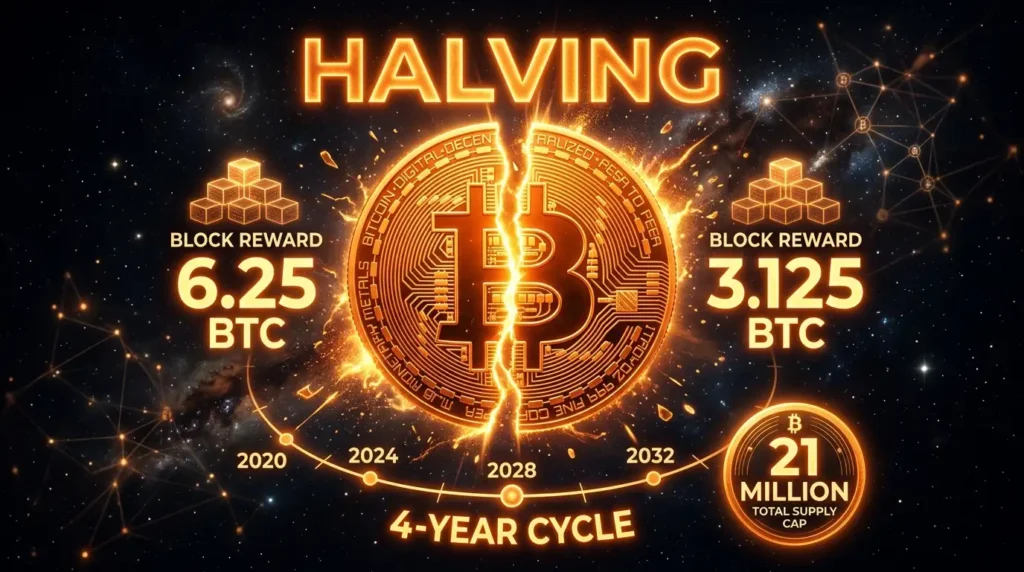
A halving (sometimes “halvening”) is a pre-programmed event in Bitcoin’s code where the reward given to miners for adding a new block to the blockchain is cut in half.
This happens automatically every 210,000 blocks — which, at Bitcoin’s pace of one block every 10 minutes, works out to approximately every four years.
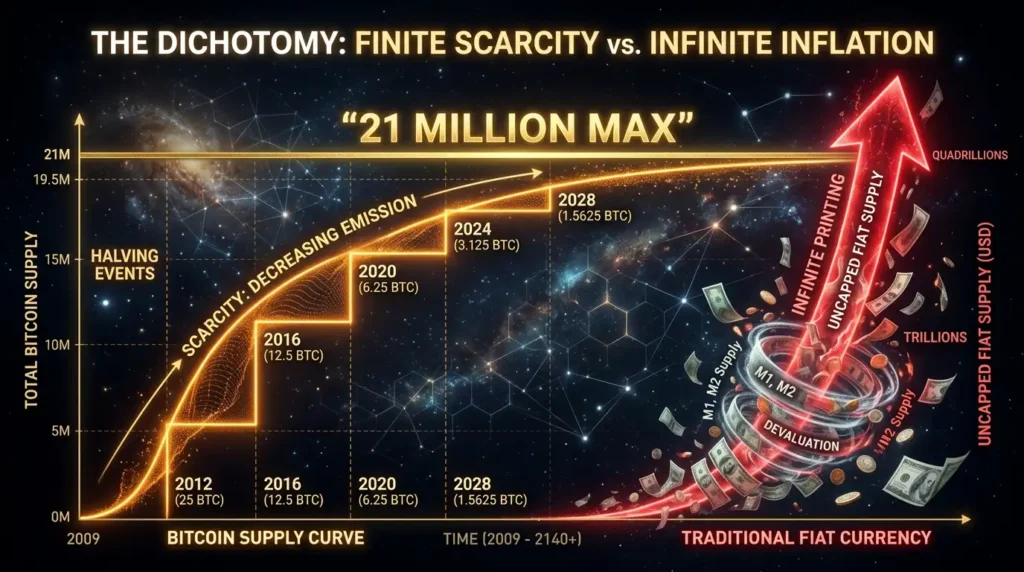
The halving is Bitcoin’s built-in mechanism for controlling its money supply. Unlike governments that can print unlimited currency, Bitcoin’s supply growth is mathematically guaranteed to slow down over time until it reaches a hard cap of 21 million BTC — and then stops forever.
Why Does the Halving Exist? The Economics of Scarcity
When Satoshi Nakamoto designed Bitcoin in 2008–2009, he built in a deliberate solution to one of the core problems with traditional money: inflation from unlimited supply.
Fiat currencies (dollars, euros, yen) can be printed indefinitely by central banks. When more currency is created than economic value is produced, each existing unit buys less — that’s inflation. The dollar has lost over 97% of its purchasing power since the Federal Reserve was created in 1913.
Bitcoin was designed to work differently. The total supply is capped at exactly 21 million coins. Not approximately 21 million — exactly. The protocol makes it mathematically impossible to create more.
But Satoshi faced a problem: if all 21 million Bitcoin were released immediately, there would be no incentive for miners to keep securing the network after the coins ran out. And releasing them all at once would create massive initial inequality.
The halving was the solution. Bitcoin is released gradually over time — starting generous, then decreasing. New Bitcoin enters circulation as miner rewards. Those rewards start at 50 BTC per block, then drop to 25, then 12.5, then 6.25, then 3.125 — halving every four years until eventually reaching zero around 2140.
This creates a disinflationary supply curve: always releasing fewer new coins than the previous period, approaching but never exceeding 21 million.
All Bitcoin Halvings: The Complete History
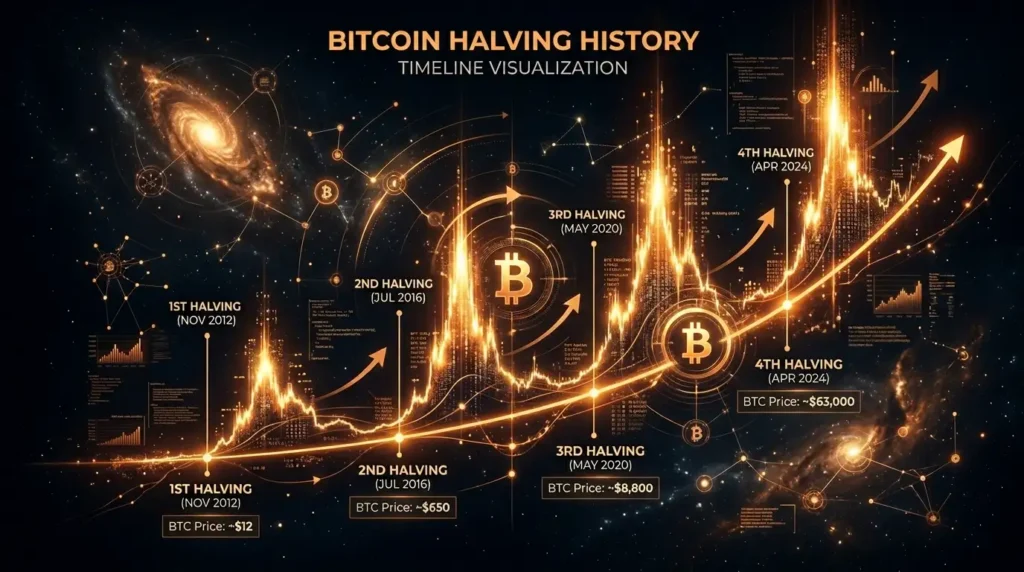
| Halving # | Date | Block Height | Reward Before | Reward After | BTC Price at Halving |
|---|---|---|---|---|---|
| Genesis | Jan 3, 2009 | 0 | — | 50 BTC | ~$0 |
| 1st Halving | Nov 28, 2012 | 210,000 | 50 BTC | 25 BTC | ~$12 |
| 2nd Halving | Jul 9, 2016 | 420,000 | 25 BTC | 12.5 BTC | ~$650 |
| 3rd Halving | May 11, 2020 | 630,000 | 12.5 BTC | 6.25 BTC | ~$8,600 |
| 4th Halving | Apr 19, 2024 | 840,000 | 6.25 BTC | 3.125 BTC | ~$63,000 |
| 5th Halving | ~2028 | 1,050,000 | 3.125 BTC | 1.5625 BTC | TBD |
| … | … | … | … | … | … |
| Final Halving | ~2140 | — | ~0 | 0 BTC | TBD |
What Happened After Each Halving? The Price Story
This is the question everyone wants to know: does the halving cause Bitcoin’s price to rise?
After the 1st Halving (2012):
Bitcoin was at ~$12 when the halving occurred. Within 12 months, it hit $1,150 — a roughly 9,500% increase. The first major bull run in Bitcoin history.
After the 2nd Halving (2016):
Bitcoin was at ~$650. Within 18 months, it reached $19,800 — approximately a 3,000% increase. The 2017 crypto mania that introduced cryptocurrency to the mainstream.
After the 3rd Halving (2020):
Bitcoin was at ~$8,600, in the middle of COVID-19 economic uncertainty. Within 18 months, it reached $69,000 — approximately a 700% increase. Ethereum hit new highs. DeFi exploded. NFTs became a cultural phenomenon.
After the 4th Halving (2024):
Bitcoin was at ~$63,000 at the halving date (April 19, 2024). The market had already been boosted by the January 2024 approval of US Bitcoin spot ETFs. By late 2025, Bitcoin exceeded $109,000 — an all-time high.
The pattern: Every halving has been followed by a significant bull run within 12–18 months. However, there are important caveats to understand before treating this as a guaranteed formula.
Why Does the Halving Tend to Affect Price?
The economic logic is straightforward:
Supply side: Before the 2024 halving, approximately 900 new Bitcoin were created every day. After the halving, that dropped to approximately 450 per day. If demand stays constant but new supply is cut in half, basic economics suggests upward price pressure.
Miner selling pressure: Miners incur real costs (electricity, hardware) and must sell some of their Bitcoin rewards to cover expenses. When the halving cuts their reward in half, the amount of Bitcoin they’re forced to sell daily also decreases — reducing a constant source of sell pressure in the market.
Psychological impact: The halving is a well-known, scheduled event. It generates media attention, increases awareness of Bitcoin’s fixed supply, and attracts new investors who learn about it for the first time.
The “buy the rumor” effect: Markets often price in expected events in advance. Bitcoin typically sees price appreciation in the months before a halving as investors position ahead of the event.
The Important Caveats: What the Halving Doesn’t Guarantee
Past performance doesn’t guarantee future results — and this is especially true with only four data points.
The 2024 halving showed an interesting variation: Bitcoin actually reached its all-time high of ~$73,000 before the halving (in March 2024), then consolidated for several months after the event before resuming its upward trend. This was partly because the January 2024 ETF approval had already driven significant demand ahead of the halving.
The diminishing impact: Each halving reduces Bitcoin’s inflation rate by less in absolute terms. The first halving cut supply growth from ~7,200 BTC/day to ~3,600. The fourth halving cut it from ~900 to ~450. As 94%+ of all Bitcoin has already been mined, each future halving represents a smaller relative supply shock.
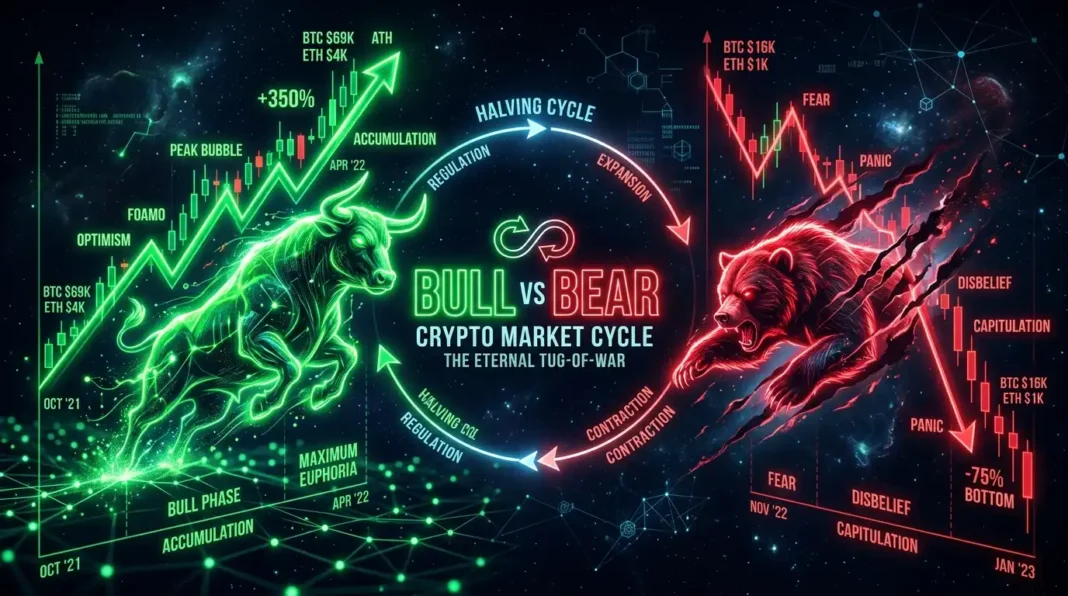
Other factors matter enormously: The 2022 bear market happened less than two years after the 2020 halving. Macroeconomic conditions, regulatory developments, exchange collapses, and market sentiment all override the halving’s supply mechanics in the short term.
The takeaway: The halving creates favorable supply conditions for Bitcoin price appreciation, but it’s not a guaranteed trigger or a reliable timing signal for exactly when the bull run will happen.
How Does the Halving Affect Bitcoin Miners?
The halving creates real economic pressure on miners:
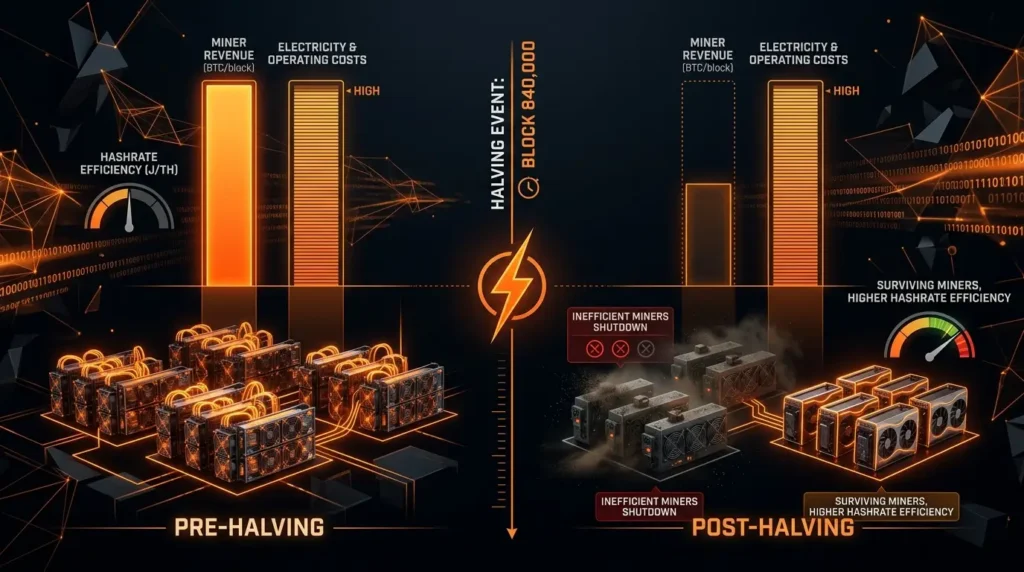
Revenue cut in half overnight: A miner earning the equivalent of $100,000/month in block rewards the day before the halving earns ~$50,000 the day after — while their electricity and hardware costs remain exactly the same.
Miner capitulation: Less efficient miners who were barely profitable suddenly become unprofitable and shut down. This temporarily reduces the network’s total hash rate — making mining slightly easier for surviving miners and eventually rebalancing economics.
Hash rate recovery: Historically, the hash rate dips briefly after each halving (as inefficient miners exit), then recovers and exceeds pre-halving levels within weeks to months, as higher Bitcoin prices (driven partly by the supply reduction) make mining profitable again for efficient operators.
The long-term mining question: Bitcoin halvings will continue until approximately 2140, when all 21 million Bitcoin will have been mined. At that point, miners will receive zero block rewards — only transaction fees. Whether transaction fee revenue will be sufficient to incentivize enough mining for network security is a legitimate open question that won’t be answered for over a century.
The Halving for Other Cryptocurrencies
Bitcoin invented the halving, but other cryptocurrencies have adopted similar mechanisms:
Litecoin (LTC): Also has a halving every 840,000 blocks (~4 years). Most recent: August 2023 (reward: 12.5 → 6.25 LTC). Next: ~2027.
Bitcoin Cash (BCH): Follows the same halving schedule as Bitcoin (every 210,000 blocks). April 2024 halving reduced reward to 3.125 BCH.
Ethereum: Does not have a halving. Instead, switched from PoW to PoS in 2022, dramatically reducing ETH issuance (by ~90%) and introducing EIP-1559, which burns a portion of transaction fees — making ETH potentially deflationary during periods of high activity.
Most altcoins: Have various supply mechanisms, but many don’t have fixed supply caps or halvings. Each project has its own tokenomics.
Bitcoin’s Supply: The Numbers in Context
| Metric | Number |
|---|---|
| Maximum Bitcoin supply | 21,000,000 BTC |
| Bitcoin mined as of 2026 | ~19.7 million BTC (93.8%) |
| Bitcoin remaining to be mined | ~1.3 million BTC |
| Bitcoin mined per day (post-2024 halving) | ~450 BTC |
| Current annual inflation rate | ~0.85% |
| Year last Bitcoin will be mined | ~2140 |
| Bitcoin estimated permanently lost | 3–4 million BTC (lost wallets, dead keys) |
The “effective supply” of Bitcoin is actually lower than 21 million because an estimated 3–4 million BTC are permanently inaccessible — locked in lost wallets, forgotten private keys, or Satoshi Nakamoto’s wallets which haven’t moved since 2010. This further reduces the circulating supply available to buyers.
Key Halving Terminology
Halving (Halvening): The event where Bitcoin’s block reward is cut in half, occurring every 210,000 blocks (~4 years).
Block Reward: The amount of newly created Bitcoin given to the miner who successfully adds a new block. Currently 3.125 BTC.
Block Subsidy: Another term for the block reward portion that comes from newly created Bitcoin (as opposed to transaction fees).
Disinflationary: A monetary policy where supply continues growing but at a decreasing rate — Bitcoin’s supply always increases, just slower and slower over time.
Supply Cap: Bitcoin’s hard limit of 21 million total coins that can ever exist.
Miner Capitulation: When miners with high operating costs shut down after a halving because their revenue no longer covers costs.
Hash Rate: The total computational power of the Bitcoin network. Temporarily dips after halvings as inefficient miners exit.
Stock-to-Flow (S2F): A valuation model that measures the ratio of existing supply (stock) to new annual supply (flow). Bitcoin’s S2F ratio doubles with each halving — proponents argue this drives price appreciation.
The 4-Year Cycle: The informal name for crypto’s observed bull-bear market pattern, roughly aligned with Bitcoin’s halving schedule.
The Bottom Line
The Bitcoin halving is one of the most elegant mechanisms in modern finance. In a world where every government can print unlimited money and central bankers make inflation policy behind closed doors, Bitcoin has a completely transparent, mathematically predetermined supply schedule that no human can alter.
The halving is Bitcoin’s version of a central bank meeting — except it happens automatically, on schedule, with exactly the outcome that was published in Satoshi’s whitepaper in 2008. No surprises. No discretion. No exceptions.
Whether the halving “causes” bull markets is genuinely uncertain with only four data points. But what it undeniably does is create a system where new supply decreases over time while demand is determined by global markets — and that supply-demand dynamic has historically favored Bitcoin holders.
The next halving is expected around 2028, when the reward will drop to 1.5625 BTC per block. Put it in your calendar.
Programmed scarcity. Mathematical certainty. No central bank required. ₿
Disclaimer: This article is for informational purposes only and does not constitute financial advice. Cryptocurrency investments carry significant risk, including the potential loss of all invested capital. Always conduct your own research before making any investment decisions.