If you’ve spent any time around crypto, you’ve heard people saying things like “we’re in a bull run” or “crypto winter is here.” Friends who lost money in 2022 warn you about bear markets. YouTubers promise the next bull run will make you rich.
But what do these terms actually mean? How do you know which phase you’re in? How long do they last? And most importantly — what should you do in each one?
These are the questions this guide answers. Understanding market cycles isn’t just academic — it’s one of the most practical skills in crypto, because the same asset can double your money or destroy your portfolio depending on when you buy and sell.
The Quick Answer: Bull vs Bear
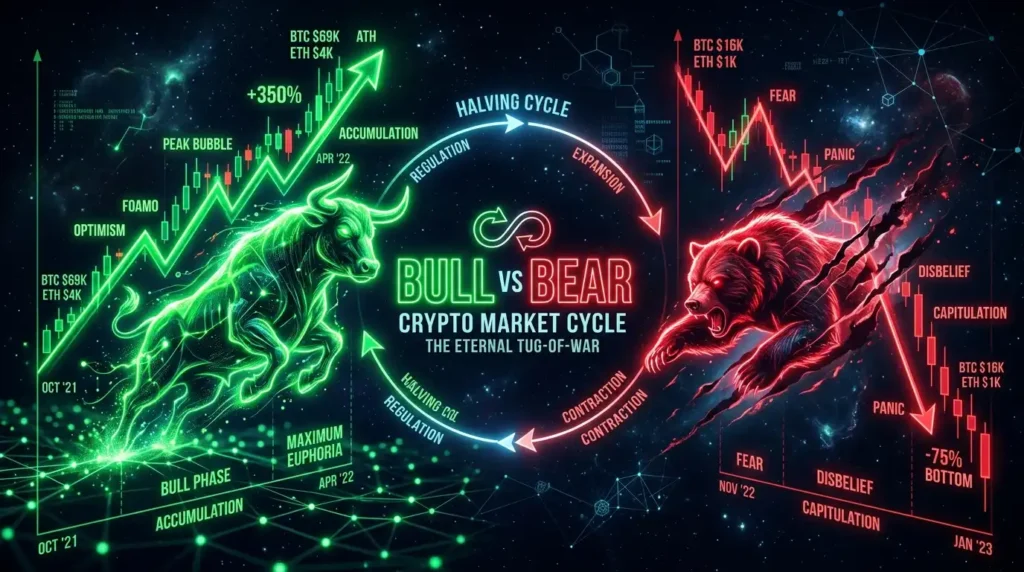
Bull market: A sustained period of rising prices — generally defined as a 20%+ increase from recent lows — characterized by optimism, growing adoption, and increasing media attention.
Bear market: A sustained period of falling prices — generally defined as a 20%+ decline from recent highs — characterized by fear, reduced participation, and negative sentiment.
The terms come from how these animals attack: a bull thrusts its horns upward (rising prices), a bear swipes its claws downward (falling prices). Simple, visual, and surprisingly accurate as metaphors for market psychology.
The key word in both definitions is sustained. A single bad week doesn’t make a bear market. A single good week doesn’t make a bull run. These are extended phases that can last months or years, driven by shifting investor psychology, macroeconomic conditions, and — in crypto’s case — a phenomenon unique to this asset class: the Bitcoin halving.
What Drives Crypto Bull Markets?
Several interconnected forces fuel bull markets in crypto:
Bitcoin Halvings — The Most Predictable Catalyst
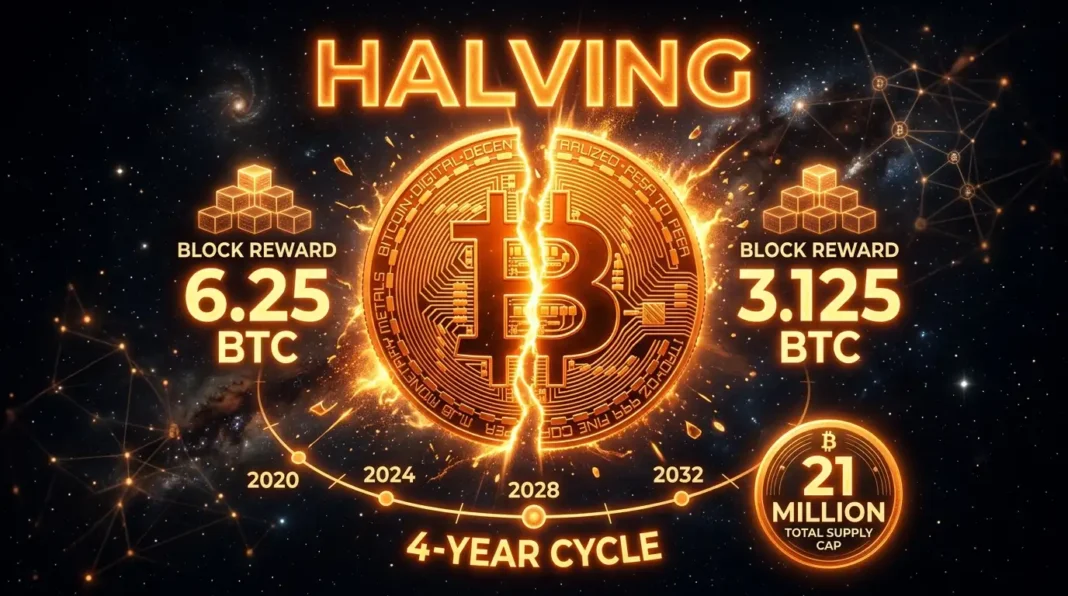
Every approximately four years, Bitcoin’s block reward is cut in half. This reduces the rate at which new Bitcoin enters circulation. If demand stays the same or grows while supply growth slows, basic economics suggests prices should rise.
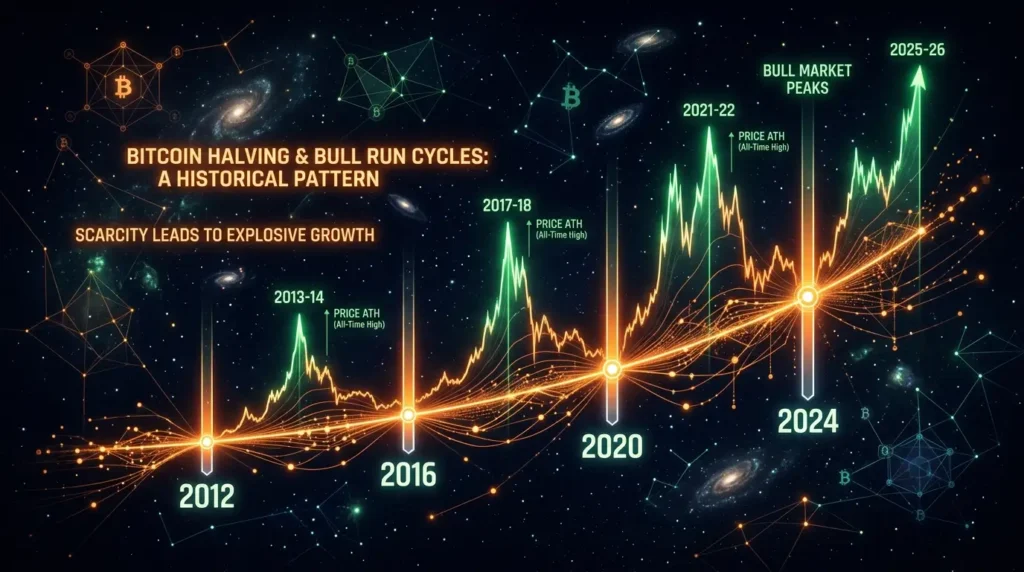
Historically, every Bitcoin halving has been followed by a significant bull market:
- 2012 halving → 2013 bull run (BTC: $12 → $1,150)
- 2016 halving → 2017 bull run (BTC: $650 → $19,800)
- 2020 halving → 2020–2021 bull run (BTC: $8,500 → $69,000)
- 2024 halving (April) → 2024–2025 bull run (BTC: $30,000 → ~$109,000)
This halving-driven cycle has created crypto’s famous “4-year cycle” — though it’s not a precise clock and shouldn’t be treated as guaranteed.
Institutional Adoption
The January 2024 launch of Bitcoin spot ETFs in the US — bringing BlackRock, Fidelity, and other Wall Street giants into Bitcoin — represented a structural shift in demand. Institutions now allocate to crypto as part of diversified portfolios, creating consistent buy pressure that didn’t exist in previous cycles.
Macroeconomic Conditions
When central banks cut interest rates and inject liquidity into the economy (quantitative easing), investors reach for riskier, higher-yielding assets. Crypto benefits disproportionately from loose monetary policy. Conversely, rising interest rates (as in 2022) tend to kill bull markets by making safe assets like bonds relatively more attractive.
Regulatory Clarity
Regulatory uncertainty suppresses crypto investment. When regulations become clearer and more favorable — as happened in the US in 2024–2025 under a crypto-friendly administration — institutional and retail money flows more freely into the market.
Technology Milestones
Major protocol upgrades, new use cases, and ecosystem growth create genuine demand. Ethereum’s transition to Proof of Stake, the rise of Layer 2 networks, and the explosion of DeFi and NFTs all contributed to sustained bull market conditions.
What Drives Crypto Bear Markets?
Post-Bull Exhaustion
Every bull market eventually runs out of buyers. Prices get too high relative to any rational valuation. Latecomers buy the top. Early investors take profits. The selling gradually outweighs the buying. Prices begin to fall.
Macroeconomic Tightening
Rising interest rates and tighter monetary policy pull money out of risk assets. The 2022 bear market was largely driven by the Federal Reserve’s aggressive rate hikes to combat inflation — the fastest rate-hiking cycle in 40 years.
Major Negative Events
The 2022 bear market was compounded by a series of catastrophic events: the UST/LUNA collapse ($40–50B wiped out in May 2022), the Three Arrows Capital (3AC) implosion (a massive crypto hedge fund), and the FTX fraud (November 2022). Each event reduced trust in the broader ecosystem.
Fear and Negative Feedback Loops
Bear markets accelerate through psychology. Falling prices trigger fear. Fear triggers selling. More selling causes more price drops. More drops cause more fear. This self-reinforcing cycle is why crypto bear markets can be so brutal — Bitcoin fell 77% peak-to-trough in 2018, and 77% again in 2022. Most altcoins lost 90%+.
The 4 Phases of a Crypto Market Cycle
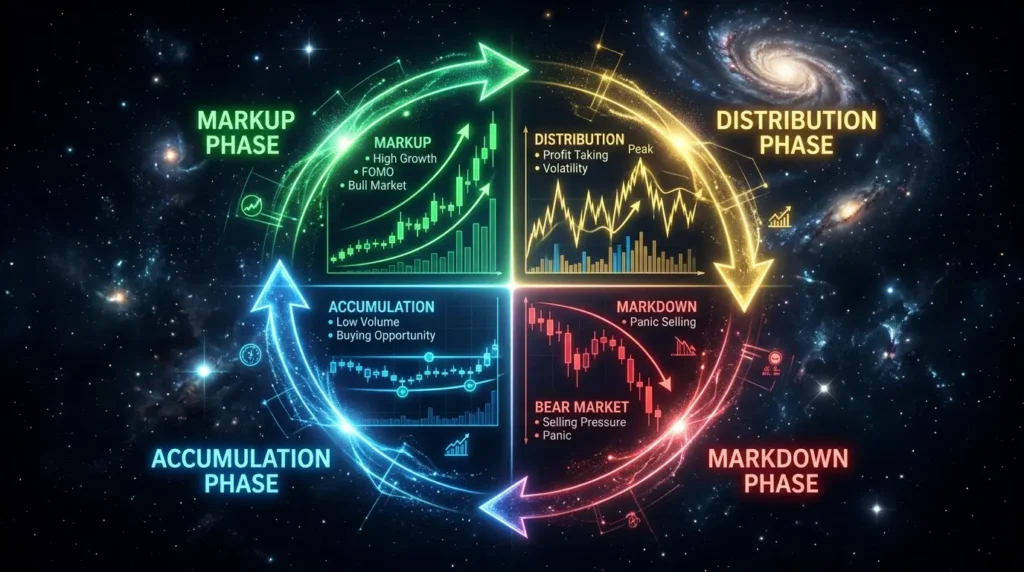
Markets don’t randomly flip between bull and bear. They move through identifiable phases:
Phase 1 — Accumulation
Happens after a painful bear market. Prices move sideways. Media ignores crypto. Most retail investors have given up or “quit crypto forever.” Volume is low. But this is when smart money — institutions, long-term investors, experienced traders — quietly begins buying. Nobody rings a bell at the bottom.
Phase 2 — Bull Market (Markup)
Prices start rising consistently. First slowly, then faster. The narrative changes: “crypto is back.” Media coverage increases. New investors enter. FOMO (Fear Of Missing Out) sets in. Price appreciation feeds on itself as more people buy in, driving prices higher, attracting more buyers. This phase can last 12–18 months and produce extraordinary gains.
Phase 3 — Distribution
The peak of the cycle. Prices may still be rising, but early investors and institutions are quietly selling to the retail investors flooding in at all-time highs. Volatility increases. “This time is different” narratives peak. This is the most emotionally deceptive phase — it feels like strength, but weakness is forming underneath.
Phase 4 — Bear Market (Markdown)
Prices fall. First slowly, then rapidly. Narratives shift: “crypto is dead.” Media covers every hack, fraud, and regulatory action. New investors panic-sell at losses. Weak projects collapse. The cycle repeats: the accumulation phase eventually begins again for those with patience.
Historical Bitcoin Market Cycles
| Cycle | ATH | Bear Market Low | Peak-to-Trough Drop | Duration |
|---|---|---|---|---|
| 2013–2015 | $1,150 (Nov 2013) | $152 (Jan 2015) | -87% | ~410 days |
| 2017–2018 | $19,800 (Dec 2017) | $3,200 (Dec 2018) | -84% | ~364 days |
| 2021–2022 | $69,000 (Nov 2021) | $15,500 (Nov 2022) | -77% | ~375 days |
| 2025–? | ~$109,000 (Jan 2025) | Ongoing correction | TBD | TBD |
Key patterns from history:
- Bitcoin bear markets typically see 77–87% drops from peak to trough
- Bear markets typically last 300–420 days
- Altcoins typically fall 90–99% from peak during bear markets (much worse than Bitcoin)
- Every bear market has eventually ended with a new bull run
Where Are We in 2026?
Bitcoin reached its latest all-time high of approximately $109,000 in January 2025, following the April 2024 halving and the US Bitcoin ETF launch in January 2024. By April 2026, Bitcoin has been trading around $68,000–$73,000 — well below the 2025 peak.
This represents a ~35% correction from ATH — significant, but not yet at the scale of previous full bear markets (which saw 77–87% drops).
Whether this is:
- A mid-cycle correction before another leg up
- The beginning of a full bear market
- Or a new paradigm where ETF-driven demand prevents classic bear market drops
…is genuinely uncertain. Reasonable analysts disagree. Anyone claiming certainty about where we are in the cycle is guessing.
What history tells us: bear markets end, bull markets eventually return, and the people who stay in the game through the down cycles are the ones who benefit most from the next up cycle.
How to Navigate a Bull Market
Take profits — actually do it
The most common regret in crypto: holding all the way up through the bull run and then back down again without selling anything. Define price targets in advance. Sell 20–30% at +100%. Sell more at +200%. Don’t let greed hold you in at the top.
Reduce altcoin exposure near peaks
Altcoins amplify Bitcoin’s movements — they rise faster in bull markets and fall harder in bear markets. As the bull market matures and the distribution phase approaches, rotating profits from altcoins into Bitcoin or stablecoins reduces risk.
Don’t use leverage
Bull markets create the illusion of invincibility. Leverage (borrowing to trade) amplifies gains in good times and destroys portfolios in bad times. Many retail traders who get rich in a bull market give it all back when they use leverage and the market turns.
Watch for signs of overheating
The Fear & Greed Index consistently in “Extreme Greed,” everyone around you talking about crypto, taxi drivers giving stock tips, altcoin projects with no utility at all-time highs — these are signs of late-cycle mania, not sustainable growth.
How to Navigate a Bear Market
Don’t panic-sell the bottom
The single most value-destroying action in crypto. Selling Bitcoin at $15,000 in late 2022 meant missing the entire subsequent bull run. Bear markets feel endless when you’re in them. They’re not.
Dollar-Cost Average (DCA)
Instead of trying to “catch the bottom” (which nobody does consistently), invest a fixed amount at regular intervals — weekly or monthly. This averages your entry price over time and removes the psychological burden of timing the market.
Stablecoins earn yield
Bear markets are long. Sitting in stablecoins while earning 4–6% in DeFi lending is more productive than holding crypto that’s declining. It preserves capital and generates returns while waiting for the cycle to turn.
Focus on quality
Bear markets reveal which projects are real and which were hype. Bitcoin and Ethereum survive every cycle. Most altcoins don’t. Concentrating holdings in the highest-quality assets reduces the risk of permanent loss (versus temporary price declines).
Use the time to learn
Bear markets are quieter. Projects build. New technology emerges. The people who study DeFi, Layer 2s, or emerging sectors during the bear are positioned to act early in the next bull.
The Fear & Greed Index: A Useful (Imperfect) Tool
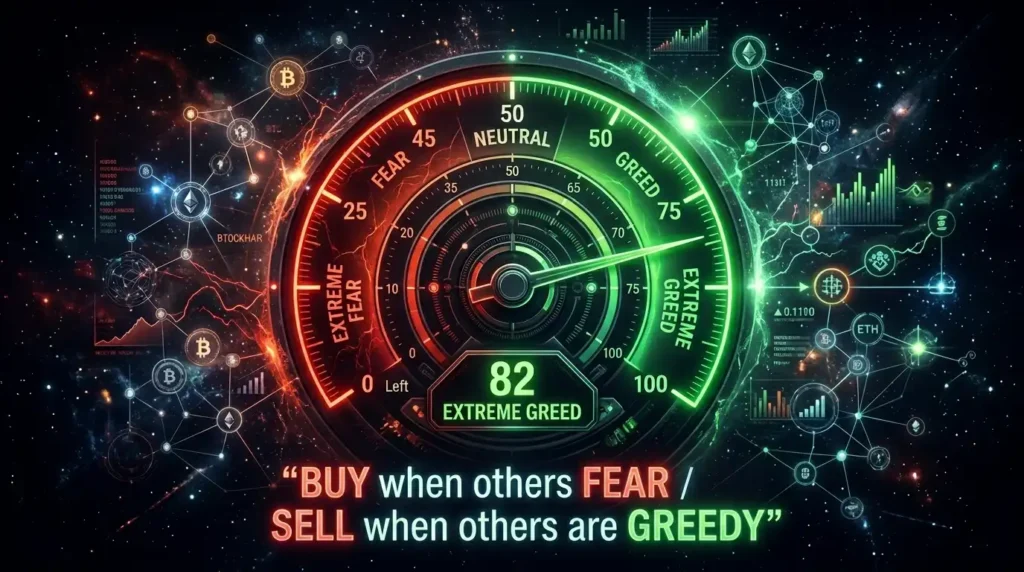
The Crypto Fear & Greed Index (alternative.me) tracks market sentiment on a scale of 0–100:
- 0–25: Extreme Fear — historically associated with buying opportunities
- 25–50: Fear — negative market sentiment
- 50–75: Greed — positive market sentiment
- 75–100: Extreme Greed — historically associated with caution/selling
The classic contrarian strategy: “be greedy when others are fearful, be fearful when others are greedy.” The index hit “Extreme Fear” in the days before several major recoveries. It hit “Extreme Greed” near multiple peaks.
It’s not a perfect timing tool — sentiment can stay extreme for weeks or months — but it’s a useful sanity check against your own emotions.
The Biggest Mistakes in Each Market Phase
Bull market mistakes:
- Believing “this time is different” — the bull will never end
- Investing money you can’t afford to lose (rent, emergency fund)
- Using leverage — amplifies losses as much as gains
- Buying hyped altcoins with no utility at the peak
- Not taking any profits on the way up
Bear market mistakes:
- Panic-selling quality assets at the bottom
- “Revenge trading” — making increasingly risky bets to recover losses
- Giving up on crypto entirely at the bottom of the cycle
- Holding worthless altcoins hoping they’ll recover (some never do)
- Trying to “catch falling knives” — buying large positions too early before the real bottom
Key Terminology
Bull Market: A sustained period of rising prices (20%+ gain from recent lows) with growing optimism and participation.
Bear Market: A sustained period of falling prices (20%+ decline from recent highs) with fear and reduced participation.
Bull Run: An intense, accelerated phase within a bull market where prices rise rapidly over a shorter period.
Crypto Winter: An informal term for a prolonged, severe bear market.
Altcoin Season: A phase (typically in the middle-to-late bull market) where altcoins outperform Bitcoin significantly.
DCA (Dollar-Cost Averaging): Investing a fixed amount at regular intervals regardless of price — reduces the impact of market timing.
FOMO (Fear Of Missing Out): The anxiety-driven urge to buy into a rising market for fear of missing gains. Historically leads to buying near peaks.
FUD (Fear, Uncertainty, Doubt): Negative sentiment or news (often exaggerated) that drives selling during bear markets.
Bitcoin Halving: The programmed event (every ~4 years) that cuts Bitcoin’s block reward in half — historically a trigger for bull markets.
Fear & Greed Index: A sentiment indicator tracking crypto market emotions from Extreme Fear (0) to Extreme Greed (100).
Capitulation: The final phase of a bear market where remaining holders give up and sell — often marking the bottom.
The Bottom Line
Crypto markets move in cycles. Always have. Probably always will.
Bull markets create wealth for those who participate. Bear markets destroy the unprepared and create extraordinary buying opportunities for the patient.
The mistake most new investors make is treating current conditions as permanent. “Crypto is dead” feels true at the bear market bottom. “This is only going up” feels true at the bull market peak. Both feelings are wrong, and acting on either destroys returns.
The investors who build real wealth in crypto are the ones who understand the cycle, manage their emotions, take profits in bull markets, accumulate in bear markets, and stay in the game long enough to see multiple cycles.
Markets will go up. Markets will come down. The question is whether you’ll still be holding when they go back up again.
Be the bull and the bear. Own the cycle. 📈📉
Disclaimer: This article is for informational purposes only and does not constitute financial advice. Cryptocurrency investments carry significant risk, including the potential loss of all invested capital. Always conduct your own research before making any investment decisions.