You’ve heard the word a thousand times. Politicians debate it. Banks fear it. Tech companies claim to be “building on it.” But if someone asked you right now to explain what blockchain actually is — without using the word “blockchain” — could you do it?
Most people can’t. And that’s completely fine. Blockchain is one of those concepts that sounds intimidating but becomes surprisingly simple once someone explains it without the jargon.
That’s exactly what this guide does.
By the end, you’ll understand what a blockchain is, how it works, why it matters, and why it’s become the foundation of the entire cryptocurrency world — all in plain English.
The Quick Answer: What Is Blockchain?
A blockchain is a digital record book that is shared across thousands of computers at the same time. Every entry in this record book is permanent — once something is written in, it can never be erased or changed.
That’s it. That’s the core idea.
The “block” refers to a package of data — say, a batch of transactions. The “chain” refers to the fact that each new package is cryptographically linked to the previous one, forming a continuous, unbreakable chain of history stretching back to the very first transaction.
Because thousands of computers around the world all hold identical copies of this record book, no single person, company, or government controls it. To change anything in the history, you’d need to simultaneously overpower thousands of computers worldwide — which is practically impossible.
This combination of properties — permanent, shared, tamper-proof, and without a central authority — is what makes blockchain revolutionary.
The Problem Blockchain Was Designed to Solve
To understand why blockchain matters, start with the problem it solves.
Imagine you want to send $500 to a friend in another country. What happens?
You ask your bank to deduct $500 from your account. Your bank contacts their bank. Fees get charged. It takes 1–5 business days. Both banks update their own private ledgers. You hope everything went correctly.
At every step, you’re trusting an intermediary — a bank — to keep honest records. If the bank makes an error, gets hacked, goes bankrupt, or decides to freeze your account, you have no recourse. The bank is the sole authority over your money.
This “trust the middleman” model underlies virtually every financial transaction on Earth. Banks, brokers, notaries, escrow agents — they all exist to create trust between parties who don’t know each other.
Blockchain eliminates the need for this middleman.
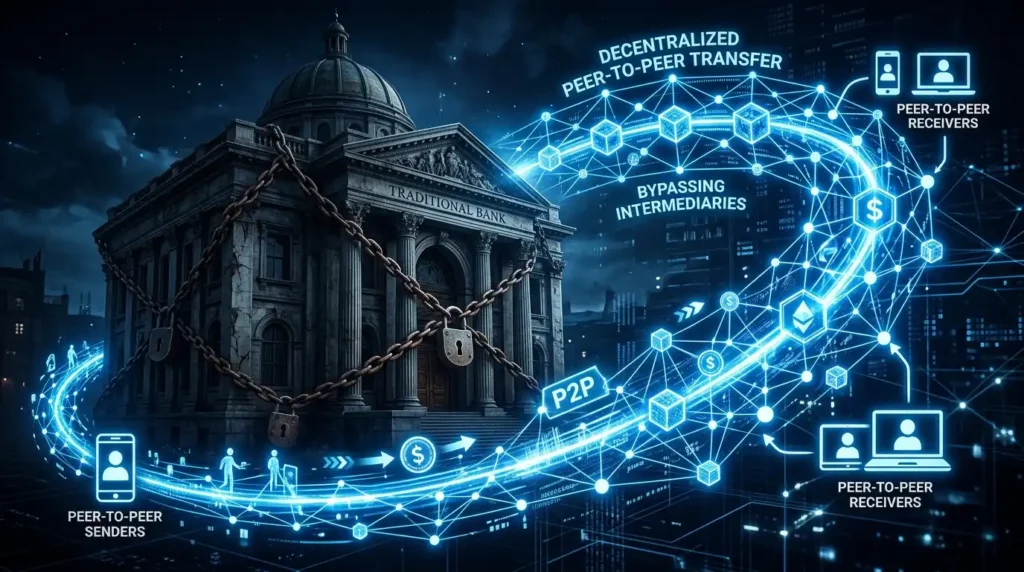
Instead of trusting a bank to keep honest records, you trust a mathematical system that thousands of independent computers verify simultaneously. No one can manipulate it. No one can selectively freeze accounts. The rules are enforced by code, not by institutions.
This is the revolutionary insight behind Bitcoin, and behind blockchain technology generally.
How Does Blockchain Actually Work? Step by Step
Let’s walk through exactly what happens when a transaction gets recorded on a blockchain — using a simple example.
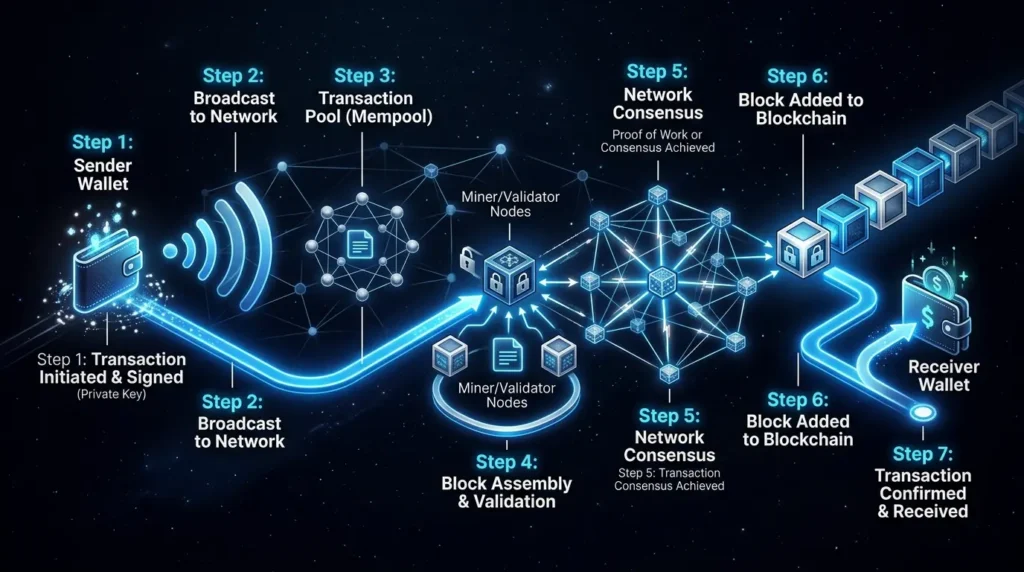
Step 1 — Someone initiates a transaction.
Alex wants to send 0.1 Bitcoin to Jamie. Alex uses her private key (think: a secret digital signature) to authorize the transaction. This creates a digital message that says: “Alex sends 0.1 BTC to Jamie.”
Step 2 — The transaction is broadcast to the network.
This message is transmitted to the global Bitcoin network — thousands of computers (called “nodes”) running Bitcoin software. Every node receives a copy of this pending transaction.
Step 3 — Nodes validate the transaction.
Each node independently checks: Does Alex actually have 0.1 BTC to send? Is her digital signature valid? Does this transaction follow all the rules of the Bitcoin protocol? If yes, the transaction is considered valid. If Alex tried to send Bitcoin she doesn’t have, every honest node would reject it.
Step 4 — The transaction gets bundled into a block.
Valid transactions are grouped together into a new “block.” Think of this as a page in the record book that contains hundreds or thousands of new entries. A Bitcoin block currently holds up to about 2,000–3,000 transactions.
Step 5 — A consensus mechanism confirms the block.
Before the block can be added to the chain, the network must reach agreement that it’s legitimate. This is where consensus mechanisms come in (we’ll explain these shortly). The winning computer gets to add the block and earns a reward.
Step 6 — The block is added to the chain.
The new block is permanently linked to the previous block using a cryptographic fingerprint called a “hash.” This chain of linked blocks creates an immutable history that extends back to the very first Bitcoin transaction in January 2009.
Step 7 — All nodes update their copies.
Every node in the network updates its copy of the blockchain to include the new block. Alex’s Bitcoin is now Jamie’s Bitcoin — recorded permanently, transparently, and without any bank involved.
Total time for this process on Bitcoin: approximately 10 minutes. On Solana or Ethereum Layer 2 networks: under a second.
What Is a Block? Breaking It Down
Each block in the chain contains:
Transaction Data: The actual content of the block — the list of transactions included (who sent what to whom and when).
Timestamp: The exact time the block was created.
Hash: A unique cryptographic fingerprint of this block’s contents. Change even one character in the block’s data, and the hash changes completely. This is what makes blocks tamper-proof.
Previous Block’s Hash: A reference to the block that came before it. This is the “chain” in blockchain — each block links back to the previous one, creating an unbreakable sequence.
Nonce (in Proof of Work systems): A special number that miners adjust when trying to solve the mathematical puzzle required to add the block (more on this below).
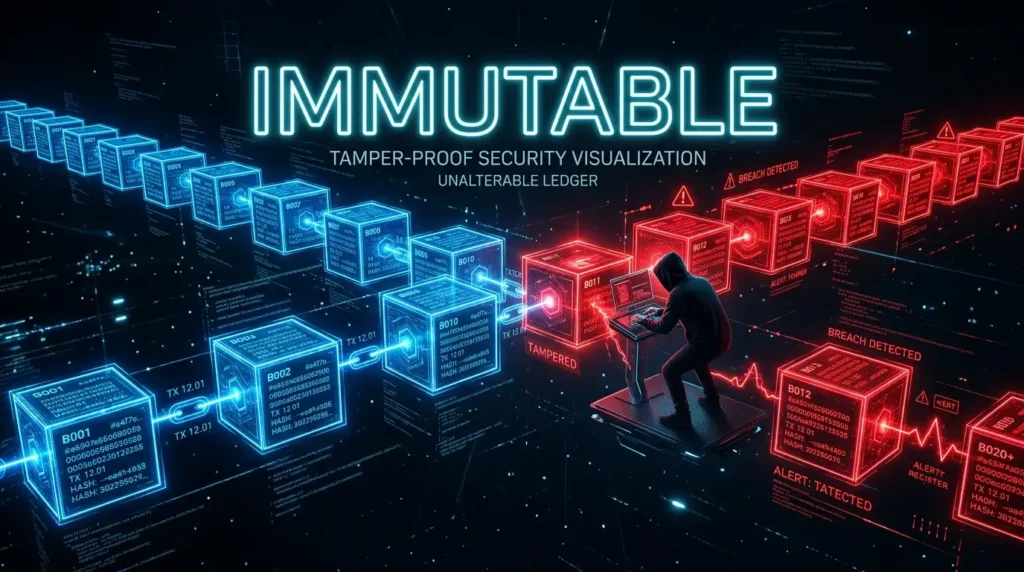
Because each block contains the hash of the previous block, altering any historical block would require recalculating every subsequent block — and doing it across thousands of computers simultaneously before the honest network adds the next legitimate block. The computational cost makes this effectively impossible for any attacker.
What Are Nodes?
A node is simply any computer that participates in the blockchain network by downloading and maintaining a copy of the full blockchain history.
Full nodes store the entire blockchain and independently verify every transaction against the protocol rules. As of 2026, Bitcoin has over 15,000 reachable full nodes spread across every continent. Nobody owns these nodes — they’re run by individuals, companies, and enthusiasts worldwide.
Miners / Validators are specialized nodes that compete to add new blocks. In Proof of Work systems, these are miners. In Proof of Stake systems, these are validators.
Light nodes store only part of the blockchain and are used by mobile wallets and everyday users who don’t need to verify everything independently.
The more nodes a blockchain has — and the more geographically distributed they are — the more decentralized and resilient it is. No single government can shut down Bitcoin because it would need to simultaneously shut down 15,000+ computers in dozens of countries.
Consensus Mechanisms: How Computers Agree Without Trusting Each Other
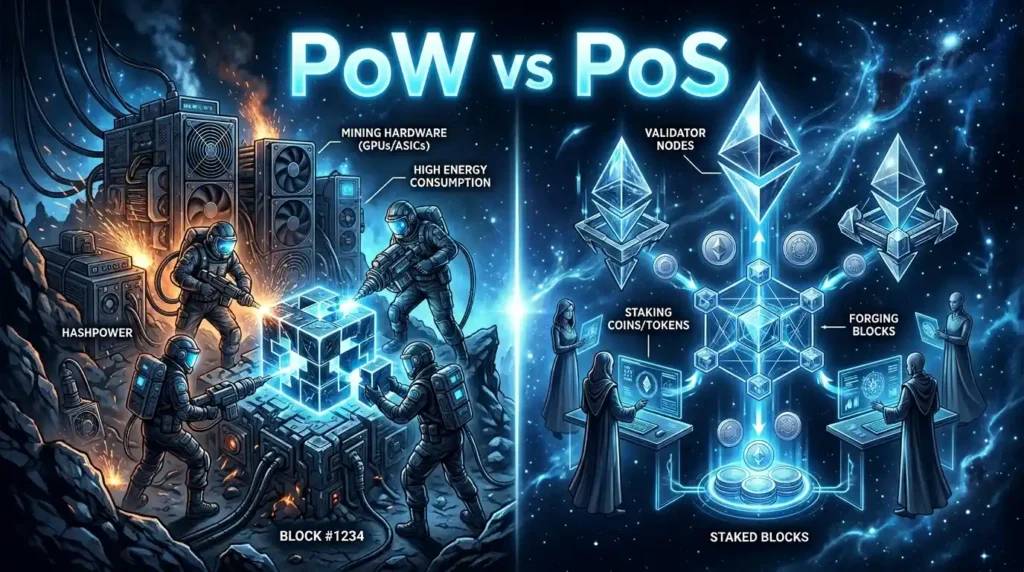
Here’s the fascinating challenge at the heart of blockchain: how do thousands of computers, run by strangers who don’t know or trust each other, all agree on the same version of history?
This is called the consensus problem, and blockchain solves it through two main mechanisms:
Proof of Work (PoW) — Used by Bitcoin
In Proof of Work, computers (called “miners”) compete to solve a complex mathematical puzzle. The first miner to find the solution earns the right to add the next block and receives a reward in newly created cryptocurrency.
The puzzle is intentionally difficult — requiring massive computational effort — but the solution is easy for other nodes to verify in milliseconds. Think of it like a lottery where buying tickets requires real work, but checking if someone won takes no effort.
Why this works: To add a fraudulent block, an attacker would need to solve the puzzle faster than all honest miners combined. At Bitcoin’s current scale, that would require more computing power than currently exists — and cost billions of dollars in hardware and electricity.
The tradeoff: Proof of Work consumes enormous amounts of energy. Bitcoin mining uses roughly the same electricity as a medium-sized country. This is its most criticized feature.
Proof of Stake (PoS) — Used by Ethereum, Solana, Cardano, and most modern blockchains
In Proof of Stake, validators lock up (stake) their own cryptocurrency as collateral. The network randomly selects validators to propose new blocks, with selection weighted toward those with more stake. Validators who behave honestly earn rewards. Those who try to cheat lose their staked funds — a punishment called “slashing.”
Why this works: Validators have real money at risk. Acting dishonestly destroys their own investment. The economic incentives keep the network honest without requiring energy-intensive computation.
The advantage: Proof of Stake uses approximately 99.9% less energy than Proof of Work. Ethereum reduced its energy consumption by over 99% when it switched from PoW to PoS in September 2022.
Ethereum now has over 800,000 validators securing its network — the largest validator set of any blockchain.
Public vs. Private Blockchains
Not all blockchains are the same. They differ in who can participate:
Public blockchains (like Bitcoin and Ethereum) are completely open. Anyone can join as a node, submit transactions, or become a validator. The entire history is visible to anyone. There’s no central owner or gatekeeper. These are the most decentralized type.
Private blockchains are controlled by a single organization. Think of a bank running its own internal blockchain for record-keeping. Only approved participants can join. This sacrifices decentralization for speed and privacy — but raises the question of why use blockchain at all if one entity controls it.
Consortium blockchains are shared between a group of organizations. Several banks or shipping companies might run a consortium blockchain together. More decentralized than private, less open than public.
The honest truth: When most people say “blockchain” in the context of crypto, they mean public blockchains. That’s where the real innovation lives.
What Is Blockchain Used For in 2026?
Blockchain’s core properties — immutability, decentralization, transparency, and programmability — make it useful in surprising ways beyond just digital money:

Cryptocurrency: The original and still dominant use case. Bitcoin, Ethereum, and thousands of other digital currencies use blockchain as their ledger. Every transaction ever made is permanently recorded.
Smart Contracts: Ethereum introduced the idea of “programmable blockchain” — code that executes automatically when conditions are met. “If Alice sends 1 ETH, automatically send 100 tokens back to Alice.” No middleman, no delay, no risk of one party backing out. This enables DeFi, NFTs, DAOs, and much more.
DeFi (Decentralized Finance): Lending, borrowing, trading, and earning interest — all without banks, using smart contracts. Billions of dollars worth of assets are locked in DeFi protocols in 2026.
Real-World Asset Tokenization: Companies are putting ownership of real assets (government bonds, real estate, art) onto blockchains as digital tokens. Franklin Templeton runs a $1+ billion money market fund on Stellar. This makes traditionally illiquid assets tradeable 24/7.
Supply Chain Tracking: Companies like Walmart and Maersk use blockchain to track products from factory to shelf. Because records can’t be altered, the provenance of goods is verifiable — reducing fraud, counterfeiting, and contamination risks.
Digital Identity: Blockchain enables “self-sovereign identity” — the ability to prove who you are without depending on any government or company database. You control your own verifiable credentials.
Voting: Some jurisdictions are experimenting with blockchain-based voting systems where each vote is cryptographically recorded and publicly verifiable without revealing who voted for whom.
Enterprise spending on blockchain crossed $15 billion in 2026, signaling that companies now treat it as real digital infrastructure, not just an experiment.
Blockchain vs. Traditional Database: Key Differences
| Feature | Traditional Database | Blockchain |
|---|---|---|
| Who controls it? | Single entity (company, bank) | No one / all participants |
| Can records be changed? | Yes, by the owner | No (immutable) |
| Who can see it? | Access granted by owner | Public (on public chains) |
| Who verifies transactions? | Trusted central authority | All nodes independently |
| Speed | Very fast | Slower (varies by chain) |
| Energy use | Low | Higher (especially PoW) |
| Censorship resistant? | No | Yes (public blockchains) |
| Requires trust in a party? | Yes | No |
The honest summary: If you need a fast, private database controlled by one organization — use a traditional database. Blockchain adds value specifically when you need multiple parties who don’t trust each other to share a reliable record without a central authority.
Blockchain’s Limitations: The Honest Part
Blockchain technology is genuinely revolutionary, but it’s not magic. Here are its real limitations:
Speed: Bitcoin processes about 7 transactions per second. Ethereum handles 15–30. Visa processes over 65,000. This “blockchain trilemma” — the difficulty of being fast, secure, AND decentralized simultaneously — is the central challenge of blockchain engineering. Layer 2 solutions (like Ethereum’s Arbitrum and Optimism) address this by handling transactions off the main chain, with fees often below one cent.
Energy Consumption: Proof of Work blockchains (especially Bitcoin) use enormous amounts of electricity. This is a genuine environmental concern, though many mining operations use renewable energy.
Irreversibility: The same immutability that makes blockchain secure also means mistakes are permanent. Send crypto to the wrong address? There’s no “undo.” Lose your private key? Your funds are gone forever.
Scalability: Storing a full copy of the Bitcoin blockchain now requires over 500 GB. Ethereum requires over 1 TB. Running a full node is increasingly demanding on storage and bandwidth.
Not Truly Anonymous: Most public blockchains are pseudonymous, not anonymous. Wallet addresses are visible, and sophisticated chain analysis can often link addresses to real identities through exchange KYC data or transaction patterns.
The Applications Can Still Be Hacked: The blockchain itself is extremely hard to compromise. But the exchanges, wallets, and smart contracts built on top of it can have vulnerabilities — as demonstrated by billions of dollars in DeFi hacks.
A Quick Glossary: Blockchain Terms Demystified
Block: A batch of transactions packaged together and added to the chain.
Chain: The linked sequence of blocks, each referencing the one before it, stretching back to the genesis block.
Node: A computer that maintains a copy of the blockchain and participates in the network.
Hash: A unique cryptographic fingerprint of data. Change anything in the data, and the hash changes completely.
Private Key: Your secret digital signature — the password that proves you own your cryptocurrency. Lose it and you lose your funds.
Public Key / Address: The public identifier you share to receive funds. Like your bank account number (but you can have unlimited ones).
Consensus Mechanism: The rules by which the network agrees on which transactions are valid. The two main types are Proof of Work and Proof of Stake.
Mining: The process of solving mathematical puzzles to add blocks in Proof of Work blockchains.
Staking: Locking up cryptocurrency as collateral to become a validator in Proof of Stake blockchains.
Smart Contract: Self-executing code stored on a blockchain that automatically performs actions when predetermined conditions are met.
Genesis Block: The very first block in a blockchain. Bitcoin’s genesis block was mined by Satoshi Nakamoto on January 3, 2009.
Immutable: Cannot be changed or deleted. Once a transaction is recorded on a blockchain, it is permanent.
The Bottom Line: Why Blockchain Matters
Blockchain is not just a technical curiosity. It’s a fundamentally new way of creating trust between parties who don’t know each other — without any intermediary.
For 5,000 years of recorded history, trust in financial transactions required powerful intermediaries: temples, banks, governments, notaries. Every wire transfer, every stock trade, every property deed depended on someone in the middle keeping honest records.
Blockchain makes the first time in human history when two strangers can exchange value — money, data, property rights — with mathematical certainty, no middleman, and no possibility of either party cheating.
That’s not just a technology innovation. That’s a social one.
Not magic. Not perfect. But genuinely revolutionary. 🔗
Disclaimer: This article is for informational purposes only and does not constitute financial advice. Cryptocurrency investments carry significant risk, including the potential loss of all invested capital. Always conduct your own research before making any investment decisions.