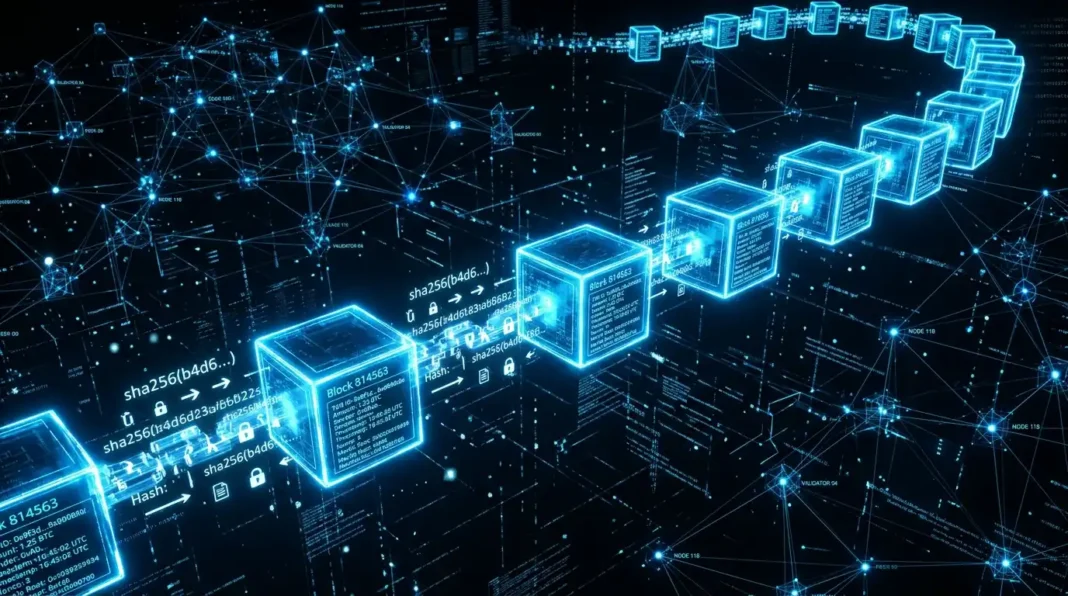
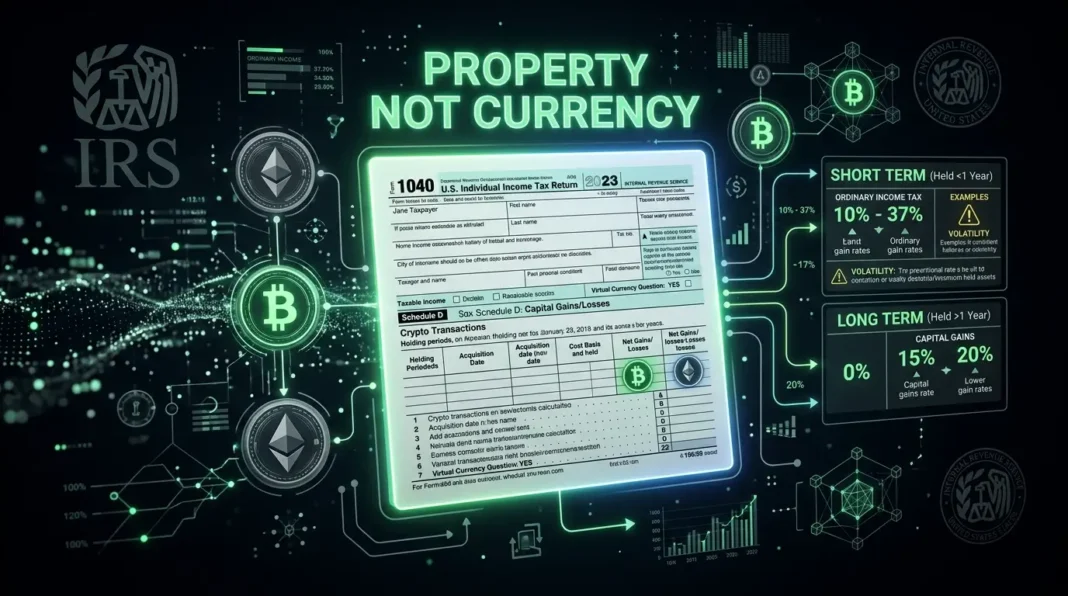
When people hear “crypto mining,” they often imagine someone digging for digital gold on a computer. The word “mining” is actually a metaphor — but like most metaphors, it obscures more than it reveals.
Crypto mining isn’t about finding hidden coins buried in code. It’s about something far more important: keeping a decentralized financial network honest without any central authority in charge.
Bitcoin has been running continuously since January 2009 — processing transactions 24 hours a day, 7 days a week, for over 15 years — with no company running it, no CEO making decisions, and no government overseeing it. Mining is the mechanism that makes that possible.
Let’s break down exactly how.
The Quick Answer: What Is Crypto Mining?
Crypto mining is the process of validating transactions and adding them to a blockchain — in exchange for a reward in newly created cryptocurrency.
When you send Bitcoin to someone, that transaction doesn’t instantly appear on the blockchain. It first sits in a waiting area called the “mempool” alongside thousands of other unconfirmed transactions. Miners are the participants who:
- Pick up transactions from the mempool
- Bundle them into a candidate block
- Compete to solve a mathematical puzzle
- Add the winning block to the blockchain
- Earn newly minted Bitcoin as a reward
Mining does two things simultaneously: it validates and records transactions, AND it introduces new coins into circulation. Neither function is separable from the other.
Why Does Bitcoin Need Mining at All?
This is the most important question. The answer goes back to the fundamental challenge of decentralized money.
Imagine you’re running a global payment network with no central authority. You need to answer one critical question: how do you prevent someone from spending the same money twice?
With a bank, this is easy — the bank has a central ledger and deducts your balance immediately. But Bitcoin has no central bank. Thousands of computers around the world each hold a copy of the transaction history. If two of them disagree about who owns what, which version is correct?
This is called the “double-spend problem,” and mining solves it through a mechanism called Proof of Work.
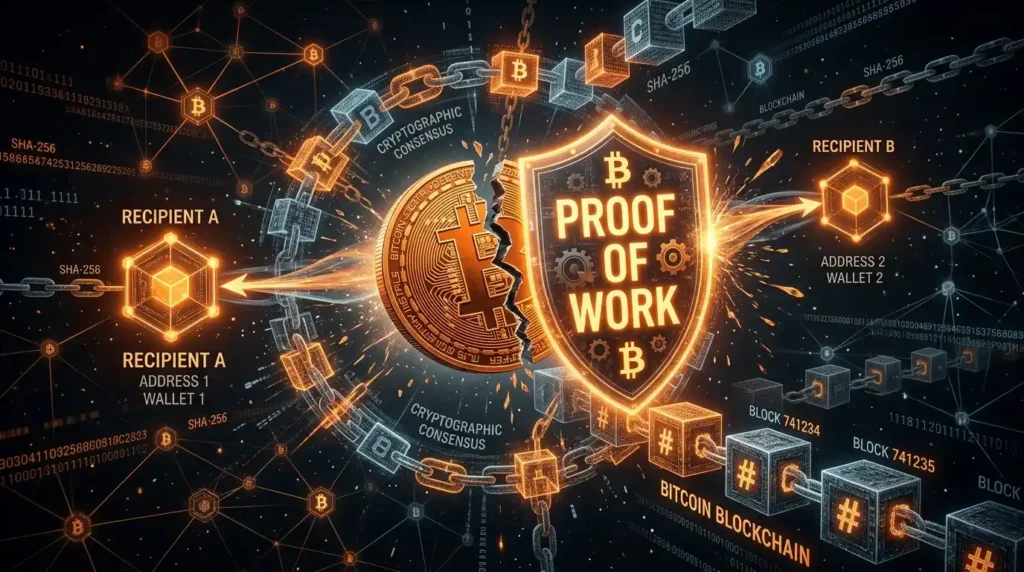
Here’s the key insight: to add a new block to the Bitcoin blockchain, you must prove you’ve done real work — specifically, used real electricity to solve a mathematical puzzle. This makes cheating expensive. To rewrite history (for example, to spend the same Bitcoin twice), you’d need to redo all that computational work for every subsequent block — faster than the entire honest network is adding new ones. At Bitcoin’s current scale, this would require more computing power than exists on Earth.
Mining isn’t just how new coins are created. It’s how Bitcoin maintains trust without trusting anyone.
How Does Crypto Mining Actually Work? Step by Step
Let’s walk through exactly what happens when a new Bitcoin block is created:
Step 1 — Transactions pile up in the mempool.
Every Bitcoin transaction broadcast to the network sits in a shared waiting pool (the mempool) until a miner includes it in a block. Higher-fee transactions get prioritized.
Step 2 — A miner assembles a candidate block.
The miner selects a batch of transactions from the mempool, bundles them into a proposed new block, and adds some metadata: the timestamp, a reference to the previous block’s hash, and a special variable called a nonce.
Step 3 — The miner starts hashing.
The miner runs the entire block of data through a mathematical function called SHA-256 (Bitcoin’s hashing algorithm). This produces a unique 64-character string — the block’s “hash.” Think of it as a digital fingerprint.
The network has a target: the hash must start with a certain number of zeros. A hash that starts with “000000000000000a9c…” meets the target. A hash that starts with “f4a7c9…” does not.
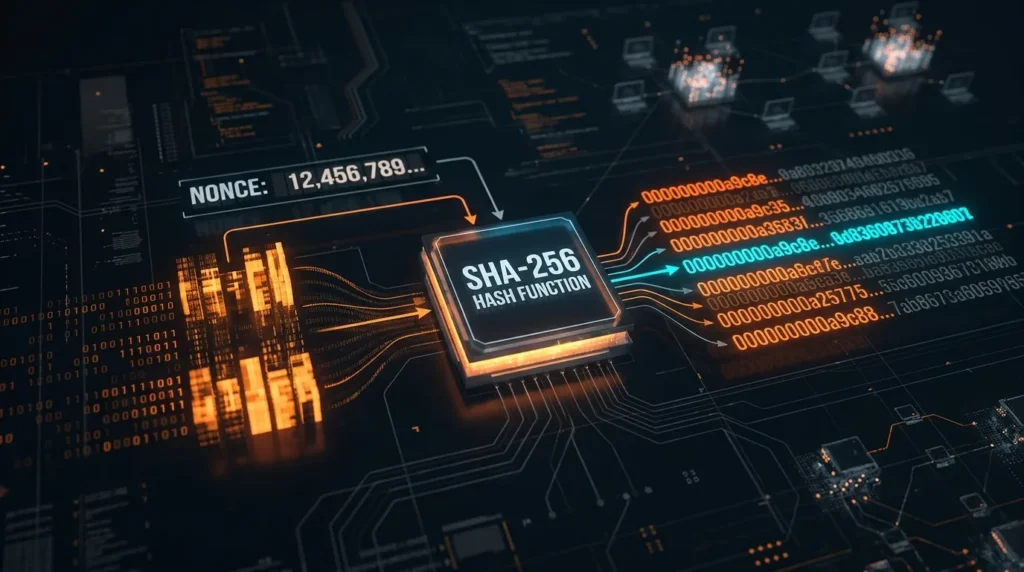
Step 4 — Trial and error at massive scale.
Here’s the catch: there’s no way to calculate what nonce produces a hash that meets the target. The only approach is to try billions of different nonce values, generating a new hash each time, until one meets the requirement.
A modern industrial Bitcoin miner (ASIC) makes about 100–300 trillion hash attempts per second. The entire Bitcoin network in 2026 collectively makes around 600 exahashes per second — that’s 600 followed by 18 zeros. Per second.
Step 5 — A winner is found.
When a miner finally generates a hash that meets the target, they immediately broadcast their winning block to the network. Other nodes verify it — which takes about a millisecond — even though finding it required enormous work.
Step 6 — The block is added to the chain.
All honest nodes add the new block to their copy of the blockchain. The miner who found the solution earns the block reward: currently 3.125 BTC plus all the transaction fees included in the block.
Step 7 — The difficulty adjusts.
Bitcoin automatically recalibrates the mining difficulty approximately every two weeks to maintain an average block time of 10 minutes. If more miners join and blocks are coming faster, difficulty increases. If miners leave, difficulty decreases. This self-regulating system keeps the network stable regardless of how much computing power joins or exits.
What Is Hash Rate?
Hash rate is the measure of computational power dedicated to mining — expressed in hashes per second.
| Unit | Meaning |
|---|---|
| KH/s | Kilohashes — thousands of hashes per second |
| MH/s | Megahashes — millions per second |
| GH/s | Gigahashes — billions per second |
| TH/s | Terahashes — trillions per second |
| PH/s | Petahashes — quadrillions per second |
| EH/s | Exahashes — quintillions per second |
Bitcoin’s network hashrate in early 2026 exceeds 600 EH/s. A single modern industrial ASIC miner typically produces around 200–300 TH/s. The network is so large that a single home miner has roughly the same chance of finding a Bitcoin block solo as winning a major lottery.
Higher hash rate means:
- More security — harder to attack the network
- More competition — harder to mine profitably without scale
What Is Mining Difficulty?
Mining difficulty is a number that automatically adjusts to keep Bitcoin’s block time at approximately 10 minutes.
If the total network hash rate increases (more miners join), difficulty increases — making the puzzle harder. If hash rate decreases (miners leave), difficulty decreases — making the puzzle easier.
This adjustment happens every 2,016 blocks (roughly two weeks). It’s one of Bitcoin’s most elegant design features: no matter how much or how little computing power is thrown at the network, new blocks keep arriving at roughly the same steady pace.
Mining Hardware: From CPUs to ASICs
Mining hardware has evolved dramatically since Bitcoin’s launch in 2009:
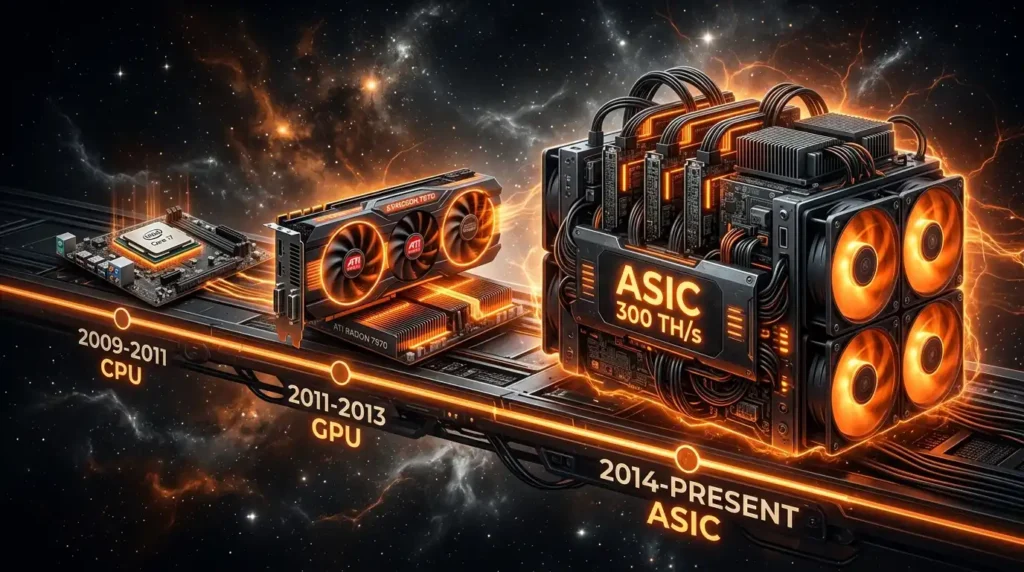
CPU Mining (2009–2010): Bitcoin’s early days when Satoshi Nakamoto and a handful of enthusiasts mined on regular laptop processors. Completely impractical for Bitcoin today.
GPU Mining (2010–2013): Miners discovered that graphics cards (GPUs) were much better at the parallel computations required for hashing. This started the first mining arms race.
FPGA Mining (2011–2012): Field-Programmable Gate Arrays — specialized chips that could be configured for specific tasks — briefly dominated before being replaced.
ASIC Mining (2013–Present): Application-Specific Integrated Circuits — chips designed for one purpose only: mining a specific cryptocurrency. Modern ASICs are thousands of times more efficient than GPUs at Bitcoin mining. They dominate the industry completely.
In 2026, Bitcoin mining means ASIC mining. Companies like Bitmain (Antminer series) and MicroBT (WhatsMiner series) produce industrial-grade machines that run 24/7, consume 3,000–5,000 watts of power, and generate substantial heat and noise.
GPU mining still exists for certain altcoins that haven’t been ASIC-dominated — like Ethereum Classic, Ravencoin, and Kaspa.
CPU mining is only practical for one major coin: Monero (XMR), whose RandomX algorithm is specifically engineered to resist ASICs and favor CPUs — an intentional design choice to keep mining decentralized.
Mining Pools: Teamwork for Consistent Rewards
Given how difficult it is to solo-mine Bitcoin, the vast majority of miners participate in mining pools.
A mining pool is a collective of miners who combine their hash rate and share rewards proportionally to the work each contributed.
Why pools matter: At 300 TH/s, a solo home miner statistically expects to find one Bitcoin block every few decades. But in a pool, they earn a tiny fraction of every block the pool finds — resulting in small, consistent daily payments rather than a massive lottery win that might never come.
How pool payouts work: When the pool finds a block and earns the 3.125 BTC reward, that amount is split among all pool members based on their contributed hash rate. Pool fees typically range from 1–3% of earnings.
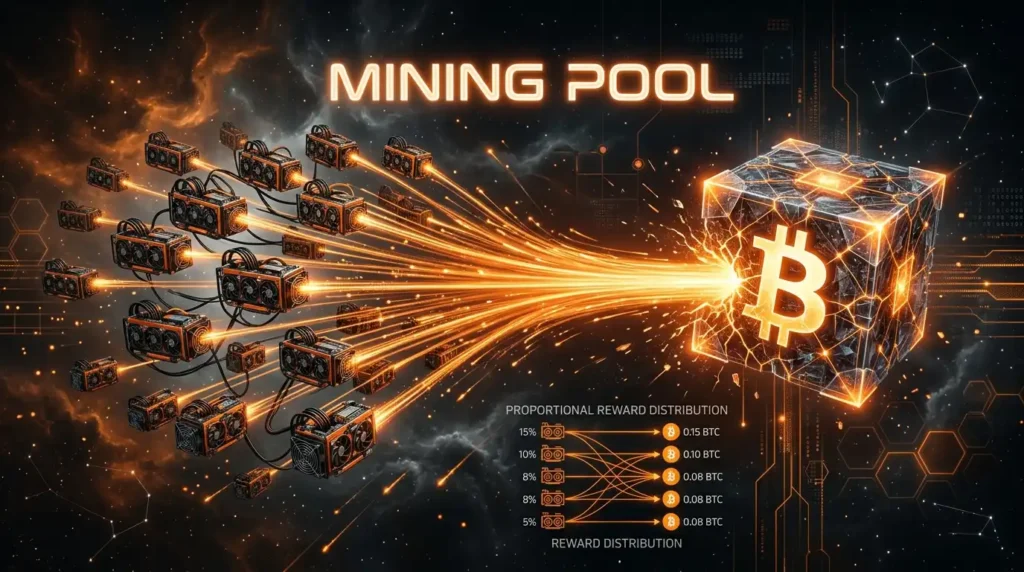
Major mining pools in 2026: Foundry USA leads by hash rate, followed by AntPool, F2Pool, ViaBTC, and SpiderPool.
The Bitcoin Halving: Why Miner Rewards Shrink Over Time
Bitcoin was designed with a fixed supply of 21 million coins and a predictable schedule of decreasing rewards.
Approximately every four years (every 210,000 blocks), Bitcoin undergoes a halving: the block reward is cut in half.
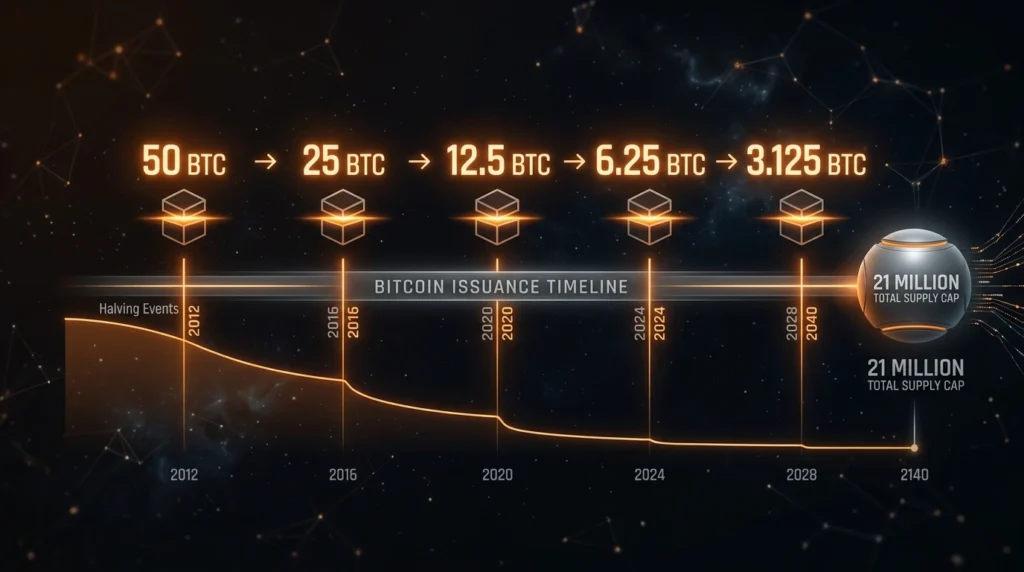
Bitcoin halving history:
- 2009 launch: 50 BTC per block
- 2012 halving: 25 BTC per block
- 2016 halving: 12.5 BTC per block
- 2020 halving: 6.25 BTC per block
- April 2024 halving: 3.125 BTC per block (current)
- Next halving: ~2028 — reward will drop to 1.5625 BTC
As the block reward shrinks, miners become increasingly dependent on transaction fees to cover their costs. Bitcoin’s long-term security model assumes that as the block subsidy approaches zero (around 2140), transaction fees will provide sufficient incentive for miners to secure the network.
The Energy Question: Why Does Mining Use So Much Electricity?
Bitcoin mining is energy-intensive by design. This is a feature, not a bug — but it’s worth understanding honestly.
The numbers: Bitcoin’s global electricity consumption is estimated at approximately 95–162 TWh annually (Cambridge Centre for Alternative Finance estimates, 2026). This is comparable to the annual electricity consumption of a medium-sized country like Poland.
Why so much energy? The security of Bitcoin’s blockchain is directly proportional to the energy spent on mining. More energy = harder to attack. If mining were cheap, attacking the network would also be cheap. The energy cost is the cost of security in a system with no trusted authority.
The renewable energy picture: A growing portion of Bitcoin mining uses renewable energy — hydropower, geothermal, solar, and wind — partly because miners are attracted to the cheapest electricity available, which is often excess renewable power. The Bitcoin Mining Council (a voluntary industry group) estimated renewable energy usage at around 52–58% of Bitcoin’s energy mix in 2025.
The honest debate: Whether this energy expenditure is “worth it” depends on how you value what Bitcoin provides — a censorship-resistant, permissionless global payment network with no central authority. Reasonable people disagree. What’s important is understanding the tradeoff clearly rather than dismissing it.
What Can Be Mined in 2026?
Not all cryptocurrencies use mining. Only Proof of Work blockchains require miners.
Major mineable cryptocurrencies in 2026:
| Coin | Algorithm | Best Hardware |
|---|---|---|
| Bitcoin (BTC) | SHA-256 | ASIC only |
| Litecoin (LTC) | Scrypt | ASIC |
| Dogecoin (DOGE) | Scrypt (merged with LTC) | ASIC |
| Monero (XMR) | RandomX | CPU (ASIC-resistant) |
| Kaspa (KAS) | kHeavyHash | ASIC/GPU |
| Ethereum Classic (ETC) | Ethash | GPU |
| Zcash (ZEC) | Equihash | ASIC/GPU |
Notable: Ethereum can no longer be mined. In September 2022 (“The Merge”), Ethereum switched from Proof of Work to Proof of Stake, eliminating its entire mining economy overnight. ETH validators now secure the network through staking, not mining.
Is Crypto Mining Profitable in 2026?
The honest answer: it depends heavily on your electricity cost.
Electricity is 70–80% of ongoing mining costs. The math is simple: if the value of the crypto you mine per day exceeds your daily electricity cost plus hardware depreciation, you profit. If not, you lose.
Key profitability factors:
- Electricity price: Profitable Bitcoin mining in 2026 generally requires below $0.07–$0.10 per kWh. Industrial miners in the best locations pay $0.03–$0.05/kWh.
- Hardware efficiency: Modern ASICs produce more hash rate per watt than older models. Efficiency is measured in joules per terahash (J/TH) — lower is better.
- Bitcoin price: A higher BTC price makes mining more profitable; a lower price squeezes margins.
- Network difficulty: As more miners join, difficulty increases, reducing each miner’s share of rewards.
- Block reward: Currently 3.125 BTC per block after the April 2024 halving.
For home miners: Small-scale home mining is generally not profitable for Bitcoin in 2026 unless you have very cheap electricity. Some hobbyists enjoy it for learning or ideological reasons (supporting decentralization), but shouldn’t expect significant profit.
Interesting 2026 trend: A growing number of mining companies are repurposing their infrastructure for AI and high-performance computing (HPC) data centers, treating Bitcoin mining as one revenue stream alongside AI workloads — which can earn more revenue per megawatt at current prices.
Key Mining Terminology
Proof of Work (PoW): The consensus mechanism requiring miners to solve computational puzzles to add blocks and earn rewards.
Hash: A unique cryptographic fingerprint produced by running data through a mathematical function. For Bitcoin, this uses SHA-256.
Nonce: A variable number that miners change repeatedly, generating different hash outputs, until finding one that meets the network’s target.
Hash Rate: The computational power dedicated to mining, measured in hashes per second.
Mining Difficulty: A network parameter that automatically adjusts every two weeks to keep Bitcoin’s block time at approximately 10 minutes.
Block Reward: The amount of newly minted cryptocurrency awarded to the miner who successfully adds a new block. Currently 3.125 BTC.
Halving: A programmed event that cuts Bitcoin’s block reward in half approximately every four years.
ASIC: Application-Specific Integrated Circuit — hardware designed specifically for mining one cryptocurrency algorithm.
Mining Pool: A collective of miners who share hash rate and split rewards proportionally.
Mempool: The waiting area where unconfirmed transactions sit until a miner includes them in a block.
The Bottom Line
Crypto mining is the elegant solution to one of the hardest problems in computer science: how do thousands of strangers, with no authority to trust, agree on a shared truth?
Bitcoin’s answer was simple: make disagreement expensive. To add a new block — or to rewrite history — requires proof of real work: real electricity, real hardware, real cost. Cheating costs more than it’s worth.
Mining isn’t just coin production. It’s the heartbeat of a decentralized financial system — the mechanism that keeps Bitcoin honest, secure, and running without any company, bank, or government in charge.
Every 10 minutes, another block. Every block, another victory for trustless math over trusted institutions. ⛏️
Disclaimer: This article is for informational purposes only and does not constitute financial advice. Cryptocurrency investments carry significant risk, including the potential loss of all invested capital. Always conduct your own research before making any investment decisions.