Right now, when you post a photo to Instagram, Instagram owns it. When you build an audience on YouTube, YouTube owns the relationship. When you store files in Google Drive, Google controls access. When you get banned from Twitter, you lose everything — your followers, your content, your presence.
This is the internet as it currently works: you create, platforms own.
Web3 is the attempt to change that fundamental dynamic — to build an internet where users own their data, their assets, and their digital identities, with no corporation in the middle.
Whether that vision succeeds, partially succeeds, or remains mostly theory is one of the most important debates in technology right now.
The Three Eras of the Internet
To understand Web3, you need to understand what came before it.
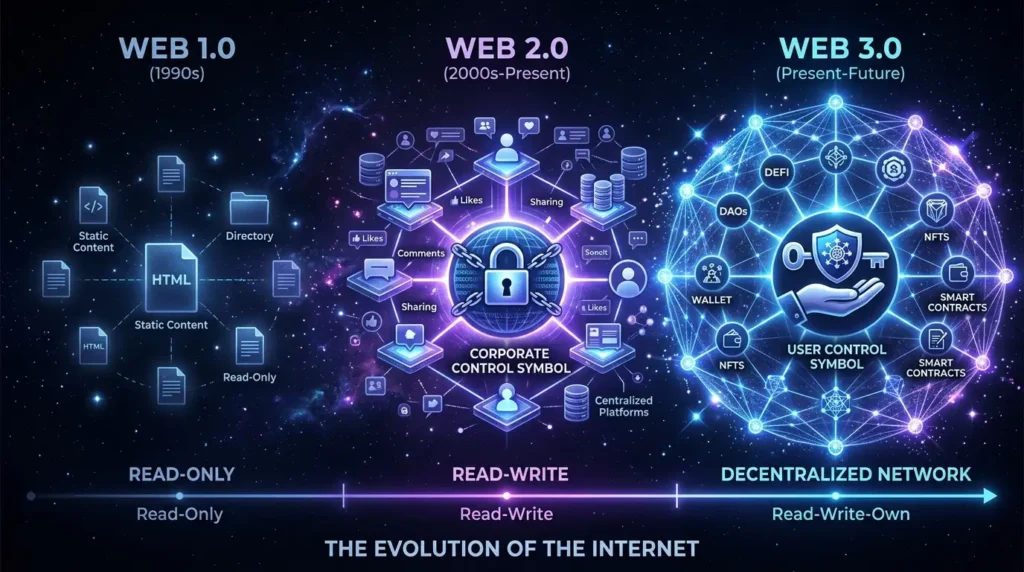
Web1 (1990–2004): Read
The first internet. Static web pages, mostly text and basic HTML. You could visit Yahoo and read content. You couldn’t create content, couldn’t interact, couldn’t participate. The web was a library — you browsed, others published.
Web2 (2004–present): Read + Write
The interactive internet. Social media, user-generated content, apps. You could create content — but platforms controlled it. Facebook gave you tools to build an audience, then decided who sees your posts via algorithm. YouTube gave you a channel, then demonetized it. Amazon gave you a marketplace, then competed against your product.
Web2 created incredible tools and connected billions of people. It also concentrated extraordinary power in a handful of companies: Google, Meta, Amazon, Apple, Microsoft. Your data became their product. Your relationship with your audience belonged to their platform.
Web3 (2014–present): Read + Write + Own
The internet of ownership. Instead of platforms storing your data, blockchain networks record it. Instead of companies controlling your digital assets, cryptographic keys in your wallet prove your ownership. Instead of corporations running the infrastructure, decentralized networks of nodes — owned by no single entity — maintain it.
The phrase captures it perfectly: Web1 was read-only. Web2 is read-write. Web3 is read-write-own.
The Core Idea: Ownership Without Intermediaries
The revolutionary claim of Web3 is this: you can prove ownership of digital things without trusting any company.
In the physical world, a deed proves you own a house. A bank account proves you have money. A passport proves who you are. All of these require trusting an institution to maintain the record.
In Web3, the blockchain is the record. It’s maintained by thousands of independent computers globally, with no central authority. No company can alter it, delete it, or take it away from you.
This has real implications:
You own your crypto. With a self-custody wallet, your Bitcoin or Ethereum is controlled by your private key — not a bank, not an exchange, not any company. Nobody can freeze it. Nobody can reverse a transaction. Nobody can prevent you from using it.
You own your digital assets. An NFT proving you own a game item, a piece of art, or a membership pass is recorded on-chain. The game company can shut down — you still have the token.
You control your identity. In Web3, your wallet address is your identity. You log into apps by signing a transaction with your wallet — no username, no password, no email to hand over. Decentralized Identifiers (DIDs) take this further, letting you carry a verified identity across applications without any central authority issuing it.
The Four Pillars of Web3
1. Decentralization
Data and infrastructure distributed across many computers, not stored on servers owned by one company. No single point of control. No single point of failure. No central authority that can be pressured to censor, ban, or alter.
2. Permissionless Access
Anyone with an internet connection and a wallet can participate. No application forms, no KYC for most services, no geographic restrictions, no approval from a gatekeeper. Uniswap processes billions in trades daily — nobody approves who can use it.
3. Trustlessness
You don’t need to trust the counterparty or the platform. You trust the code. Smart contracts execute automatically when conditions are met — the buyer gets the item, the seller gets the payment, with no escrow company in between. The rules are public and can’t be changed mid-transaction.
4. Native Ownership
Digital assets on blockchains are owned by cryptographic keys, not by platforms. They can be transferred peer-to-peer without a platform’s permission. They exist on public ledgers verifiable by anyone.
What Does Web3 Actually Look Like?
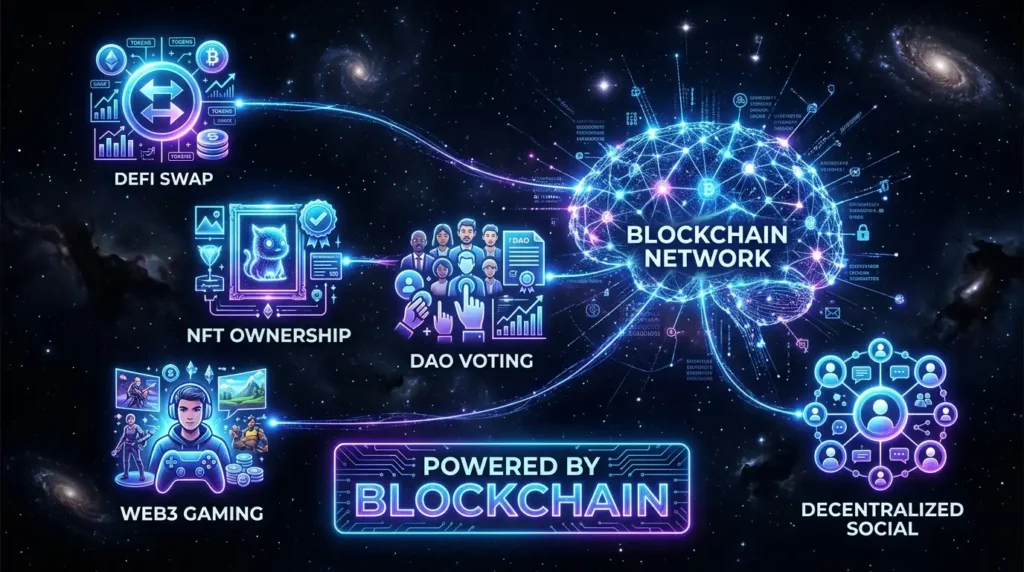
Web3 isn’t a single product or platform — it’s an ecosystem of applications built on blockchain infrastructure.
DeFi (Decentralized Finance)
Lending, borrowing, trading, earning yield — all without banks or brokerages. Uniswap processes token swaps without any company matching orders. Aave lets you borrow crypto against collateral without a loan officer. Billions of dollars flow through these systems with no central operator. (Full DeFi coverage in our dedicated section.)
NFTs
Proof of ownership for digital assets — art, game items, memberships, real-world assets — recorded on public blockchains verifiable by anyone.
DAOs (Decentralized Autonomous Organizations)
Organizations governed by token holders through smart contracts rather than by executives. Voting happens on-chain; if a proposal passes, the smart contract executes it automatically — no CEO required to sign off.
Web3 Gaming
Games where players genuinely own in-game items. If the developer shuts down, the items (as NFTs) still exist on-chain. Players can sell items peer-to-peer, potentially earning from gameplay.
Decentralized Social Media
Platforms like Farcaster and Lens Protocol where your profile and followers are stored on-chain — not in a corporate database. If one client disappears, you can take your identity and audience to another.
Self-Sovereign Identity
Your digital identity carried in your wallet rather than managed by Google, Facebook, or a government database. You choose what to share, with whom, and when.
The Honest Assessment: What Web3 Is and Isn’t in 2026
Web3 has had a complex journey. The 2021–2022 hype cycle attracted billions in venture capital, produced thousands of projects with no utility, and crashed badly. By 2023, the term had become almost toxic in mainstream tech circles.
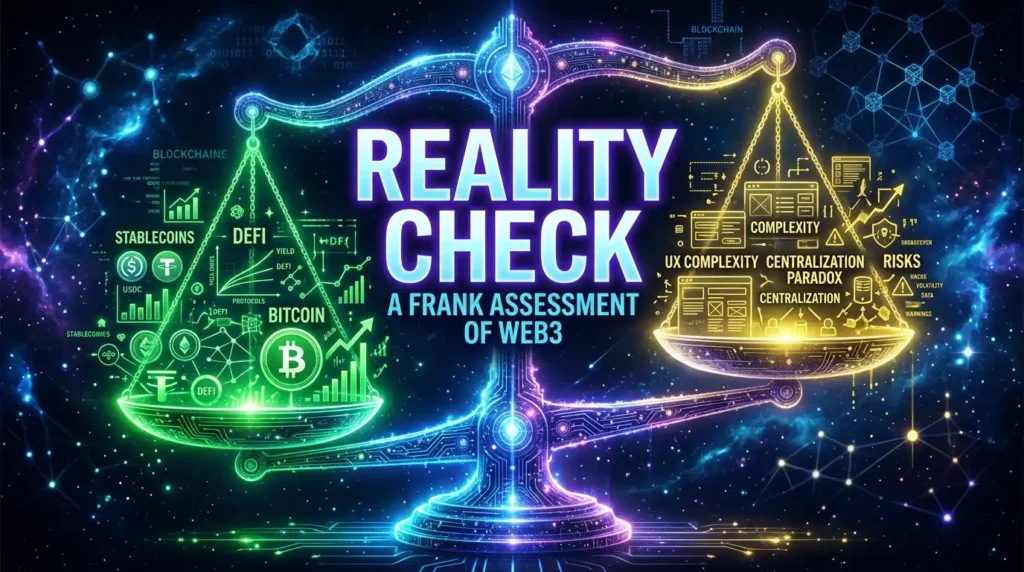
What survived and is genuinely working:
- Stablecoins: USDC processed over $20 trillion in cumulative transactions by end-2024, powering real cross-border payments and DeFi
- DeFi infrastructure: Protocols like Uniswap, Aave, and Compound process billions in legitimate financial activity
- Bitcoin and Ethereum: Both operating at global scale as decentralized networks with no central control
- Real-world asset tokenization: Growing rapidly, with financial institutions tokenizing treasury bills, real estate, and private credit
What remains genuinely hard:
- User experience: Seed phrases, gas fees, wallet management — Web3 is still far harder to use than Web2 apps
- Scalability: Blockchains process fewer transactions per second than centralized databases, at higher cost
- The centralization paradox: Much of Web3 runs on centralized infrastructure — most Ethereum nodes connect via Infura and Alchemy (two companies), most NFTs are viewed through OpenSea, most trades happen on Coinbase and Binance. True decentralization is harder than the theory suggests
- Regulatory uncertainty: Governments globally are still determining how to regulate crypto assets, DeFi, and DAOs
The honest framing: Web3 is a genuine technological shift, not a scam — but it’s also not yet the mainstream internet replacement its proponents claimed in 2021. It’s infrastructure being built, with real use cases emerging alongside significant challenges.
Web2 vs Web3: The Key Differences
| Feature | Web2 | Web3 |
|---|---|---|
| Data storage | Centralized servers (Google, Meta, Amazon) | Distributed blockchain networks |
| Identity | Email/password, company-managed | Wallet address, cryptographic keys |
| Asset ownership | Platform-controlled | User-controlled (self-custody) |
| Payments | Banks, payment processors | Cryptocurrency (native to the web) |
| Governance | Corporate decisions | Token holder voting (DAOs) |
| Access | Platform approval required | Permissionless |
| Censorship | Platforms can ban, delete, restrict | Very difficult to censor on-chain data |
| Revenue model | Advertising, data mining | Token incentives, protocol fees |
Key Web3 Terminology
Web3: The umbrella term for the next generation of the internet built on blockchain technology, emphasizing decentralization, user ownership, and trustless interactions.
dApp (Decentralized Application): An application whose core logic runs on a blockchain smart contract rather than a company’s servers.
Wallet: Your identity and ownership proof in Web3 — a pair of cryptographic keys that controls your on-chain assets and lets you sign transactions.
DID (Decentralized Identifier): A form of digital identity managed by the user rather than a central authority.
DAO (Decentralized Autonomous Organization): An organization governed by on-chain token voting rather than traditional corporate hierarchy.
Permissionless: Any protocol or application that anyone can access and use without approval from a gatekeeper.
Trustless: Systems where you don’t need to trust the counterparty — you trust the code. Smart contracts execute automatically per programmed rules.
On-chain: Data or activity recorded on a public blockchain, visible and verifiable by anyone.
Off-chain: Data or activity that happens outside a blockchain, often on traditional servers. Many Web3 apps combine both.
The Bottom Line
Web3 is not a finished product. It’s a direction of travel — a vision for what the internet could look like if users owned their digital lives rather than corporations.
Some of that vision is already real. Bitcoin is 15 years old and has never been controlled by any company. Ethereum hosts thousands of applications with billions in assets. Stablecoins are processing more transaction value than many traditional payment networks.
Some of it is still aspirational. The user experience remains challenging. True decentralization is harder to achieve than the theory suggests. The transition from Web2 to Web3 won’t happen overnight — and may never be total.
But the fundamental idea — that the internet could work with users owning their data and assets, rather than corporations owning everything and letting you borrow access — is one of the most important ideas in technology right now.
Read. Write. Own. The third word changes everything. 🌐
Disclaimer: This article is for informational purposes only and does not constitute financial advice. Cryptocurrency investments carry significant risk, including the potential loss of all invested capital. Always conduct your own research before making any investment decisions.