In a world where most blockchains launch fast and fix problems later, Cardano decided to do something different: fix the problems before launching. Every major protocol update goes through peer-reviewed academic research before implementation. Every component is formally verified using mathematical proofs. Every design decision is documented in published papers that anyone can scrutinize.
The result is a blockchain that’s either the most rigorous and well-engineered in existence, or the most over-engineered and slow-moving — depending on who you ask.
Cardano (ADA) currently trades around $0.24–0.25, has a market cap of approximately $8–9 billion, and sits around #10–13 by market cap. It’s down over 90% from its all-time high of $3.10 set in September 2021. It’s also one of the most staked cryptocurrencies in the world, with over 63% of circulating supply delegated across 3,000+ independent stake pools — a decentralization record no other major blockchain can match.
This is Cardano’s story: the blockchain that took its time, and is still waiting for the world to catch up.
The Quick Answer: What Is Cardano?
Cardano is a proof-of-stake blockchain platform designed for smart contracts, decentralized applications, and real-world financial use cases. It’s built on peer-reviewed academic research and uses a custom consensus mechanism called Ouroboros — the first provably secure proof-of-stake protocol in blockchain history.
ADA is the native cryptocurrency of the Cardano network. It’s used to:
- Pay transaction fees
- Stake to secure the network and earn rewards
- Vote on governance proposals
- Participate in the treasury system that funds ecosystem development
The name “ADA” honors Ada Lovelace — the 19th century mathematician widely regarded as the world’s first computer programmer. A fitting tribute for a blockchain built by academics.
Who Created Cardano? The Ethereum Refugee
Cardano was founded in 2017 by Charles Hoskinson — one of the original co-founders of Ethereum — and Jeremy Wood. Hoskinson left the Ethereum project in 2014 after disagreements with Vitalik Buterin over the project’s direction (specifically, whether Ethereum should be a commercial or non-profit venture).
After leaving, Hoskinson founded Input Output Global (IOG) — the research and development company that built Cardano. The project was also supported by two other organizations: the Cardano Foundation (promoting adoption) and Emurgo (helping businesses integrate the technology).
The naming has a distinctly academic flavor throughout:
- Cardano = named after Gerolamo Cardano, a 16th century Italian polymath and mathematician
- ADA = named after Ada Lovelace, 19th century mathematician
- Ouroboros = named after the ancient symbol of a snake eating its own tail
If you ever wondered what a blockchain built by people who love academic history would look like — it’s this one.
Hoskinson’s approach was fundamentally different from Bitcoin or Ethereum: instead of building first and solving problems as they arise, Cardano would research solutions rigorously first, then build. This philosophy has produced some of the most mathematically elegant blockchain infrastructure in existence — and also some of the slowest development timelines.
How Does Cardano Actually Work?
Ouroboros: The First Provably Secure PoS Protocol
Cardano’s consensus mechanism, Ouroboros, was published in a peer-reviewed academic paper in 2017 — the first proof-of-stake protocol with a formal mathematical proof of security equivalent to Bitcoin’s Proof of Work.
Here’s how it works in simple terms:

Time on Cardano is divided into epochs (5-day periods), which are further divided into slots (20-second intervals). For each slot, the network randomly selects a slot leader — a stake pool that has been delegated enough ADA — to produce a block and validate transactions.
The randomness of slot leader selection is based on a cryptographic process called verifiable random function (VRF), which ensures no one can predict or manipulate who gets selected. Your chances of being selected as a slot leader are proportional to your stake — bigger pools get selected more often, but small pools still get their turn.
The Extended UTxO Model (eUTxO)
Cardano uses an extended version of the Unspent Transaction Output (UTxO) model — the same accounting system used by Bitcoin, but extended with smart contract capabilities.
Why does this matter? Bitcoin’s UTxO model makes transactions highly predictable — you know exactly what will happen before the transaction executes. Ethereum’s account-based model allows more flexibility but makes predicting transaction outcomes harder (which is why Ethereum gas fees can spike unexpectedly).
Cardano’s eUTxO tries to get the best of both worlds: the predictability of Bitcoin with the programmability of Ethereum. Smart contracts on Cardano are deterministic — you know the exact outcome and exact fee before submitting.
Two-Layer Architecture
Cardano separates its functions into two layers:
- Cardano Settlement Layer (CSL): Handles ADA transactions — sending and receiving
- Cardano Computation Layer (CCL): Handles smart contracts and dApps
This separation means each layer can be independently optimized and upgraded without affecting the other. It’s technically elegant — though critics point out that this complexity has also contributed to slower development.
Plutus: Smart Contracts on Cardano
Cardano’s smart contract language is Plutus — based on Haskell, a functional programming language favored in academia for its mathematical rigor and formal verification properties.
Haskell is not the most popular programming language among developers (that would be Solidity for Ethereum, or Rust for Solana). This has been a genuine adoption bottleneck — fewer developers means fewer projects, fewer DApps, and less ecosystem activity.
Cardano Tokenomics: The Numbers That Matter
| Metric | Data |
|---|---|
| Ticker | ADA |
| Current Price | ~$0.24–0.25 (April 2026) |
| Market Cap | ~$8–9 billion |
| Rank | #10–13 |
| Circulating Supply | ~36 billion ADA |
| Maximum Supply | 45 billion ADA (hard cap) |
| ADA Staked | ~63%+ of circulating supply |
| Staking APY | ~3–5% (no lock-up, no slashing) |
| Number of Stake Pools | 3,000+ |
| All-Time High | $3.10 (September 2, 2021) |
| Treasury Balance | $1 billion+ |
The 45 Billion Hard Cap
Like Bitcoin, Cardano has a hard maximum supply — 45 billion ADA, no exceptions. No new ADA can ever be created beyond this limit. Approximately 36 billion are currently in circulation, with the remaining ~9 billion releasing gradually through staking rewards drawn from a reserve pool.
This reserve-based model means staking rewards come from a built-in supply of ADA that was set aside at genesis, slowly releasing over decades. Over time, as the reserve depletes, transaction fees become more important for sustaining the network — an elegant economic model, though one that relies on transaction volume eventually growing substantially.
Staking: The Most Accessible in Crypto
Cardano’s staking mechanics are arguably the most user-friendly among major blockchains:
- No minimum amount — you can stake 1 ADA
- No lock-up period — your ADA remains liquid
- No slashing risk — you can’t lose your ADA through your validator’s mistakes
- No technical knowledge required — delegate from any wallet in a few clicks
- Rewards every 5 days — distributed at the end of each epoch
Compare this to Ethereum (32 ETH minimum for solo staking, withdrawal queues) or even liquid staking which still involves smart contract risk. Cardano’s staking is genuinely simple — which explains why over 63% of circulating supply is staked, one of the highest participation rates in crypto.
The Treasury: $1 Billion for Ecosystem Development
A portion of each transaction fee and staking reward goes into Cardano’s treasury — a community-governed fund for ecosystem development. By 2026, this treasury holds over $1 billion worth of ADA.

This treasury is governed by the Voltaire governance system (see below). Token holders vote on which projects and initiatives receive funding — making Cardano one of the few blockchains with genuine on-chain governance over substantial financial resources.
The Voltaire Era: On-Chain Governance
In 2026, Cardano is in the Voltaire era — the final phase of its original development roadmap. Voltaire brings full on-chain governance to the network, allowing ADA holders to:

- Vote directly on protocol changes
- Elect Delegated Representatives (DReps) to vote on their behalf
- Approve or reject treasury expenditures
- Propose and ratify hard forks
This is genuinely novel in crypto. Most blockchains have informal governance — developers propose changes, miners or validators signal approval, and changes happen. Cardano has formal, on-chain governance where ADA holders have direct democratic control over the protocol’s future.
The practical question in 2026: will this governance system be fast enough to compete with more agile development environments? Early results suggest governance is slower than centralized decision-making — by design — but the community values decentralized control over speed.
Cardano’s Price History: The Long Game
2017: Cardano launches through an ICO. ADA starts at about $0.02 and quickly rises to $0.70 by year-end as the crypto bull market lifts all boats.
January 2018: ADA hits $1.33 — its first major peak. Then the brutal 2018 bear market arrives. ADA falls back to around $0.03.
2019–2020: Years of quiet development. The Shelley upgrade launches in 2020, enabling staking and dramatically increasing decentralization. Price gradually recovers.
2021: The rocket launches. ADA rises from $0.17 in January to its all-time high of $3.10 on September 2, 2021 — driven by the Alonzo hard fork announcement (bringing smart contracts to Cardano) and broader bull market euphoria. Market cap briefly exceeds $100 billion.
Late 2021: The Alonzo hard fork launches smart contracts. The crypto market peaks and begins declining. ADA starts a long descent.
2022: Crypto winter. ADA falls from $1.30 to below $0.30 — an 80%+ decline. The DeFi ecosystem on Cardano remains small compared to Ethereum and the newly dominant Solana.
2023–2024: Slow recovery. Development continues — Hydra scaling, Mithril, Midnight privacy sidechain — but market enthusiasm for ADA remains muted. Cardano’s reputation as “the blockchain that over-promises and under-delivers” sticks, fairly or not.
2025: ADA rises to approximately $1.00–1.20 during the bull run, but fails to make new all-time highs. Critics note that five years after launch, Cardano’s DeFi TVL remains under $600 million — a fraction of Ethereum’s tens of billions.
Early 2026: ADA trades around $0.24–0.25 — down over 90% from its ATH. Three potential catalysts loom: a spot ADA ETF filing by Grayscale, the Midnight privacy sidechain launch, and the CLARITY Act commodity classification.
What Is Cardano Used For?
Smart Contracts and DApps
Since the Alonzo hard fork in 2021, Cardano supports smart contracts through the Plutus language. The DeFi ecosystem includes lending protocols, DEXs, and stablecoin platforms — but remains small. TVL in Cardano DeFi crossed $552 million in 2026, growing rapidly but still a fraction of Ethereum ($60+ billion) or Solana ($4+ billion).
Real-World Asset Tracking
One of Cardano’s most interesting non-financial use cases: agricultural supply chain tracking. Companies have used Cardano to track fresh produce from farms to consumers, educational credentials, and anti-counterfeit verification for luxury goods. This “blockchain for real-world impact” narrative has been particularly prominent in Africa and developing markets.
Identity and Credentials
Cardano’s Atala PRISM platform provides decentralized identity solutions — allowing individuals to own and control their digital credentials without relying on centralized authorities. Real deployments exist in Ethiopia (educational credentials for 5 million students) and other African nations.
Payments and Staking
ADA functions as a straightforward payment currency within the Cardano ecosystem, and its frictionless staking model makes it attractive as a yield-generating asset for longer-term holders.
Midnight: Privacy-Preserving Applications
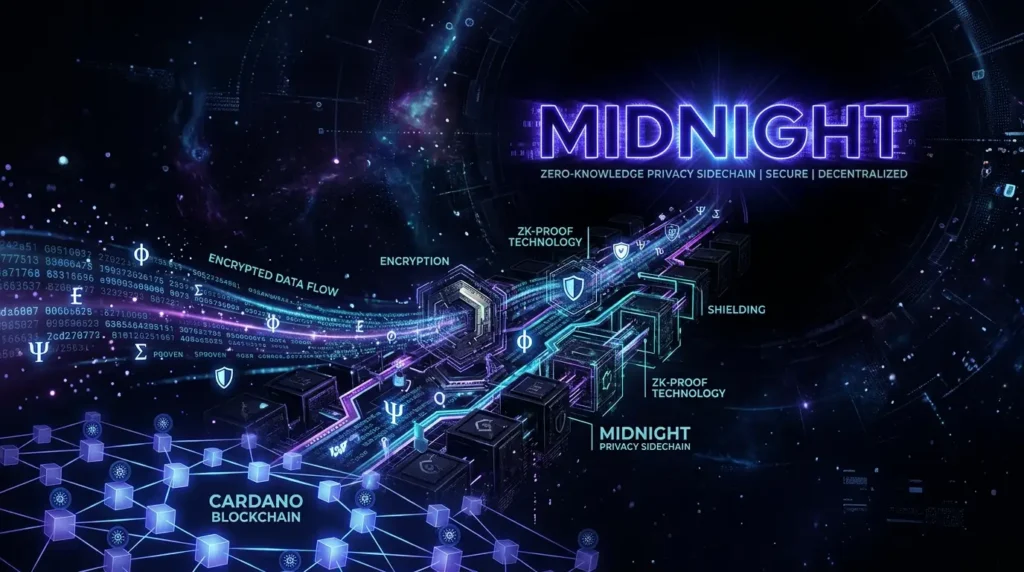
Cardano’s Midnight sidechain — launching in Q1 2026 — brings zero-knowledge proof technology for privacy-preserving applications. This opens the door for enterprise use cases that require both blockchain transparency and data confidentiality — a combination that most public blockchains can’t offer.
The Honest Critique: Why Critics Call It a “Ghost Chain”
No balanced article about Cardano can avoid this question. The “ghost chain” criticism — that Cardano is a technically impressive but largely unused blockchain — has followed ADA for years.
The data in 2026 is mixed:
Arguments for the criticism:
- DeFi TVL of ~$552 million vs Ethereum’s $60+ billion and Solana’s $4+ billion
- Developer activity lower than Ethereum, Solana, and even BNB Chain
- Five years after smart contract launch, ecosystem remains nascent
- ADA down 90%+ from ATH while Ethereum and Solana have recovered more
Arguments against the criticism:
- Over 63% staking participation — extraordinary for a major blockchain
- 3,000+ stake pools — genuinely the most decentralized staking system in crypto
- TVL growing 23%+ in recent weeks — momentum is real if small
- Midnight privacy sidechain addresses enterprise demand others can’t
- $1 billion treasury provides runway for continued development
- Academic methodology means fewer security exploits than competitors
The honest assessment: Cardano’s technology is genuinely excellent. Its adoption lags its technical merit. Whether that gap closes in 2026 depends on execution — shipping Midnight successfully, growing the developer ecosystem, and deploying the treasury effectively.
2026 Catalysts: What Could Change the Narrative?
Grayscale Spot ADA ETF: Filed in February 2025 with the SEC. If approved (earliest window August 2026), this would bring institutional capital into ADA for the first time at scale. The staking yield angle is compelling — ADA’s 3-5% with no lock-up and no slashing risk is a cleaner product than ETH staking for institutional purposes.
CLARITY Act Commodity Classification: If ADA receives formal commodity classification, it eliminates securities uncertainty and opens doors for institutional allocation.
Midnight Sidechain Launch: Zero-knowledge privacy for enterprise applications — the use case most other public blockchains can’t serve. Enterprise adoption could meaningfully change Cardano’s TVL story.
Voltaire Treasury Deployment: With $1 billion+ available, effective treasury spending on ecosystem growth (developer grants, infrastructure, adoption) could accelerate the network significantly.
Cardano Risks: The Honest Version
Persistent adoption gap: The fundamental risk — Cardano’s DeFi ecosystem remains far behind Ethereum and Solana. If the gap doesn’t close, ADA’s price reflects a declining relevance narrative.
Developer ecosystem challenges: Plutus/Haskell has a steeper learning curve than Solidity. Fewer developers = fewer projects = less activity = lower fees = lower security budget over time.
Speed of development: Peer-reviewed academic rigor is Cardano’s strength and weakness. Changes take longer. In a fast-moving industry, slow can mean irrelevant.
Price performance vs ATH: ADA is down 90%+ from its 2021 high. Recovering to previous ATH requires not just price appreciation but a fundamental improvement in ecosystem adoption metrics that haven’t materialized yet.
Competition: Ethereum’s L2 ecosystem, Solana’s speed, and a dozen other smart contract platforms all compete for the same developers and users.
How to Buy Cardano (ADA) in the US: Step by Step
Step 1: Choose a regulated exchange
- Coinbase — ADA fully supported, beginner-friendly
- Kraken — excellent ADA liquidity, supports staking
- Gemini — regulated, clean interface
Step 2: Create and verify your account
Standard KYC — government-issued ID required.
Step 3: Deposit funds
ACH bank transfer for lowest fees. Debit card for instant access.
Step 4: Buy ADA
Search for ADA or Cardano, enter dollar amount, confirm.
Step 5: Stake your ADA
This is where Cardano shines. Move ADA to a native wallet:
- Eternl — most feature-rich Cardano wallet
- Lace — official wallet by IOG, clean interface
- Yoroi — lightweight, mobile-friendly
In your wallet, choose a stake pool and delegate. No lock-up, no minimum, rewards every 5 days. Staking on Cardano is genuinely one of the easiest yield experiences in crypto.
Key Cardano Terminology for Beginners
Ouroboros: Cardano’s proof-of-stake consensus protocol — the first with formal mathematical security proofs.
Epoch: A 5-day time period on Cardano, at the end of which staking rewards are distributed.
Slot: A 20-second window within an epoch during which a stake pool may produce a block.
Slot Leader: The stake pool selected to produce a block during a given slot.
eUTxO: Extended Unspent Transaction Output — Cardano’s transaction accounting model combining Bitcoin’s predictability with smart contract capability.
Plutus: Cardano’s smart contract language, based on Haskell.
DRep: Delegated Representative — an elected governance participant who votes on behalf of ADA holders in the Voltaire governance system.
Project Catalyst: Cardano’s community fund for ecosystem development proposals — part of the Voltaire governance era.
Midnight: Cardano’s privacy-focused sidechain using zero-knowledge proof technology.
Hydra: Cardano’s Layer 2 scaling solution, targeting extremely high transaction throughput.
IOG: Input Output Global — the research and development company that built Cardano, founded by Charles Hoskinson.
Should You Buy Cardano in 2026?
We are not financial advisors. But we’ll give you the most honest assessment we can.
Cardano is one of the most technically sophisticated blockchains in existence. Its staking system is genuinely the most accessible and well-designed in crypto. Its governance model is the most formal and democratic. Its research methodology is the most rigorous. Its decentralization — 3,000+ stake pools — is unmatched.
And yet, in 2026, its DeFi ecosystem remains small, its developer community is growing slowly, and its price is 90%+ below its ATH while competitors have partially recovered.
The bull case: Cardano is a long-term play on doing blockchain correctly, not fast. Midnight, ETFs, CLARITY Act, and effective treasury deployment could collectively change the narrative in 2026–2027. The staking mechanics are genuinely superior for conservative holders.
The bear case: Five years after smart contracts launched, the adoption hasn’t arrived. “The technology is great but nobody’s using it” is not a thesis for price appreciation.
If you believe in the long-term vision and can accept that Cardano moves on academic timelines rather than market timelines — ADA might be worth a position in a diversified crypto portfolio. If you need near-term catalysts and momentum, there are more dynamic options.
Much peer review. Very research. Such epochs.
Disclaimer: This article is for informational purposes only and does not constitute financial advice. Cryptocurrency investments carry significant risk, including the potential loss of all invested capital. Always conduct your own research before making any investment decisions.