Here’s a thought experiment.
Imagine a safe deposit box at a bank. Inside is everything you own — your savings, investments, valuables. The bank gives you one key, and only one key. No spare. No master copy. No way for anyone, including the bank, to make another one.
If you lose the key, the box is sealed forever. Nobody can open it. Not a locksmith. Not a judge. Not the bank. The contents are inaccessible until the end of time.
Now imagine that key is twelve words written on a piece of paper.
That’s your seed phrase. And that paper — whether it’s locked in a fireproof safe or sitting on your kitchen table — is the single most important object in your entire crypto life.
The Quick Answer: What Is a Seed Phrase?
A seed phrase (also called a recovery phrase, mnemonic phrase, or backup phrase) is a sequence of 12 or 24 simple English words that serves as the complete backup for a cryptocurrency wallet.
Every non-custodial wallet — whether it’s MetaMask, a Ledger hardware wallet, Trust Wallet, or any other — generates a seed phrase when you first set it up. These words are derived from a list of exactly 2,048 possible words defined by the BIP-39 standard (Bitcoin Improvement Proposal 39), the universal protocol for wallet recovery across the crypto industry.
The seed phrase encodes everything needed to reconstruct your wallet from scratch on any compatible device. Not just one account — every address, every blockchain, every token in every account derived from that wallet.
The fundamental truth about seed phrases: Whoever has the seed phrase controls the crypto. Not whoever has the device. Not whoever has the app password. Not whoever has the exchange account. The seed phrase is the ultimate authority.
How Does a Seed Phrase Actually Work?
Understanding the mechanics makes the importance obvious.
When you create a wallet, the software generates a large random number — essentially rolling hundreds of virtual dice simultaneously to create something completely unpredictable. This random number is your “entropy” — the source of uniqueness that makes your wallet yours and nobody else’s.
That random number is then converted into the 12 or 24 words you write down. The conversion uses the BIP-39 word list so that your backup is human-readable rather than a string of 256 random digits.
From those words, the wallet derives a master private key — and from that master key, it can mathematically generate thousands of individual private keys, one for each address on each blockchain. Bitcoin addresses, Ethereum addresses, Solana addresses, and everything else — all derived from the same single seed phrase.
This is why it’s called a hierarchical deterministic (HD) wallet: the hierarchy of keys is determined completely and reproducibly from a single seed.
The remarkable property: if you enter the same 24 words into any BIP-39 compatible wallet anywhere in the world, you’ll always get exactly the same wallet with exactly the same addresses and exactly the same balances. The math is deterministic. It never varies.
Seed Phrase vs. Private Key: What’s the Difference?
These terms are related but not the same:
Private Key: Controls a single wallet address. A long string of letters and numbers (typically 64 hexadecimal characters) that proves ownership of one specific address. If someone gets your private key for one address, they can steal funds from that address only.
Seed Phrase: Controls everything. The master backup that generates all the private keys for all addresses in your wallet — across all blockchains. One seed phrase can produce millions of individual private keys.
The hierarchy: Seed phrase → Master private key → Individual private keys → Wallet addresses
If a private key is a house key, the seed phrase is the key to the entire housing complex. A thief with one house key can rob one unit. A thief with the master key can rob everything.
12 Words vs. 24 Words: Does It Matter?
Both are extremely secure. Here’s the technical difference:
12-word phrase: 128 bits of entropy. The number of possible combinations is approximately 2^128 — a number so large that all the computers on Earth trying every combination for billions of years couldn’t crack it.
24-word phrase: 256 bits of entropy. Doubles the security mathematically. Used as the default by most hardware wallets (Ledger, Trezor).
Practical reality: Both are effectively impossible to brute-force. The choice between 12 and 24 words doesn’t matter for everyday users — what matters is how well you protect whichever one you have. A 24-word phrase stored carelessly is vastly less secure than a 12-word phrase stored properly.
The Rules for Your Seed Phrase
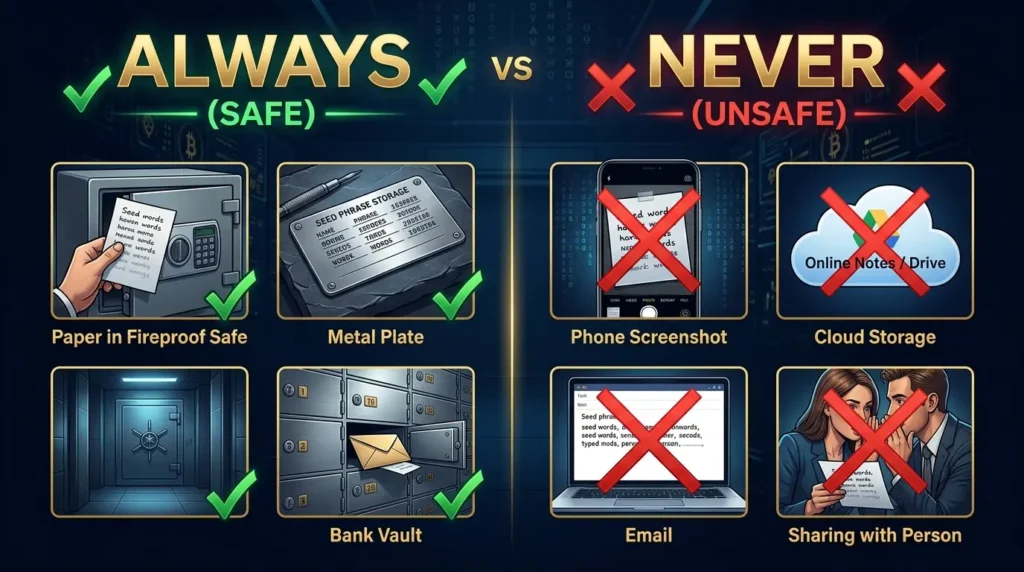
These aren’t suggestions. They’re the difference between owning your crypto and losing it.
✅ DO:
- Write it down by hand on paper immediately when your wallet shows it
- Write every word correctly, in the correct order
- Verify by re-entering the words when prompted (the wallet will ask)
- Store it in a physically secure location — a locked safe, a safety deposit box
- Consider making a second copy stored in a separate physical location
- Consider engraving it on a metal plate for fire and water resistance
- Tell a trusted family member where it’s stored (for inheritance planning)
❌ NEVER:
- Take a photo or screenshot of it
- Type it into any website, app, or email
- Store it in cloud services (Google Drive, iCloud, Dropbox, Notes)
- Save it in a password manager
- Text it to yourself or anyone else
- Show it to anyone — including “customer support”
- Store it on your computer or phone in any form
The golden rule: Your seed phrase should exist in exactly one place — written on physical material, stored physically, accessible only to you (and possibly a trusted person in case of your death).
The #1 Scam: Fake Customer Support
The most common way people lose their crypto in 2026 is simple social engineering.
You post a question in a Discord server or on Twitter/X about a wallet issue. Within minutes, a “support agent” appears in your DMs, offering to help. They walk you through “troubleshooting steps” that eventually require you to enter your seed phrase on a website or share it directly.
The moment you share it, your wallet is empty.
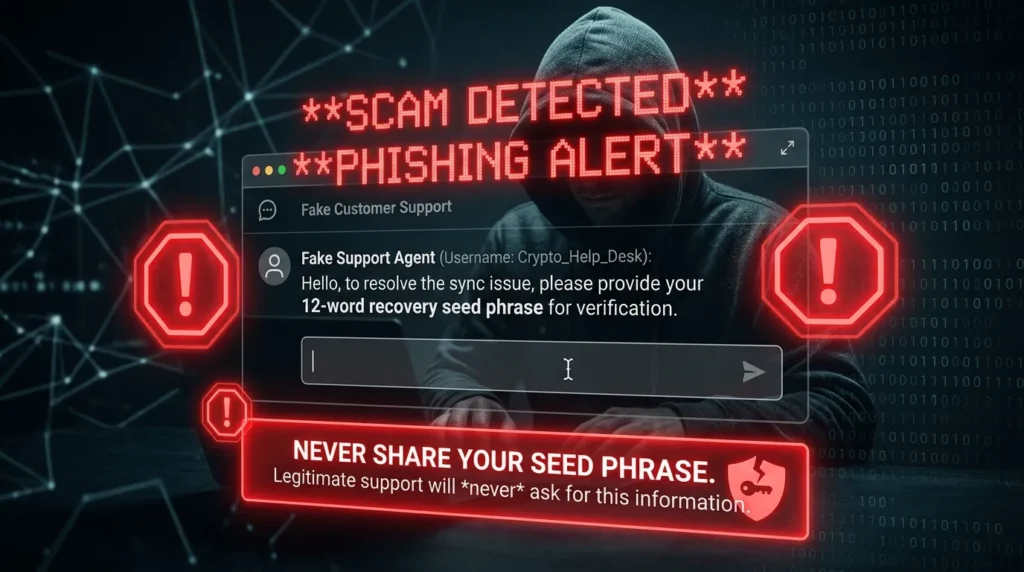
The absolute rule: No legitimate wallet, exchange, protocol, or support agent will ever ask for your seed phrase. Ever. Under any circumstances whatsoever.
Ledger won’t ask. MetaMask won’t ask. Coinbase won’t ask. If anyone asks for your seed phrase — regardless of how official they look, what they say, or how urgent the situation seems — it’s a scam. Disconnect immediately.
How to Store Your Seed Phrase: From Basic to Advanced
Level 1 — Paper (minimum standard)
Write it clearly on paper with a ballpoint pen. Store in a drawer or basic envelope. This is better than digital storage but vulnerable to water damage, fire, ink fading, and anyone who finds the paper.
Level 2 — Paper in a safe (good for most people)
Write on paper and store in a fireproof/waterproof home safe. Add a second copy in a safety deposit box at a bank. This is the practical minimum standard for anyone holding significant value in crypto.
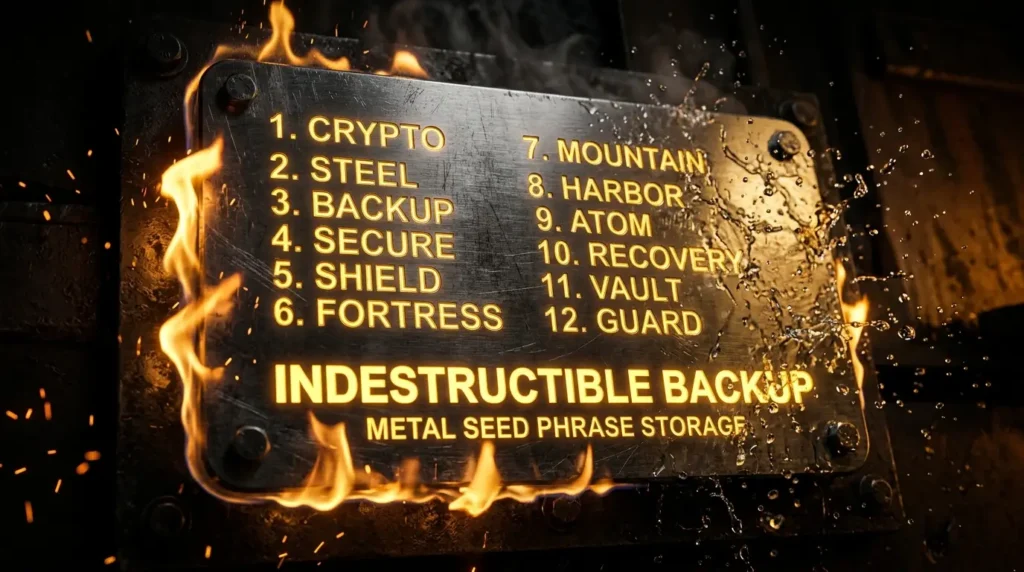
Level 3 — Metal plate (serious protection)
Stamp or engrave your seed phrase onto a stainless steel or titanium plate. Metal plates survive house fires (steel melts at ~1,370°C, far above typical house fire temperatures), floods, and physical abuse. Products like Cryptosteel, Billfodl, and CryptoTag are specifically designed for this. Expect to pay $50–$100 for a quality metal backup.
Level 4 — Multiple geographic copies
Two or three copies in different locations — home safe, safety deposit box at a bank, trusted family member in another city. This protects against localized disasters (fire destroying your home, flooding a storage unit).
Level 5 — Shamir Secret Sharing (advanced)
A cryptographic technique that splits your seed phrase into multiple “shares” (e.g., 3 shares where any 2 are sufficient to reconstruct the phrase). Distribute shares to trusted people or locations. Even if one share is stolen or lost, the thief can’t reconstruct your seed phrase without the others. Supported by Trezor.
What Happens If You Lose Your Seed Phrase?
This is the question nobody wants to answer honestly: if you lose your seed phrase, your crypto is gone.
No recovery. No customer support. No appeal. No exceptions.
This isn’t a flaw in the system — it’s the point. The whole value of self-custody is that nobody can touch your crypto without your permission. The trade-off is that nobody can help you if you lose access.
An estimated 20% of all Bitcoin in existence — worth hundreds of billions of dollars — is permanently inaccessible because people lost their seed phrases, lost hardware wallets without backups, or discarded hard drives containing wallet files.
This is why backup is not optional. The hardware wallet itself is replaceable. The seed phrase is not.
What to Do If Your Seed Phrase Is Compromised
If you have reason to believe your seed phrase has been exposed — you accidentally posted it, stored it digitally and suspect a hack, or someone saw it:
Act immediately:
- Create a completely new wallet on a clean, trusted device
- Transfer all funds from every address on the compromised wallet to the new wallet as quickly as possible
- Abandon the old wallet entirely — never use it again
- The compromised seed phrase is permanently unsafe
Speed matters. Once a thief has your seed phrase, they can drain your wallet at any time. Some thieves wait patiently.
Key Terminology
Seed Phrase: 12 or 24 words that serve as the complete backup for a crypto wallet. Also called recovery phrase, mnemonic phrase, or backup phrase.
BIP-39: The Bitcoin Improvement Proposal that standardized seed phrases — defining the 2,048-word list used and the derivation process. Ensures compatibility across different wallet software.
Entropy: The random number generated during wallet creation that forms the basis of your seed phrase. More entropy = more security.
HD Wallet (Hierarchical Deterministic): A wallet where all keys are derived from a single seed phrase, so one backup covers everything.
Master Private Key: The root key derived from the seed phrase, from which all individual wallet addresses are generated.
Derivation Path: The mathematical route from seed phrase to specific address. Different blockchains use different derivation paths.
Passphrase (25th Word): An optional extra word added to the seed phrase for additional security. Creates an entirely different wallet from the same seed words — provides protection even if the physical backup is stolen.
Shamir Backup: An advanced technique that splits the seed phrase into multiple shares, any subset of which can reconstruct the original.
The Bottom Line
Most things in crypto are recoverable. You can buy back a token that dropped. You can rebuild a portfolio after a loss. You can choose a different exchange after one shuts down.
A lost seed phrase is not recoverable. Ever.
The seed phrase is the one thing in crypto that has no second chance. No support ticket. No court order. No technology on earth can open a wallet whose seed phrase is lost, because the security doesn’t depend on any company or authority — it depends on mathematics.
Treat those 12 or 24 words accordingly. Write them down right now if you haven’t. Store them safely. Tell someone you trust where they are.
Everything else in crypto can be rebuilt. Your seed phrase cannot be replaced.
Write it down. Lock it up. Never share it. That’s it. 📝🔐
Disclaimer: This article is for informational purposes only and does not constitute financial advice. Cryptocurrency investments carry significant risk, including the potential loss of all invested capital. Always conduct your own research before making any investment decisions.