If you’ve ever heard someone mention Bitcoin and nodded along pretending you totally understood — this article is for you. No judgment. Even people who have been in crypto for years sometimes struggle to explain it clearly. So let’s fix that, once and for all.
Bitcoin is the original cryptocurrency. The one that started it all. The one your uncle keeps telling you he bought in 2013 and sold too early. It’s been declared dead over 400 times by mainstream media — and yet here it is, sitting at a market cap of over $1.3 trillion and trading at around $68,000 per coin as of early 2026.
So what exactly is Bitcoin, how does it work, and should you care? Let’s dig in.
The Quick Answer: What Is Bitcoin?
Bitcoin (ticker: BTC) is a decentralized digital currency. That means it’s money — but without a bank, government, or any central authority controlling it. Transactions happen directly between people, recorded on a public database called the blockchain, and secured by math so complex that even your most paranoid friend can’t find a flaw in it.
It was designed to let you send value to anyone in the world, at any time, without asking permission from anyone. Think of it as the internet of money — open, borderless, and available 24/7.
Who Created Bitcoin? The Mystery That Still Isn’t Solved
Here’s where it gets interesting. Bitcoin was created by someone — or a group of people — using the pseudonym Satoshi Nakamoto. In October 2008, right in the middle of the global financial crisis (coincidence? probably not), Nakamoto published a nine-page document called the Bitcoin Whitepaper: “Bitcoin: A Peer-to-Peer Electronic Cash System.”
The first Bitcoin block — called the genesis block — was mined on January 3, 2009. Embedded in its code was a message referencing a newspaper headline about bank bailouts. A subtle jab at the traditional financial system that would set the tone for Bitcoin’s entire existence.
Nakamoto actively developed Bitcoin and communicated with early contributors until mid-2010 — and then simply vanished. No goodbye, no reveal, nothing. The true identity of Satoshi Nakamoto remains one of the biggest unsolved mysteries in tech. Over the years, multiple people have claimed to be Nakamoto (most famously Craig Wright, to the eye-rolling of the entire crypto community), but none have been able to prove it convincingly.
What Nakamoto left behind, though, was worth keeping. The estimated wallet associated with Satoshi holds around 1 million BTC — coins that have never moved. At today’s prices, that’s roughly $68 billion sitting completely still.
How Does Bitcoin Actually Work?
Let’s break this down without making your brain hurt.
The Blockchain

Every Bitcoin transaction ever made is recorded on the blockchain — a public, distributed ledger that anyone can view but nobody can alter. Think of it as a Google spreadsheet that everyone can read, but that no single person controls or can edit.
New transactions are grouped into “blocks” and added to the chain roughly every 10 minutes. Each block is connected to the previous one through a cryptographic hash, making it practically impossible to go back and change historical records without redoing all the work that came after. This is why Bitcoin transactions are considered irreversible.
Mining
New Bitcoin enters circulation through a process called mining. Miners are computers (very powerful, very electricity-hungry computers) competing to solve complex mathematical puzzles. The first one to solve the puzzle gets to add the next block to the blockchain and receives a block reward in fresh Bitcoin.
This process serves two purposes: it creates new Bitcoin and it secures the network. Changing a fraudulent transaction would require redoing all the computational work that followed it — which, given Bitcoin’s current hashrate of over 700 exahashes per second, would require more energy than most countries consume. Good luck with that.
The 21 Million Cap
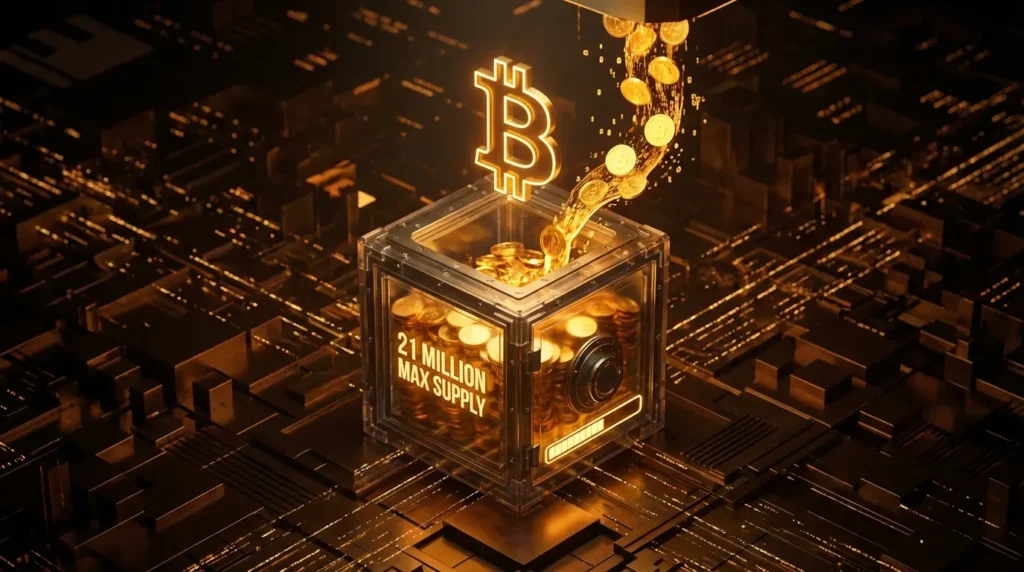
This is perhaps Bitcoin’s most important feature: there will only ever be 21 million Bitcoin. It’s written in the code. Nobody can change it without unanimous network consensus — which, given the decentralized nature of Bitcoin, is essentially impossible.
As of early 2026, approximately 20 million BTC are already in circulation — about 95% of the total supply. The remaining ~1 million BTC will be released gradually through mining rewards until around the year 2140.
This hard cap is why many people compare Bitcoin to gold. Gold is scarce because there’s a limited amount of it in the Earth’s crust. Bitcoin is scarce because the code says so. One is enforced by geology, the other by mathematics.
Bitcoin Tokenomics: The Numbers That Matter
Understanding Bitcoin’s economics is key to understanding its value proposition. Here’s a breakdown:
| Metric | Data |
|---|---|
| Ticker | BTC |
| Current Price | ~$68,000 (April 2026) |
| Market Cap | ~$1.37 trillion |
| Rank | #1 |
| Circulating Supply | ~20.01 million BTC |
| Maximum Supply | 21 million BTC |
| All-Time High | $126,272 (October 6, 2025) |
| Current Block Reward | 3.125 BTC |
| Next Halving | ~2028 |
| BTC Dominance | ~58% of total crypto market cap |
The Halving: Bitcoin’s Built-In Deflation Mechanism
Every approximately four years, Bitcoin undergoes a halving — an event where the block reward paid to miners is cut in half. This is hardcoded into Bitcoin’s protocol and happens automatically.
Here’s the halving history:
- 2009: 50 BTC per block
- 2012 (1st halving): 25 BTC per block
- 2016 (2nd halving): 12.5 BTC per block
- 2020 (3rd halving): 6.25 BTC per block
- 2024 (4th halving): 3.125 BTC per block
- ~2028 (5th halving): 1.5625 BTC per block
Why does this matter? Because it systematically reduces the rate at which new Bitcoin enters circulation. Less new supply hitting the market, combined with steady or growing demand, has historically preceded significant price increases. Note the word “historically” — past performance doesn’t guarantee future results, and anyone who tells you otherwise is probably trying to sell you something.
Where Does All the Bitcoin Go?
Here’s an interesting fact: a significant portion of the 20 million mined Bitcoin is effectively out of circulation forever. Estimates suggest that between 3 and 4 million BTC have been permanently lost — forgotten wallet passwords, hard drives thrown away, people who bought pizza for 10,000 BTC in 2010 and would prefer not to think about it.
Additionally, Satoshi’s estimated ~1 million BTC has never moved. Whether this is intentional or because the keys are lost forever, nobody knows. Either way, the effective circulating supply is lower than the numbers suggest.
Bitcoin’s Price History: A Rollercoaster With No Seatbelts
If you thought your last flight was turbulent, you haven’t seen Bitcoin’s price chart.
2009–2010: Bitcoin had essentially no price. The famous story: in May 2010, programmer Laszlo Hanyecz paid 10,000 BTC for two pizzas. At today’s prices, that’s roughly $680 million. Those are the most expensive pizzas in human history, and Laszlo seems to be handling it remarkably well.
2013: Bitcoin first broke $1,000, then crashed back down to around $200. The media declared it dead (the first of many times).
2017: Bitcoin hit nearly $20,000, driven by retail mania and ICO speculation. Then spent all of 2018 crashing back to around $3,000.
2020–2021: Institutional money arrived. MicroStrategy, Tesla, and others began buying Bitcoin as a treasury asset. Bitcoin hit $64,000 in April 2021, then crashed back to $30,000, then recovered to nearly $69,000 before collapsing again in 2022.
2022: The crypto winter. FTX collapsed. Bitcoin dropped to around $16,000. The media declared it dead again (approximately the 380th time).
2024: The halving happened in April. Spot Bitcoin ETFs launched in the US in January, bringing institutional capital at scale. Bitcoin hit a new all-time high.
2025: Bitcoin reached its highest price on October 6, 2025, hitting $126,272. A new all-time high that many had predicted but few believed would come so quickly.
Early 2026: Bitcoin is trading around $68,000, down from its ATH but still up massively from where it was just a few years ago.
What Is Bitcoin Used For?
Bitcoin was originally designed as peer-to-peer electronic cash — a way to send money without a bank. In practice, it has evolved into something more nuanced.
Store of Value (“Digital Gold”)
This is Bitcoin’s dominant use case today. Major institutions, corporations, and governments now hold Bitcoin as a reserve asset. Strategy (formerly MicroStrategy) is the largest known corporate holder, having accumulated hundreds of thousands of BTC. The narrative here is simple: Bitcoin is scarce, portable, and censorship-resistant — making it an attractive alternative to gold for the digital age.
Payments
Bitcoin can be used to send money anywhere in the world in minutes, for a fraction of what a wire transfer would cost. The Lightning Network — a second-layer protocol built on top of Bitcoin — enables near-instant payments with fees measured in fractions of a cent. El Salvador famously made Bitcoin legal tender and uses Lightning for everyday transactions.
Hedge Against Inflation
In countries experiencing currency devaluation (Argentina, Venezuela, Turkey come to mind), Bitcoin has served as a lifeline for people trying to preserve the value of their savings. When your national currency loses 50% of its value in a year, digital gold starts looking pretty attractive.
Speculation
Let’s be honest — a lot of people buy Bitcoin because they think the price will go up. This is a legitimate use case, even if it’s not the most glamorous one. Bitcoin’s volatility makes it attractive for traders, though it also makes it terrifying for those who put in more than they can afford to lose.
Who Controls Bitcoin?
Nobody. And everybody. That’s the honest answer.

Bitcoin is governed by its code, which can only be changed if the vast majority of the network — miners, node operators, developers, and users — agree to the change. This has happened before (the SegWit upgrade in 2017, the Taproot upgrade in 2021), but it’s a slow, contentious process by design.
No single company, government, or individual can freeze your Bitcoin, reverse a transaction, or change the rules of the network. This is Bitcoin’s superpower and, depending on your perspective, also its biggest challenge from a regulatory standpoint.
Bitcoin Risks: What You Need to Know Before Buying
Bitcoin is not a safe investment. Anyone who tells you otherwise is either naive or lying. Here are the real risks:
Volatility: Bitcoin has dropped 80%+ from peak to trough multiple times in its history. If you invest $1,000 and it drops to $200, you need to be okay with that possibility.
Regulatory risk: Governments around the world are still figuring out how to regulate crypto. Unfavorable regulations could impact Bitcoin’s price and usability.
Technical risk: Losing your private keys means losing your Bitcoin forever. There is no customer service to call, no password reset email.
Security risk: Exchanges and wallets have been hacked. If you’re holding significant amounts, a hardware wallet (Ledger, Trezor) is strongly recommended.
Concentration risk: A relatively small number of wallets hold a large percentage of all Bitcoin. Large holders — “whales” — can influence the market significantly.
Environmental concerns: Bitcoin mining consumes a substantial amount of energy. While the industry is moving toward renewables, this remains a legitimate criticism.
How to Buy Bitcoin in the US: Step by Step
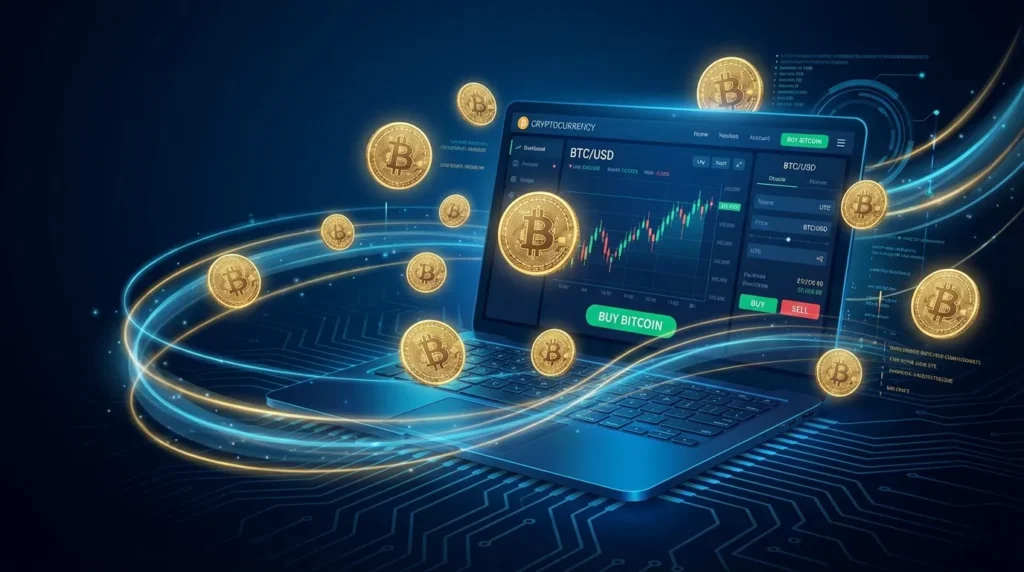
Buying Bitcoin in the US has never been easier. Here’s the straightforward process:
Step 1: Choose an exchange
For US residents, the most reputable options are:
- Coinbase — best for beginners, regulated, user-friendly
- Kraken — excellent security track record, good for intermediate users
- Gemini — strong regulatory compliance, NY-based
Step 2: Create and verify your account
All regulated US exchanges require KYC (Know Your Customer) verification. You’ll need a government-issued ID and typically a selfie. This takes anywhere from a few minutes to a day.
Step 3: Deposit funds
Link a bank account or use a debit card. Bank transfers are slower but have lower fees. Debit cards are instant but cost more.
Step 4: Buy Bitcoin
Enter the amount in USD you want to spend. You don’t need to buy a whole Bitcoin — you can buy as little as $1 worth. Bitcoin is divisible to 8 decimal places, with the smallest unit (0.00000001 BTC) called a satoshi.
Step 5: Consider your storage
For small amounts, leaving Bitcoin on a reputable exchange is fine. For larger amounts, consider moving it to a hardware wallet (Ledger or Trezor) where you control your private keys.
Should You Buy Bitcoin in 2026?
We at TheHashmark are not financial advisors and this is not financial advice. What we can tell you is this:
Bitcoin is the most established, most liquid, most institutionally adopted cryptocurrency in existence. It has survived multiple 80% drawdowns, regulatory crackdowns, exchange collapses, media death announcements, and a global pandemic. Its supply is fixed, its network effect is enormous, and institutional adoption continues to grow.
It is also volatile, energy-intensive, and operates in a regulatory environment that is still evolving.
Whether Bitcoin belongs in your portfolio depends entirely on your financial situation, risk tolerance, and investment timeline. What’s certain is that ignoring it entirely means ignoring an asset class that has outperformed virtually every other investment over the past decade.
Do your own research. Start small if you decide to invest. And whatever you do, don’t sell your entire position after a 20% dip and then watch it recover 300% over the next year. That experience is unpleasant. We’ve heard.
Bitcoin vs. Other Cryptocurrencies: How Does It Compare?
| Feature | Bitcoin (BTC) | Ethereum (ETH) | Solana (SOL) |
|---|---|---|---|
| Launch Year | 2009 | 2015 | 2020 |
| Primary Use | Store of value / payments | Smart contracts / DeFi | Fast transactions / DeFi |
| Max Supply | 21 million | No hard cap | No hard cap |
| Consensus | Proof of Work | Proof of Stake | Proof of History + PoS |
| Transaction Speed | ~7 TPS | ~15-30 TPS | ~65,000 TPS |
| Market Cap Rank | #1 | #2 | #5 |
Bitcoin is the slowest and most limited in terms of programmability — but it’s also the most secure, most decentralized, and most widely recognized. Different tools for different purposes.
Key Bitcoin Terminology for Beginners
Satoshi (sat): The smallest unit of Bitcoin (0.00000001 BTC). Named after the creator.
HODL: Crypto slang for holding your Bitcoin long-term rather than selling during downturns. Originally a typo in a 2013 forum post that became legendary.
Whale: An individual or entity holding large amounts of Bitcoin, capable of moving the market.
Halving: The event that cuts Bitcoin’s block reward in half every ~4 years.
Cold storage: Keeping Bitcoin offline on a hardware wallet, away from internet-connected devices.
Mempool: The waiting room for unconfirmed Bitcoin transactions. When the network is busy, transactions queue here.
Lightning Network: Bitcoin’s second-layer payment protocol enabling instant, cheap transactions.
The Bottom Line
Bitcoin is more than 15 years old, has survived everything the world has thrown at it, and continues to grow. It’s imperfect — slow, energy-hungry, and not great for buying coffee (unless you use Lightning). But as a store of value and a decentralized financial alternative, it has proven its case more convincingly than almost anyone expected in 2009.
Whether you’re here because you’re curious, because your coworker won’t stop talking about it, or because you genuinely want to understand where the global financial system might be heading — understanding Bitcoin is a good place to start.
And if you do buy some? Welcome to the most interesting waiting room in finance. Grab a seat. It’s going to be a ride.
Disclaimer: This article is for informational purposes only and does not constitute financial advice. Cryptocurrency investments carry significant risk. Always do your own research before investing.