Sei launched in August 2023 with a bold claim: it was the first sector-specific Layer 1 blockchain — built specifically for trading. Its order book primitives, MEV protection, and optimized architecture were designed to give decentralized exchanges capabilities that general-purpose blockchains couldn’t match.
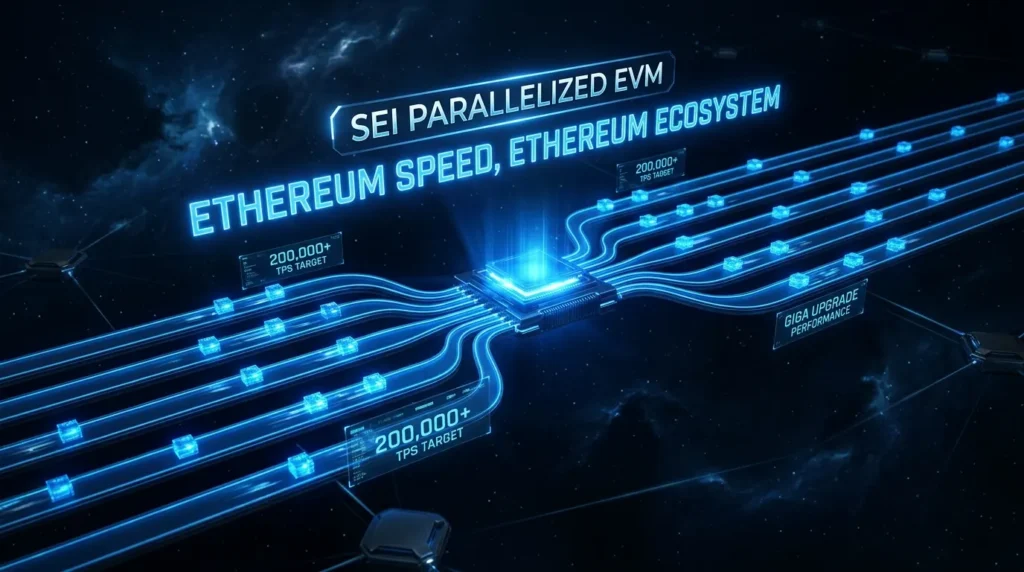
Two years later, Sei’s story has taken an unexpected turn. Rather than building a niche trading-focused ecosystem, the team made a dramatic architectural pivot — transforming Sei into a Parallelized EVM chain. The goal: combine Ethereum’s developer ecosystem with the throughput of a next-generation chain. The Sei Giga upgrade now targets 200,000+ TPS with sub-400ms finality — numbers that would make it the fastest EVM-compatible chain ever built.
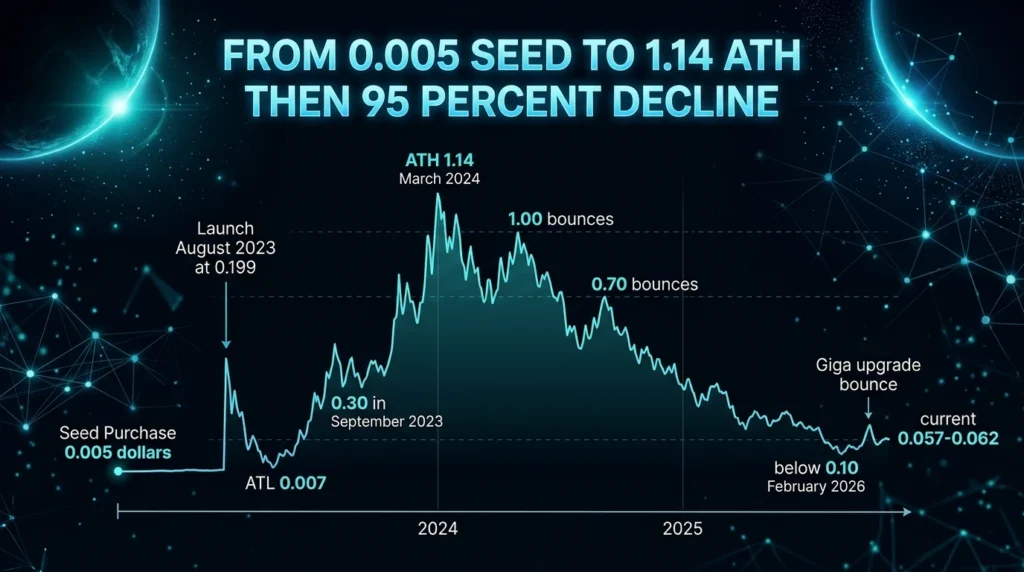
In May 2026, SEI trades approximately $0.057–0.062 — roughly 95% below its all-time high of $1.14 reached in March 2024. The network claims to be the #1 EVM chain by number of active users despite its token’s significant price decline. Total supply is 10 billion with approximately 6.4–6.85 billion SEI in circulation.
What Is Sei? The Evolution from Trading Chain to Parallelized EVM
The Original Vision (2022–2023)
Sei was founded by Jay Jog and Jeff Feng — two Stanford computer science graduates with backgrounds at Robinhood, Google, and other tech companies. The original thesis was straightforward: existing blockchains weren’t built for the specific demands of trading. Ethereum was too slow and expensive. Solana was fast but had different tradeoffs. Sei would build a Layer 1 with:
- A native on-chain order book as a protocol primitive
- MEV protection against front-running
- Parallel order execution
- Cosmos SDK architecture for IBC interoperability
The network launched in August 2023 after a community airdrop accompanying the mainnet.
The V2 Pivot: Parallelized EVM (2024)
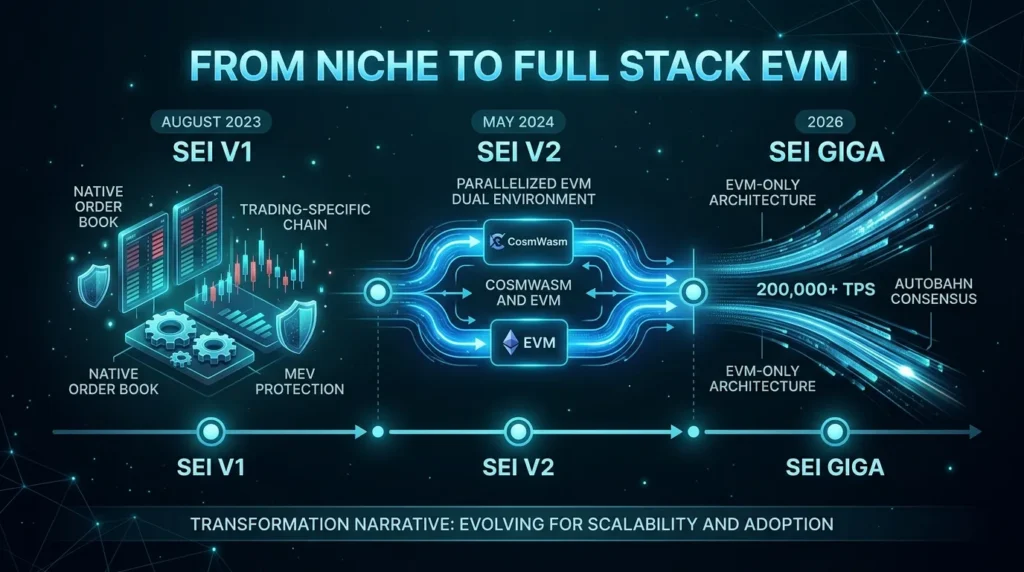
In May 2024, Sei launched its most significant upgrade: Sei V2 — introducing a Parallelized EVM. This was a strategic pivot from “trading-specific chain” to “the fastest EVM-compatible chain.”
Why the pivot? EVM compatibility unlocks the entire Ethereum developer ecosystem — millions of developers and thousands of existing applications. Rather than asking developers to learn new tooling, Sei V2 allows them to deploy existing Solidity contracts with parallel execution benefits.
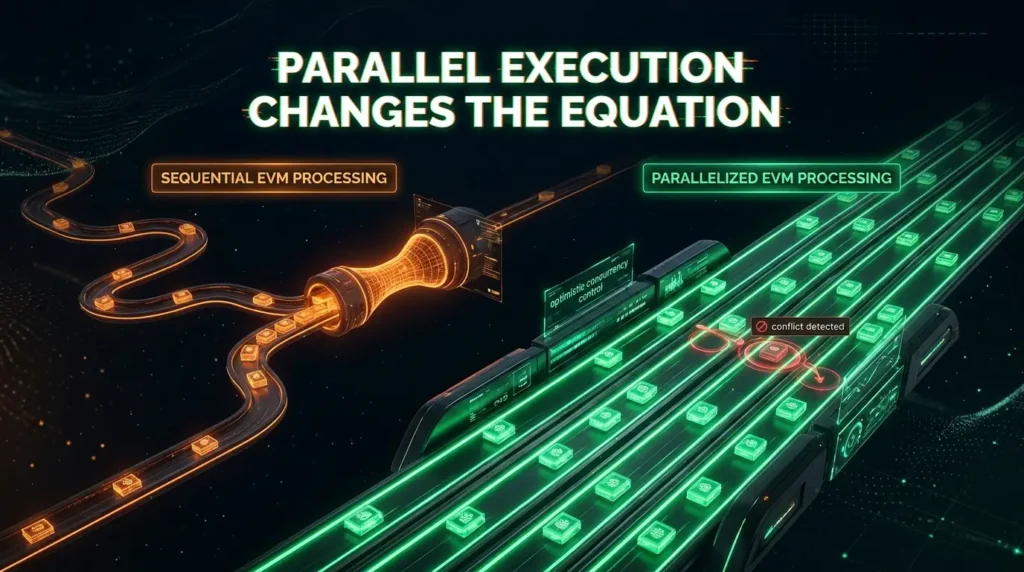
How Parallelized EVM works: Sei’s architecture executes EVM transactions in parallel using optimistic concurrency control — transactions are optimistically executed simultaneously, with conflict detection and re-execution when dependencies are identified. For transactions without dependencies (the majority), performance is dramatically higher than sequential EVM execution.
The dual environment: Sei V2 maintained both:
- EVM environment: Standard Solidity contracts, MetaMask compatibility, Ethereum tooling
- CosmWasm environment: Cosmos-native contracts for IBC-enabled applications
The 2026 Transition: EVM-Only Architecture
In February 2026, Coinbase Markets announced Sei’s transition from Cosmos-based transactions to an EVM-only architecture — executed April 6–8, 2026.
This represents Sei going all-in on EVM: disabling IBC (Inter-Blockchain Communication) inbound transfers and fully committing to the Ethereum developer ecosystem. The decision signals a strategic bet that EVM compatibility and the broader Ethereum ecosystem are more valuable to Sei’s growth than Cosmos interoperability.
Sei Giga: The 2026 Upgrade
The most technically ambitious development in Sei’s history — Sei Giga — is being deployed through 2026.
What Sei Giga Delivers
Autobahn Consensus: A new consensus architecture separating data availability, consensus, and execution layers. Allows for asynchronous execution — the network doesn’t need to wait for consensus before beginning execution of the next block.
Target performance:
- 200,000+ TPS (transactions per second)
- Sub-400ms finality
- Significantly improved performance under high load
For context: Ethereum mainnet handles ~15–30 TPS. Optimism and Arbitrum (Ethereum L2s) handle thousands of TPS. Solana handles 2,000–4,000 TPS in production. Sei’s 200,000 TPS target would be unprecedented for an EVM-compatible chain if achieved at production scale.
The Giga Market Impact
On April 22, 2026, news of the Giga upgrade implementation caused SEI to surge over 10% — breaking above a descending resistance level with $112 million in derivatives volume in a single session. TVL rose to $61.44 million, indicating meaningful capital inflows.
The upgrade’s reception confirms market interest in ultra-high-performance EVM infrastructure — though the price remains far below peak levels.
How Sei Works: Technical Architecture
Parallel Execution
Traditional EVM blockchains execute transactions sequentially — one at a time. Sei’s parallel execution engine processes transactions simultaneously when they don’t conflict:
Optimistic concurrency control:
- Transactions are speculatively executed in parallel
- The system detects any state conflicts (two transactions trying to modify the same state)
- Conflicting transactions are re-executed sequentially
- Non-conflicting transactions (the majority in typical workloads) complete faster
This approach is similar to how modern databases handle concurrent writes — familiar technology applied to blockchain execution.
MEV Protection
Sei implements MEV protection through batch order processing — orders of the same type within a block are batched and executed at uniform prices, preventing front-running bots from inserting themselves between user transactions.
This was inherited from the original trading-focused design and maintained through the V2 pivot — making Sei’s MEV protection a genuine differentiator even in its new EVM-compatible incarnation.
SeiDB
Sei developed SeiDB — a custom database architecture optimized for blockchain state storage. Rather than using general-purpose databases like LevelDB (common in other chains), SeiDB was designed specifically for blockchain access patterns — improving read/write performance and reducing state bloat. In October 2025, SeiDB was merged into the main chain repository, signaling its maturation as a stable component.
The SEI Airdrop: Community Distribution at Launch
Season 1 Airdrop (August 2023)
Sei launched its mainnet in August 2023 with a community airdrop distributed alongside the mainnet launch.
3% of total supply (300 million SEI) was specifically allocated for community airdrops — distributed to:
- Early users of the Sei testnet
- Community participants and contributors
- Ecosystem builders and active community members
The airdrop was modest in scale compared to some other high-profile distributions, but it served its purpose of bootstrapping initial community engagement.
At listing price (~$0.19–0.20), 300 million SEI in airdrop allocations represented approximately $57–60 million in total distributed value — meaningful but not extraordinary by the standards of major Layer 1 launches.
OKX Cryptopedia Campaign (2024)
In 2024, Sei collaborated with OKX Wallet for Cryptopedia Season 25 — distributing over $300,000 worth of SEI tokens to participants who completed designated on-chain tasks. This continued the pattern of ecosystem incentive programs targeting active users.
Ongoing Ecosystem Fund
Beyond the initial airdrop, the Ecosystem Reserve (a significant portion of total supply) continues to fund:
- Developer grants for builders on Sei
- Community incentive programs
- Protocol integrations and partnerships
SEI Price History: Launch, ATH, and the Grinding Decline
Pre-Launch Funding (2022–2023)
Before listing on exchanges, Sei raised over $95 million in multiple funding rounds:
- Seed round: Multicoin Capital purchased SEI at $0.005 per token — a price that would represent a 228x return at the ATH
- Additional rounds at higher prices from institutional investors
Listing and Early Trading (August 2023)
SEI launched trading in August 2023 at approximately $0.199 before quickly declining to $0.119 — reflecting initial selling pressure from early participants.
The all-time low was recorded at approximately $0.007–0.008 (August 2023, very early trading) before finding support.
By September 2023, SEI recovered to $0.30, pushing market cap toward $500 million — showing early investor interest in the trading-focused Layer 1 narrative.
The ATH: March 2024
SEI reached its all-time high of $1.14 on approximately March 16, 2024 — coinciding with the broader crypto bull market and heightened attention on high-performance Layer 1 alternatives.
At ATH, SEI’s market cap exceeded $7 billion at current supply, making it briefly a top-40 cryptocurrency. The Sei V2 Parallelized EVM announcement was well-received by the market, contributing to the late-2023 and early-2024 rally.
The Long Decline: One Step at a Time
The decline from $1.14 to current levels has been one of the more severe in the Layer 1 category:
2024 (post-ATH): After the March 2024 peak, SEI declined with the broader altcoin market. Two significant rallies — one to ~$1.00 early and another to ~$0.70 late in 2024 — were both used by sellers to exit. Each recovery ran into heavy selling pressure.
2025: The decline accelerated. SEI failed to hold the critical $0.30 support level. By mid-2025, SEI was below $0.20. By December 2025, it reached $0.13.
2026: SEI fell below the $0.10 support level in February 2026 — a psychologically significant level for the market. The April 2026 Giga upgrade news provided a temporary bounce (10%+ in one session), but structural headwinds remained.
May 2026: SEI trades approximately $0.057–0.062 — roughly 95% below the $1.14 ATH.
The character of the decline: A persistent grind lower with occasional sharp bounces (10–20%) that ultimately fail to establish new higher lows. The pattern reflects:
- Heavy token unlock pressure: 112–132 million SEI unlock per month in 2026 as Foundation and early investor vesting continues
- High circulating supply: ~6.4–6.85 billion of 10 billion total already in circulation
- Macro headwinds: Broader altcoin weakness vs. Bitcoin throughout 2025–2026
- Execution concerns: The transformation from trading-specific chain to Parallelized EVM required market confidence in a pivoting narrative
Who Built Sei and Who Backed It?
The Founding Team
Jay Jog (Co-founder) — Stanford CS graduate, former software engineer at Robinhood where he worked on trading infrastructure. His background in trading systems directly informed Sei’s original design philosophy.
Jeff Feng (Co-founder) — Stanford graduate with experience across tech and crypto. Former roles at Google, Coinbase, and other technology companies.
The team expanded significantly, incorporating talent from Robinhood, Google, Coinbase, Databricks, Uber, Goldman Sachs, and other prominent technology and finance companies — building an unusually strong technical bench for a blockchain project.
The Institutional Backers
Sei raised over $95 million from prominent investors:
Multicoin Capital — led or participated in early rounds, buying SEI at $0.005 during the seed. One of the most respected crypto-native research and investment funds — known for deep technical due diligence on Layer 1 infrastructure.
Jump Crypto — the crypto arm of Jump Trading. Particularly significant given Sei’s focus on trading infrastructure — Jump’s investment signals credibility from one of the world’s most sophisticated trading firms.
Coinbase Ventures — Coinbase’s investment arm. The subsequent Coinbase Markets announcement facilitating Sei’s EVM migration (April 2026) demonstrates an ongoing strategic relationship.
OKX Ventures, Circle Ventures, Delphi Ventures — additional institutional participants representing exchanges, stablecoin infrastructure, and crypto-native research.
The breadth and quality of the investor syndicate — particularly Multicoin, Jump, and Coinbase — provided Sei with both capital and strategic relationships crucial to exchange listings and ecosystem development.
The Sei Ecosystem in 2026
Network metrics:
- 5 billion+ cumulative transactions processed
- 90 million+ wallets
- Claim of #1 EVM chain by number of active users
- TVL: ~$61 million (April 2026, up from lower levels pre-Giga)
Key applications:
- DragonSwap — the primary DEX on Sei
- Silo — lending and borrowing protocol
- Jellyfish — concentrated liquidity DEX
- Yaka — yield optimizer and liquidity management
Sei V2’s EVM compatibility has brought Ethereum-native developers and applications to the network — including multiple DeFi protocols originally built for EVM chains.
Target use cases (2026):
- High-frequency DeFi trading (perpetuals, options, spot)
- AI agent economies (autonomous on-chain AI trading systems)
- Real-world asset (RWA) tokenization
- High-performance gaming
SEI Tokenomics (May 2026)
| Metric | Data |
|---|---|
| Price | ~$0.057–0.062 |
| Market cap | ~$370–430 million |
| Circulating supply | ~6.4–6.85 billion SEI |
| Total supply | 10 billion SEI (hard cap) |
| All-time high | $1.14 (March 16, 2024) |
| All-time low | ~$0.007–0.008 (August 2023) |
| CoinMarketCap ranking | ~#100–120 |
| FDV | ~$570–620 million |
| Monthly unlock (2026) | ~112–132 million SEI |
Distribution
- Ecosystem Reserve: largest allocation (includes staking rewards, grants, airdrops)
- Foundation: significant allocation, mostly vested
- Team: one-year cliff + five years variable vesting
- Private Sale Investors: unlocking incrementally through 2024–2026
- Binance Launchpool: fully vested early
The unlock concern: With monthly unlock volumes of 112–132 million SEI projected through 2026, consistent sell pressure from vesting allocations remains a structural headwind. By 2027, most major vesting schedules conclude, potentially relieving this pressure.
Sei vs. The Competition
Sei competes across two dimensions: as a high-performance Layer 1, and specifically as an EVM-compatible chain.
| Sei | Solana | Arbitrum | Base | Aptos | |
|---|---|---|---|---|---|
| Technology | Parallelized EVM | Rust/Sealevel | Optimistic rollup | Optimistic rollup | Move / Block-STM |
| Target TPS (2026) | 200,000+ (Giga) | ~65,000 theoretical | Thousands | Thousands | 150,000+ theoretical |
| Production activity | 5B+ cumulative TXs | ~2,000–4,000 TPS | High | High | ~10M daily |
| EVM compatible | Yes (V2+) | No | Yes | Yes | No |
| Market cap | ~$400M | ~$65–80B | ~$760M | (No token) | ~$730M–1.1B |
| ATH | $1.14 | ~$260 | $2.39 | — | $20.39 |
| Key advantage | Parallelized EVM speed, MEV protection | Ecosystem depth | DeFi ecosystem | Consumer adoption | Move safety |
Sei’s unique position: The only EVM-compatible chain with native parallel execution at the base layer. Other EVM chains (Arbitrum, Base, Optimism) achieve parallelism at the application layer or through off-chain sequencing — Sei does it at the execution layer itself.
The challenge: Ethereum L2s (Arbitrum, Base) have dramatically deeper DeFi ecosystems and TVL. Solana has faster consensus and larger DeFi TVL. Sei’s theoretical throughput advantage hasn’t yet translated into the ecosystem depth needed to challenge these established networks.
How to Buy SEI
Available on: Binance, Coinbase, Bybit, OKX, KuCoin, Gate.io
SEI is compatible with MetaMask (via EVM) and Sei-native wallets. The April 2026 EVM migration means SEI can now be stored and interacted with using standard Ethereum tooling.
Key Terminology
Parallelized EVM: Sei’s execution environment that processes EVM transactions in parallel — the core technical innovation of Sei V2.
Sei Giga: Sei’s 2026 major upgrade targeting 200,000+ TPS and sub-400ms finality via Autobahn consensus.
Autobahn Consensus: Sei’s new consensus architecture separating data availability, consensus, and execution layers for asynchronous processing.
Optimistic Concurrency Control: Sei’s parallel execution method — transactions execute simultaneously with conflict detection and re-execution for dependencies.
SeiDB: Custom database architecture optimized for blockchain state storage — merged into main chain in October 2025.
MEV Protection: Sei’s batch order processing preventing front-running — transactions of the same type processed simultaneously at uniform prices.
Twin-Turbo Consensus (V1): Sei’s original high-performance consensus mechanism before the Giga upgrade.
SEI: Native token used for gas fees, staking, and governance.
Disclaimer: This article is for informational and educational purposes only and does not constitute financial advice. Cryptocurrency investments carry significant risk, including the potential loss of all invested capital. Always conduct your own research before making any investment decisions.