Optimism holds a unique place in crypto history: it was the first major Ethereum Layer 2 to launch a governance token, one of the first to run a widely-praised multi-round airdrop program, and the creator of the OP Stack — the open-source framework that became the dominant infrastructure for building new Ethereum Layer 2 chains.
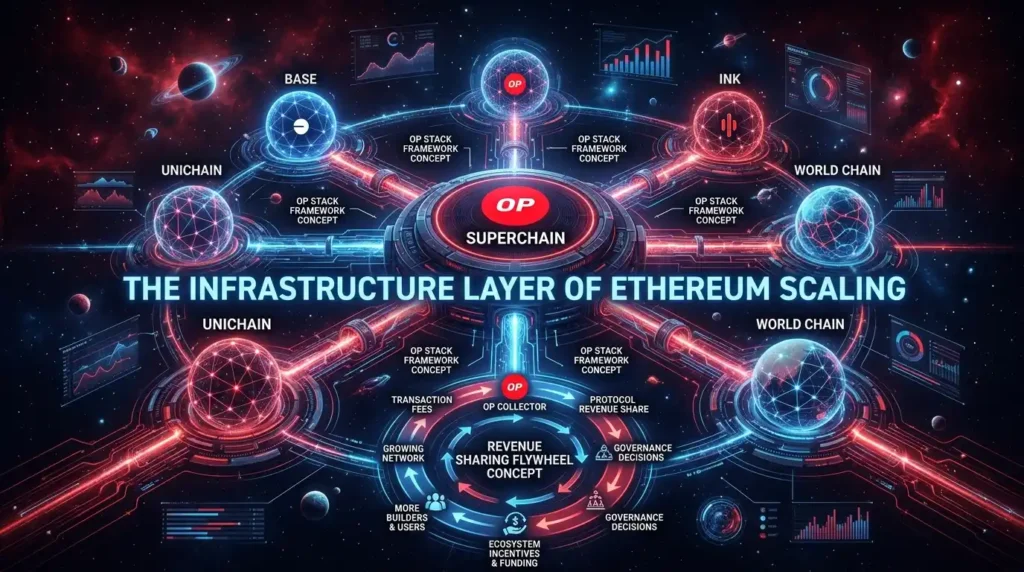
By early 2026, the Superchain — the growing network of chains built on the OP Stack — includes Base (Coinbase), Unichain (Uniswap), Ink (Kraken), and World Chain (Worldcoin), among others. Yet the OP token itself tells a harsher story: trading at approximately $0.12 in May 2026 — roughly 97.5% below its February 2024 all-time high of $4.84.
The gap between Optimism’s technological influence and OP’s price performance is one of the defining contradictions in the Layer 2 narrative.
What Is Optimism?
Optimism is an Ethereum Layer 2 network using Optimistic Rollup technology — the same fundamental approach as Arbitrum, but with a different ecosystem strategy and architectural philosophy.
Where Arbitrum focused on building deep DeFi liquidity on a single chain, Optimism focused on creating infrastructure — the OP Stack — that others could use to build their own L2 chains. This strategy produced the Superchain concept: a unified network of interconnected Ethereum scaling chains, each contributing to a shared economic model.
Founded: 2019 by Jing Wang and Karl Floersch (later joined by Ben Jones and others at Optimism PBC, now Optimism Foundation)
Mainnet launch: December 2021
How Optimism Works: Optimistic Rollups
Like Arbitrum, Optimism uses optimistic rollup technology:
- Transactions are processed off-chain by a sequencer
- Transaction data is batched and posted to Ethereum as calldata
- A ~7-day fraud proof window allows anyone to challenge invalid transactions
- Challenged transactions are re-executed on Ethereum; valid ones finalize
Key performance:
- Gas fees: $0.01–$0.50 vs. $5–50+ on Ethereum mainnet
- Throughput: Thousands of TPS vs. ~15–30 on Ethereum
- EVM compatibility: 100% — any Ethereum contract deploys without modification
- Withdrawal to Ethereum: ~7 days due to the fraud proof window
Bedrock upgrade (2023): Optimism’s major architectural upgrade reduced gas fees through batch compression, shortened deposit times, and improved node performance — bringing Optimism’s architecture closer to Ethereum’s while reducing costs.
Optimistic Rollups vs ZK Rollups: The Strategic Choice
Optimism built on optimistic rollups — a choice with clear current advantages but emerging competitive pressure from ZK alternatives.
Optimistic Rollups (Optimism, Arbitrum, Base)
Pros: Full EVM compatibility from day one, simpler architecture, faster initial deployment, larger existing DeFi ecosystems.
Cons: 7-day withdrawal delay (capital inefficiency), security relies on active fraud monitoring, bridges are a hack vector.
ZK Rollups (zkSync, StarkNet, Polygon zkEVM, Scroll)
Pros: Cryptographic verification of every transaction — no trust assumptions. Withdrawals in minutes to hours. Better bridge security through ZK proofs.
Cons: Computationally expensive, harder to achieve full EVM equivalence, less mature ecosystems.
Optimism’s Response: The ZK Transition
Recognizing ZK’s long-term security advantages, Optimism is actively transitioning:
In February 2026, Optimism announced a partnership with Succinct to integrate zero-knowledge proving across the OP Stack. The goal: make ZK validity proofs canonical for the OP Stack, enabling instant withdrawals from L2 to L1 — eliminating the 7-day wait that has long been optimistic rollups’ biggest disadvantage.
This ZK integration, if successful, would combine optimistic rollups’ EVM compatibility and ecosystem depth with ZK’s cryptographic security and fast finality — potentially the best of both worlds. It also included a 10-year post-quantum security roadmap for quantum-resistant cryptography.
The OP Stack: Optimism’s Real Achievement
If Optimism’s single most important contribution to Ethereum scaling is one thing — it’s the OP Stack.
The OP Stack is an open-source, modular framework for building Ethereum Layer 2 chains. Any team can use it to launch an L2 that:
- Inherits Ethereum security
- Is EVM-compatible
- Connects to the Superchain’s shared communication and economic model
The revenue-sharing model: Every OP Stack chain contributes to the Optimism Collective through a standardized model — the greater of 2.5% of total chain revenue or 15% of onchain profit flows back to Optimism.
Major chains built on OP Stack:
- Base (Coinbase) — the largest consumer crypto L2 by user activity
- Unichain (Uniswap) — Uniswap’s dedicated chain for DeFi
- Ink (Kraken) — Kraken’s L2
- World Chain (Worldcoin) — Sam Altman’s identity project
- Mode, Zora, Metal — various ecosystem chains
The Base Departure: A Major 2026 Setback
The most significant news in Optimism’s 2026 story is not a triumph — it’s a departure.
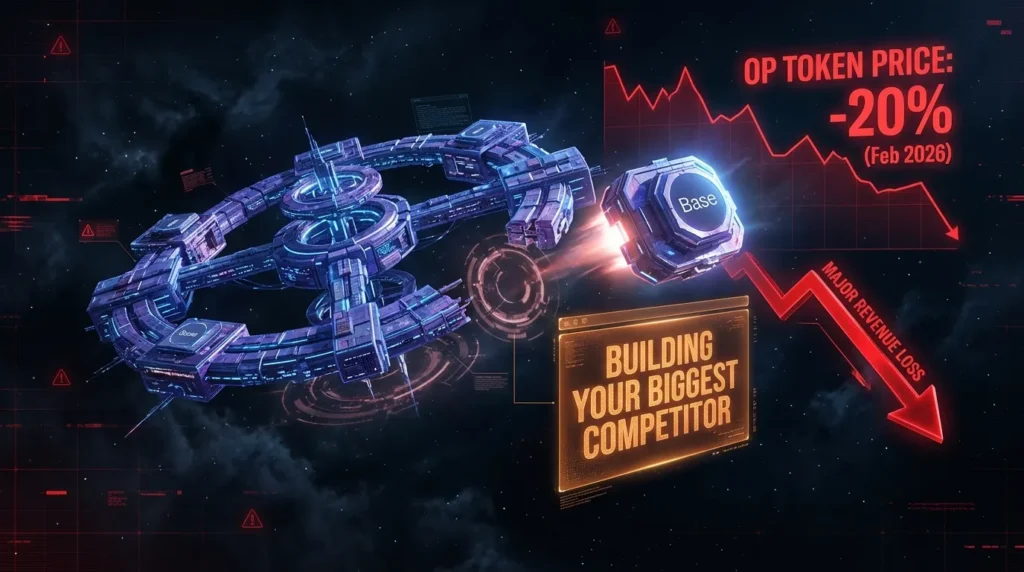
In February 2026, Base announced it was transitioning away from the OP Stack to its own independent unified technology stack. Base’s stated rationale: desire for faster development cycles (six upgrades per year vs. OP Stack’s typical three) and reduced architectural complexity.
Why this matters: Base had been contributing approximately 97% of the Superchain’s shared revenue pool. Its departure immediately cut the revenue base that Optimism’s buyback program and ecosystem funding relied on.
The departure led to a significant drop in the OP token’s price, with declines of over 20% observed immediately following the announcement.
Base remains an OP Enterprise customer during the transition — paying for infrastructure support — but its eventual full independence would represent a fundamental change to the Superchain’s economic model.
The strategic question: Was Optimism’s Superchain model a genuine moat, or did it create the conditions for its largest customer to develop the skills to eventually become independent? The Base departure forced this uncomfortable question into the open.
The OP Airdrop Program: Four Rounds of Community Rewards
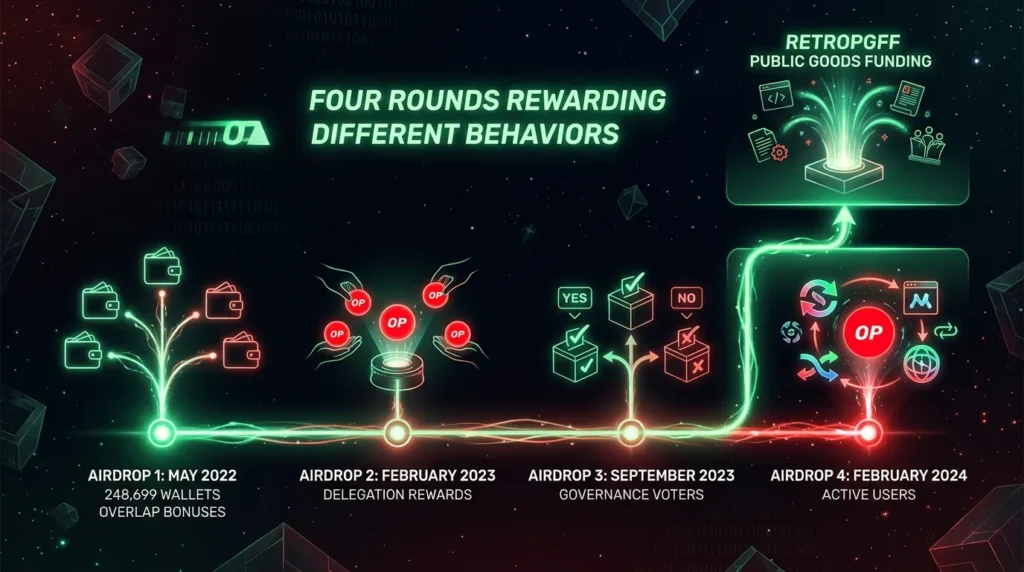
Optimism ran one of the crypto industry’s most extended and community-focused airdrop programs — four distinct rounds targeting different types of ecosystem participation.
Airdrop 1 (May 2022): The Foundation
The first OP airdrop distributed tokens to 248,699 wallet addresses based on multiple eligibility criteria:
Eligibility factors:
- Active Optimism users (transactions on OP Mainnet)
- Overlap bonuses: Users who participated in multiple ecosystems (Gitcoin donors, Snapshot voters, multisig signers, Uniswap users who also used OP) received larger allocations
- DAO voters — governance participants across Ethereum
Total distributed: ~5% of total OP supply in Airdrop 1
The overlap bonus system was philosophically meaningful — it rewarded users who demonstrated cross-ecosystem engagement rather than single-protocol maximalists. The criteria reflected Optimism’s values around public goods and collective ecosystem building.
Airdrop 2 (February 2023): Delegation Rewards
The second airdrop targeted OP governance participants — specifically users who had delegated their OP tokens to active governance delegates.
This rewarded ecosystem governance participation rather than just network usage — an unusual approach that prioritized political engagement over financial activity.
Airdrop 3 (September 2023): Governance Voters
The third airdrop directly rewarded OP holders who had voted in Optimism governance. Voting activity between January 2023 and July 2023 determined eligibility.
Airdrop 4 (February 2024): Optimism Users
The fourth and largest individual airdrop targeted active OP Mainnet users — based on transaction activity between January 2023 and January 2024. Over 22,000 addresses received tokens.
Why the Airdrop Program Was Notable
Optimism’s multi-round approach was philosophically distinct from one-time drops:
Rewarding different behaviors: Each round targeted different community segments — early adopters, governance participants, voters, active users. No single round captured everyone, but across four rounds, most genuine participants received recognition.
Retroactive Public Goods Funding (RetroPGF): Beyond the numbered airdrops, Optimism distributed significant OP through its RetroPGF program — rewarding builders who had created public goods for the Ethereum ecosystem (open-source tools, documentation, educational content). This is arguably Optimism’s most philosophically innovative contribution — the idea that past valuable work should be retroactively compensated even when it was done without expectation of reward.
The community response to the airdrop program was generally positive — seen as fair, broad, and values-aligned. The governance-focused drops were criticized by some as favoring politically active participants over everyday users, but the overall program maintained strong community goodwill.
OP Price History: ATH, Decline, and the Base Shock
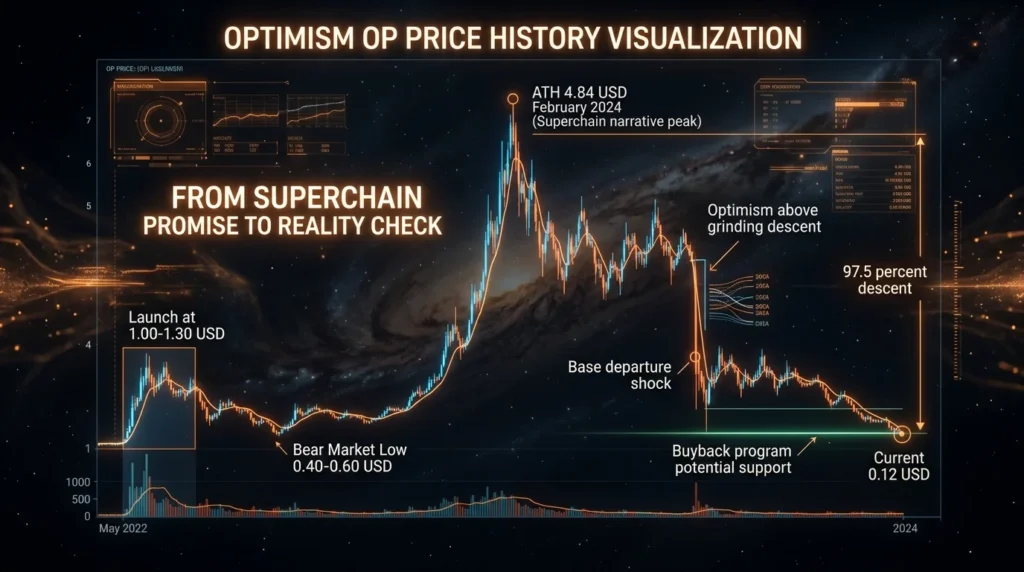
Launch and Early Trading (2022)
OP launched in May 2022 during a bear market — the same month the Terra/LUNA ecosystem collapsed. Despite the difficult environment, the token found initial buyers.
Listing price: OP launched at approximately $1.00–1.30, quickly establishing a trading range as airdrop recipients sold and new buyers entered.
2022 bear market: Like most altcoins, OP declined through the 2022 bear market — trading as low as around $0.40–0.60 range before recovering.
The Bull Market Peak: February 2024
OP’s best period coincided with the broader crypto bull market of late 2023 and early 2024 — driven by Bitcoin ETF approval anticipation and altcoin optimism.
On approximately February 5–6, 2024, OP reached its all-time high of $4.84 — roughly 4–5x from its listing price. This peak reflected genuine excitement about the Superchain narrative: multiple major companies (Coinbase, Kraken, Uniswap) building on OP Stack seemed to validate the infrastructure strategy.
The Decline: From $4.84 to $0.12
What followed the ATH was one of the most severe percentage declines in the Layer 2 token category:
2024: OP began declining almost immediately from ATH. Despite continued Superchain growth (new chains joining), the token consistently made lower highs and lower lows.
2025: Continued weakness. OP fell below $1, testing the patience of holders who had bought near the ATH.
February 2026: The Base departure announcement accelerated the decline — a 20%+ single-day drop on news that its largest revenue contributor was leaving the OP Stack ecosystem.
May 2026: OP trades approximately $0.12 — 97.5% below its $4.84 ATH.
The character of the decline: Unlike some tokens that crash suddenly, OP’s decline has been a prolonged grind — multiple attempts to recover (20–40% bounces during risk-on crypto periods) consistently met with selling pressure from ongoing token unlocks. The pattern: two steps down, one step up, repeat. Each positive development (new OP Stack chain, buyback announcement) provided temporary relief before the broader trend resumed.
Structural headwinds:
- Continuous token unlocks: Vesting schedule extends into 2029. Monthly core contributor unlocks (~0.5% of total supply) create consistent sell pressure
- 2% annual inflation: Additional inflationary pressure on top of vesting unlocks
- Base departure: Loss of ~97% of shared Superchain revenue disrupts the buyback program’s economics
- Governance token without direct fee capture (historically): Until the February 2026 buyback program, OP had no mechanism linking network usage to token value
Who Built Optimism and Who Backed It?
The Team
Optimism was founded by Jing Wang and Karl Floersch — Ethereum researchers and engineers who had previously worked on Ethereum’s core protocol development, particularly plasma and state channel research. The organization is now structured as the Optimism Foundation — a non-profit dedicated to growing the ecosystem.
The team has always been deeply ideologically aligned with Ethereum’s values — open source, public goods, decentralization. This is reflected in the RetroPGF program and the OP Stack being freely available to anyone.
The Backers
Optimism raised significant venture capital from top-tier investors. The investor list includes some of the most prominent names in crypto-native and crossover venture:
- Paradigm — co-led Optimism’s major funding rounds. One of the most respected technical crypto venture firms globally, with deep Ethereum ecosystem alignment
- Andreessen Horowitz (a16z) — participated in Optimism’s funding
- Dragonfly Capital, Coinbase Ventures, and other crypto-native funds
Total funding across multiple rounds reached approximately $170–200+ million — providing substantial resources for long-term development without immediate token sale pressure.
The backing of Paradigm in particular — whose portfolio includes Ethereum itself, Uniswap, and other foundational crypto infrastructure — provided strong technical and reputational validation for Optimism’s approach.
Key 2026 Developments
OP Token Buyback Program (February 2026): Governance approved directing 50% of Superchain revenue to monthly OP token buybacks via OTC swaps — transitioning to fully on-chain mechanisms within ~6 months. Based on ~$17.5M in annual Superchain revenue, this injects meaningful buy-side demand, directly linking OP’s value to ecosystem activity for the first time.
Base Departure from OP Stack (February 2026): Base announced transition to its own independent technology stack — taking with it the ~97% of Superchain shared revenue it had contributed. Major near-term negative for Optimism’s economic model.
ZK Proving Integration with Succinct (February 2026): Partnership to integrate ZK validity proofs across the OP Stack — targeting instant L2-to-L1 withdrawals, eliminating the 7-day fraud proof window.
OP Enterprise Launch (January 2026): Managed blockchain infrastructure offering for enterprises wanting to build on OP Stack with dedicated support.
Post-Quantum Security Roadmap (2026): 10-year plan to integrate quantum-resistant cryptography into the OP Stack.
Privacy Boost (April 2026): Sunnyside Labs launched the first privacy feature on OP Stack — using ZK proofs and trusted execution environments (TEEs) for confidential computing targeted at enterprises.
The OP Token
OP is the governance token of the Optimism Collective — a bicameral governance system managing protocol upgrades, ecosystem funding, and treasury allocation.
Token functions:
- Governance: Vote on protocol upgrades, RetroPGF rounds, ecosystem fund allocation
- Buyback target: Since February 2026, 50% of Superchain revenue funds monthly OP purchases
Previously: OP had no direct fee capture mechanism — fees went to sequencer revenue, not OP holders. The February 2026 buyback program fundamentally changes this dynamic.
OP Tokenomics (May 2026)
| Metric | Data |
|---|---|
| Price | ~$0.12 |
| Market cap | ~$258–265 million |
| Circulating supply | ~2.15 billion OP |
| Total supply | 4.294 billion OP |
| All-time high | $4.84 (February 2024) |
| All-time low | ~$0.10 |
| CoinMarketCap ranking | ~#157–159 |
| FDV | ~$520 million |
| Annual inflation | 2% per year |
Distribution
- Retroactive Public Goods Funding: 20%
- User Airdrops: 19%
- Core Contributors: 19%
- Investors: 17%
- Ecosystem Fund (unallocated + partner + seed + governance): 25%
Optimism vs. The Competition
| Optimism | Arbitrum | Base | zkSync/StarkNet | |
|---|---|---|---|---|
| Technology | Optimistic rollups | Optimistic rollups | Optimistic rollups (OP Stack) | ZK rollups |
| TVL (2026) | ~$500M+ | ~$1.8–2B | ~$2–3B | ~$200–500M |
| Withdrawal speed | ~7 days (ZK transition in progress) | ~7 days | ~7 days | Minutes-hours |
| OP Stack chains | OP Mainnet, Unichain, Ink, World Chain | N/A | Base (departing) | N/A |
| Security model | Fraud proofs (ZK transition in progress) | Fraud proofs | Fraud proofs | ZK proofs |
| Token | OP | ARB | None | Various |
| Key differentiation | OP Stack ecosystem, RetroPGF, Superchain vision | DeFi depth | Consumer adoption | ZK security |
| Key challenge | Base departure, token decline | Fee capture | Independence from OP | Ecosystem immaturity |
The Base paradox: Optimism’s greatest success story — Base adopting OP Stack — became its biggest threat when Base decided to develop independence. Optimism created the conditions for its largest customer to grow strong enough to leave.
How to Buy OP
Available on: Coinbase, Kraken, Binance, Bybit, OKX
OP is an ERC-20 token on Ethereum compatible with MetaMask, Ledger, and Trezor. It is also the native governance token on OP Mainnet.
Key Terminology
OP Stack: Optimism’s open-source, modular framework for building Ethereum Layer 2 chains.
Superchain: The growing network of OP Stack-based chains contributing to shared security and economic model.
Optimism Collective: The bicameral governance body managing the Optimism ecosystem — comprising the Token House (OP holders) and the Citizens’ House.
RetroPGF (Retroactive Public Goods Funding): Optimism’s program for retroactively rewarding builders of public goods for the Ethereum ecosystem.
Sequencer: The entity ordering and processing transactions on Optimism before Ethereum submission.
Bedrock: Optimism’s major 2023 architectural upgrade improving gas efficiency and Ethereum compatibility.
OP Enterprise: Optimism’s managed infrastructure offering for enterprise blockchain deployments (2026).
Disclaimer: This article is for informational and educational purposes only and does not constitute financial advice. Cryptocurrency investments carry significant risk, including the potential loss of all invested capital. Always conduct your own research before making any investment decisions.