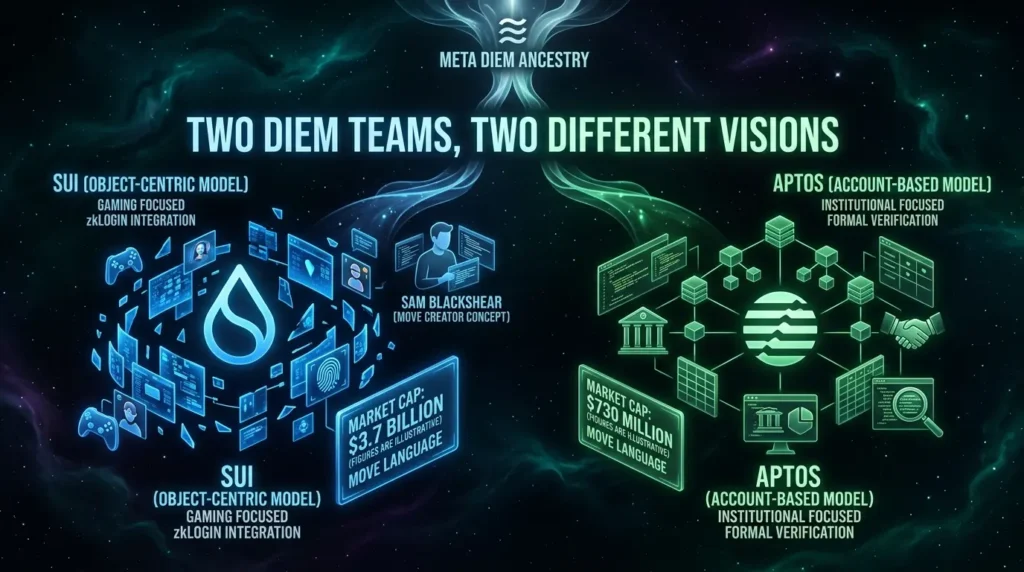
When Meta’s Diem blockchain project was shut down in early 2022, it released not one but two teams of world-class engineers who would go on to build competing blockchains. The Aptos team focused on safety and institutional adoption. The Sui team — the other group of Diem alumni — focused on a fundamentally different architectural philosophy: treating digital assets as objects, not account balances.
This seemingly subtle technical choice has profound implications for performance, composability, and user experience — and it’s the defining characteristic that separates Sui from virtually every other blockchain, including its closest competitor Aptos.
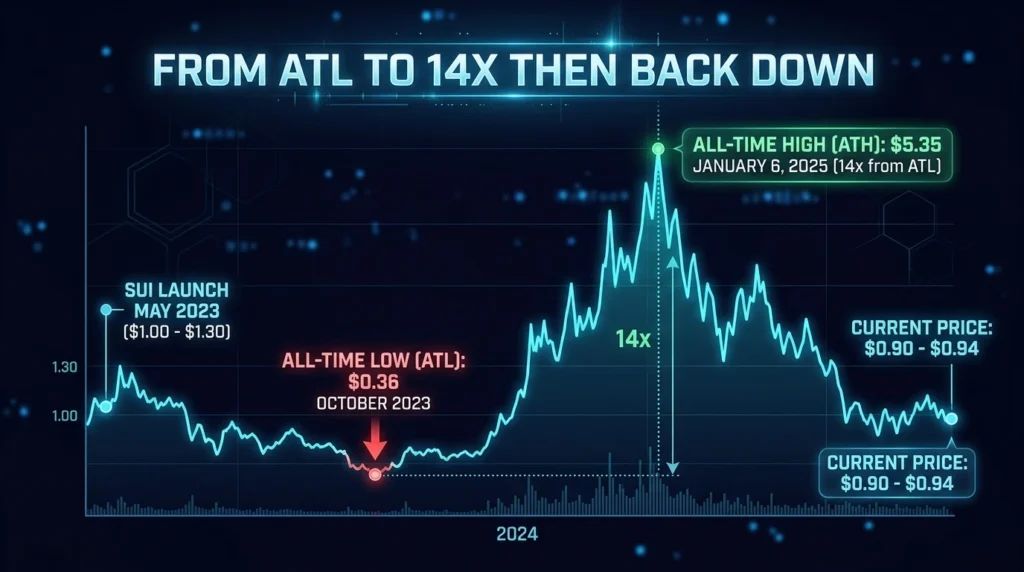
Sui trades at approximately $0.93 in April 2026, holding rank 29 globally with a market cap around $3.7 billion. Its all-time high of $5.35 was reached on January 6, 2025 — making it one of the standout performers of the 2024–2025 bull run cycle. By May 2026, SUI trades approximately $0.90–0.94, roughly 83% below its ATH but still holding a top-30 market cap position — a relative resilience compared to many Layer 1 competitors.
The Origin Story: More Diem Alumni
Meta’s Diem Legacy
Like Aptos, Sui emerged from the wreckage of Meta’s Diem blockchain project. But while the Aptos founders (Mo Shaikh and Avery Ching) came from the business and engineering leadership side of Diem, the Sui founders came from its deepest technical research layers.
Mysten Labs was founded in 2021 by five former executives and lead architects from Meta’s Novi Research — the team responsible for the Diem blockchain and the Move programming language:
- Evan Cheng — CEO, former Director of Engineering at Meta’s Novi Research
- Adeniyi Abiodun — CPO, former Product Manager at Novi
- Sam Blackshear — CTO, the original creator of the Move programming language
- George Danezis — Chief Scientist, distributed systems and cryptography researcher
- Kostas Chalkias — Chief Cryptographer, world-class cryptography expert
The presence of Sam Blackshear — the actual inventor of Move — is particularly significant. While Aptos also uses Move, Sui’s team includes the person who designed the language from scratch. This gave Sui a unique ability to evolve Move for its specific architectural needs, resulting in Sui Move — a variant of Move that differs meaningfully from the version used by Aptos.
Mainnet launch: May 3, 2023 — approximately seven months after Aptos.
What Makes Sui Different: The Object-Centric Model
This is the most important technical concept to understand about Sui — and the one most often glossed over in superficial coverage.
Traditional Account-Based Blockchains
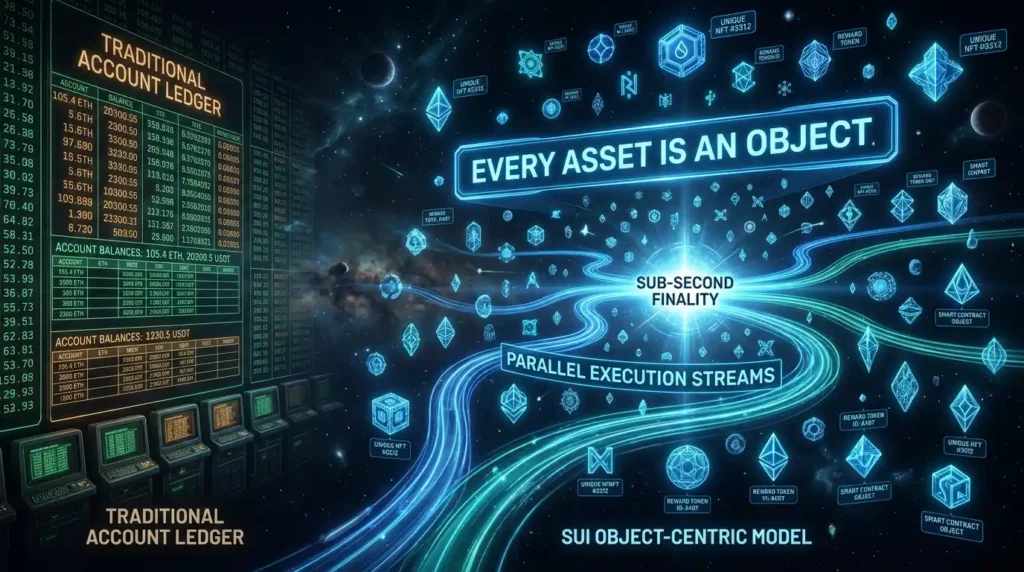
Most blockchains — Ethereum, Solana, Aptos — use an account-based model. Your assets are entries in a global ledger:
“Account 0xABCD has 2.5 ETH and 500 USDC.”
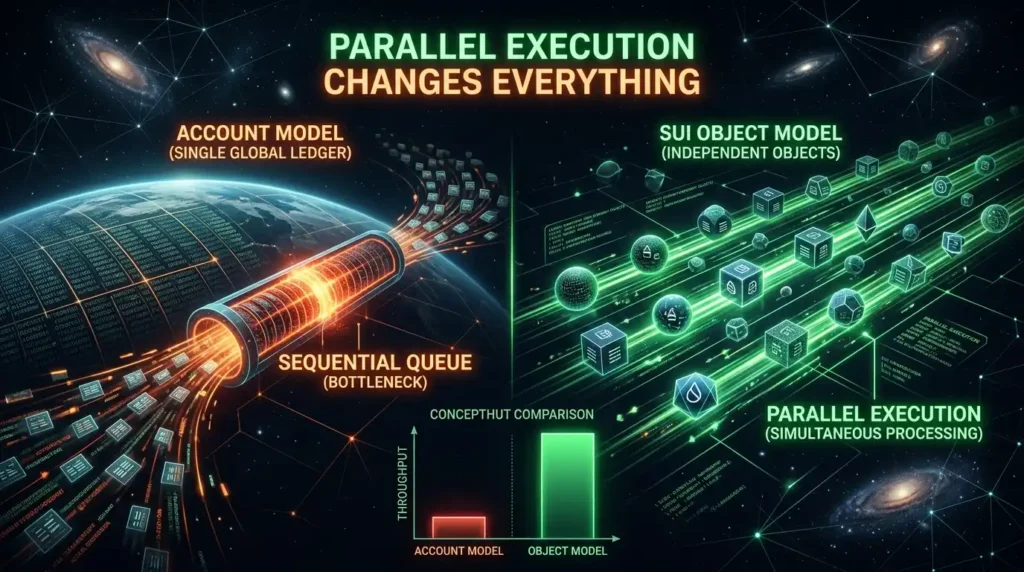
Everything is tracked as numbers associated with addresses. This model is conceptually simple but creates bottlenecks: every transaction that touches the same account must be processed sequentially, because they’re all reading and writing to the same ledger entries.
Sui’s Object Model
Sui treats every digital asset as a unique, owned object on the blockchain:
- Your 2.5 ETH is not an entry in your account — it’s a specific, uniquely identified ETH object owned by your address
- Your 500 USDC is a specific USDC object
- Your NFT is an object with its own ID and properties
- Your liquidity position in a DEX is an object
Why this matters:
True parallel execution: Because objects are independent, transactions that operate on different objects can be executed simultaneously — no waiting. A simple transfer of your personal objects (sending SUI to someone, transferring an NFT) can be processed instantly with minimal consensus overhead.
Programmable transaction blocks: Sui allows complex sequences of transactions to be composed atomically — dozens of operations bundled into a single transaction that either all succeed or all fail.
Instant finality for simple transactions: Single-owner object transactions can achieve consensus in sub-second time through a simplified fast-path consensus — without the full BFT overhead required for shared-object transactions.
zkLogin: Users can log into Sui applications using familiar web credentials (Google, Apple, Facebook OAuth) — a significant UX improvement that removes the need for seed phrase management for most users.
Sui Move vs. Aptos Move: The Sibling Languages
Both Sui and Aptos use Move, but their implementations diverge significantly — enough to make code largely non-portable between the two.
Aptos Move: Closer to the original Diem/Core Move — account-based, similar to the version developed at Meta. Focuses on safety and formal verification.
Sui Move: Extended and modified to support Sui’s object-centric model. Objects are first-class entities; the ownership model differs from Aptos Move. Optimized for the specific parallelism capabilities of Sui’s architecture.
The practical consequence: A Move developer on Aptos cannot easily deploy their code on Sui without modification, and vice versa. Despite sharing a common ancestor, Sui Move and Aptos Move are effectively different languages for practical deployment purposes.
Move’s common advantage over Solidity: Both variants share Move’s core safety properties — assets as first-class objects that can’t be accidentally duplicated or destroyed, formal verification capabilities, and resistance to entire categories of exploits common in Solidity (Ethereum’s language).
The SUI Token Launch: A Controversial Start
Unlike some projects that ran extended community programs before launch, Sui’s token distribution was more contentious and drew criticism from the community.
The Launch Controversy
Sui launched its mainnet on May 3, 2023 with a token generation event (TGE) that immediately drew criticism:
Initial circulating supply: Only ~5% of the total 10 billion SUI supply was in circulation at launch — meaning the initial market cap figures were misleading relative to the fully diluted valuation.
No traditional airdrop: Unlike Aptos (which airdropped to testnet users before launch) or Arbitrum (which ran a celebrated two-year community program), Sui launched without a significant community airdrop. There was no large distribution to early users or community members.
Large investor allocation: A significant portion of the supply was held by private investors with upcoming unlock schedules — creating predictable selling pressure.
The community reaction at launch was mixed-to-negative on the tokenomics side. Many felt the initial circulation was deceptively low and that community members who had supported the project weren’t adequately rewarded.
Post-Launch Ecosystem Incentives
While the launch lacked a traditional airdrop, Mysten Labs and the Sui Foundation subsequently deployed significant ecosystem incentive programs:
Bullshark Quests (2023–2024): On-chain activity campaigns rewarding users for specific DeFi actions — swapping, bridging, NFT transactions. Distributed SUI to active participants.
DeFi Season campaigns: Multiple rounds of liquidity incentives for major DeFi protocols on Sui — Cetus, Turbos, Aftermath Finance, DeepBook.
These programs partially addressed the community concerns from launch — but the lack of a clean, transparent initial airdrop remains a point of comparison with Aptos and Arbitrum.
SUI Price History: Explosive Rise, Sharp Correction
Launch and Early Trading (May 2023)
SUI launched in May 2023 at approximately $1.00–1.30 — during a period of moderate crypto market activity. The initial price quickly declined as early investors and validators began selling.
First significant low: SUI hit $0.3643 in October 2023 — down nearly 70% from launch and representing the all-time low. This period coincided with broad crypto market weakness and early skepticism about whether Sui could compete with established Layer 1s.
The Breakout: Late 2024 to January 2025
The real Sui story happened in 2024. While most altcoins struggled to keep pace with Bitcoin, Sui staged one of the most remarkable performances of the bull market cycle:
Mid-2024: SUI began recovering as the DeFi ecosystem on Sui expanded rapidly. Daily active addresses grew significantly. The network started attracting genuine DeFi TVL — not just speculative trading.
Q4 2024: SUI became one of the top-performing major altcoins — frequently appearing in trending lists and outperforming many larger-cap Layer 1s. The narrative of “Solana killer” gained traction as transaction volumes and ecosystem metrics improved.
January 6, 2025: SUI reached its all-time high of $5.35 — a remarkable 14x+ increase from its October 2023 lows. At peak, Sui’s market cap exceeded $20 billion. The network was processing millions of daily transactions, and DeFi TVL had grown to several billion dollars.
The 2025 Decline
After the January 2025 ATH, SUI followed the broader altcoin market into a correction:
2025 bear: SUI declined significantly from $5.35 — losing over 80% of its peak value across 2025 as the broader crypto market rotated back toward Bitcoin and macro uncertainty weighed on risk assets.
The character of the decline: Like Aptos and other high-performance Layer 1s, Sui’s decline was a grinding descent with multiple significant bounces. The network continued growing operationally during this period — adding 1 million new wallet addresses daily at peak growth — while the token price fell.
Contributing factors:
- Massive token unlocks throughout 2024–2025 (1.4 billion SUI unlocked for private investors in Q2 2024 alone)
- Broader altcoin underperformance vs. Bitcoin
- Competition from Solana (which maintained much stronger DeFi ecosystem metrics)
- High FDV (fully diluted valuation of ~$9.2 billion at current prices implies significant future dilution as remaining 60% of supply unlocks)
May 2026: SUI trades approximately $0.90–0.94 — roughly 83% below its $5.35 ATH but still rank #29–31 globally. Daily volume has reached $3.1 billion in recent sessions — approximately 6.3% of market cap, showing meaningful trading activity relative to market cap.
Who Built Sui and Who Backed It?
Mysten Labs Team
Evan Cheng (CEO) — Directed engineering at Meta’s Novi Research. Previously held senior roles at Apple (LLVM compiler) and Arm. Deep technical background in compilers and systems programming.
Sam Blackshear (CTO) — Created the Move programming language from scratch at Meta. A foundational figure in the entire Move ecosystem — both Sui and Aptos exist because of his language design work.
George Danezis (Chief Scientist) — Distinguished academic researcher in distributed systems and privacy-preserving technologies. Former professor at University College London.
Kostas Chalkias (Chief Cryptographer) — World-class cryptographer with contributions to threshold signatures, zero-knowledge proofs, and other foundational crypto primitives.
This team represents one of the deepest technical benches in the Layer 1 space — arguably stronger on pure research credentials than any competitor outside of Ethereum’s original team.
The Backers
The project raised over $300 million across multiple rounds from investors including Andreessen Horowitz, FTX Ventures (prior to its collapse), Coinbase Ventures, and others.
Breaking this down:
Series A ($36 million, December 2021): Led by Andreessen Horowitz (a16z) — the dominant crypto venture fund, known for backing Ethereum, Solana, and other foundational projects. Participating: Redpoint Ventures, Lightspeed Venture Partners, Coinbase Ventures, and others.
Series B ($300 million, September 2022): One of the largest Layer 1 funding rounds in history. Led by FTX Ventures (the venture arm of FTX, prior to its November 2022 collapse — Mysten Labs recovered from this exposure through a legal settlement). Additional participants: Binance Labs, Franklin Templeton, Dragonfly Capital, Coinbase Ventures, and others.
The FTX connection: FTX Ventures led the Series B before FTX’s collapse. Mysten Labs subsequently entered a legal settlement with the FTX bankruptcy estate, recovering the funds FTX had committed. This episode created short-term uncertainty but was ultimately resolved without lasting damage to the project.
The backing of a16z and Coinbase Ventures in the Series A, followed by the breadth of institutional participation in the Series B, provided Sui with substantial financial runway and institutional validation — essential for the long-term development program.
The Sui Ecosystem in 2026
DeFi
Sui’s DeFi ecosystem has grown significantly since launch:
- TVL: Approximately $400–600 million (varying with SUI price)
- Stablecoin supply: Growing, with USDC and USDT deployments
- Key protocols: Cetus (largest DEX by volume), Aftermath Finance, Turbos Finance, DeepBook (on-chain central limit order book native to Sui), Navi Protocol (lending), Scallop (lending)
DeepBook: Sui’s native on-chain CLOB (Central Limit Order Book) built directly into the protocol layer — enabling institutional-grade order book trading without application-layer overhead. A differentiating feature for financial applications.
Consumer Apps and Gaming
Sui’s object model and fast finality make it particularly suited for gaming and consumer applications where individual asset management (inventory items, characters, in-game assets) is central:
- Multiple blockchain gaming titles deploying on Sui
- zkLogin enabling mainstream user onboarding without seed phrases
AI Integration
In 2026, Sui has been actively positioning itself as infrastructure for AI agent ecosystems — where AI agents need to autonomously hold, transfer, and interact with digital assets. The object model’s clear ownership semantics are advantageous for this use case.
USDsui Stablecoin Mechanism
The USDsui stablecoin mechanism routes yields from backing assets to repurchase and burn SUI tokens — creating a deflationary sink and demand pressure for SUI while funding DeFi incentives and automated market-making liquidity. This mechanism represents an attempt to create sustainable, usage-driven demand for the SUI token.
CME Futures Launch (2026)
The launch of CME SUI futures in 2026 marked a significant institutional milestone — bringing SUI into the same category as Bitcoin and Ethereum as assets with regulated futures markets accessible to institutional investors.
SUI Tokenomics (May 2026)
| Metric | Data |
|---|---|
| Price | ~$0.90–0.94 |
| Market cap | ~$3.6–3.75 billion |
| Circulating supply | ~3.95–4.0 billion SUI |
| Total supply | 10 billion SUI (hard cap) |
| All-time high | $5.35 (January 6, 2025) |
| All-time low | $0.3643 (October 2023) |
| CoinMarketCap ranking | ~#29–31 |
| FDV | ~$9.0–9.4 billion |
| Annual inflation (Q2 2025) | ~3.5% (declining from 11.1% in Q2 2024) |
Distribution
- Community reserve (Sui Foundation): ~50%
- Early contributors (team): ~20%
- Investors: ~14%
- Treasury: ~10%
- Community access program: ~6%
The vesting concern: With ~60% of total supply still not yet in circulation, SUI faces significant future dilution risk. Major unlock events occurred throughout 2024–2025 (1.4 billion SUI unlocked in Q2 2024), and the schedule continues into 2026 and beyond. The declining inflation rate (from 11.1% in 2024 to 3.5% in 2025) shows improvement, but the overhang remains meaningful.
Sui vs. The Competition
Sui vs. Aptos: The Move Civil War
The most direct comparison — two teams from the same Diem ancestry, building with the same language family, competing for the same developer mindshare.
| Sui | Aptos | |
|---|---|---|
| Architecture | Object-centric | Account-based |
| Move variant | Sui Move (object model) | Aptos Move (account model) |
| Key advantage | Parallel execution, zkLogin, gaming | Institutional backing, Move Prover safety |
| Market cap | ~$3.7B | ~$730M–1.1B |
| ATH | $5.35 (Jan 2025) | $20.39 (Jan 2023) |
| Current price | ~$0.90–0.94 | ~$0.90–1.03 |
| DeFi TVL | ~$400–600M | ~$400–600M |
| Developer origin | Sam Blackshear (Move creator) | Avery Ching (Diem CTO) |
The competitive reality: Sui has overtaken Aptos in market cap — a significant reversal from the early months when Aptos launched first and captured initial attention. Sui’s object model has proven more popular with gaming and consumer application developers, while Aptos has focused more on institutional DeFi and formal verification.
Sui vs. Solana
Sui’s performance aspirations often draw comparisons to Solana — the current throughput leader with the deepest non-Ethereum DeFi ecosystem.
| Sui | Solana | |
|---|---|---|
| Market cap | ~$3.7B | ~$65–80B |
| TVL | ~$400–600M | ~$8–10B |
| Language | Move | Rust |
| Key advantage | Object model, zkLogin | Ecosystem depth, network effects |
| Weakness | Smaller ecosystem, token supply overhang | Network stability history |
Sui competes with Solana for developer attention and application deployment. Solana’s dramatically larger existing ecosystem and liquidity represent a significant competitive moat. Sui’s object model provides architectural advantages for certain use cases — particularly gaming and consumer apps with complex asset management — but hasn’t yet translated into a serious challenge to Solana’s overall ecosystem dominance.
How to Buy SUI
Available on: Coinbase, Kraken, Binance, Bybit, OKX, Gate.io
SUI is the native token of the Sui blockchain — stored in the Sui Wallet (official), Suiet Wallet, or Ethos Wallet. Not EVM-compatible — requires a Sui-native wallet.
Key Terminology
Sui Move: The variant of the Move programming language used on Sui — modified to support Sui’s object-centric model.
Object-centric model: Sui’s architecture treating every digital asset as a unique, independently owned object — enabling true parallel execution and instant finality for single-owner transactions.
Parallel execution: Processing multiple transactions simultaneously — possible on Sui because independent object transactions don’t conflict.
zkLogin: Sui feature allowing users to log into applications using OAuth providers (Google, Apple) without managing seed phrases.
Programmable transaction blocks: Sui’s ability to compose complex sequences of operations into a single atomic transaction.
DeepBook: Sui’s native on-chain central limit order book — institutional-grade trading built into the protocol layer.
Mysten Labs: The company behind Sui — founded by five former Meta Diem/Novi Research team members.
USDsui: Stablecoin mechanism on Sui that routes backing asset yields to repurchase and burn SUI tokens.
Disclaimer: This article is for informational and educational purposes only and does not constitute financial advice. Cryptocurrency investments carry significant risk, including the potential loss of all invested capital. Always conduct your own research before making any investment decisions.