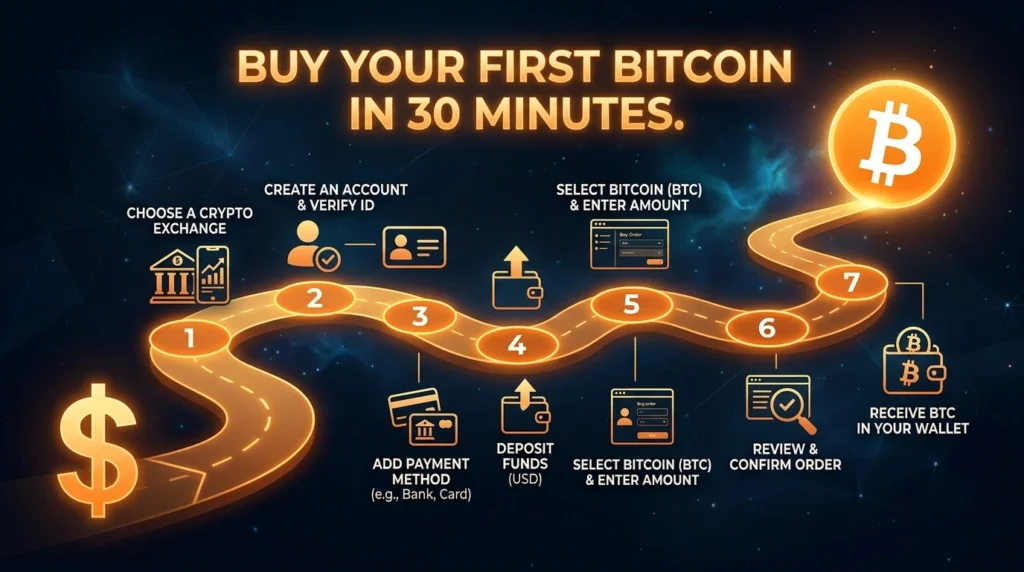
Buying Bitcoin for the first time is easier than most people expect. The entire process — from creating an account to owning your first BTC — takes about 30 minutes on most platforms, and you can start with as little as $10.
This guide walks you through every step clearly, from choosing where to buy to securing what you own.
Before You Start: 3 Things to Know
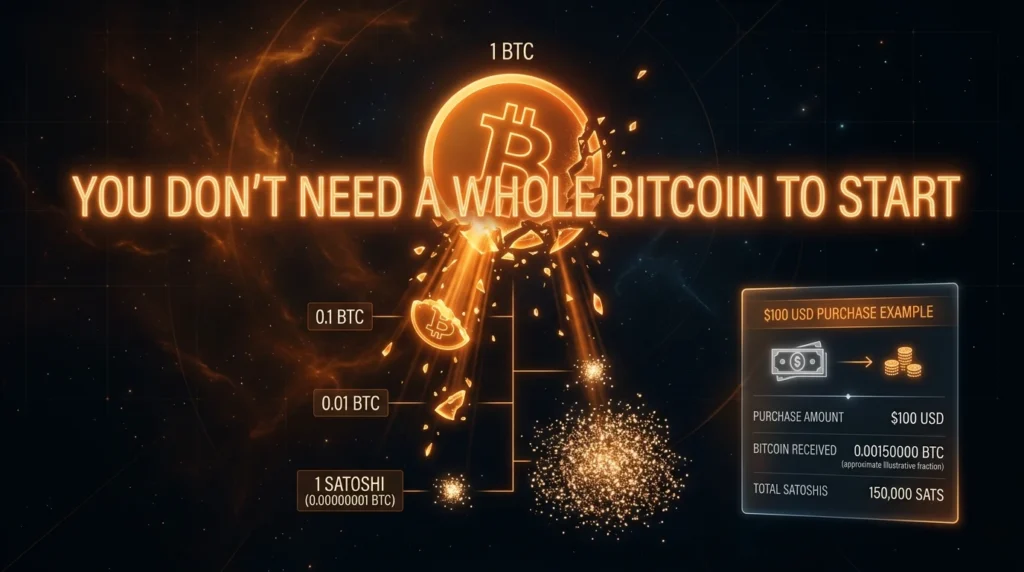
1. You don’t need to buy a whole Bitcoin.
Bitcoin is divisible to 8 decimal places. The smallest unit is called a satoshi (0.00000001 BTC). You can buy $20, $100, or $1,000 worth — whatever makes sense for you.
2. Only invest what you can afford to lose.
Bitcoin is volatile. Its price can move 10–20% in a week. Start with an amount that won’t cause you financial stress if it drops.
3. Use a regulated exchange.
In 2026, buying Bitcoin through a licensed, regulated exchange is the safest and most straightforward path. This guide focuses on that method.
Step 1: Choose Your Exchange
The exchange is the platform where you’ll buy Bitcoin with dollars (or your local currency). For first-time buyers, the most important factors are simplicity, regulation, and security — not the lowest possible fees.
Best options for first-time buyers:
Coinbase — The most beginner-friendly US-based exchange. Clean interface, clear instructions, FDIC insurance on USD balances, publicly traded on NASDAQ. Available in all US states. Fees are higher on the standard interface but the experience is the smoothest available.
Kraken — Excellent for beginners who also want room to grow. Flat 1% fee on the standard interface, transparent pricing, 14-year security track record with no customer fund losses, 24/7 phone support. Not available in Maine or New York.
Gemini — Best option for New York residents. Fully licensed under the NY BitLicense. Clean interface, strong security record.
Binance.US — Lowest fees for US users on major pairs (0% on BTC/USDT). Fewer features than global Binance but well-suited for straightforward spot purchases.
For this guide, we’ll use Coinbase as the example — the steps are nearly identical on any platform.
Step 2: Create Your Account
- Go to coinbase.com (or your chosen exchange’s official website — bookmark it, don’t search)
- Click “Get started” or “Sign up”
- Enter your email address and create a strong, unique password (use a password manager)
- Verify your email by clicking the link sent to you
Security tip: Use a dedicated email address for crypto accounts — one you don’t use for anything else. This reduces exposure if other accounts are breached.
Step 3: Complete Identity Verification (KYC)
Every regulated exchange requires identity verification — this is a legal requirement, not optional.
What you’ll need:
- Government-issued photo ID (driver’s license or passport)
- A selfie or live photo (to confirm you’re the real person)
- Sometimes: proof of address (bank statement, utility bill)
The process:
- Upload photos of your ID through the exchange’s verification flow
- Complete a selfie or video check
- Wait for approval — usually instant to a few hours, occasionally 1–2 business days
Once verified, your account is ready to fund and trade.
Step 4: Enable Two-Factor Authentication (2FA)
Before depositing anything — set up 2FA.
- Go to Account → Security → Two-Factor Authentication
- Choose Authenticator App (Google Authenticator, Authy) — NOT SMS
- Download the authenticator app on your phone
- Scan the QR code shown on the exchange
- Write down the backup codes — store them offline physically
- Enter the 6-digit code to confirm setup
This takes 5 minutes and significantly protects your account. Not enabling 2FA is the #1 cause of crypto account compromises.
Step 5: Add a Payment Method
Bank transfer (ACH) — Recommended
- Go to Payment Methods → Add Bank Account
- Enter your bank routing and account numbers
- Some exchanges require a small verification deposit
- ACH deposits are usually free and take 1–3 business days
- This is the cheapest way to buy Bitcoin
Debit card
- Instant — your Bitcoin purchase executes immediately
- Convenient but costs 2–4% extra in card processing fees
- For a $500 purchase, that’s $10–20 extra vs. a free bank transfer
Wire transfer
- Good for larger amounts ($10,000+)
- Faster than ACH but typically costs $10–25 in wire fees
For your first purchase: A debit card gets you started immediately. Once you’re comfortable, switch to ACH for lower costs.
Step 6: Place Your First Bitcoin Purchase
Simple/Instant Buy (Recommended for first-timers):
- Click “Buy” or “Buy/Sell”
- Select Bitcoin (BTC)
- Enter the dollar amount you want to spend (e.g., $100)
- The exchange shows how much BTC you’ll receive and the total fee
- Review everything, then click “Buy now” or “Confirm”
Done. You now own Bitcoin.
What you’ll see:
- Your BTC balance appears in your account immediately
- The price shown is what you paid per BTC
- Your total BTC reflects the dollar amount divided by the purchase price
Market order vs. Limit order:
- Market order (default): Buys immediately at the current price. Fast and simple. Best for beginners.
- Limit order (advanced): You set the exact price you want to pay. The order executes only when Bitcoin reaches that price. Better pricing but requires learning the advanced interface.
Start with market orders. Move to limit orders after you understand how the exchange works.
Step 7: Decide Where to Store Your Bitcoin
After buying, you have a choice:
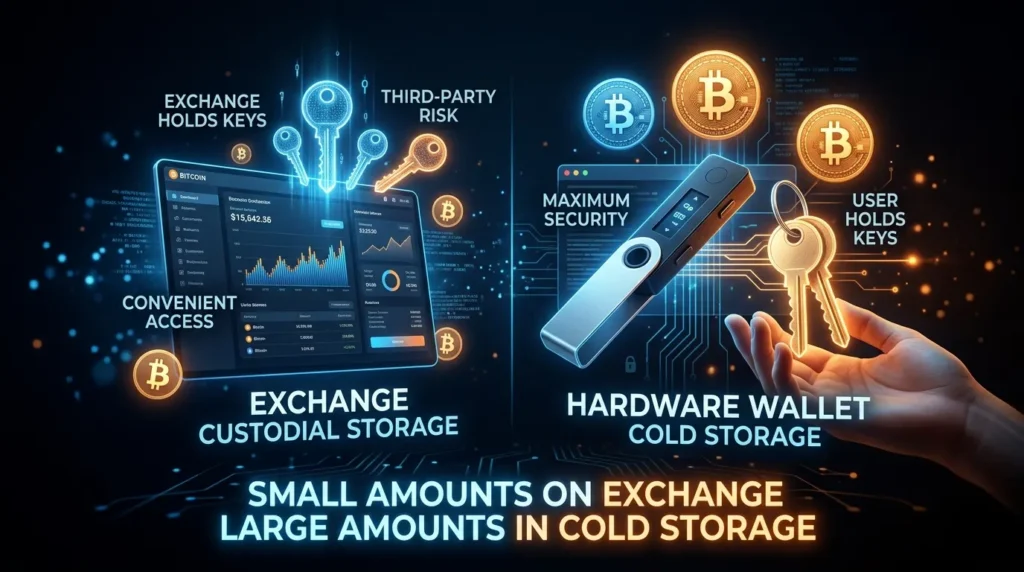
Option A: Leave it on the exchange (simplest)
Your Bitcoin stays in Coinbase’s custodial wallet. No additional setup required. Suitable for:
- Small amounts (under $1,000)
- Active buyers who plan to trade or sell soon
- Beginners still learning the basics
Option B: Transfer to a personal wallet (more secure)
Move your Bitcoin off the exchange to a wallet where you control the private keys. Suitable for:
- Larger amounts ($1,000+)
- Long-term holding (“buy and hold for years”)
- Anyone who wants full ownership and control
The safest long-term storage is a hardware wallet (Ledger or Trezor). These devices store your private keys offline — not connected to the internet, immune to exchange hacks.
Our recommendation: For your first purchase, leave it on the exchange while you learn. Once you’re comfortable and accumulating more, invest in a hardware wallet for long-term storage.
How Much Should You Buy?
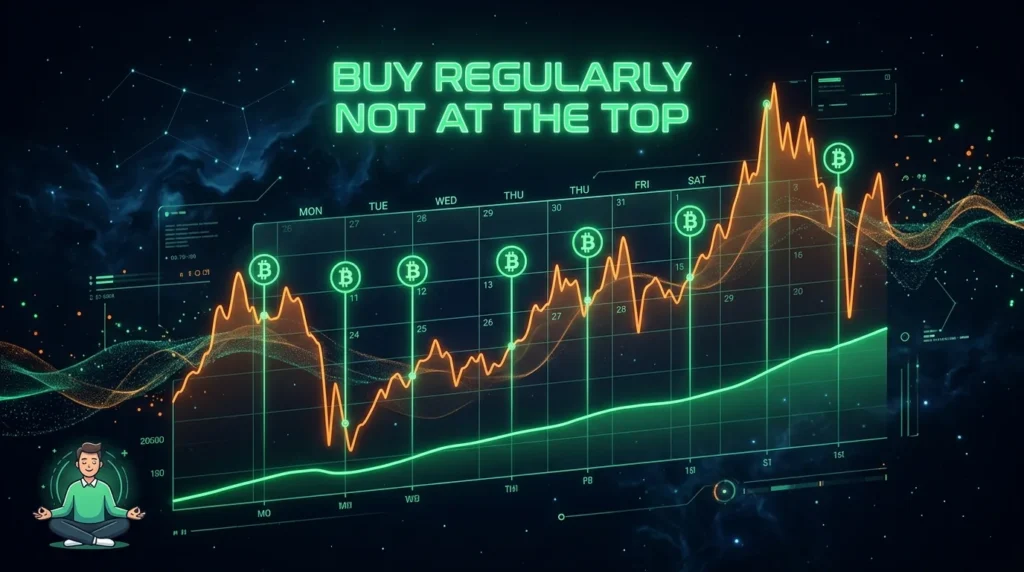
There’s no right answer — but here’s practical guidance:
Common first purchase: $50–$500
Enough to feel real and learn the process, not so much that a price drop causes significant financial stress.
Dollar-cost averaging (DCA): Instead of a single large purchase, many investors buy a fixed amount regularly — $50 every week, or $100 every month. This spreads your entry price over time and removes the pressure of trying to “time” the market.
Coinbase, Kraken, and most major exchanges offer recurring buy features — you set the amount and frequency once, and it executes automatically.
Bitcoin ETFs: An Alternative
In January 2024, the SEC approved spot Bitcoin ETFs — the first time US investors could get Bitcoin exposure through traditional brokerage accounts.
What is a Bitcoin ETF?
A Bitcoin ETF is a fund that holds Bitcoin on your behalf. You buy shares in the fund through a standard brokerage account (Fidelity, Schwab, etc.) — exactly like buying a stock.
Examples: BlackRock’s IBIT, Fidelity’s FBTC
ETF advantages:
- No crypto wallet required
- Available in IRAs and 401(k)s — potentially tax-advantaged
- Familiar brokerage interface
- Zero trading commissions at most brokerages
ETF disadvantages:
- Annual management fee (~0.25%) that compounds over time
- You don’t own actual Bitcoin — no private keys, no withdrawal
- Can’t use it in DeFi or Web3
- Depends on the fund manager
The key difference: Direct Bitcoin purchase = you own the actual asset. ETF = you own shares in a fund that owns Bitcoin. Both provide price exposure, but only direct purchase gives you real ownership.
Taxes: What First-Time Bitcoin Buyers Need to Know (US)
The IRS treats Bitcoin as property, not currency. This means:
- Buying Bitcoin: Not a taxable event
- Selling Bitcoin for profit: Taxable — capital gains tax applies
- Trading Bitcoin for another crypto: Taxable
- Spending Bitcoin on purchases: Taxable
Short-term vs. long-term:
- Hold Bitcoin for less than 1 year before selling → short-term capital gains (taxed as ordinary income, up to 37%)
- Hold for more than 1 year → long-term capital gains (0%, 15%, or 20% depending on income)
Starting in 2026: Brokers must issue Form 1099-DA for crypto transactions, showing proceeds. Keep records of your purchase price and date for every transaction.
Practical advice: Keep a simple spreadsheet of every purchase (date, amount, price paid). This becomes your cost basis when you eventually sell.
5 Mistakes to Avoid on Your First Bitcoin Purchase
1. Not enabling 2FA before depositing
Every day you have funds on an exchange without 2FA is unnecessary risk.
2. Using SMS for 2FA
SMS is vulnerable to SIM-swap attacks. Use an authenticator app.
3. Buying because of hype or FOMO
“Bitcoin just hit a new all-time high, I need to buy now!” is how people buy at peaks. A small, regular purchase schedule (DCA) removes emotion from the equation.
4. Investing more than you can afford to lose
Bitcoin can drop 50%+ in a bear market. Your first purchase should be an amount you’re comfortable watching decline — because it might.
5. Ignoring withdrawal fees when transferring
When you eventually move Bitcoin to a personal wallet, check the network fee. Bitcoin blockchain fees vary — sometimes $2, sometimes $15+. Not a disaster, just worth knowing in advance.
Key Terminology for First-Time Buyers
BTC: The ticker symbol for Bitcoin.
Satoshi: The smallest unit of Bitcoin (0.00000001 BTC). Named after Bitcoin’s creator Satoshi Nakamoto.
KYC (Know Your Customer): Identity verification process required by regulated exchanges.
Private Key: The cryptographic key that proves ownership and allows you to move Bitcoin. Never share it.
Seed Phrase: 12 or 24 words that can restore your wallet. The backup of your private keys. Store offline only.
Market Order: Buy or sell immediately at the current price.
Limit Order: Set a specific price — executes only when the market reaches that price.
DCA (Dollar-Cost Averaging): Buying a fixed dollar amount on a regular schedule — weekly, monthly — regardless of price.
Hardware Wallet: A physical device (Ledger, Trezor) that stores your Bitcoin private keys offline.
The Bottom Line
Buying Bitcoin for the first time takes about 30 minutes:
- Choose a regulated exchange (Coinbase or Kraken for US users)
- Create account, verify identity (KYC)
- Enable 2FA — authenticator app, not SMS
- Add bank account or debit card
- Buy your first Bitcoin — start small
- Decide on storage — exchange for now, hardware wallet for larger amounts later
The most important thing isn’t timing the market or finding the cheapest fees — it’s starting with a solid, regulated exchange, securing your account properly, and only investing what you can afford to lose.
Welcome to Bitcoin. 🟠
Disclaimer: This article is for informational purposes only and does not constitute financial advice. Cryptocurrency investments carry significant risk, including the potential loss of all invested capital. TheHashmark.com may receive a commission if you sign up through affiliate links, at no additional cost to you. Always conduct your own research before making any investment decisions.