When blockchain developers talk about the future of institutional finance on-chain, Avalanche keeps coming up. Not because it’s the biggest network. Not because it has the most DeFi activity. But because Avalanche solved a problem that most blockchains haven’t: how to give enterprises and financial institutions their own customizable blockchain — with their own rules, their own validators, and their own compliance requirements — while still connecting to the broader crypto ecosystem.
That vision has attracted some serious players. BlackRock deployed a $500 million tokenized fund on Avalanche. JPMorgan runs an enterprise subnet called Evergreen. VanEck launched the first US spot AVAX ETF in January 2026. The SEC classified AVAX as a digital commodity in March 2026. And real-world asset (RWA) tokenization on Avalanche has surged to $2.1 billion — doubling since April 2025.
AVAX currently trades around $8.88, has a market cap of approximately $3.8 billion, and sits around #24 by market cap. It’s down over 93% from its all-time high of $144.96. And yet, the institutional adoption story building around Avalanche in 2026 is arguably more compelling than at any point in its history.
Let’s break it all down.
The Quick Answer: What Is Avalanche?
Avalanche is a high-performance Layer 1 blockchain platform designed for speed, scalability, and — most importantly — customizable blockchain infrastructure for enterprises and institutions.
Its core innovation is the subnet architecture: the ability for any organization to launch their own dedicated blockchain with custom rules, custom validators, and custom compliance requirements, while still benefiting from Avalanche’s consensus security and interoperability.
Think of Avalanche as a blockchain operating system. The base network provides security and consensus. On top of it, anyone can deploy their own specialized chain — a financial institution runs a compliant tokenization platform, a gaming company runs a high-speed gaming chain, a government agency runs a permissioned identity network. All interconnected, all benefiting from sub-second finality.
AVAX is the native token used to:
- Pay transaction fees (which are 100% burned — creating deflation)
- Stake to become a validator or delegator and earn rewards
- Participate in subnet validation (all subnet validators must also validate the Primary Network)
- Participate in governance
Who Created Avalanche?
Avalanche was created by Ava Labs, founded in 2018 by Emin Gün Sirer — a Cornell University professor and computer scientist with decades of distributed systems research. His co-founders were Kevin Sekniqi and Maofan “Ted” Yin.
Sirer brings genuine academic credibility: he co-authored research on Bitcoin’s Selfish Mining vulnerability in 2013 and had been studying consensus mechanisms long before the blockchain boom. Avalanche launched its mainnet in September 2020 after raising $42 million in a public token sale.
The Avalanche9000 upgrade (2025) reduced the cost of launching a new subnet by 99.9% — dramatically lowering barriers for institutional deployments and making the subnet ecosystem far more accessible.
How Does Avalanche Actually Work?
The Three-Chain Architecture
Avalanche’s Primary Network consists of three built-in blockchains, each optimized for a specific purpose:
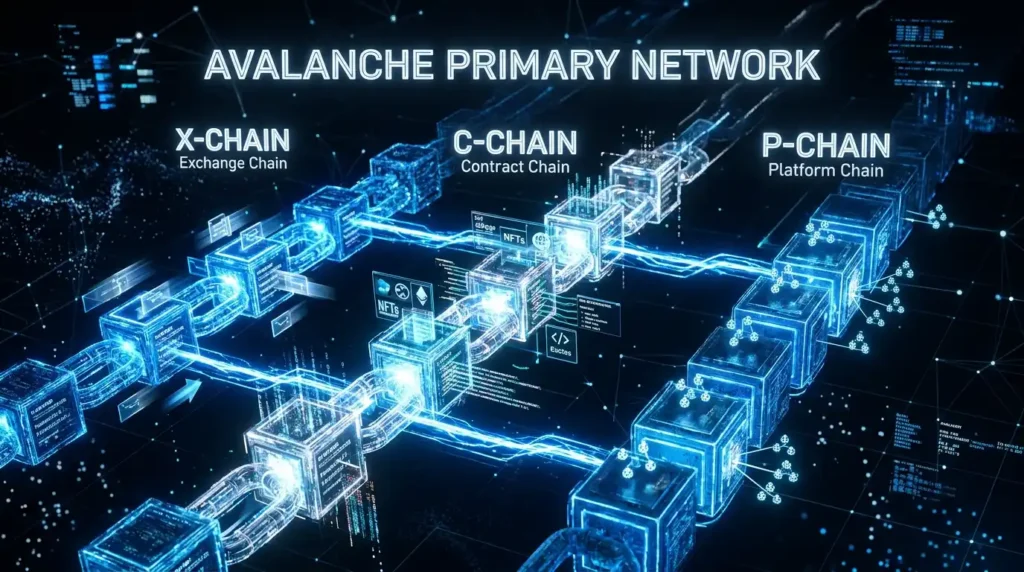
X-Chain (Exchange Chain)
- Creates and transfers digital assets, including AVAX
- Transaction fees fixed at 0.001 AVAX
- Optimized for fast asset transfers, not smart contracts
- Uses Avalanche consensus (DAG-based)
C-Chain (Contract Chain)
- Hosts smart contracts and DeFi applications
- Fully compatible with the Ethereum Virtual Machine (EVM)
- Where almost all Avalanche DApps live
- Developers can deploy Ethereum Solidity code directly
P-Chain (Platform Chain)
- Coordinates validators and staking
- Manages subnet creation and tracking
- The backbone of Avalanche’s governance and infrastructure
This three-chain design allows each function to be independently optimized. The C-Chain handles complex smart contracts without congesting the X-Chain’s asset transfers.
Avalanche Consensus: Sub-Second Finality
Avalanche uses a novel consensus mechanism — not Proof of Work, not traditional Proof of Stake, but repeated random sampling: nodes repeatedly query small random samples of other nodes. When enough samples agree, consensus locks in. This process converges in under 1 second.
Key results:
- Sub-second finality: Transactions confirmed in less than 1 second
- High throughput: 4,500+ TPS on the C-Chain
- No forks: Once confirmed, transactions cannot be reversed
- Energy efficient: No mining required
Subnets: Avalanche’s Killer Feature
A subnet (now also called an Avalanche L1) is an independent blockchain that runs on Avalanche’s infrastructure. Each subnet can have its own rules, validators, token, gas fees, and privacy settings.
The critical economic rule: every subnet validator must also validate the Primary Network by staking at least 2,000 AVAX. As subnets grow, demand for AVAX staking grows proportionally — directly linking subnet adoption to AVAX demand.
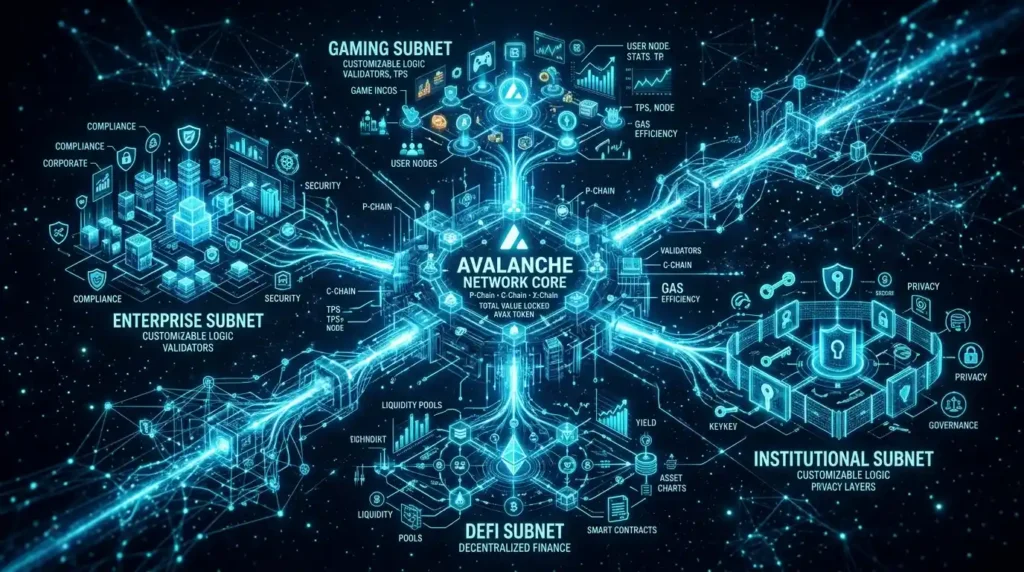
Real subnet examples in 2026:
- Evergreen (JPMorgan): Institutional DeFi with compliance layers
- Spruce (BlackRock): Tokenized fund infrastructure
- DFK Chain: Blockchain gaming
- Various RWA platforms: Tokenized bonds, securities, and structured products
AVAX Tokenomics: The Numbers That Matter
| Metric | Data |
|---|---|
| Ticker | AVAX |
| Current Price | ~$8.88 (April 2026) |
| Market Cap | ~$3.8 billion |
| Rank | ~#24 |
| Circulating Supply | ~431 million AVAX |
| Maximum Supply | 720 million AVAX (hard cap) |
| All-Time High | $144.96 (November 2021) |
| Staking APY | ~8–11% (varies by duration) |
| Min. Validator Stake | 2,000 AVAX |
| Min. Delegator Stake | 25 AVAX |
| RWA TVL on Avalanche | ~$2.1 billion |
| Fee Burn | 100% of all transaction fees |
The 100% Fee Burn: True Deflation
Avalanche burns 100% of all transaction fees. Every transaction on the network permanently destroys AVAX — no validator receives the fees, they vanish from supply entirely.
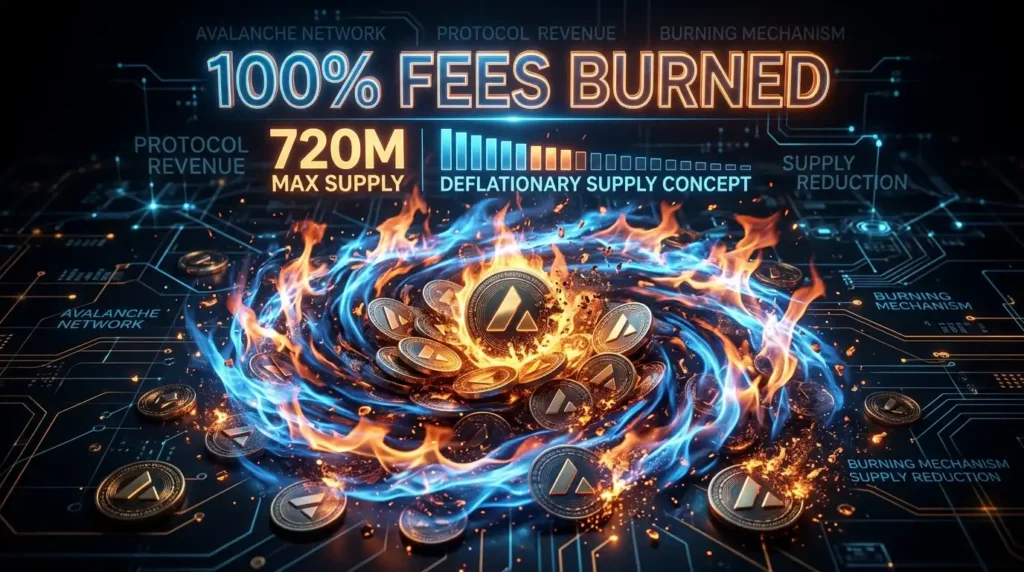
This is more aggressive than Ethereum (which burns only the base fee, with validators keeping tips). As network usage grows, AVAX supply contracts. The 720 million maximum supply becomes a theoretical ceiling — actual circulating supply will end up lower as usage increases.
The 720 Million Hard Cap
The 720 million total AVAX are distributed as follows:
- 360 million minted at genesis (circulating supply + locked allocations)
- 360 million released as staking rewards over at least 10 years
As of April 2026, approximately 431 million AVAX are in circulation — about 60% of the maximum. Remaining staking rewards release slowly over the coming decade, creating predictable supply dynamics.
2026: The Institutional Adoption Moment
VanEck Spot AVAX ETF (VAVX) — January 2026
VanEck launched VAVX — the first US spot Avalanche ETF — on January 26, 2026. Critically, this ETF includes staking rewards passed through to investors — making it a yield-generating institutional product.
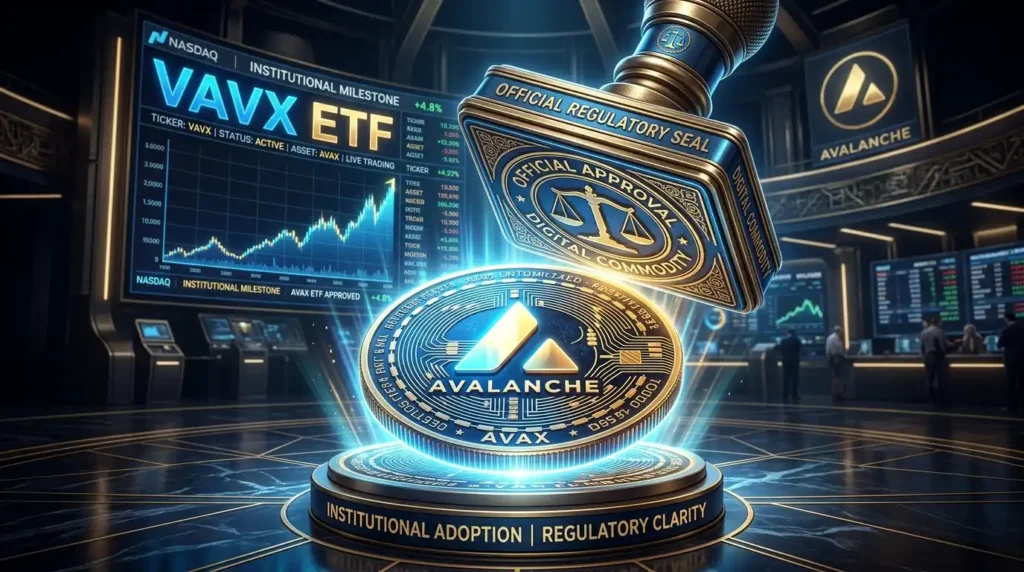
This is a significant differentiator from Bitcoin ETFs (which don’t generate yield). AVAX’s 8–11% staking APY becomes accessible to traditional investors through regular brokerage accounts — potentially a major catalyst for institutional inflows.
SEC Digital Commodity Classification — March 2026
On March 17, 2026, the SEC included AVAX in a list of 16 digital commodities — alongside Bitcoin and Ethereum. This classification shifts regulatory oversight to the CFTC, removes securities law barriers, and clears the path for additional regulated products.
$2.1 Billion in RWA Tokenization
Real-world asset tokenization on Avalanche has doubled to $2.1 billion since April 2025. Key deployments:
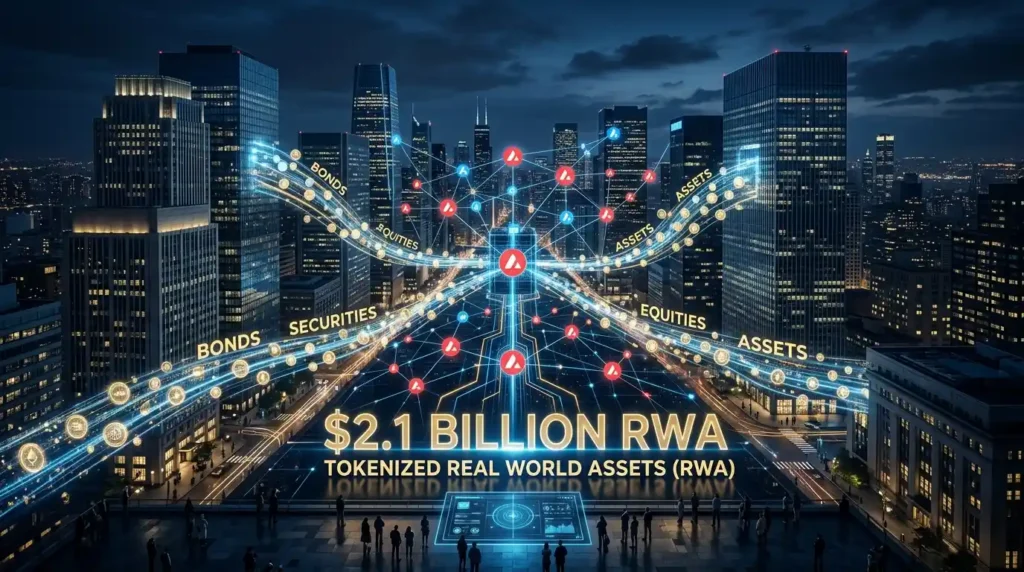
- BlackRock’s BUIDL fund ($500 million) — tokenized US Treasury fund
- Securitize — EU-regulated tokenized security platform under DLT Pilot Regime
- Intain Digital Liquidity Gateway — tokenized loans for community banks
- KB Kookmin Card (South Korea) — hybrid stablecoin payment system
- Grayscale — research projecting $19 trillion tokenization market with Avalanche as key infrastructure
Avalanche Treasury Company (AVAT)
A Nasdaq-listed entity (AVAT) plans to hold over $1 billion in AVAX — creating structured, long-term institutional buying demand and reducing circulating supply through staking.
What Is Avalanche Used For?
Institutional Finance and RWA Tokenization
Avalanche’s clearest competitive advantage: financial institutions use Avalanche subnets to tokenize traditional assets — bonds, equities, real estate, private credit — with custom compliance controls. This is the fastest-growing use case and Avalanche’s most differentiated market position.
DeFi
Avalanche’s C-Chain hosts Trader Joe (DEX), Aave, Benqi (lending), and other DeFi protocols. EVM compatibility means any Ethereum protocol can be deployed on Avalanche with minimal code changes.
Gaming
Multiple blockchain games run on dedicated Avalanche subnets — benefiting from high throughput and low fees without competing with financial transaction traffic.
Enterprise Payments
South Korea’s KB Kookmin Card is building a hybrid stablecoin payment system on Avalanche. Animoca Brands is expanding Avalanche’s gaming and entertainment ecosystem across Asia and the Middle East.
AVAX Price History: From Launch to Institutional Era
September 2020: Mainnet launches. AVAX starts around $4.
2021: The bull market. AVAX rises from ~$3 to an all-time high of $144.96 on November 21, 2021 — driven by DeFi activity and broad altcoin euphoria. Peak market cap exceeds $35 billion.
2022: Crypto winter. AVAX falls from $90+ to below $10 — a decline exceeding 93%.
2023–2024: Gradual recovery. Institutional pilots begin. AVAX recovers to $40–50 range. The subnet strategy gains credibility.
2025: Avalanche9000 upgrade launches. BlackRock and JPMorgan deployments go live. RWA TVL begins its dramatic rise.
Early 2026: AVAX trades around $8.88 — significantly below previous highs but with its strongest institutional fundamentals ever. VanEck ETF live, SEC commodity classification confirmed, $2.1B RWA TVL.
Avalanche Risks: The Honest Version
Deep drawdown from ATH: AVAX is ~94% below its all-time high. The institutional narrative has not yet translated into retail price recovery.
Competition: Ethereum’s L2 ecosystem, Solana, and other modular blockchains all compete for institutional RWA deployments. Avalanche’s subnet advantage is real but not unique — Polygon CDK and Optimism Superchain offer similar customizable infrastructure.
Institutional timeline: Enterprise blockchain projects move slowly. Generating significant on-chain volume from institutional deployments takes years. Price appreciation may lag fundamental adoption.
Retail attention elsewhere: In 2026, retail trading is concentrated on Bitcoin, Solana, and newer narratives. Avalanche’s institutional story appeals to sophisticated investors but generates less speculative excitement.
Validator barrier: The 2,000 AVAX minimum for validators concentrates validation among larger holders, raising decentralization concerns.
How to Buy AVAX in the US: Step by Step
Step 1: Choose a regulated exchange
- Coinbase — AVAX fully supported, beginner-friendly
- Kraken — strong AVAX liquidity
- Bybit — competitive trading fees
Step 2: Create and verify your account
Standard KYC — government ID required.
Step 3: Deposit funds
ACH bank transfer for lowest fees. Debit card for instant access.
Step 4: Buy AVAX
Search for AVAX or Avalanche, enter dollar amount, confirm.
Step 5: Staking options
- Core Wallet — official Avalanche wallet, supports native staking
- Ledger — hardware wallet with AVAX support for maximum security
- VanEck VAVX ETF — staking-inclusive exposure through traditional brokerage
Minimum staking amounts: 25 AVAX for delegators, 2,000 AVAX for validators.
Key Avalanche Terminology for Beginners
AVAX: Avalanche’s native token — used for fees (100% burned), staking, and governance.
Subnet / Avalanche L1: A custom blockchain built on Avalanche, with its own rules and validators.
X-Chain: Avalanche’s asset transfer chain for AVAX and token movements.
C-Chain: Avalanche’s EVM-compatible smart contract chain where DApps live.
P-Chain: Avalanche’s infrastructure chain managing validators and subnets.
Avalanche Consensus / Snowman: The novel consensus protocols enabling sub-second finality.
RWA: Real World Assets — tokenized traditional financial assets like bonds and equities.
Sub-second finality: Transactions confirmed in under 1 second — faster than any major competitor.
VAVX: The VanEck spot AVAX ETF — first US regulated staking-inclusive AVAX product.
Evergreen: JPMorgan’s institutional DeFi subnet on Avalanche.
BUIDL: BlackRock’s $500 million tokenized US Treasury fund deployed on Avalanche.
Should You Buy AVAX in 2026?
We are not financial advisors. Here’s the most balanced assessment we can offer.
The bull case for AVAX is genuinely compelling: it’s the leading platform for institutional blockchain adoption outside of Ethereum. Sub-second finality, customizable subnets, EVM compatibility, and 100% fee burn create a strong value proposition. BlackRock, JPMorgan, and VanEck are real institutional endorsements. The RWA tokenization market is projected at $19 trillion — and Avalanche is positioned at its center.
The bear case is equally honest: AVAX is 94% below its ATH and has been underperforming the broader market. Institutional adoption doesn’t automatically translate to retail price appreciation. Competition from Ethereum L2s is intense. At $8.88, AVAX either represents deep value or a sustained underperformer.
For patient investors who believe the institutional blockchain narrative is real and Avalanche has structural advantages in that space — current levels could represent an interesting long-term position. For anyone seeking near-term momentum, other options may be more suitable.
Disclaimer: This article is for informational purposes only and does not constitute financial advice. Cryptocurrency investments carry significant risk, including the potential loss of all invested capital. Always conduct your own research before making any investment decisions.