Bitcoin is digital gold. Litecoin is digital silver.
That’s the original pitch from Charlie Lee, Litecoin’s creator — and remarkably, 15 years later, it still holds up. While thousands of cryptocurrencies have launched, hyped, crashed, and disappeared since 2011, Litecoin has done something genuinely rare: it simply kept working. No major hacks. No catastrophic failures. No dramatic pivots. 380 million transactions processed without a single network interruption.
In a space defined by volatility and broken promises, Litecoin’s defining characteristic is boring reliability. And in crypto, boring reliability is worth a lot.
Litecoin (LTC) currently trades around $53–55, has a market cap of approximately $4.1 billion, and sits around #20 by market cap. It’s down significantly from its all-time high of $412.96 but has survived every crypto winter intact. The next halving is approaching in July 2027 — historically Litecoin’s most important price catalyst — and the pre-halving accumulation narrative is already building.
Let’s break it all down.
The Quick Answer: What Is Litecoin?
Litecoin (LTC) is a peer-to-peer cryptocurrency launched in 2011 as a fork of Bitcoin’s source code, designed to be faster, cheaper, and more accessible than Bitcoin for everyday transactions.
The key design differences from Bitcoin:
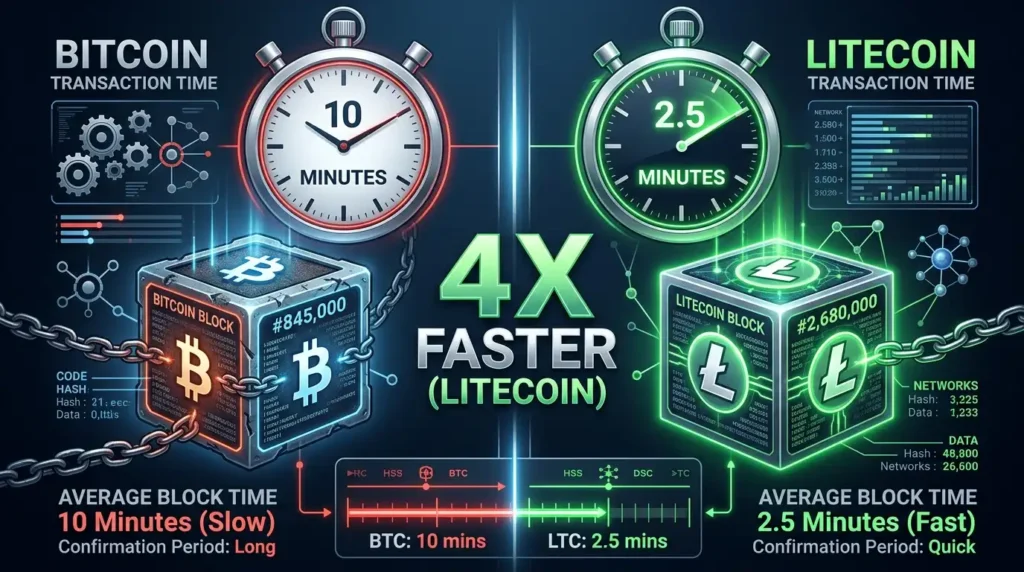
- 4x faster blocks: 2.5 minutes vs Bitcoin’s 10 minutes
- 4x more coins: 84 million maximum vs Bitcoin’s 21 million
- Lower fees: Fractions of a cent per transaction
- Scrypt algorithm: Different mining algorithm making early ASIC resistance more accessible
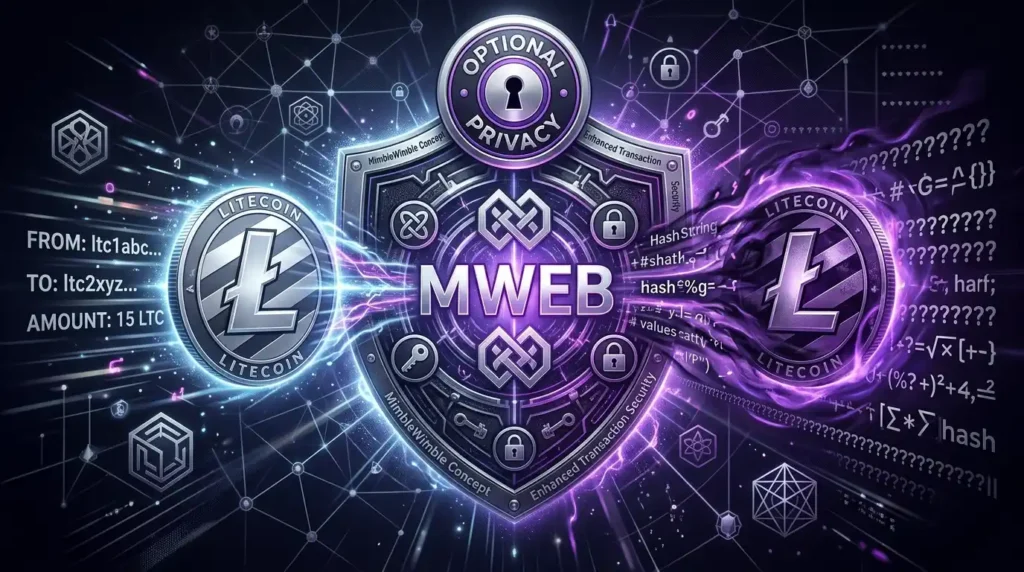
- MWEB privacy: Optional confidential transactions via MimbleWimble Extension Blocks
If Bitcoin is the savings account — a store of value you hold long-term — Litecoin was designed to be the checking account: what you actually use for day-to-day spending.
Who Created Litecoin? The Charlie Lee Story
Litecoin was created by Charlie Lee — a former Google engineer and later Coinbase engineering director — and released on October 7, 2011. Lee saw Bitcoin and recognized its potential but also its limitations for everyday use. His goal was simple: take Bitcoin’s proven foundation and optimize it for speed and accessibility.
Unlike most crypto founders, Lee launched Litecoin with no pre-mine and no ICO — he released the source code on GitHub and let anyone mine from block one. This fair launch model is one reason Litecoin has maintained credibility while many contemporaries disappeared.
In 2017, Lee made a controversial decision that raised eyebrows but was arguably principled: he sold and donated all of his LTC at near all-time high prices. His stated reason: holding LTC while leading the Litecoin Foundation created a conflict of interest — if he promoted Litecoin for personal gain, that would undermine trust. Critics said it was a top-tick sell by an insider. Supporters called it genuine integrity. The debate continues.
Lee remains active in the Litecoin ecosystem as the Litecoin Foundation’s managing director, continuing development work without holding the asset he advocates for.
How Does Litecoin Actually Work?
The Scrypt Algorithm
Litecoin uses the Scrypt hashing algorithm instead of Bitcoin’s SHA-256. Originally designed to resist ASIC mining and keep the network accessible to ordinary computers, Scrypt eventually had ASICs developed for it — but these were different from Bitcoin ASICs, creating a separate mining ecosystem.
The key result: Litecoin mining and Bitcoin mining use different hardware, meaning miners choose between the two rather than one displacing the other. This gives Litecoin its own independent security budget.
Merged Mining with Dogecoin
In a fascinating symbiosis, Litecoin can be merged mined with Dogecoin — miners simultaneously mine both coins with the same computational work. This dramatically increased Litecoin’s hashrate and security, while also keeping Dogecoin’s network secure.
The result: Litecoin has one of the highest hashrates among non-Bitcoin Proof of Work cryptocurrencies — far more secure than its market cap alone would suggest.
MimbleWimble Extension Blocks (MWEB)
In May 2022, Litecoin activated MimbleWimble Extension Blocks (MWEB) — one of its most significant upgrades ever.
MWEB is an optional privacy layer that allows users to:
- Hide transaction amounts
- Hide sender and receiver information
- Benefit from improved scalability (smaller block sizes)
The key word is “optional.” Users choose whether to use MWEB privacy features or standard transparent transactions. This design was intentional — making privacy opt-in rather than default addresses regulatory concerns about mandatory privacy coins, while still providing strong confidentiality for those who need it.
The regulatory tradeoff: Despite the opt-in design, several South Korean exchanges (Upbit, Bithumb, Coinone, Korbit) delisted LTC after MWEB activation because their regulations require full transaction transparency. This is a genuine adoption headwind in privacy-sensitive regulatory environments.
Block Time and Transaction Speed
Litecoin’s 2.5-minute block time means transactions achieve their first confirmation roughly 4x faster than Bitcoin. Combined with very low fees (fractions of a cent), this makes Litecoin genuinely practical for payments in a way that Bitcoin often isn’t for small transactions.
The network processes approximately 54 transactions per second — significantly more than Bitcoin’s ~5 TPS, though far less than high-throughput networks like Solana or Visa.
Litecoin Tokenomics: The Numbers That Matter
| Metric | Data |
|---|---|
| Ticker | LTC |
| Current Price | ~$53–55 (April 2026) |
| Market Cap | ~$4.1 billion |
| Rank | ~#20 |
| Circulating Supply | ~76.84 million LTC |
| Maximum Supply | 84 million LTC (hard cap) |
| % Already Mined | ~91.5% |
| All-Time High | $412.96 (May 10, 2021) |
| Block Time | ~2.5 minutes |
| Current Block Reward | 6.25 LTC |
| Next Halving | July 2027 |
| Post-Halving Reward | 3.125 LTC |
| Total Transactions | 380 million+ (zero interruptions) |
| Spot ETF | Canary LTCC on Nasdaq (October 2025) |
The 84 Million Cap: Silver to Bitcoin’s Gold
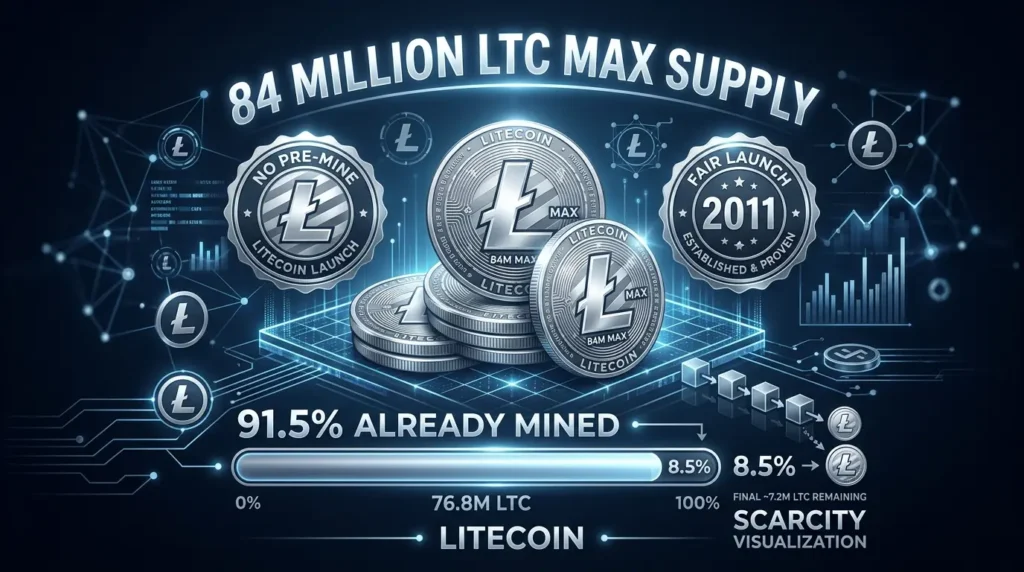
Litecoin’s maximum supply of 84 million coins is exactly 4x Bitcoin’s 21 million cap. This was deliberate — a nod to silver’s historical relationship with gold, where silver circulates more widely while gold is stored as reserve value.
With approximately 76.84 million LTC already mined (91.5% of maximum supply), Litecoin is approaching full issuance. The remaining ~7.16 million LTC will be mined gradually over the coming century, with halvings reducing the rate every four years until the last LTC is mined around 2142.
No Pre-Mine: Why It Matters
Unlike Ethereum (significant pre-sale allocation), Ripple (retained massive XRP reserves), and many other cryptocurrencies, Litecoin had zero pre-mine. Every LTC ever created was earned through mining. This gives Litecoin a legitimacy argument that few cryptocurrencies can match.
The Halving Cycle: Litecoin’s Most Important Pattern
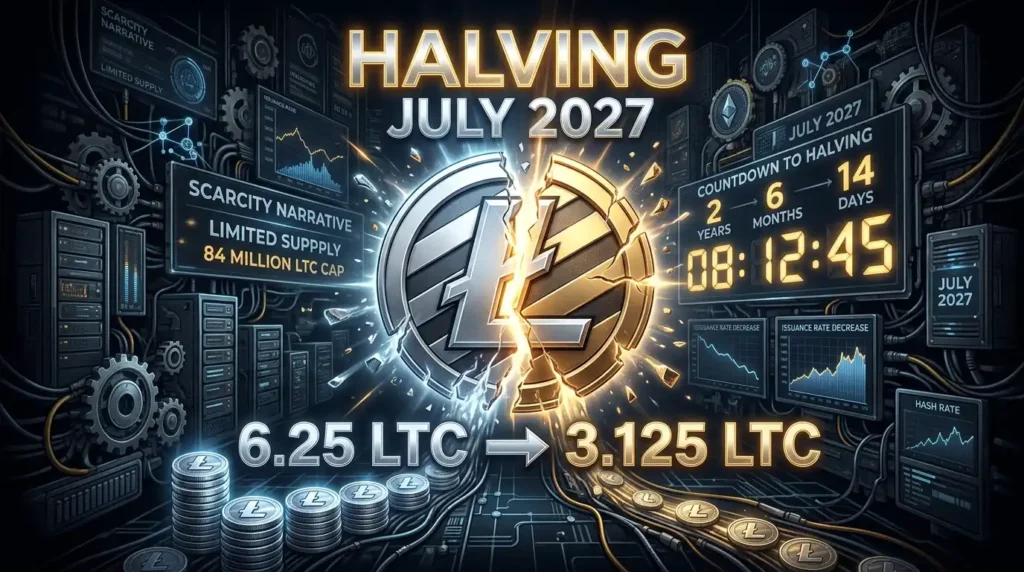
Litecoin undergoes a halving approximately every 4 years (every 840,000 blocks), reducing the block reward by 50%. Here’s the complete halving history and price behavior:
Halving 1 — August 25, 2015
- Reward: 50 → 25 LTC
- Pre-halving rally, then sell-the-news decline
- Part of the broader 2015 crypto recovery
Halving 2 — August 5, 2019
- Reward: 25 → 12.5 LTC
- LTC rallied from $29 to $145 in June 2019 (pre-halving anticipation)
- Sold off immediately after the event — classic “buy the rumor, sell the news”
- Closed 2019 at $41
Halving 3 — August 2, 2023
- Reward: 12.5 → 6.25 LTC
- Pre-halving rally to $114 in July 2023
- Same pattern: sold off after the event
- Closed 2023 at $72 (only +4% for the year vs Bitcoin’s +150%)
The pattern: Litecoin’s halvings don’t work like Bitcoin’s. Bitcoin halvings have historically preceded major bull runs (with a 12–18 month lag). Litecoin’s halvings generate pre-event rallies that are then sold. The post-halving supply reduction effect is real but plays out more slowly.
Next Halving — July 2027
- Reward: 6.25 → 3.125 LTC
- Pre-halving anticipation typically begins 12–18 months before the event
- 2026 is the pre-halving accumulation window
Litecoin Price History: 15 Years of Survival
2011: Litecoin launches at essentially zero. Early adopters mine with CPUs and GPUs.
2013: First major bull run. LTC reaches $40 amid Bitcoin’s first major surge — an incredible gain for a 2-year-old coin with no marketing budget.
2015–2016: Crypto winter. LTC falls to $1.15 — its all-time low. The Litecoin Foundation forms and continues development.
2017: The great altcoin bull market. LTC rises from ~$3 to $370 in December 2017 — roughly a 12,000% gain in one year. Charlie Lee sells his holdings at this peak.
2018–2019: Bear market. LTC falls from $370 to $22. Second halving drives pre-event rally to $145 in June 2019, then sell-off.
2020: COVID crash briefly sends LTC below $25. Then one of its best years — closes 2020 at $124, up 202%. Institutional money enters crypto broadly.
May 10, 2021: All-time high of $412.96 — riding Bitcoin’s surge above $60K and mass retail adoption.
2022: Crypto winter. Terra/LUNA collapse and FTX implosion devastate markets. MWEB launches but triggers South Korean exchange delistings. LTC closes at $70.
2023: Third halving drives pre-event rally to $114 in July, then sell-off. Closes at $72 — only +4% in a year when Bitcoin gained 150%.
2024: Opens at $68, rallies to $102 alongside Bitcoin’s halving momentum, crashes to $49, then surges past $100 again in Q4 as Bitcoin crosses $100K. Closes near $143.
Early 2026: LTC trades around $53–55 — below January 2026 highs above $80. Consolidating in a $50–55 range. Next halving in July 2027 is beginning to attract pre-halving attention.
What Is Litecoin Used For?
Payments and Everyday Transactions
Litecoin’s primary use case has always been payments — fast, cheap, reliable digital cash. The Litecoin Foundation reports 380 million lifetime transactions with zero network interruptions. In just the first months of 2026, the network processed 11.5 million transactions.
Real merchants and payment processors accept LTC globally. Litecoin’s transaction fees (fractions of a cent) and 2.5-minute confirmation times make it practical for in-person and online purchases in a way that Bitcoin’s higher fees and slower confirmations don’t always permit.
Private Transactions (MWEB)
For users who need financial privacy, MWEB provides optional confidential transactions on a proven, decade-old network. This is more conservative than dedicated privacy coins (Monero, Zcash) but more accessible than no privacy at all.
Testing Ground for Bitcoin Innovations
Litecoin has historically served as Bitcoin’s testnet for major protocol upgrades:
- SegWit (Segregated Witness): Activated on Litecoin in 2017, before Bitcoin
- Lightning Network: Implemented on Litecoin, helping validate the technology
- MimbleWimble: Implemented on Litecoin (Bitcoin ultimately chose not to adopt it)
This “testbed” role gives Litecoin a genuine relationship with Bitcoin’s ecosystem rather than positioning itself as a pure competitor.
Canary Litecoin ETF (LTCC) — Institutional Access
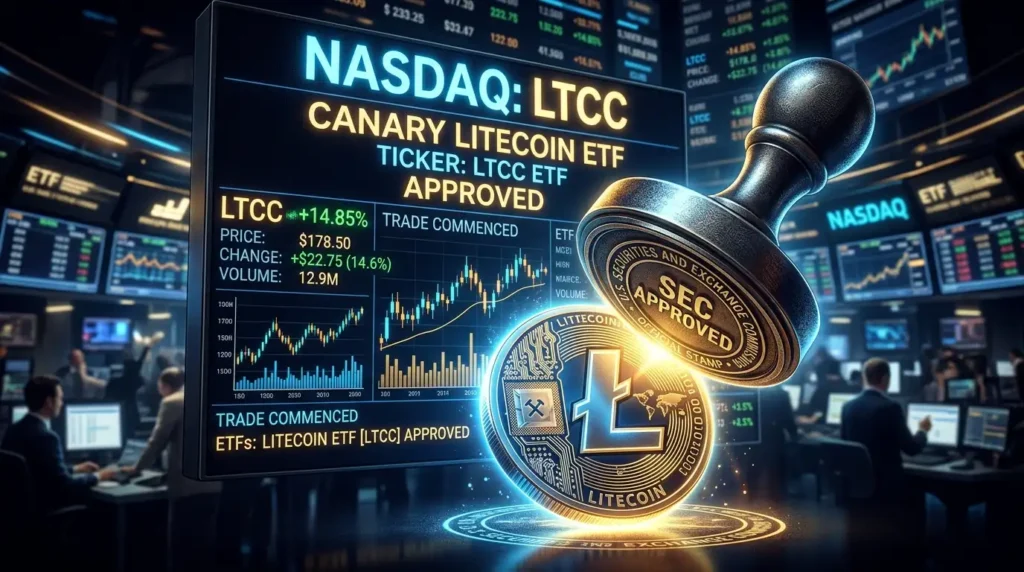
On October 27, 2025, Canary Capital launched the Canary Litecoin ETF (Nasdaq: LTCC) — the first-ever spot Litecoin ETF approved by the SEC. This is a landmark moment for LTC’s institutional legitimacy.
Key facts about LTCC:
- Listed on Nasdaq under ticker LTCC
- SEC-registered investment vehicle — fully regulated
- Accessible via brokerage accounts, self-directed IRAs, and tax-advantaged accounts
- Custodians: BitGo Trust and Gemini Trust Company
- Tracks LTC price via CoinDesk Litecoin Price Index
This makes Litecoin one of only a handful of cryptocurrencies (alongside Bitcoin, Ethereum, XRP, Solana) with an SEC-approved spot ETF in the United States — a significant validation of LTC’s regulatory standing and institutional appeal.
Store of Value (Secondary)
Increasingly, long-term holders treat LTC as a secondary store-of-value asset — a lower-priced, more accessible version of Bitcoin with similar fundamental properties (fixed supply, PoW consensus, proven security).
Litecoin Risks: The Honest Version
The irrelevance risk: Litecoin’s core advantages — faster transactions, lower fees — are no longer unique. Solana settles in 400ms for fractions of a cent. TRON processes USDT at near-zero cost. Even Bitcoin’s Lightning Network offers instant, cheap payments. The “digital silver” narrative requires a reason to use LTC specifically, not just fast/cheap crypto generally.
Halving underperformance: Unlike Bitcoin, Litecoin’s post-halving supply shocks have historically generated pre-event rallies followed by sell-offs. The 2027 halving narrative may follow the same pattern: excitement before, disappointment after.
MWEB regulatory risk: Privacy features create ongoing regulatory uncertainty. Further exchange delistings (beyond South Korea) are possible, particularly if global regulations tighten around privacy-capable cryptocurrencies.
Development activity: Litecoin is a relatively small, focused team. Development velocity is slower than well-funded Layer 1 platforms. The ecosystem has fewer applications and less developer activity than most top-20 blockchains.
Competition from stablecoins: For actual payment use cases, USDT on TRON or USDC on Solana are increasingly competitive — they’re fast, cheap, and don’t expose users to crypto price volatility during transactions.
How to Buy Litecoin in the US: Step by Step
Step 1: Choose a regulated exchange
- Coinbase — LTC fully supported, most beginner-friendly US platform
- Kraken — strong LTC liquidity, well-regulated
- Gemini — regulated, clean interface, supports LTC
Step 2: Create and verify your account
Standard KYC — government ID required.
Step 3: Deposit funds
ACH bank transfer for lowest fees. Debit card for instant access.
Step 4: Buy LTC
Search for LTC or Litecoin, enter dollar amount, confirm. At ~$53, one full LTC is accessible even for small investors.
Step 5: Storage
- Litecoin Core — the official full node wallet, maximum security and self-sovereignty
- Electrum-LTC — lightweight desktop wallet
- Ledger / Trezor — hardware wallets both support LTC for cold storage
- Trust Wallet — mobile wallet with LTC support
- Canary LTCC ETF — regulated exposure via brokerage or IRA account (Nasdaq: LTCC)
For MWEB private transactions: use a wallet that supports MWEB (Litecoin Core, some others).
Key Litecoin Terminology for Beginners
LTC: The ticker symbol for Litecoin — the native currency of the Litecoin network.
Scrypt: Litecoin’s mining algorithm — different from Bitcoin’s SHA-256, requiring different hardware.
Halving: The scheduled reduction of block rewards by 50% every 840,000 blocks (~4 years). Next halving: July 2027.
Block reward: The LTC paid to miners for each successfully mined block. Currently 6.25 LTC.
MWEB (MimbleWimble Extension Blocks): Litecoin’s optional privacy feature hiding transaction amounts and participants.
Merged mining: The ability to simultaneously mine LTC and DOGE with the same hardware.
Charlie Lee: Litecoin’s creator, former Google engineer and Coinbase director.
Litecoin Foundation: The non-profit organization supporting Litecoin’s development and adoption.
Silver to Bitcoin’s Gold: The founding metaphor positioning LTC as the more liquid, everyday-use complement to Bitcoin’s store-of-value role.
Fair launch: No pre-mine, no ICO — all LTC created through mining from block one.
Should You Buy Litecoin in 2026?
We are not financial advisors. And full disclosure: we know some of our readers hold LTC as a significant portfolio position — so we’ll be especially honest here.
The bull case for LTC: It’s been alive and functional for 15 years without a single major failure. That durability is genuinely rare and valuable. The next halving in July 2027 will reduce daily LTC supply by half — and historically, the 12–18 months before a halving are the most favorable accumulation period. At $53 with 91.5% of supply already mined, the new supply entering the market is minimal. MWEB adds genuine privacy utility. Merged mining with Dogecoin means security is higher than market cap suggests. And LTC has survived bear markets that killed thousands of competitors.
The honest caution: Litecoin has consistently underperformed Bitcoin in every recent cycle. The “digital silver” narrative requires people to actually use LTC for payments — but stablecoins and faster networks are increasingly filling that role. Three halvings have produced pre-event rallies and post-event disappointments. Development is slow relative to competitors.
The most realistic framing: Litecoin is a conservative, lower-volatility crypto asset that tends to participate in bull markets while preserving capital better than most altcoins in bear markets. It’s not a moonshot. It’s the old reliable truck in a fleet of sports cars — not glamorous, but it’s never broken down.
For a long-term, diversified crypto portfolio with limited downside expectations — LTC has a case. For maximum upside potential — there are likely better options in the current cycle.
Disclaimer: This article is for informational purposes only and does not constitute financial advice. Cryptocurrency investments carry significant risk, including the potential loss of all invested capital. Always conduct your own research before making any investment decisions.