Shiba Inu was created in August 2020 by an anonymous developer known only as “Ryoshi” — explicitly as a joke, explicitly to rival Dogecoin, and explicitly with no serious purpose. One quadrillion tokens were minted. Half were sent to Ethereum co-founder Vitalik Buterin as a prank (he donated most to COVID-19 relief and burned the rest). The other half were locked in a Uniswap liquidity pool.
That’s where SHIB’s story should have ended. Instead, it became the second-largest meme coin on Earth.
Six years later, Shiba Inu has evolved from a pure joke into something more complex — an ecosystem with its own Layer 2 blockchain, decentralized exchange, governance token, and multi-token economic model. It’s been classified as a digital commodity by US regulators. It’s been added to Japan’s “Green List” alongside Bitcoin and Ethereum. It has 270 million wallet addresses. It has processed over 1.5 billion transactions on its Shibarium Layer 2.
And yet, as of April 2026, SHIB trades at $0.0000059 — down over 93% from its all-time high. The burn mechanism removes tokens at a pace mathematically insufficient to move the price on its own. Shibarium has low TVL. And “SHIB to $1” — the community’s most cherished dream — would require a market cap larger than the combined GDP of every country on Earth.
This is SHIB’s story: the meme coin that got serious, and the math that won’t let it be free.
The Quick Answer: What Is Shiba Inu (SHIB)?
Shiba Inu (SHIB) is an Ethereum-based ERC-20 token that launched as a meme cryptocurrency in 2020 and has evolved into a multi-token ecosystem built around the Shibarium Layer 2 network.
Unlike Dogecoin (which runs on its own blockchain), SHIB is built on Ethereum — giving it access to Ethereum’s security and DeFi infrastructure from day one. This technical foundation allowed the Shiba Inu team to build increasingly sophisticated products on top of the original meme token.
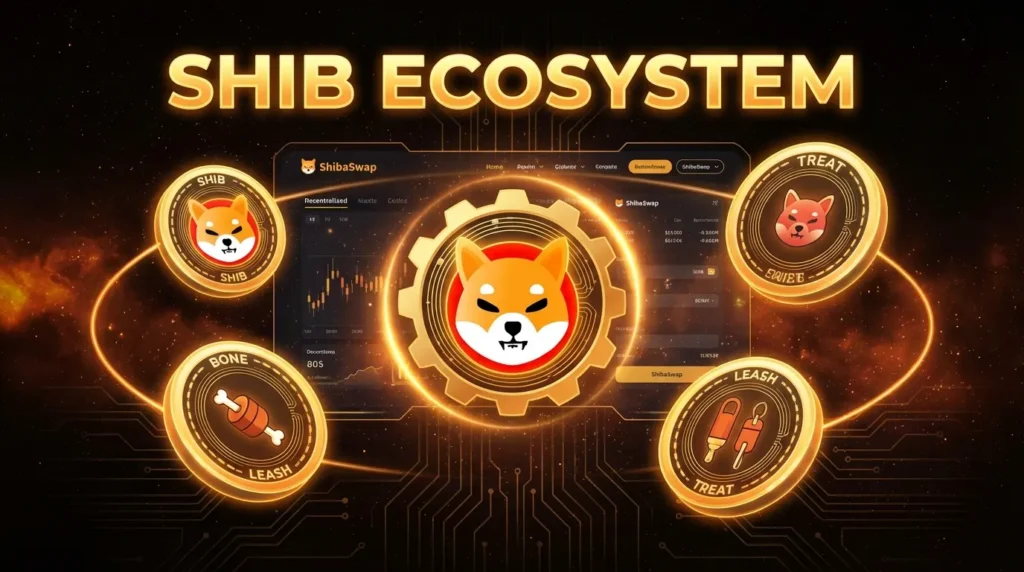
The SHIB ecosystem in 2026 includes:
- SHIB — the flagship community token and ecosystem reserve currency
- BONE — the governance and gas token for Shibarium
- LEASH — a scarce ecosystem token with limited supply
- TREAT — a newer token tied to AI integration plans
- ShibaSwap — the ecosystem’s decentralized exchange
- Shibarium — SHIB’s Layer 2 blockchain
- Shib Alpha Layer — a Layer 3 (L3) rollup abstraction stack
Who Created Shiba Inu?
Shiba Inu was created in August 2020 by Ryoshi — an anonymous developer whose identity remains unknown to this day. The name references the Shiba Inu breed of Japanese dog — the same breed featured in the original Doge meme.
Ryoshi’s founding philosophy was deliberately anti-establishment: SHIB was decentralized from day one, with no pre-mine for founders, no VC allocation, and no central authority. The anonymous creator eventually stepped back entirely, handing the ecosystem to its community.
Shytoshi Kusama — also pseudonymous — emerged as the lead developer and ambassador, driving SHIB’s evolution from meme coin to ecosystem project. In 2026, the project is governed through the SHIB DAO (Decentralized Autonomous Organization), with ongoing governance elections to select leadership councils and visionaries.
The “Welly’s” fast food chain in Italy is connected to the SHIB ecosystem — an unusual real-world adoption attempt that doubled as a marketing initiative. More significantly, the Shibarium bridge exploit in September 2025 resulted in lost funds, and the team is compensating affected users through “Shibarium SOUs” — NFT-based IOU tokens stored permanently on Ethereum.
How Does SHIB Actually Work?
SHIB as an ERC-20 Token
At its core, SHIB is a standard Ethereum ERC-20 token — meaning it lives on the Ethereum blockchain, uses Ethereum’s security for transaction validation, and can be used in any Ethereum-compatible DeFi application.
The original supply was 1 quadrillion SHIB (1,000,000,000,000,000). That’s one thousand trillion tokens — a number so large that “SHIB to $1” would require a market capitalization larger than the entire global economy combined.
Through the burn mechanism, approximately 410 trillion SHIB have been permanently destroyed since launch, leaving approximately 589 trillion in circulation as of 2026.
Shibarium: The Layer 2 Network
Launched in 2023, Shibarium is SHIB’s Ethereum Layer 2 blockchain — designed to process transactions faster and cheaper than Ethereum’s mainnet. By running transactions on Shibarium and settling them on Ethereum, the network offers:
- Lower transaction fees
- Faster confirmation times
- A dedicated environment for SHIB ecosystem DApps
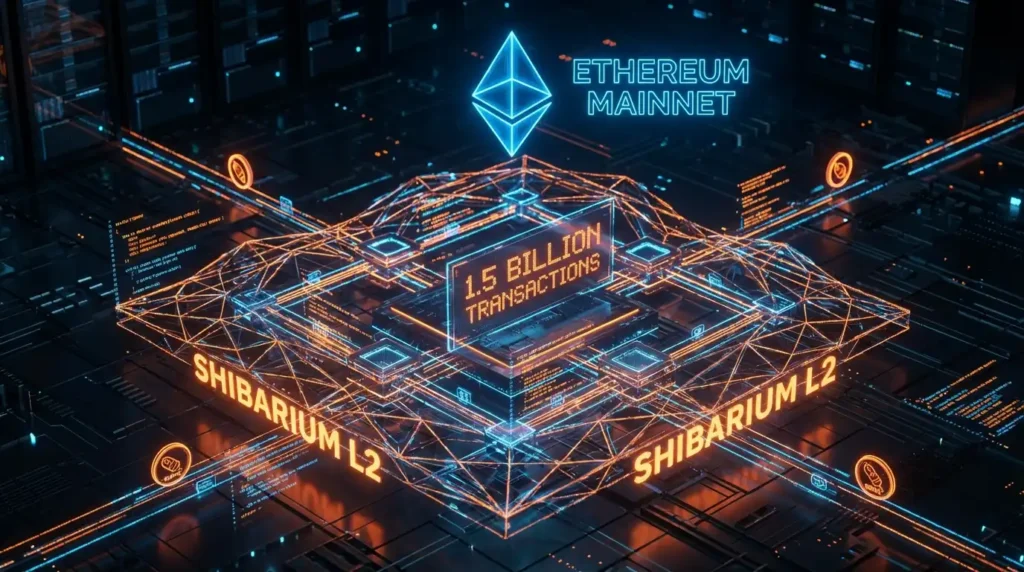
As of March 2026, Shibarium has processed 1.5+ billion transactions — a meaningful adoption metric, though its Total Value Locked (TVL) remains low relative to major L2 competitors.
BONE is the gas token for Shibarium — meaning users pay transaction fees in BONE, not SHIB. However, a portion of Shibarium transaction fees is converted to SHIB and burned automatically, creating the deflationary link between network activity and SHIB’s supply.
The Burn Mechanism: The Math Reality Check
The burn mechanism is SHIB’s most discussed feature — and the source of both excitement and frustration.
Every transaction on Shibarium triggers a small automatic SHIB burn. Community-driven burn events add more. Large holders (“whales”) voluntarily burn tokens. The result: 410+ trillion SHIB burned since launch.
The math problem:
- Starting supply: 1 quadrillion SHIB
- Burned: ~410 trillion
- Remaining: ~589 trillion
- Daily burn rate (average): ~100–200 million SHIB
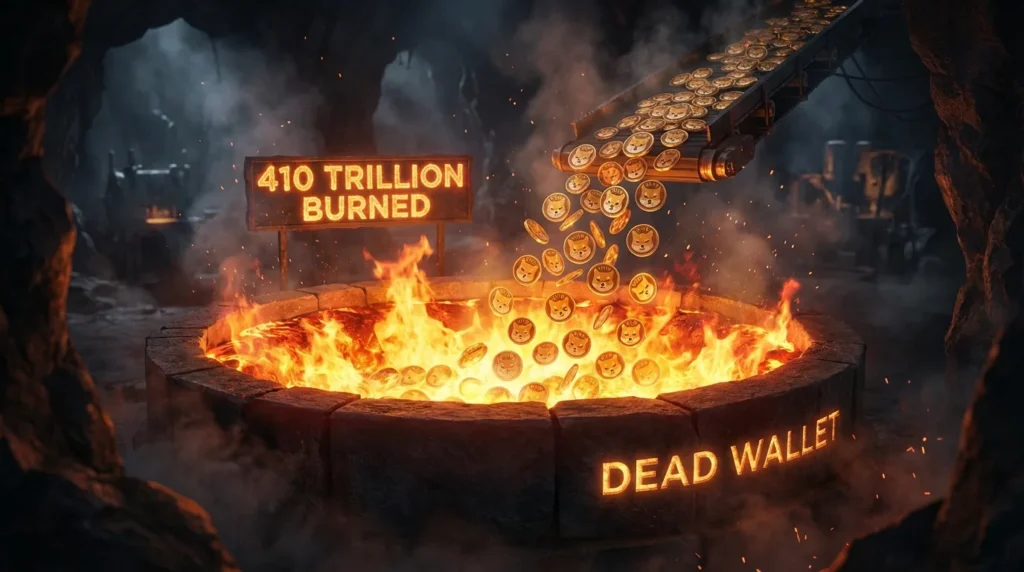
At 100–200 million SHIB burned per day, it would take thousands of years to meaningfully reduce the circulating supply. Even dramatic burn rate spikes — like the +3,900% surge on March 24, 2026 that removed 15–20 million tokens — barely register against 589 trillion in circulation.
This is the brutal tokenomics reality: the burn mechanism is directionally correct but mathematically insufficient to drive price appreciation on its own. For SHIB to appreciate significantly, demand must grow faster than the mathematics of supply reduction suggests.
Shib Alpha Layer (L3)
The Shib Alpha Layer — announced in beta in June 2025 — is a Layer 3 rollup abstraction stack built on top of Shibarium. L3 solutions run on top of L2s, enabling even faster and cheaper transactions for specific use cases. The Alpha Layer incorporates Fully Homomorphic Encryption (FHE) — a cutting-edge privacy technology allowing computations on encrypted data without decrypting it.
This upgrade would enable private smart contracts on the SHIB ecosystem — a significant technological leap from its meme origins. Whether it achieves meaningful adoption remains to be seen.
SHIB Tokenomics: The Numbers That Matter
| Metric | Data |
|---|---|
| Ticker | SHIB |
| Current Price | ~$0.0000059 (April 2026) |
| Market Cap | ~$3.5 billion |
| Rank | ~#15–20 |
| Original Supply | 1 quadrillion SHIB |
| Lifetime Burns | ~410 trillion SHIB |
| Circulating Supply | ~589 trillion SHIB |
| Blockchain | Ethereum (ERC-20) |
| All-Time High | ~$0.00008845 (October 2021) |
| Layer 2 | Shibarium |
| Shibarium Transactions | 1.5+ billion |
| Wallet Addresses | 270 million+ |
| Gas Token (Shibarium) | BONE |
The $1 SHIB Fantasy: Why It’s Mathematically Impossible
Every new SHIB holder eventually asks: “When $1?”
The honest answer: never, under any realistic scenario.
At $1 per SHIB with 589 trillion tokens in circulation, the total market cap would be $589 trillion. For context:
- Total global GDP (all countries combined): ~$110 trillion
- Total global wealth (all assets): ~$450 trillion
- Bitcoin’s entire market cap: ~$1.7 trillion
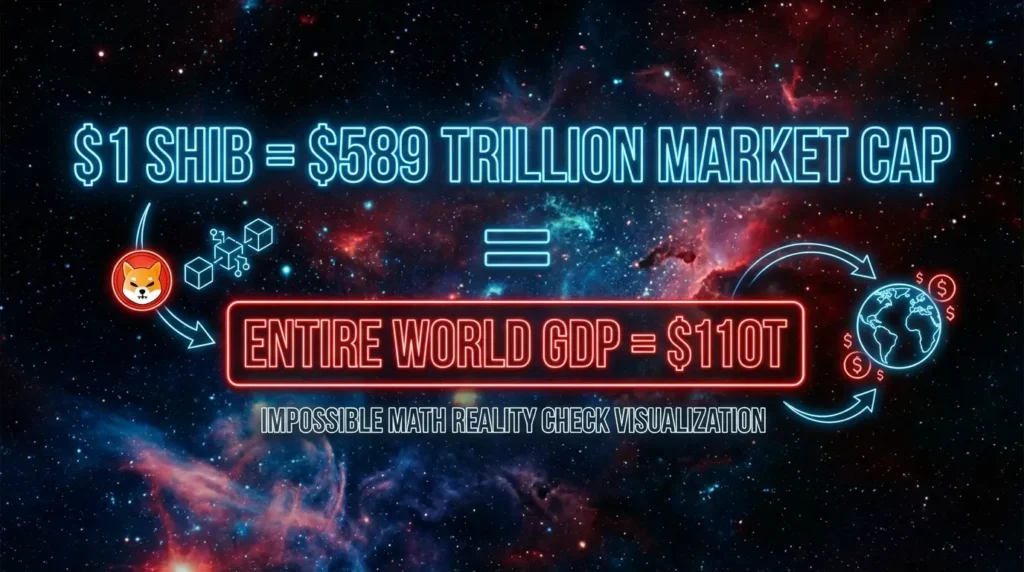
A $589 trillion market cap for a single cryptocurrency is literally impossible — it would be larger than everything of value that exists on Earth.
A more realistic target: $0.0001 per SHIB would represent a market cap of ~$59 billion — achievable, but still a significant premium over current levels, requiring substantial ecosystem growth.
2026: The Regulatory Win and Ecosystem Struggles
Digital Commodity Classification (March 2026)
In a significant regulatory development, the SEC and CFTC jointly classified SHIB as a digital commodity in March 2026 — the same status as Bitcoin and Ethereum. Additionally, Japan’s JVCEA added SHIB to its “Green List,” easing domestic exchange listings.
This regulatory clarity mitigates one of SHIB’s major risk factors and potentially broadens its investor base to include institutions that require legal certainty before exposure.
Shibarium Infrastructure Revamp (March 2026)
A mandatory infrastructure update to Shibarium’s RPC endpoints aimed at improving decentralization and reliability after past operational issues, including the September 2025 bridge exploit.
SHIB DAO Governance Elections (2026)
The Shiba Inu ecosystem is transitioning to more formal decentralized governance through SHIB DAO elections — selecting lead visionaries and councils to guide the project’s direction. This shift toward community governance represents a maturation from the informal leadership structure of earlier years.
AI Integration Plans
Lead ambassador Shytoshi Kusama has teased significant AI integration plans, with the TREAT token identified as the hub for AI spawning within the ecosystem. An AI-centric technical paper is expected in 2026. Whether this represents genuine innovation or narrative hype remains unclear.
The SHIB Ecosystem: Multiple Tokens Explained
Understanding SHIB in 2026 means understanding it’s not just one token:
SHIB — the flagship community token. Used as the ecosystem’s reserve currency and primary trading asset. Burns reduce its supply over time.
BONE — the governance token for Shibarium and its gas currency. Required for voting on governance proposals and paying transaction fees on Shibarium.
LEASH — the scarcest token in the ecosystem with extremely limited supply (107,647 tokens). Originally designed as a rebasing token, it now functions as an exclusive community asset.
TREAT — a newer token linked to AI integration and the broader ecosystem expansion. Its role is still evolving.
ShibaSwap — SHIB’s decentralized exchange where users can swap tokens, provide liquidity, and earn rewards across ecosystem tokens.
SHIB Price History: From Zero to Billions
August 2020: SHIB launches. Price essentially zero. Ryoshi sends half the supply to Vitalik Buterin “as a prank.”
May 2021: The bull market takes SHIB to extraordinary heights. SHIB rises from near-zero to $0.0000388 in May 2021 — a gain of millions of percentage points for early holders. The story of people who turned $100 into life-changing sums spreads virally.
October 2021: All-time high of approximately $0.00008845 on October 28, 2021. The “SHIB army” is at peak excitement. Market cap briefly exceeds $40 billion, making SHIB one of the top 10 cryptocurrencies.
2022: Crypto winter. SHIB falls 90%+ from ATH. The bear market is brutal for all meme coins.
2023: Shibarium launches. The “meme coin becomes utility ecosystem” narrative emerges. Some recovery in price.
2024: Bull market recovery. SHIB reaches ~$0.000045 — approaching ATH territory — driven by broader crypto enthusiasm and Shibarium adoption narrative.
2025: Bridge exploit on Shibarium damages sentiment. Price retreats. The team works on compensation and infrastructure improvements.
Early 2026: SHIB trades around $0.0000059 — down over 93% from ATH. Digital commodity classification provides regulatory clarity. The fundamental tension between enormous supply and limited burn velocity remains the core investment question.
What Is SHIB Used For?
Trading and Speculation
The honest primary use case: the vast majority of SHIB volume is speculative trading. People buy SHIB expecting price appreciation, particularly during bull markets when meme coin narratives generate retail enthusiasm.
ShibaSwap DeFi
SHIB holders can deposit tokens in ShibaSwap’s liquidity pools to earn trading fees, participate in liquidity mining, and access various yield opportunities across the ecosystem’s tokens.
Shibarium DApps
A growing number of decentralized applications are being built on Shibarium — gaming, DeFi, NFTs — that use SHIB as a primary asset. The ecosystem’s growth is the long-term bull thesis.
Payments
A number of merchants accept SHIB as payment, including in the Welly’s fast food chain. As Shibarium reduces transaction costs, SHIB’s utility for small purchases improves.
Community and Culture
Perhaps SHIB’s most underrated value: community cohesion. The “SHIB Army” is one of the most active and passionate communities in crypto — organizing burn events, governance votes, charitable campaigns, and ecosystem development. This community creates social proof and word-of-mouth that pure fundamentals cannot replicate.

SHIB Risks: The Honest Version
The supply problem: 589 trillion tokens is an almost incomprehensible number. The burn mechanism, while directionally deflationary, removes tokens at a pace that cannot meaningfully reduce supply on any reasonable timeline without a dramatic increase in Shibarium adoption.
Meme dependency: SHIB’s price remains heavily driven by social media sentiment, influencer attention, and broader crypto bull/bear cycles. This creates extreme volatility with limited fundamental support during bear markets.
Shibarium adoption: With TVL of approximately $1 million — compared to billions on major L2s — Shibarium has not yet proven it can attract sustained developer and user activity beyond SHIB ecosystem participants.
Bridge security: The September 2025 Shibarium bridge exploit highlighted real security risks. Cross-chain bridges remain one of crypto’s most vulnerable attack surfaces.
Competition: Newer meme ecosystems on Solana and other chains compete for the same speculative capital that historically flowed to SHIB.
No hard supply cap and no deflationary guarantee: Unlike Bitcoin’s hard-capped 21 million, SHIB’s burn mechanism depends on usage and community action — neither of which is guaranteed.
How to Buy SHIB in the US: Step by Step
Step 1: Choose an exchange
- Coinbase — SHIB fully supported, beginner-friendly
- Kraken — strong SHIB liquidity
- Robinhood — SHIB available, very beginner-friendly interface
Step 2: Create and verify your account
Standard KYC — government ID required.
Step 3: Deposit funds
ACH bank transfer for lowest fees. Debit card for instant access.
Step 4: Buy SHIB
Because SHIB trades at fractions of a cent, $100 buys approximately 17 million SHIB tokens — which feels psychologically impressive, even if the math means each token is worth almost nothing individually.
Step 5: Storage
- MetaMask — most popular Ethereum wallet, SHIB displays natively
- Trust Wallet — mobile-friendly with SHIB support
- Ledger — hardware wallet for maximum security of larger holdings
Key SHIB Terminology for Beginners
SHIB Army: The passionate global community of Shiba Inu holders — one of the most active in crypto.
Shibarium: SHIB’s Ethereum Layer 2 network for faster, cheaper transactions.
Burn: Permanently sending tokens to a “dead wallet” address from which they can never be retrieved, reducing circulating supply.
Dead Wallet: An Ethereum address with no private key — tokens sent here are destroyed forever.
BONE: SHIB ecosystem governance token and Shibarium gas currency.
ShibaSwap: The official Shiba Inu decentralized exchange.
Shytoshi Kusama: Lead developer and ambassador of the Shiba Inu ecosystem (pseudonymous).
Ryoshi: The anonymous creator of Shiba Inu.
Shib Alpha Layer (L3): A Layer 3 rollup built on Shibarium with privacy features via Fully Homomorphic Encryption.
TREAT: Newer ecosystem token tied to AI integration plans.
SHIB DAO: The decentralized autonomous organization governing the Shiba Inu ecosystem.
Should You Buy SHIB in 2026?
We are not financial advisors. But we’ll be unusually direct here.
The bull case: SHIB has one of crypto’s strongest communities. Digital commodity classification is a genuine positive. Shibarium is real infrastructure that other meme coins lack. 1.5 billion transactions processed is meaningful. AI integration via the Alpha Layer could create a new narrative. And in crypto, community-driven assets with strong brand recognition can outperform their fundamentals during bull markets.
The bear case is harder to ignore: 589 trillion tokens with a burn rate that removes hundreds of millions per day — against a supply of hundreds of trillions — is a mathematical headwind that no amount of community enthusiasm can overcome in the short term. Shibarium’s TVL is $1 million. SHIB is 93% below ATH. The $1 target is not just unlikely — it’s arithmetically impossible.
The honest framework: SHIB is a high-beta speculative asset that tends to outperform during bull markets and underperform during bear markets — amplifying the cycle in both directions. It is not a long-term value investment in the traditional sense. It is a community-driven, speculative token with real infrastructure being built around it.
If you decide to invest: keep position sizes small relative to your portfolio, have clear exit targets, and understand that the primary risk is not losing 10–20% — it’s losing 80–90% in the next bear market.
Disclaimer: This article is for informational purposes only and does not constitute financial advice. Cryptocurrency investments carry significant risk, including the potential loss of all invested capital. Always conduct your own research before making any investment decisions.